Character Generator for Story: Build Unforgettable Characters With AI (May 2026)
2026-05-06
A great story is never about what happens. It's about who it happens to. The heist doesn't matter if we don't care about the thief. The romance falls flat if we can't feel the contradiction between what the character wants and what they're afraid of. Character is story — and yet character creation remains the single hardest thing for AI writing tools to get right.
The demand for better character tools is staggering. The global AI character generator market was valued at $976 million in 2025 and is projected to reach $2.17 billion by 2032, while the AI-generated personalized storytelling market — where character-driven narrative is the product — hit $3.8 billion in 2025 and is projected to reach $19.6 billion by 2034, growing at a 19.9% CAGR. Meanwhile, 20 million people are already writing fiction with AI — and most of them are hitting the same wall: tools that generate characters as cardboard cutouts rather than complex people who drive narratives forward.
The Creative Fiction Writer on Jenova was built to solve exactly this — a dedicated character generator for story writers that doesn't just produce traits and backstories, but builds psychologically deep characters and weaves them into narratives where every scene is driven by who those characters are.
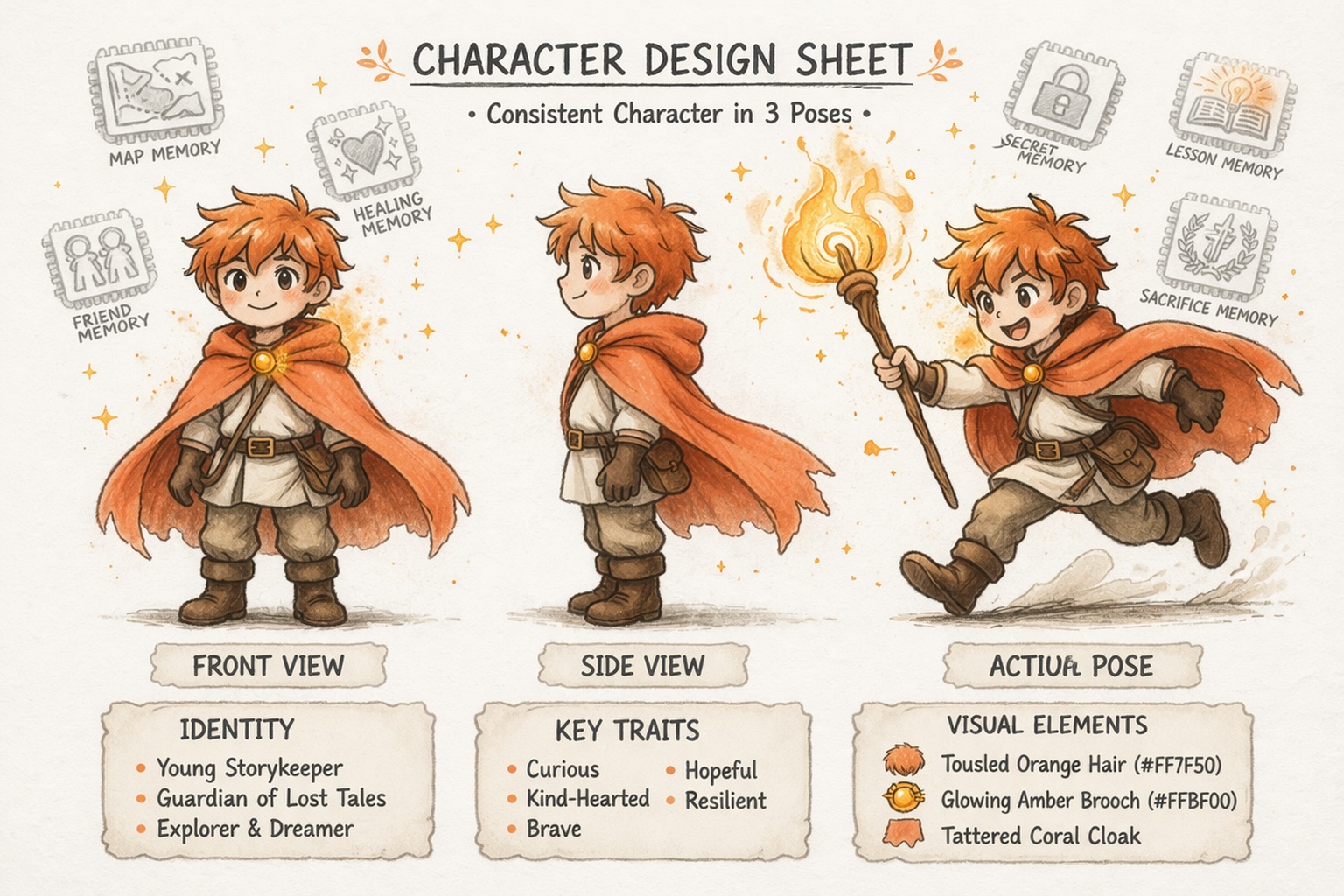
Quick Answer: What Is a Character Generator for Stories?
A character generator for stories is an AI tool that helps writers create fully realized fictional characters — personality, voice, psychology, relationships, flaws — and develop them within narratives where character drives plot, not the reverse.
- 🧠 Psychological depth — Build characters with core desires, fears, wounds, and contradictions using the Creative Fiction Writer
- 🎭 Discovery through improvisation — Inhabit your characters and find their voice through action with the Roleplay Game Master
- ✍️ Voice consistency — Maintain distinct character voices across entire manuscripts with persistent cross-session memory
- 🎯 Character-driven premises — Engineer story concepts around psychology, not generic plot templates, with the Prompt Generator
The Problem: Why Most AI Character Generators Produce Cardboard Cutouts
The Character-Plot Divorce
The most fundamental failure in AI-assisted fiction isn't bad prose — it's the disconnect between character and story. As a comprehensive 2026 guide on creating fictional characters for AI explained:
"Most people start with plot. 'I want a story about a heist.' 'I want a romance set in Paris.' The AI then generates characters to serve that plot, and the characters end up feeling like props rather than people." — Medium, Bindu Biwaal
The result is stories where a protagonist who would never open that door — opens it, because the plot requires it. A relationship that hasn't earned its confrontation — confronts, because the outline says chapter seven is the fight scene. The AI handles "what happens next" competently. It handles "what would this specific person do next" almost never.
Memory That Kills Character Continuity
A character's depth isn't established in a single scene — it accumulates across chapters, through repeated choices, evolving relationships, and the slow revelation of contradiction. Yet most AI writing tools can't sustain that accumulation.
A 2026 comparison of leading platforms confirmed that tools like NovelAI operate within roughly 8,000-token context windows — the AI "forgets your hero's eye color by chapter three." ChatGPT Free resets entirely between sessions. Even tools with lorebook systems require writers to manually manage character details rather than letting the narrative build organically.
"Most bots forget details after a handful of scenes." — Tribulant, 2026 AI Comparison
For character-driven fiction — where the protagonist's decision in chapter fifteen must reflect the wound established in chapter two — this memory fragility isn't an inconvenience. It's a dealbreaker.
Generic Characters From Generic Tools
A hands-on test of ten AI story generators in 2026 found that "output quality is functional but leans formulaic across longer drafts — repetitive sentence patterns and generic descriptions surfaced consistently." The characters inside those stories inherit that same formulaic quality. They speak in the same rhythms, react with the same emotional vocabulary, and make the same safe choices regardless of the backstory the writer provided.
The problem isn't the AI — it's the input workflow. Writers type "a mysterious woman with dark hair" and expect a fully realized person to appear. What they get is a visual description without psychology, a name without a voice, a backstory without a wound. The tool never asks the questions that matter: What does she want so badly it scares her? What would she sacrifice? What lie does she tell herself?
The Tool Fragmentation Problem
Writers in 2026 face a fragmented landscape: one tool for character profiles, another for story outlining, a third for drafting, a fourth for dialogue testing, and a fifth for editing. A SidekickWriter analysis confirmed that "simple chatbots are fine for emails, but they fail when you need a cohesive narrative." A character generator for stories needs to handle the entire arc — from the first spark of a personality to the final line of their story — inside a single persistent workspace.
Why Creative Fiction Writer Is the Character Generator Serious Writers Need
This is exactly what the Creative Fiction Writer was built for — not a chatbot that generates character traits on request, but a narrative partner that treats character and story as inseparable.
While tools like Sudowrite offer fiction-specific features including a Story Engine and writing-mode workflows, and NovelAI provides lorebook systems for tracking world-building details, Jenova's Creative Fiction Writer combines deep character intelligence with unlimited persistent memory and multi-model flexibility that standalone fiction tools can't match. You're not manually maintaining a character bible or re-feeding trait lists every session — the system accumulates character knowledge organically through conversation.
| Capability | Generic AI Chatbots | Dedicated Fiction Tools | Creative Fiction Writer |
|---|---|---|---|
| Character-story integration | Generates both but doesn't connect them | Story Bible/Lorebook — manual management | Characters drive narrative automatically via persistent memory |
| Character memory | Resets each session | 8K–16K token lorebooks | Unlimited cross-session memory |
| Character voice consistency | Drifts within long conversations | Requires constant re-prompting | Maintains distinct voices across extended projects |
| Multi-model access | Locked to one model | Single proprietary model | GPT-5.4, Claude Opus 4.6, Gemini 3.1 Pro Preview, plus xAI and DeepSeek |
| Character contradiction tracking | No awareness | No awareness | Tracks flaws, wounds, contradictions — flags inconsistencies |
Persistent Character Memory
The single biggest differentiator for character work is memory. Jenova's cross-session memory stores every character detail — personality traits, speech patterns, relationship dynamics, emotional shifts, secrets revealed, trust broken and rebuilt — across unlimited sessions. Close the browser, return weeks later, and the Creative Fiction Writer remembers that your protagonist's guardedness cracked in chapter six, partially rebuilt in chapter nine, and is about to be tested again.
No lorebook. No manual context management. No re-feeding character sheets every session.
Multi-Model Character Voices
Different AI models produce different character textures. GPT-5.4 excels at sharp, psychologically precise character work. Claude Opus 4.6 produces emotionally nuanced voices with literary subtlety. Gemini 3.1 Pro Preview handles large ensemble casts with distinct voice separation. Jenova gives you access to all of them — switch models mid-draft to find the voice that fits a specific character's POV chapter without losing a single detail about who they are.
Character Direction Through Natural Language
The Creative Fiction Writer responds to character-level creative direction the way a skilled developmental editor would:
"Build a character profile for Detective Mira Vasquez. She's brilliant but ethically compromised — she planted evidence once to convict someone she was certain was guilty, and it worked, and she's never been sure whether that makes her a good cop or a corrupt one. Her core fear is that there's no meaningful difference. She copes with dry humor and overwork. She has a sister she's close to but lies to constantly."
"Write the scene where Mira interrogates a suspect she personally likes. She knows he did it. He knows she knows. Neither says it directly. The dialogue should reveal Mira's method — she builds intimacy to extract confessions, and she hates herself for being good at it."
"I've written twelve chapters from Mira's POV. Now I need chapter thirteen from the suspect's perspective. He should be sympathetic but not innocent. His voice should be warmer than Mira's — more emotionally open, which is why she found the interrogation unsettling. Maintain everything we've established about both characters."
These aren't prompts for generic text generation — they're the kind of character-level creative direction that transforms AI from a word generator into a genuine story collaborator.
Related Agents You'll Also Like
Roleplay Game Master
Some characters can't be built through outlining — they need to be discovered. The Roleplay Game Master creates immersive narrative worlds where you inhabit your characters and find their voice through action rather than description. Uncertain how your protagonist would react under pressure? Play the scene. Let the character surprise you — then lift those discoveries into your manuscript.
- 🎭 Unlimited persistent memory for character consistency across hundreds of interactions
- 🌍 Dynamic world-building that tests characters against unpredictable situations
- 🎲 Character discovery through improvisation — find out who they are by watching them act
Writing Assistant
Once your characters are built and your draft is complete, the Writing Assistant refines the prose — tightening dialogue, sharpening voice distinction, and ensuring each character's speech patterns remain consistent throughout. It adapts to your style rather than flattening it.
- ✂️ Line-level editing that preserves each character's distinct voice
- 📐 Structural feedback on character arc pacing and emotional beats
- 🔄 Adapts to any genre, format, and audience
Film Screenwriter
Characters built for prose don't automatically translate to screen. The Film Screenwriter understands how to reveal character through action and dialogue rather than interiority — translating psychological depth into the specific constraints of visual storytelling.
- 🎬 Character introduction through action, not exposition
- 💬 Subtext-rich dialogue that reveals psychology without stating it
- 📝 Character-driven scene breakdowns for pilot scripts and features
How It Works: From Concept to Complete Character
Step 1: Start With Inner Architecture, Not Appearance
Open the Creative Fiction Writer and begin with the questions that matter. Skip "tall, dark hair, mysterious" — start with the psychological foundation:
"I need a character for a literary thriller. Start with five essentials: her core desire, her deepest fear, the wound that shaped her, her defining flaw, and her central contradiction — the tension between what she believes about herself and what's actually true."
The agent doesn't just list traits — it builds them in relation to each other, ensuring the character's psychology is internally consistent and dramatically productive.
Step 2: Develop Voice Through Dialogue
A character isn't real until they speak. Ask the Creative Fiction Writer to generate dialogue that reveals personality:
"Write three conversations between Mira and different people — her sister, her partner at work, and a suspect. She should sound recognizably like the same person in all three, but her register, honesty level, and emotional armor should shift depending on who she's talking to."
Step 3: Discover Through Improvisation
@mention the Roleplay Game Master in the same chat to inhabit the character. Place Mira in an unplanned situation and see what she does. Does she react the way your outline predicts? Does she surprise you? The best character details emerge from improvisation, not planning.
"I'm Mira. It's 2 AM and I'm sitting in my car outside the suspect's apartment. I told myself I was just driving by. I've been here forty minutes. What happens next — stay in character and let me respond as her."
Step 4: Build the Supporting Cast
No character exists in isolation. Develop the relationships that define and pressure your protagonist — the sister who knows too much, the partner who trusts too easily, the antagonist who mirrors the protagonist's worst qualities:
"Build Mira's partner, Detective Tomás Reyes. He should complement and challenge her — where she's cerebral and guarded, he's intuitive and open. But he's not naive. Give him his own wound and his own contradiction. He should feel like a protagonist in his own story who happens to be in hers."
Step 5: Switch Models for Different Character Textures
Use the model selector to experiment. One model might produce sharper, more psychologically clinical character work; another might bring more emotional warmth or literary nuance. Your character's history stays consistent — only the rendering texture changes.
Step 6: Refine and Export
When the character work is complete and the draft is polished, @mention the Writing Assistant for editorial refinement. Download as PDF, Word, or TXT directly from the chat. Your entire character development history — every trait, every test scene, every revision — lives in one persistent conversation.
Results & Use Cases
📖 The Literary Novelist Building an Ensemble Cast
Scenario: A writer is developing a multi-POV literary novel with six narrators whose storylines intersect at a single event — each character needs a distinct voice, psychology, and relationship to the central mystery.
Traditional Approach: Maintains a spreadsheet of character traits, a separate document for voice samples, and a folder of reference notes. Uses ChatGPT for brainstorming, but it forgets character distinctions within a single session. By draft three, two characters sound identical and a third has contradicted their own backstory.
With Jenova: She builds all six characters with the Creative Fiction Writer across multiple sessions — each character's psychology, voice, and relationship dynamics stored in persistent memory. When she writes chapter fourteen from Narrator Four's perspective, the AI remembers not only who Narrator Four is but how she feels about Narrators Two and Six based on events established in earlier chapters. No spreadsheet. No re-prompting. No voice bleed between characters.
💼 The Screenwriter Developing a Pilot
Scenario: A TV writer needs to pitch a character-driven drama — the network wants a character bible, sample dialogue, and a pilot script that demonstrates the ensemble's chemistry.
Traditional Approach: Writes character bibles by hand. Tests dialogue by reading it aloud. Hires a consultant for $200/hour to stress-test character consistency.
With Jenova: He builds the ensemble with the Creative Fiction Writer, then @mentions the Film Screenwriter to convert character dynamics into properly formatted pilot scenes. He uses the Roleplay Game Master to improvise key scenes — discovering that two characters have unexpected chemistry that reshapes the season arc. One platform, one memory, one cohesive character bible that feeds directly into script pages.
📱 The Indie Author Writing a Series
Scenario: A self-published fantasy author needs characters who grow across a three-book series — with foreshadowed arcs, evolving relationships, and a protagonist whose personality at the end of book three is recognizably but distinctly different from book one.
Traditional Approach: Uses Scrivener for notes and a separate AI tool for brainstorming. By book two, she's lost track of which character traits were established in which chapter. Her beta readers flag that the protagonist seems to have "reset" between books.
With Jenova: She builds the protagonist's full psychological profile with the Creative Fiction Writer in book one — core desire, wound, flaw, contradiction. By book three, the persistent memory tracks how each of those elements has shifted through specific plot events. The character who was guarded in book one and tentatively open in book two enters book three carrying the specific emotional scar tissue of everything that's happened — without the writer manually reminding the AI of any of it.
📊 The Game Writer Building NPCs
Scenario: A narrative designer needs forty characters for an RPG — each with a distinct personality, dialogue style, and relationship web that players will encounter across sixty hours of gameplay.
Traditional Approach: Writes character sheets by hand. Uses ChatGPT for dialogue samples. Can't maintain consistency across forty characters in a single context window. Ends up with NPCs who all sound vaguely the same.
With Jenova: He uses the Creative Fiction Writer to develop each character in depth, then the Roleplay Game Master to play-test critical NPC interactions — ensuring each character reacts authentically to player choices. When the player betrays NPC #17, the AI generates a response consistent with that specific character's psychology, not a generic "betrayal response." Persistent memory means every NPC's personality survives between development sessions.
FAQ
What makes a good character generator for story writing different from a regular AI chatbot?
A regular chatbot generates character descriptions on request — name, appearance, a few traits. A dedicated character generator for stories builds psychological architecture: core desires, fears, wounds, contradictions, and the specific ways those elements manifest in dialogue, decisions, and relationships. The Creative Fiction Writer goes further by maintaining that architecture across unlimited sessions, so characters develop organically rather than being re-described from scratch every time you write.
Can AI actually create characters with genuine depth, or just surface-level descriptions?
AI excels at generating character traits and backstory elements. The deeper challenge — making characters behave consistently based on psychology across a full narrative — requires persistent memory and structured creative direction that most tools lack. The key insight from experienced AI fiction writers is to start with inner architecture (desire, fear, wound, flaw, contradiction) rather than appearance, then test those elements through improvisation. The Creative Fiction Writer supports both approaches — building depth through planning and discovering it through action.
How do I keep characters consistent across a long novel or series?
This is where most AI tools fail and where Jenova's persistent memory is decisive. Traditional tools require lorebooks, story bibles, and manual re-prompting — and even then, leading platforms operate within 8,000-token context windows that can't hold a full character's history. The Creative Fiction Writer stores every trait, shift, and relationship across unlimited sessions automatically. Your character's evolution is cumulative, not reset.
How does Jenova compare to Sudowrite or NovelAI for character creation?
Sudowrite ($10–44/month) offers a Story Engine and writing-specific workflows — excellent for drafting, but character context is managed through manual Story Bible entries. NovelAI ($10–25/month) provides a lorebook system with roughly 8,000-token limits. Jenova's Creative Fiction Writer differentiates through unlimited persistent memory that accumulates character knowledge organically, multi-model switching (GPT-5.4, Claude Opus 4.6, Gemini 3.1 Pro Preview), and an ecosystem of complementary agents — build characters, test them through roleplay, refine prose, and adapt to screenplay format without leaving one platform. The free tier includes all features.
Is the free tier enough to build characters and write a complete story?
Yes. Persistent memory, multi-model access, the full character-building workflow, and export to PDF, Word, TXT, or CSV are all available on the free tier. Many writers develop complete character bibles, draft full manuscripts, and iterate through revision without upgrading. Paid plans start at $20/month for expanded usage limits, with no feature restrictions at any tier. No credit card required to start.
Can I use this for visual character design — not just written characters?
Jenova's agent ecosystem covers both. The Manga Creator, Comic Creator, and Graphic Designer generate visual character designs — and because they share the same persistent memory, the character you build psychologically with the Creative Fiction Writer informs the visual design without re-describing them. Write the character's soul first; illustrate them second.
Conclusion
The AI writing market is projected to grow from $1.75 billion to $10.3 billion by 2032, but market size doesn't solve the craft problem: most AI tools still treat characters as a checklist of traits rather than as the living engine that drives every great story. They generate names, appearances, and backstories — and then produce narratives where those characters behave like interchangeable props because the AI forgot who they were three scenes ago.
The Creative Fiction Writer was built for writers who know that character is story — who need a tool that builds psychological depth, tracks contradictions, maintains distinct voices across entire manuscripts, and never forgets what it's learned about the people you've created. Pair it with the Roleplay Game Master to discover characters through improvisation, the Writing Assistant to polish every line of dialogue, and the Film Screenwriter to translate depth into screencraft — and you stop generating characters and start building people worth following.
Try the Creative Fiction Writer free — no credit card required. Explore the full agent library at Jenova.