Character Consistency Checker AI: Detect Drift in Stories & Art
2026-09-18
A character who changes eye color, forgets a vow, or speaks in a new register mid-series is not a creative choice—it is a continuity failure. In September 2026, writers, illustrators, game teams, and roleplay communities still lose hours to that drift because most generative tools optimize for the next fluent sentence, not the last established fact. Jenova functions as a character consistency checker AI environment: specialized agents hold a living character bible, compare new scenes against it, and keep voice, looks, and lore aligned across long projects.
- ✅ Persistent, cross-session memory for traits, relationships, and world state
- ✅ Dedicated agents for manga, comics, screenplays, games, and immersive roleplay
- ✅ Private knowledge bases you can load with lore bibles, model sheets, and dialogue samples
- ✅ Multi-model access so continuity review and creative drafting can use different models
To understand why a dedicated consistency layer matters, it helps to look at where characters actually break—inside context windows, across visual generations, and in relationships that should have been remembered.
Quick Answer: What Is a Character Consistency Checker AI?
A character consistency checker AI is a specialized tool that compares a character’s voice, appearance, and lore against a living bible so stories, art, and roleplay stay coherent over time. It does not replace authorship; it flags contradictions before readers, players, or collaborators do.
Key capabilities:
- Hold traits, backstory, and relationships in persistent memory instead of a vanishing chat window
- Check new prose, panels, and dialogue against an established persona
- Keep visual identity stable across manga, comics, webtoons, and concept art
- Carry the same person through screenplays, games, and long-running roleplay without a reset
Why Characters Drift in AI-Assisted Work
Creative teams already use generative tools at scale. 51% of creative businesses report using AI, compared with 33% of businesses overall—and the UK creative industries contributed nearly £146 billion in GVA in 2024. Adoption is real. Reliable character identity is not.
But keeping a persona stable across chapters, episodes, and sessions is frustratingly difficult:
- Context windows drop older traits, vows, scars, and names
- Image prompts redraw hair, costume, and age from scratch
- Dialogue tone flips when the model “helps” by sounding generic
- Relationships and locations reset as if prior scenes never happened
- Manual continuity passes consume the time AI was supposed to save
Context windows are not a character bible
Large language models can sound consistent for a few thousand tokens and then quietly invent a new person. A 2025 survey of memory mechanisms in LLM systems distinguishes short-term conversational context from long-term memory stored and retrieved outside the window. Without that second layer, “memory” is just whatever still fits.
Roleplay users feel this first. 78% of roleplay enthusiasts name memory as their biggest frustration, and popular character chats are widely reported to lose older details once the window fills. A checker that only rereads the last page cannot catch a contradiction introduced twenty scenes ago.
Visual identity is a second continuity problem
Writers notice voice. Artists notice the coat, the scar, the silhouette. One prompt variation and a hooded protagonist becomes a different actor. Studios already treat this as production risk: in the Broken Sword remaster, AI upscaling helped only where it held, and artists still had to correct heads and hands by hand.
That is the visual half of a character consistency checker AI: not “make more pictures,” but “make this same person again.”
Personality and voice collapse into generic helpfulness
A stoic captain who suddenly over-explains, a shy lead who becomes quippy, a villain who moralizes like a tutor—these are model defaults leaking into the role. Personality systems exist so you can test the gap. If a character is supposed to be a specific type, Personality Analyzer and an MBTI Personality Guide give you a trait map you can check dialogue against, instead of arguing from vibe.
World state and relationships reset
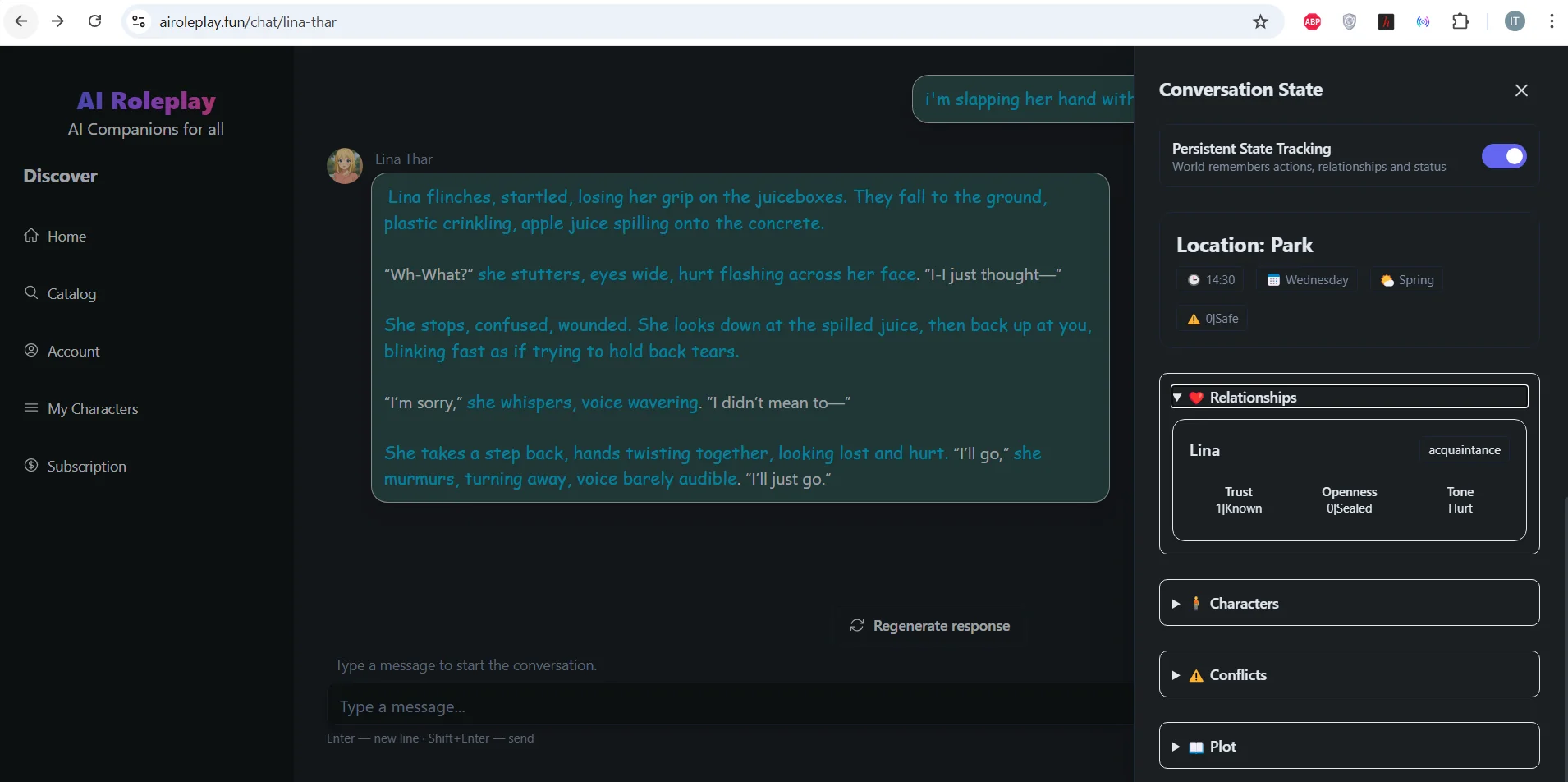
Continuity is not only appearance. It is who trusts whom, who was hurt, what spilled on the concrete, and whether the park scene still happened. Roleplay interfaces that track location, time, and relationship scores exist because free-form chat forgets those facts. When the state panel is missing, the character apologizes for a wound the model no longer believes in.
The “time saved” often moves into cleanup
The UK creative-industries AI plan notes that prompting, iteration, error correction, and quality control can absorb the hours tools claim to free. Continuity editing is that hidden tax. A checker that runs before the draft ships is cheaper than a reader who notices on page 180.
44% — Share of film, TV, video and photography businesses already using AI
10.1% — Creative businesses that delay AI because they lack trust in product safety or transparency, versus 5.7% of all businesses
This is exactly what Jenova was built for: agents that remember the person, not just the prompt.
The Jenova Solution
Jenova does not treat consistency as a plugin on a generic chatbot. It gives you domain agents with persistent memory, document-grounded knowledge bases, and the ability to keep one character bible attached while you draft, draw, and roleplay.
While consumer character apps offer broad discovery, they still lean on a sliding context window. Jenova agents keep unlimited conversation history and cross-session memory, so a scar mentioned in week one can still constrain week twelve.
| Traditional approach | Jenova |
|---|---|
| Paste a character sheet into every new chat | Persistent memory plus an attached lore bible |
| Hope the model “remembers” hair, age, and voice | Dedicated visual and writing agents checked against the same persona |
| Manual spreadsheet of relationships and locations | Long-running threads that retain world state |
| One general model for every medium | Manga, comics, screen, game, and roleplay specialists |
| Continuity pass after the damage is published | Consistency review before the scene ships |
Narrative identity: screenplays and series bibles
Film Screenwriter is built for concept, outline, draft, and revision—structure, dialogue, and character development in the same working thread. Load the bible once. Ask it to flag lines that violate established motive, knowledge, or speech patterns.
For vertical series, Microdrama Screenwriter has to hold a person across 60–100 short episodes, where a single forgotten secret wrecks a paywalled arc. That format punishes drift harder than a feature, because viewers binge contradictions in one sitting.
Visual identity: manga, comics, webtoons, and picture books
Manga Creator is designed for panel flow and a consistent art style from one-shots through long serialized runs. Comic Creator does the same job in sequential Western layouts. Webtoon Creator adds full-color continuity for vertical scroll, where a costume error is visible for an entire episode thumb-stop.
Children's Book Creator treats consistent art as a product requirement, not a nice-to-have: the same child, same dog, same red coat, spread after spread. That is character checking in its most literal form.
Games and living worlds
Game Designer Assistant supports brainstorming, systems notes, documentation, and concept art across genres. Use it to lock a protagonist’s silhouette, faction language, and NPC voice before production multiplies the mistakes.
If you need the world itself to stay honest, Civilization runs a living political simulation where rivals remember slights. College Life does the social version: friendships and fallout that should not reset when you close the tab.
Voice, type, and immersive roleplay
When the question is “would this person actually say that?”, Personality Analyzer synthesizes Big Five, MBTI, Enneagram, and attachment patterns into a checkable profile. Pair it with MBTI Personality Guide when you are verifying type, not inventing one.
Language roleplay agents are a stress test for the same machinery. Learn Russian Through Roleplay is built around unlimited memory and character consistency so the scene partner does not become a new stranger every lesson. Learn English Through Roleplay uses the same immersive pattern: the character has to stay the character, or the practice stops feeling real.
Specialized AI Agents for Character Consistency
A character consistency checker AI is most useful when the checker speaks the medium you ship in. These agents are the ones writers and designers typically open in the same month they start a series.
Manga Creator — serialized faces that cannot wander
Manga Creator is a personal mangaka for complete stories, from one-shots to long epics. Consistency is the product: panel grammar, costume language, and a face that still belongs to chapter one when you reach chapter fifty.
- Style lock across pages and volumes
- Character sheets translated into sequential pages
- Continuity notes you can interrogate mid-arc
If you also need Western issue structure, Comic Creator covers dynamic layouts and graphic-novel sagas with the same demand for a stable visual person.
Film Screenwriter — dialogue that matches the bible
Film Screenwriter walks a script from logline through revision. Use it as the prose half of your checker: “Would Mara know this fact yet?” “Does this joke belong to her or to the comic-relief friend?”
- Scene-level motive and knowledge checks
- Voice samples stored in-thread
- Outline-to-draft continuity instead of a fresh chat per act
Game Designer Assistant — NPCs, factions, and concept art
Game Designer Assistant sits where writing, systems, and visual development meet. A faction that “forgets” its taboo, or a hero whose concept art ages five years between mood boards, is a production defect.
- Character and faction bibles as working documents
- Concept-art direction tied to gameplay role
- Cross-genre reference without losing the specific person you designed
Children's Book Creator and Webtoon Creator — color, costume, cast
Children's Book Creator keeps illustrated casts readable for young eyes: the same character, page after page. Webtoon Creator does the mobile-first equivalent, where color scripts and episode hooks fail if hair, wardrobe, or age wobble.
- Recurring-cast visual rules
- Episode-to-episode wardrobe continuity
- Read-aloud or scroll rhythm that still serves the same protagonist
Personality Analyzer — the internal continuity test
Personality Analyzer is the checker for interiority. When a character’s decisions stop matching their stated type, you get a psychological contradiction, not just a continuity glitch.
- Multi-framework trait maps (Big Five, MBTI, Enneagram, attachment)
- Dialogue audits against the profile
- Growth arcs that change a person on purpose, not by accident
Try Jenova free — no credit card required.
How a Character Consistency Checker AI Works on Jenova
You do not run a separate “scan file” product. You attach the bible, pick the agent that matches the deliverable, and keep working in one memory-bearing thread.
Step 1: Load the character bible Attach bios, model sheets, voice samples, and relationship maps as a private knowledge base. The agent should be able to quote the scar, the vow, and the forbidden word without you re-pasting them.
"Here is Mara’s character bible, three costume sheets, and a list of facts she does not know until episode 6. Treat these as canon."
Step 2: Choose the agent that matches the medium Open Manga Creator for pages, Film Screenwriter for script, or Game Designer Assistant for NPCs and concept art. Medium-specific agents catch medium-specific drift—speech on the page versus silhouette in a panel.
"Using only the attached bible, draft scene 12 in Mara’s voice. Do not let her explain the relic; she still thinks it is a lantern."
Step 3: Generate, then ask for a contradiction pass Draft first if you want speed. Then require an explicit audit: traits, knowledge, visual descriptors, and relationship status. This is the actual “checker” step—comparison, not vibes.
"List every contradiction between this chapter and the bible. Flag hair, age, inventory, knowledge, and tone. Propose the smallest fix that restores canon."
Step 4: Keep the same thread so memory compounds Do not start a clean chat for every chapter. Persistent history is how a relationship that turned hurt in the park stays hurt on Wednesday. Custom agents can retain instructions, preferred models, and the same knowledge base across sessions.
"Continue from the park incident. Trust is damaged. She will not accept a joke about the spilled juice."
Step 5: Reuse the persona in the next medium The same Mara can move from script to comic to game documentation without a new invention. That is the point of a platform-level character consistency checker AI: one identity, several outputs.
Results and Use Cases
📊 Serialized manga with a locked silhouette
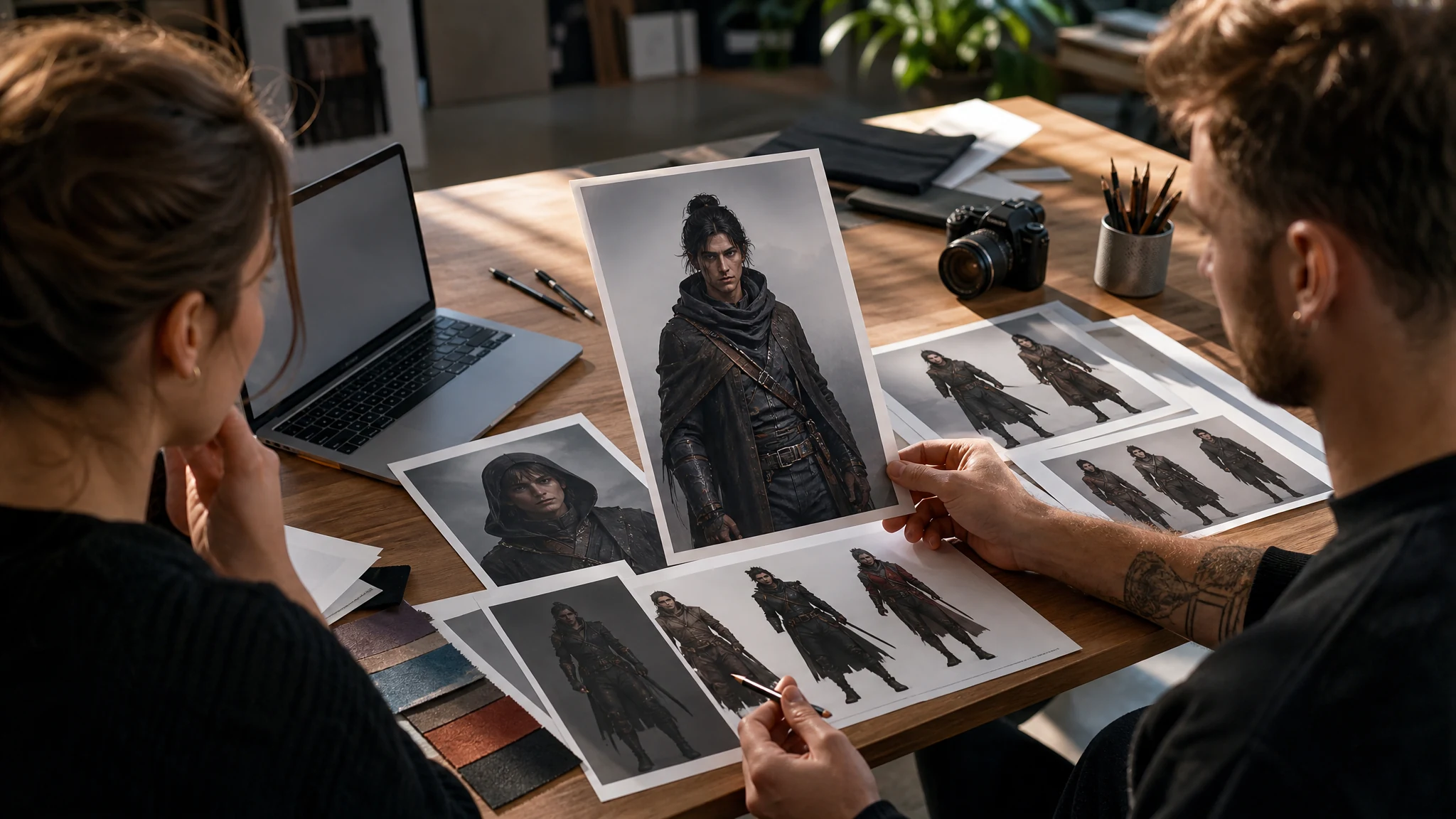
Scenario: A creator is 40 pages into a dark-fantasy one-shot that may become a series. The hooded lead’s wrap, hair, and weapon silhouette must survive every crowd panel.
Traditional approach: Re-prompt image tools, then spend an evening comparing printouts on the desk—the same workflow concept teams still use when reviewing model sheets by hand.
Jenova: Manga Creator works from attached sheets and prior pages, while a contradiction pass catches costume drift before inking.
- Same coat language across night and rain scenes
- Face and age that do not “upgrade” between chapters
- Notes you can reuse when Comic Creator needs a Western-format one-shot of the same lead
💼 Ensemble screenplay under deadline
Scenario: A writer is turning a pitch bible into a feature with six speaking roles. Two characters share a secret; one of them cannot know it in act one.
Traditional approach: Color-coded scripts, a spreadsheet of “who knows what,” and a late table read that exposes leaks.
Jenova: Film Screenwriter keeps the bible in-thread and audits knowledge, motive, and voice. Microdrama Screenwriter uses the same discipline when the story is sliced into dozens of short episodes.
- Knowledge walls that survive rewrite
- Distinct speech patterns per role
- Faster continuity passes than a full human reread of every draft
🎮 Game preproduction: hero, factions, NPCs
Scenario: An indie team needs a protagonist kit, three faction dialects, and concept notes that will not contradict the combat fantasy.
Traditional approach: Wiki pages nobody updates, concept art that ages the hero between mood boards, NPCs who all sound like the designer.
Jenova: Game Designer Assistant holds systems and character docs together. Art Advisor can critique whether the visual read matches the intended cultural and historical references.
- Silhouette and kit locked before outsourcing
- Faction language that stays internally consistent
- A paper trail production can actually follow
📱 Mobile roleplay that remembers the park
Scenario: On a commute, you continue a scene where a companion was startled, dropped juice, and pulled away. The next line has to honor hurt, location, and the relationship score—not reset to cheerful small talk.
Traditional approach: Screenshot the last reply, paste a recap, hope the model cares.
Jenova: A long-running thread on web or mobile keeps the incident. Learn English Through Roleplay or Learn Russian Through Roleplay can stay in character while you practice, because the scene partner is not allowed to become a new person.
- Relationship consequences that persist overnight
- Full feature parity across phone and desktop
- Speech-to-text when you cannot type a careful recap
FAQ
What is a character consistency checker AI?
A character consistency checker AI compares new text or images against an established persona—voice, appearance, knowledge, and relationships—so the same character does not quietly become someone else. On Jenova, that check lives inside specialized agents with persistent memory and attached lore documents, rather than in a one-off prompt.
Is Jenova free to use for character continuity work?
Yes. Jenova has a free tier with core features and limited monthly usage, and you can start without a credit card. Higher tiers increase usage if you run long series, large knowledge bases, or heavier visual passes. Continuity work is possible on free usage; volume is what you pay to scale.
How is this different from Character.AI or a generic chatbot?
Character apps are built for discovery and chat. They can still drop older details as the window fills. Jenova agents keep cross-session memory, accept a private character bible, and specialize by medium—Film Screenwriter for dialogue leaks, Manga Creator for visual drift—so the checker matches the artifact you ship.
Can a character consistency checker AI catch visual mistakes, not just prose?
Yes, if you use visual-story agents and attach model sheets. Webtoon Creator and Children's Book Creator are built around recurring-cast art. You still review outputs—the UK sector guidance is explicit that human judgment remains the quality gate—but the agent can be instructed to treat sheets as canon.
Does it work on mobile?
Yes. Jenova is built for web, iOS, and Android with synced settings, so a continuity thread you started at the desk is the same thread on the train. That matters for roleplay and for capturing a contradiction the moment you notice it.
Will the AI stay perfectly consistent without a human editor?
No honest tool should promise that. Models still hallucinate, and research on LLM memory exists because recall is an engineered system, not a given. Jenova reduces drift by persisting state and grounding in your bible. Final canon still belongs to the author, which is the augmentation-first stance the creative industries’ AI adoption plan argues for.
Keep the Same Person on Every Page
Character drift is expensive because it is boring to fix and obvious to an audience. Context windows forget. Image prompts reinvent. Relationships reset. A character consistency checker AI is the discipline of comparing every new line and likeness against a bible that does not vanish.
Jenova puts that discipline in the agents you already need to finish the work: Manga Creator and Comic Creator for faces that hold, Film Screenwriter for voices that hold, Game Designer Assistant for worlds that hold. Load the sheets. Keep the thread. Ask for the contradiction list before the scene goes public.
Explore the full agent library at Jenova.
For Developers: Character continuity agents in this article are available programmatically via the Jenova API — integrate persona tracking, lore retrieval, and consistency checks into your application with a single API call. Full documentation →