Character AI vs SillyTavern: Ease, Control, Privacy & Cost Compared
2026-10-15
Character AI vs SillyTavern comes down to convenience versus control. Character.AI is a polished app where you can start chatting in seconds. SillyTavern is a self-hosted power-user frontend that rewards patience with almost unlimited customization.
As of October 2026, many roleplayers want something in between. Roleplay Game Master gives you immersive, consistent roleplay without installing anything. It offers unlimited memory, consistent characters, and broad creative freedom with no setup.
- ✅ No installation, servers, or API keys — works in a browser or on your phone
- ✅ Unlimited memory — long campaigns stay coherent across sessions
- ✅ Consistent characters — personalities and story details hold up over time
- ✅ Private by default — conversations are never used to train public AI models
Before choosing a tool, it helps to see where each platform performs well and where it falls short. Below, we compare Character.AI and SillyTavern on setup, customization, privacy, cost, and content freedom. Then we cover the gap that sends many users looking for a third option.
Quick Answer: What Is the Difference Between Character AI and SillyTavern?
Character.AI is a hosted app with proprietary models and a large character library. SillyTavern is a free, open-source, locally installed interface that connects to any language model you supply. It trades convenience for deep control over prompts, models, and privacy.
Key differences:
- Setup: Character.AI runs instantly on web and mobile. SillyTavern requires installing NodeJS and connecting a model backend.
- Models: Character.AI uses its own models. SillyTavern works with OpenAI-compatible APIs, KoboldAI, local models, and more.
- Privacy: Character.AI's policy permits using chats to train its models. SillyTavern keeps data on your machine unless you use a cloud API.
- Cost: Character.AI has a free tier. SillyTavern is free software, but model access may cost money.
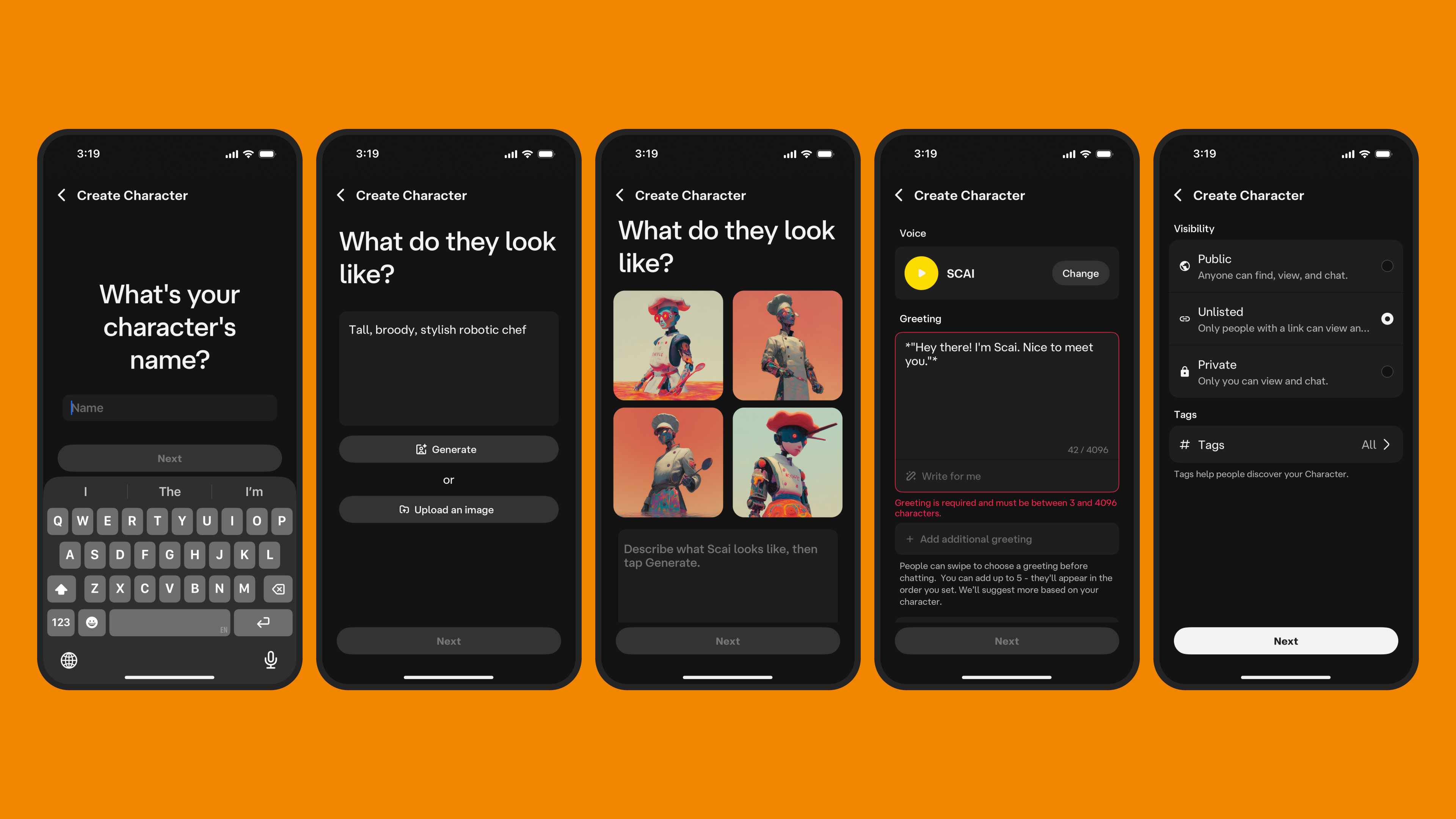
Character AI vs SillyTavern: Head-to-Head Comparison
Both platforms serve a large and fast-growing audience. Research on AI companions shows that mixed-use roleplay platforms are among the most engaging consumer AI products available.
£1.3 billion — UK AI companion sector revenue in 2024, with projected 32% annual growth through 2030
16 visits per month — Average return frequency for users of mixed-use platforms like Character.ai
Here's how the two tools compare across the factors roleplayers care about most:
| Factor | Character.AI | SillyTavern |
|---|---|---|
| Setup time | Minutes; sign up and chat | An evening or more; install, configure, connect a backend |
| Platforms | Web, iOS, Android | Self-hosted interface (Windows, Linux, and others running NodeJS 20+) |
| Models | Proprietary only | Any supported local or cloud LLM |
| Customization | Name, look, voice, greeting, visibility | Prompts, presets, World Info, CSS, extensions, group chats |
| Privacy | Chats may be used for model training | Local by default; cloud APIs send data to providers |
| Cost | Free tier, with ads noted by testers | Free software; model or API usage may cost money |
| Learning curve | Low | Steep, by design |
Setup and Accessibility
Character.AI has a guided creation flow, shown above. You name a character, describe or generate its look, pick a voice, write a greeting, and choose whether it's public, unlisted, or private. No technical knowledge is required.
SillyTavern takes a different approach. Its official documentation describes it as a locally installed interface that requires NodeJS 20 or higher. It recommends a 3000-series NVIDIA GPU with at least 6GB of VRAM if you want to run models on your own machine. The project openly says it embraces "the steep learning curve as part of the fun."
Customization and Control
This is where SillyTavern clearly leads. It is built around character cards, which are collections of prompts that define how the model behaves. Its features include:
- World Info for persistent lore
- Group chats with multiple characters
- User personas
- Built-in RAG for adding documents to chats
- A scripting engine
- Extensions for sprites, auto-summary, image generation, and text-to-speech
All of these are listed in the SillyTavern docs.
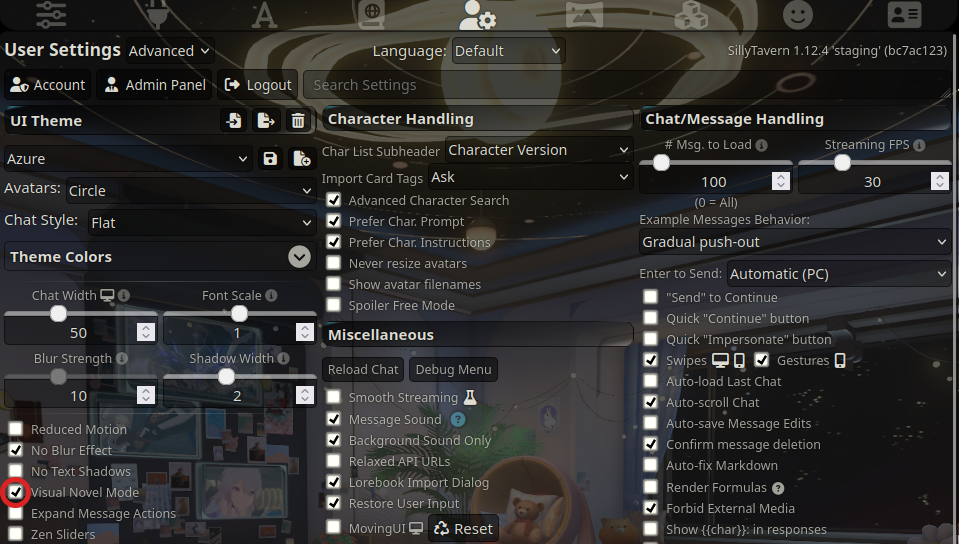
The settings screen above shows how much you can adjust. Visual Novel Mode, avatar styles, blur strength, swipe gestures, streaming FPS, and message-loading limits are all on one screen. That depth helps explain the project's community support: over 300 contributors and, according to one roundup, 25,000+ GitHub stars. It also explains why newcomers often feel overwhelmed.
Privacy and Data Ownership
Character.AI's Privacy Policy lists chat communications and voice data among the information it collects. It also states that collected information may be used to train its AI models and to support tailored advertising.
The policy adds that if you make a character public, Character.AI may keep it active even after you delete your account. The Terms of Service also grant the company a perpetual, irrevocable license to user content and generated content.
SillyTavern is more private by design, with one important exception. As one
notes, the main privacy risk comes from using cloud APIs. If you do, your chats are sent to someone else's server.Cost
SillyTavern is free and open-source under AGPL-3.0, but it is only an interface. As SourceForge's comparison points out, connecting it to a model backend may involve extra costs.
One hands-on reviewer who ran both platforms tracked the ads, the swipe cap, the setup evening, and a month of API bills. Their findings show that "free" means something different on each platform.
Content Filtering and Freedom
Character.AI reserves the right to restrict, suspend, or remove content using automated and manual moderation. Some users on SourceForge list "too censored" as a downside.
SillyTavern's filtering depends entirely on the model you connect. That is why one comparison concludes it is far more powerful "for control, privacy, and freedom from a filter."
The Trade-Off Neither Platform Solves
Most roleplayers want immersion, memory, privacy, and freedom without spending a weekend on configuration. In practice, getting all of that is difficult:
- Character.AI is easy but restrictive. You give up model choice, some privacy, and some control over content.
- SillyTavern is powerful but demanding. You manage installs, backends, presets, API keys, and possibly GPU hardware.
- Memory remains a pain point on both. Industry research describes a widespread practice of charging for memory, while self-hosted setups depend on careful context management.
- Mobile access is uneven. Character.AI is mobile-first, while SillyTavern is primarily a self-hosted interface.
This is exactly what Roleplay Game Master was built for.
Why Roleplay Game Master Fills the Gap
Roleplay Game Master is an AI roleplay partner designed for long, immersive stories. It gives you SillyTavern-level creative freedom with Character.AI-level simplicity. There's nothing to install, no backend to connect, and no preset files to manage. You describe a scenario and start playing.
| Traditional Approach | Roleplay Game Master |
|---|---|
| Install NodeJS, configure SillyTavern, and connect an API | Open a browser or mobile app and start immediately |
| Characters lose track of earlier details in long chats | Unlimited memory keeps campaigns coherent |
| Chats may be used to train the platform's own models | Conversations are never used to train public AI models |
| Rigid filters or heavy self-managed configuration | Broad creative freedom to explore any scenario |
| Desktop-centric power tools or mobile-only apps | Full experience on web, iOS, and Android |
Unlimited Memory and Consistent Characters
Long campaigns usually fail when the AI forgets things. Names change, injuries disappear, and relationships reset. Roleplay Game Master keeps track of your full story, so a betrayal from session three still matters in session thirty.
Broad Creative Freedom, No Configuration
You don't need to write system prompts or adjust sampler settings. Describe the world, the tone, and your character, and the game master builds the scene, plays the supporting cast, and responds to your choices.
"Run a grimdark fantasy campaign. I'm a disgraced knight hunting the necromancer who framed me. Keep NPCs morally gray and track my reputation in each town."
"Start a slow-burn mystery aboard a 1920s ocean liner. Play every passenger, and don't reveal the killer until I've earned it."
Privacy Without Self-Hosting
Your conversations are encrypted in transit and at rest. They are never sold to advertisers or used to train public models. You get the privacy benefits that draw people to self-hosting without managing your own server.
Honest Limitations
Roleplay Game Master is not open-source. It doesn't support custom CSS, third-party extensions, or fully offline local models. If you enjoy fine-tuning samplers and building your own extensions, SillyTavern is still the stronger fit for that kind of setup.
Related Agents You'll Also Find Useful
If you're building characters and worlds, these agents fit naturally into a roleplay workflow.
Character Creator
Design a character before you play it. Character Creator works well for roleplay OCs, fan characters, or a cast for your next campaign.
- Quick-generate characters or build them step by step with guidance
- Research existing media for accurate fan characters
- Create character portraits across genres
Creative Fiction Writer
If you want to turn a great roleplay session into a story you can share, Creative Fiction Writer can help shape it into polished prose.
- Original fiction across any genre
- Research support for believable worlds
- Editorial feedback from first draft to final manuscript
Love Island
For players who want a ready-made romance scenario, Love Island places you among eight strangers on a private island, where relationships develop based on your choices.
- Open-world romance gameplay
- Social dynamics that develop naturally between characters
- Connections and rejections driven by your decisions
Try Roleplay Game Master free, with no credit card required.
How to Start a Roleplay Campaign Without Setup
Step 1: Open Roleplay Game Master
Go to Roleplay Game Master on the web, or open it in the iOS or Android app. You don't need to install anything, choose a backend, or create an API key.
Step 2: Describe Your World and Character
Give the game master a premise, a tone, and the role you want to play. The more specific you are, the more tailored the opening scene will be.
"Cyberpunk Manila, 2089. I'm a street medic with a black-market cybernetic arm. Gritty, noir tone, with lots of faction politics."
Step 3: Set Your Rules of Play
Tell the game master how you want the story to run, such as pacing, difficulty, and how much control you want over other characters.
"Let me fail. Track my injuries and money. Never speak or act for my character."
Step 4: Play, Then Come Back Anytime
Make choices and explore. You can leave mid-scene and return days later. With unlimited memory, the game master picks up exactly where you left off, including every NPC, debt, and grudge.
Results and Use Cases
🎯 Long-Running Fantasy Campaigns
Scenario: A player wants a months-long campaign with dozens of recurring NPCs.
Traditional Approach: In SillyTavern, this means building World Info entries, managing context limits, and paying for API usage. On hosted apps, details may drift as the story grows.
Roleplay Game Master: The campaign stays consistent with no lorebook maintenance.
- NPCs remember past interactions
- Story consequences carry forward naturally
- No token budgeting or preset changes
📱 Roleplay During a Commute
Scenario: A user plays short scenes on their phone during a commute, then continues at home on a laptop.
Traditional Approach: SillyTavern usually requires remote access to a home server. Mobile-first apps may lack the depth of a full desktop setup.
Roleplay Game Master: The full experience works on iOS, Android, and web, and your progress stays in sync.
- Speech-to-text for typing-free play
- Pick up any scene on any device
- No home server required
💼 Building an Original Cast, Then Playing It
Scenario: A writer wants to develop original characters and test them in live scenes.
Traditional Approach: Write character cards by hand, troubleshoot formatting, and repeat until the AI captures the character.
Roleplay Game Master: Develop the cast with Character Creator, then bring them into a campaign.
- Characters behave consistently from the first session onward
- Fast iteration without editing card files
- Turn the best scenes into prose with the Creative Fiction Writer agent
📊 Privacy-Conscious Roleplayers
Scenario: A user leaves a hosted app after reading that chats may be used for model training, but doesn't want to manage self-hosting.
Traditional Approach: Buy a 6GB+ VRAM GPU and run local models, or accept that cloud API providers will see the chats.
Roleplay Game Master: Use a hosted service with clear privacy commitments.
- Data is never used to train public AI models
- Encryption in transit and at rest
- No data sold to advertisers
Frequently Asked Questions
Is SillyTavern better than Character AI?
It depends on what matters most to you. SillyTavern is better for control, model choice, and local privacy. It is free and open-source, but it requires installation and a model backend. Character.AI is better for convenience and casual chats on mobile. If you want deep, private roleplay without setup, Roleplay Game Master offers a middle ground.
Is SillyTavern free to use?
The software is free and open-source under the AGPL-3.0 license. However, SillyTavern is only an interface, so it needs a language model to work. Running models locally requires capable hardware, ideally an NVIDIA GPU with 6GB or more of VRAM. Cloud APIs usually charge based on usage. Free options such as AI Horde are available, but performance varies.
Does Character AI use my chats to train its models?
According to Character.AI's Privacy Policy, collected information, including chat communications, may be used to improve its services and train its AI and machine learning models. The policy also says public characters may stay on the platform after you delete your account. Avoid sharing sensitive personal information on any hosted chat service.
Can I use SillyTavern on my phone?
SillyTavern is a self-hosted interface, so mobile access usually means connecting to an instance running on a computer or server. That works for many users, but it requires some technical setup. If mobile roleplay is your priority, a hosted option such as Roleplay Game Master, which works on iOS, Android, and web, removes that setup.
Is Roleplay Game Master free?
Yes. Roleplay Game Master is available on a free tier with all core features and limited usage. Paid plans start at $20 per month and include more usage and custom model selection. Usage resets monthly, with no daily caps. Conversations are encrypted and never used to train public AI models.
What is the best Character AI alternative for long roleplay?
For long campaigns, the most important factors are memory and character consistency. SillyTavern can handle long campaigns with careful World Info and context management, but that takes ongoing work. Roleplay Game Master is designed specifically for long-form roleplay, with unlimited memory and consistent characters by default.
Conclusion: Choosing Between Character AI and SillyTavern
The Character AI vs SillyTavern decision comes down to a clear trade-off:
- Choose Character.AI if you want instant access and a large public character library, and you're comfortable with its moderation and data practices.
- Choose SillyTavern if you want maximum control and don't mind installation, backend setup, and a steep learning curve.
If you want long-term memory, consistent characters, strong privacy, and broad creative freedom without managing your own setup, neither may be the best fit. Roleplay Game Master offers that middle ground for both casual players and experienced roleplayers.
Try Roleplay Game Master now, and explore more at Jenova.
For Developers: Roleplay Game Master is available programmatically through the Jenova API. You can add long-memory interactive storytelling to your app or game with a single API call. Full documentation →