Character AI Alternative With Better Memory: Persistent RP
2026-09-17
Roleplay Game Master helps you keep immersive character roleplay coherent by remembering personalities, relationships, and plot threads across the full story — not just the most recent messages. While most character chatbots start dropping names, promises, and backstory once the thread gets long, this AI keeps canon available so the person you built still feels like themselves. In September 2026, readers hunting for a Character AI alternative with better memory usually want one thing: a chat that does not reset the relationship they spent hours creating. You should be playing the next scene, not pasting a recap of the last one.
✅ Persistent memory that outlasts a short sliding window ✅ Character-consistent voices, secrets, and relationships ✅ Complete creative freedom for any scenario you imagine ✅ Synced play on web, iOS, and Android
To understand why memory is the deciding factor, it helps to look at how character chatbots actually forget — and what has to change for a long chat to stay one continuous story.

Quick Answer: What Is a Character AI Alternative With Better Memory?
Roleplay Game Master is an AI roleplay bot that keeps characters, plots, and relationship details available across long chats instead of dropping them as the thread grows. It is built for campaigns and ongoing character work, not one-off scenes.
Key capabilities:
- Persistent conversation memory so earlier turns remain usable later
- Character consistency for names, motives, secrets, and relationships
- Retrieval of relevant story events instead of dumping the entire transcript
- Cross-session continuity so you can pause a scene and resume without a recap novel
Why Character Chatbots Forget the Person You Built
Character chat is unusually hard on language models. A long thread is not a Q&A. It is a growing web of nicknames, injuries, vows, inventory, inside jokes, and tone. Once the model can no longer see the early turns, it improvises — and improvisation looks like amnesia.
That failure mode is now well documented. Independent testers running standardized 40-turn memory checks reported that Character.AI reset around turn 21 on average and retained only 21% of introduced details by turn 40. Character.AI has shipped real memory tools since then — but those tools still sit on top of a finite budget.
Turn 21 — Average reset point recorded in a 40-turn Character.AI memory stress test
Research on long-term memory for AI makes the same distinction: a context window is not memory. Long-term memory is the ability to store, consolidate, and retrieve information across sessions, past the limit of a single window. Without that, personalization collapses into recap work.
But accessing that kind of continuity is frustratingly difficult:
- Finite context windows drop earlier turns as the chat grows
- Manual memory boxes, pins, and fact lists still fill up
- Characters contradict their own history, breaking immersion
- Session boundaries force you to write recaps instead of playing
Memory Features Are Not the Same as Unlimited Recall
Character.AI's own documentation describes a layered system: Story Memory, Facts, and Memory Usage, plus the ability to pin moments that matter. Story Memory and pinning are available to all users; Facts and the full usage visualization are c.ai+ features. As chats stretch on, the product tidies older context in the background and warns you when the bar is running low.
That is a genuine improvement over a raw sliding window. It is also still a managed quota. You are asked to protect the moments that matter, watch usage, and copy Facts into a new chat if you want continuity. A Character AI alternative with better memory should not make you the campaign wiki.
Story Memory, Facts, and Memory Usage — Character.AI's current three-part memory screen
Short Context Makes Characters Feel Like Strangers
When older dialogue falls out of view, small breaks come first. Eye color changes. A spouse vanishes. A secret is treated as news. Independent coverage of Character.AI's memory stack notes that pins and memory boxes are supplementary features on top of a limited context window, not a replacement for it.
That matches what long-term memory research has been saying: a limited context window requires a retriever that can choose relevant information from a larger store. Dumping the last page of chat is not the same as remembering who someone is.
Recaps Are a Tax on Play
The usual workaround is to paste a synopsis at the start of every session. That works until the synopsis itself becomes a second novel — and until the model still misses a detail you forgot to include. AI long-term memory is specifically the ability to recall and use past interactions across multiple sessions, which is the opposite of asking the user to re-teach the plot every night.
This is exactly what a dedicated persistent-memory roleplay AI was built for.
Why Roleplay Game Master Is a Stronger Memory Fit
This dedicated roleplay AI is a standalone character RP product for long-form play: persistent memory, stable character voices, and room to explore any scenario without stopping every twenty messages to repair canon.
While Character.AI offers Story Memory, Facts, and pinned moments — with extra capacity on c.ai+ — this agent is built around campaign memory and character consistency without asking you to manage a memory bar. You define who the people are and what already happened. The bot's job is to keep that canon available when the next scene needs it.
| Traditional Character Chat | Roleplay Game Master |
|---|---|
| Sliding window that drops early turns | Persistent memory across the full campaign |
| Pins, fact lists, and a usage bar to babysit | Resume mid-scene without restating canon |
| NPCs contradict earlier dialogue | Character-consistent voices, secrets, and relationships |
| World details evaporate as the thread grows | Lore, inventory, and plot threads stay retrievable |
| New chat often means a partial reset | Cross-session continuity for the same story |
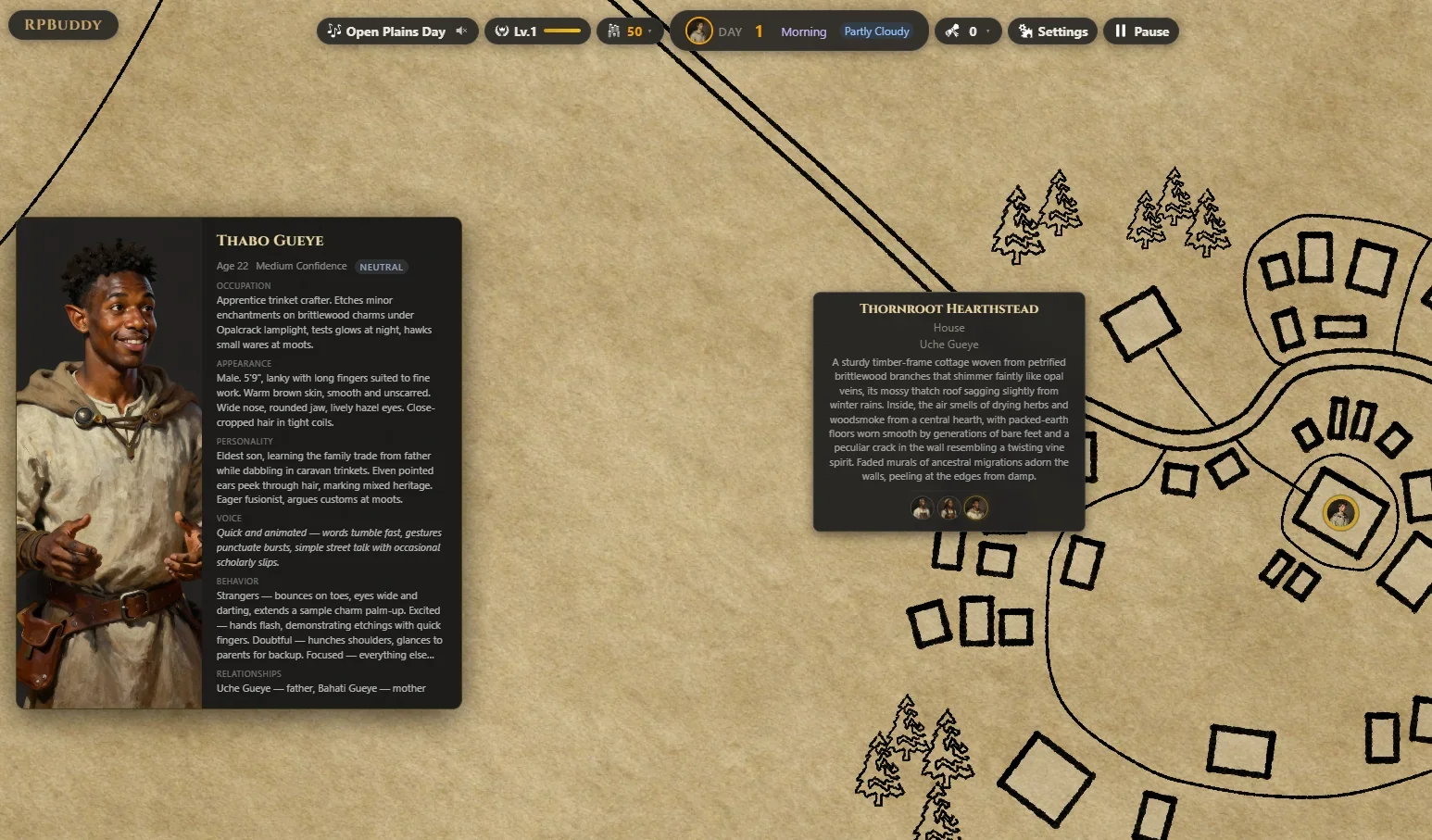
Persistent Memory Beyond a 20-Turn Cliff
The practical difference is architectural. Events from play can be stored and fetched when a new turn needs them, instead of hoping the entire transcript still fits. Evaluations of long-term memory for language models keep returning to the same requirement: the system has to decide what to keep, how to index it, and when to inject it.
A useful mental model for a Character AI alternative with better memory:
- Store character facts, relationships, and plot events outside the live window.
- Retrieve the few memories that actually matter for this turn.
- Write the next beat in-character, using that curated set.
That is closer to long-term memory for conversational agents than to a chatbot that only sees the latest page of the thread.
Character Consistency That Survives Time Jumps
Long character RP fails in small ways first: a changed speech pattern, a forgotten injury, a reset of the last fight. This AI is designed to hold those anchors so a partner character still sounds like themselves after a week away. You can leave a cliffhanger, close the app, and continue as if the scene never stopped.
"You are my RP partner. I am Captain Ilya Voss, a disgraced privateer with a broken left hand and a debt to the harbor witch. We last left off in the salt cellar under Pier 9. Continue in-character. Do not reset lore."
Creative Freedom Without Constant Canon Repair
The product promise is blunt: immersive roleplay, unlimited memory, character consistency, and complete creative freedom. In practice that means you are not negotiating with a forgetful chatbot. You are playing. If the story needs a heist, a slow-burn romance, a political court, or a quiet conversation on a train, you can stay in that register for hundreds of turns.
"Remember that Elspeth already knows I lied about the fire. She would not ask me to explain it again. Play her as wary, not naive."
"Keep the tone darkly comic. The city still uses the ration tokens from session one. Do not invent a new currency."
Researchers arguing that long-term memory is the foundation of real personalization are describing the same user expectation Character.AI players already have: if the product claims memory, the person on the other side should still know you tomorrow.
Related Agents You'll Also Find Useful
If you want the same continuity in a language-learning scene rather than a campaign, Learn English Through Roleplay puts you in immersive scenarios where idioms and grammar stick because the moment matters.
- Any scenario and intensity, not a scripted textbook dialog
- Vocabulary and natural speech practiced in-character
- Memory that lets a scene evolve instead of restarting every lesson
If your character work leans toward Japanese media, honorifics, and long-running dynamics, Learn Japanese Through Roleplay keeps the same immersive, story-first approach.
- Boundless scenarios with full creative freedom
- Vocabulary and grammar anchored to memorable scenes
- Continuity so speech levels and relationships do not reset
If the story in your head wants panels, not just prose, Manga Creator helps you turn a long character RP into a visual narrative without losing design or plot logic.
- Visual storytelling and panel flow for one-shots or long serials
- Consistent art direction across many pages
- A natural next step when a campaign wants a comic adaptation
Try Roleplay Game Master free — no credit card required.
How It Works
Step 1: Open a Scene, Not a Questionnaire Start by stating who you are, who the partner character or GM is, and where the story begins. You do not need a perfect wiki. You need enough canon for the first scene to stand.
"RP a slow-burn mystery in a rain-soaked port city. I am a cartographer who just inherited a map that should not exist. Begin in the archive at midnight."
Step 2: Lock the Details You Refuse to Lose Call out the facts that would ruin immersion if forgotten: names, injuries, relationships, house rules, tone. This roleplay AI can carry those forward so you are not restating them every twenty messages.
"House rules: no plot armor, NPCs remember debts, and magic always has a visible cost. My character will never kill a surrendering foe."
Step 3: Play Past the Point Where Other Bots Drift Keep going. Introduce subplots. Let NPCs leave and return. The test of a Character AI alternative with better memory is not the first page — it is message 80, when someone mentions a throwaway detail from the opening scene and the world still knows it.
"Weeks have passed in-world. The rival crew still has the locket from the tavern fight. Do not reintroduce it as if it is new."
Step 4: Leave and Come Back Without a Recap Novel Close the session mid-conversation if you need to. When you return, ask to continue from the last beat. Persistent memory is what makes that feel like one story instead of a series of disconnected chats.
"Continue exactly where we stopped. Do not summarize. Elspeth is still waiting for my answer."
Step 5: Steer Continuity in Plain Language If a detail starts to slip, correct it once, clearly. A memory-aware RP bot should treat that correction as canon, not as optional flavor.
"Correction: the harbor witch is named Maer, not Mira. She already knows my true name. Keep that consistent from now on."
Results & Use Cases
🎭 A Long-Running Original Character
Scenario: You spent hours building an OC — voice, history, a private joke with one NPC, and a scar nobody else can see. You want the next hundred messages to treat that person as real.
Traditional Approach: By the early twenties of a chat, testers found Character.AI already losing track of details established at the start. You pin, recap, and still watch the character drift.
The AI RP bot: You continue from the last cliffhanger. The scar is still there. The joke still lands. Play time goes into choices, not repairs.
- Long-running NPC agendas stay intact
- Inventory and injuries persist
- Subplots can sleep and return without being rewritten
💞 Character RP That Depends on Emotional History
Scenario: A slow character study where two people have already lied, forgiven, and failed each other. The next scene only works if both remember the last fight.
Traditional Approach: After a short window the partner character resets to day-one chemistry. You spend the session reminding them what they did.
Roleplay with persistent memory: The argument is still in the air. Subtext survives. You can write silence, not exposition.
- Relationship state does not wipe at session boundaries
- Secrets stay secret until you reveal them
- Voice and tone remain stable enough to feel like the same person
If you want that same continuity while practicing a language, Learn English Through Roleplay puts the memory problem in service of fluency: the scene keeps going, so the vocabulary has somewhere to live.
📱 Mobile Roleplay on a Commute
Scenario: You play in short bursts on a phone — ten minutes on the train, then nothing until evening.
Traditional Approach: Each gap costs you the thread. By the time you reopen the chat, the bot has lost the room, the stakes, or the last line of dialogue.
On iOS or Android: You pick up mid-sentence. Settings and history sync, so a mobile session is the same campaign as the desktop one, not a disposable side chat.
- Short sessions still accumulate into one story
- No need to write "quick recap" messages on a crowded train
- Speech-to-text lets you play when typing is inconvenient
FAQ
Is there a Character AI alternative with better memory?
Yes. This roleplay tool is built for chats that outgrow a short sliding window. Instead of keeping only the latest turns — or asking you to pin and ration a memory bar — it stores and retrieves story-relevant details so names, plot commitments, and character history can still inform later scenes. That is the difference between a chat that drifts and a bot you can play with for the long haul.
Why does Character.AI forget things in long chats?
Most consumer character UIs are still bounded by a context window. Character.AI added Story Memory, Facts, and pinning to protect key details, but independent 40-turn tests still found rapid detail loss by the early twenties of a conversation. Research on long-term memory for AI agents treats that gap as architectural: the model needs a store it can retrieve from across sessions, not only a longer recent transcript.
Is Roleplay Game Master free?
Yes. There is a free tier with core features and limited usage, and paid tiers if you need more headroom. You can start a campaign without a credit card. If you later want higher limits, plans scale from Plus at $20/month upward. Usage resets monthly on the billing date, with no daily caps.
How is this different from Character.AI?
Character.AI is a huge character library with layered memory tools you partly manage yourself. This agent is a dedicated long-form roleplay product: persistent memory, character consistency, and creative freedom without a usage bar to babysit. You are not browsing millions of bots. You are running one continuous story with a GM-style partner that is supposed to remember the world you already built.
Does this Character AI alternative work on mobile?
Yes. Play is available on web, iOS, and Android with feature parity and synced settings. That matters for character RP because a commute session and a late-night desktop session should be the same story, not two amnesiac chats. If you only have a phone, you can still run a long campaign.
Can it remember across sessions, not just inside one long chat?
That is the point of persistent memory. A bot that only "remembers" inside one sitting still fails the moment you close the thread. Cross-session memory is what lets you continue a scene days later. Long-term memory research frames this as the difference between a generic responder and a personalized agent that can adjust from historical interaction data.
Conclusion
A Character AI alternative with better memory is not a luxury setting. It is the difference between a relationship and a sequence of disconnected scenes. Finite windows, dropped turns, and recap labor are why so many character chats collapse just as they get good.
Roleplay Game Master solves that by treating your campaign as memory, not as a transcript that falls off the bottom of the screen. Characters stay themselves. Plot threads remain available. You can play past the twenty-message cliff without becoming the bot's editor.
Try Roleplay Game Master now. Explore more at Jenova.
For Developers: Roleplay Game Master is available programmatically via the Jenova API — integrate persistent-memory character roleplay into your application with a single API call. Full documentation →