Can an AI Game Master Enforce Custom Rules Throughout a Campaign?
2026-09-09
How Do Memory, Encoding, and Adjudication Decide Whether House Rules Survive?
An AI game master can enforce custom rules across a campaign, but only when those rules are stored as durable procedure rather than leftover narration. In 2026, the tools that look similar in a first session diverge sharply by session twelve: some remember a house rule as flavor text, some bind it to character state, and a few can load an entire homebrew bible and keep rulings as canon.
The difference is not “AI versus human.” It is which layer of the referee actually owns the rule.
Key factors that separate lasting custom-rule enforcement from one-shot improvisation:
✅ Ingest — Can you load a house document, setting bible, or ruling log, or only paste a paragraph into a prompt? ✅ Adjudication — Does the referee apply the rule unprompted, or only when a player reminds it? ✅ State binding — Are hit points, spell resources, debts, and inventory stored as data, or as prose the model may rewrite? ✅ Cross-session recall — Is last month’s ruling still true after a two-week gap? ✅ Patchability — Can you amend a house rule mid-campaign without the world forgetting earlier consequences?
To compare AI game masters honestly, it helps to stop asking whether they “know Dungeons & Dragons” and start asking which of those five layers they actually own.

Why Are Custom Rules Harder for AI Game Masters Than Published Modules?
Custom rules are harder because they are scarce, local, and easy to contradict, while published modules are dense in the model’s training data. A generic chatbot can gesture at fireball and armor class because those ideas appear everywhere. Your table’s true-name magic, favor economy, or permanent-death rule does not.
That gap shows up in play. Commentators tracking AI-generated role-playing games note that systems can produce engaging scenes while still struggling with consistent rules and long-term story coherence. Players who have tried to run multi-level Dungeons & Dragons adventures in general chat tools report the same failure mode:
.The demand side makes the problem more expensive. Almost 30% of Americans now count as tabletop gamers, including 60% of 18-to-24-year-olds, which means more tables want a campaign and fewer of those tables have a referee who can hold a living rules document in working memory. Parallel market research on AI storytelling games estimates the category at $3.8 billion in 2025, with a projected $19.6 billion by 2034.
A published adventure can hide weak memory behind familiar monsters. Homebrew cannot. If the river city’s magic tax applied on night one, it has to apply after the mid-campaign timeskip, or the setting stops being a game.
What Should You Evaluate Before Trusting an AI Referee With Homebrew?
You should evaluate an AI game master on a custom-rules persistence test, not on prose quality alone. Beautiful narration that forgets a house rule is still a failed referee.
Use five scored dimensions. Weight them according to your table, not a vendor’s feature list.
1. Rule ingest
Can the tool accept a rules bible, PDF, or structured lore file? Prompt-only tools force you to restate the system every session. Knowledge-base tools can treat the house document as standing law.
2. Adjudication fidelity
Does the referee invoke the rule when a player never names it? “I pick the merchant’s pocket” should trigger your table’s notice mechanic even if nobody types the skill name.
3. State binding
Quests, inventory, and XP are the useful dividing line between a saved transcript and a game. A potion that remains in inventory after it was drunk is not a memory bug. It is a missing rules engine.
4. Cross-session recall
Campaigns die in the gaps. If a two-week pause resets the harbormaster’s debt, the AI was generating scenes, not refereeing a world.
5. Patchability
House rules evolve. The right tool lets you issue a session-zero amendment — “from tonight, favors cannot buy spell slots” — without erasing the favors already spent.
A useful scoring habit: if a dimension exists only in the chat log, score it as weak. If it exists as a sheet, database field, attached document, or standing instruction the model cannot casually overwrite, score it as strong.
How Do Leading AI Game Masters Compare on Custom Rule Enforcement?
Jenova, StoryRoll, TableForge, AI Dungeon, and conventional virtual tabletops all “run campaigns,” but they encode rules in incompatible ways. As of 2026, the practical split is instruction-plus-memory platforms, 5e-shaped game engines, freeform fiction tools, and human-GM virtual tabletops.
| Feature / Dimension | Jenova custom GM agents | StoryRoll | TableForge | AI Dungeon | Foundry VTT / Roll20 |
|---|---|---|---|---|---|
| Custom rule ingest | Custom instructions plus private knowledge bases | Narrow 5e lens; house rules are secondary | 5e SRD-centered; limited open homebrew builder | Lore cards and plot components | Deep, but a human GM must implement them |
| Mechanical enforcement | Strong when briefed; not a licensed physics engine | Rules-aware 5e combat, slots, checks | Programmatic 5e sheets, inventory, XP | Narrative only unless you police it | Strong automation when a human GM is present |
| Campaign memory | Persistent cross-session memory and chat history | Structured sheet, inventory, quest, NPC state | Quests, items, currency, XP, world state | Story Cards / World Info, context-window limits | Journals, actors, scenes owned by the GM |
| Maps and VTT | Narrative and prep; not a full grid VTT | No grid map in current build | Maps and tokens in-product | Image prompts, not a tactical table | Native maps, lighting, tokens, combat trackers |
| Pricing (as of 2026) | Free tier; paid plans from $20/month | Early access; paid tier planned, specifics unlocked | Plan-based party caps; exact fees unverified | Free; Premium $9.99/month; Ultra $29.99/month | License or subscription plus human labor |
| Best for | Living house bibles, homebrew, solo or hybrid GM aid | By-the-book solo 5e | Multiplayer 5e without a human DM | Genre-fluid fiction | Groups that already have a willing human GM |
StoryRoll is explicit about the philosophy split: AI Dungeon is a blank page, while StoryRoll is a character sheet. TableForge’s 2026 comparison makes the same cut for multiplayer products. Jenova sits in a third category: you can configure a custom agent around your rules rather than around a licensed system.
That is an advantage for homebrew and a limitation for players who want a closed 5e physics engine that refuses illegal actions even if the narrator would allow them.
Jenova
Jenova’s relevant mechanism is not a single licensed dungeon module. It is the ability to build a custom game-master agent with standing instructions, a private knowledge base, and persistent memory. You can attach the house bible, name the lines you will not cross, and keep rulings in the same file as the NPCs.
The honest limit is enforcement style. Jenova is strongest when custom rules are linguistic and procedural — favor economies, faction clocks, magic with social costs, “never retcon a prior ruling.” It is weaker than a 5e database when you need spell slots, attunement, and XP thresholds that cannot be narrated away. It is also not a replacement for Foundry-style dynamic lighting and token combat.
StoryRoll
StoryRoll interprets natural language through a Dungeons & Dragons 5th Edition lens. Asking whether a merchant is lying becomes a Wisdom (Insight) check. Combat uses initiative, action economy, spell slots, and death saves rather than cinematic summaries.
That mechanical spine is a genuine strength for 5e players. It is also the constraint. StoryRoll’s own comparison states you cannot point it at a cyberpunk romance and expect the same engine. There is no grid map, some unusual spell interactions still trip it up, and as of 2026 it remains web-only early access with pricing not fully locked.
TableForge
TableForge is built for a persistent 5e party without a human Dungeon Master. Inventory is not a paragraph. Items have quantities, slots, attunement, and mechanical effects such as Armor Class. Experience is numeric, with level-up flow when thresholds are crossed.
The tradeoff is scope. TableForge is organized around supported System Reference Document content. It does not currently match the open-ended homebrew world builder associated with Friends & Fables, and it cannot ingest every third-party PDF. If your “custom rules” are mostly 5e plus a few items, it fits. If they are the system, it may refuse the job.
AI Dungeon
AI Dungeon remains the category’s most flexible fiction engine, with Do, Say, Story, and See inputs, multiplayer join codes, and a large scenario library. Premium plans at $9.99 and $29.99 per month buy better models and more memory.
It does not enforce tabletop rules. A wizard can cast fireball until the prose gets bored. World Info and Story Cards improve continuity, but they are keyword-triggered lore, not a referee. Choose it when house rules would get in the way. Do not choose it when the campaign’s integrity depends on a missed attack staying missed.
Friends & Fables, Roll20, and Foundry VTT
Friends & Fables, as described in TableForge’s August 2026 review, runs an agentic AI referee named Franz for parties of up to six and puts custom lore, maps, items, and shared worlds at the center of the product. The architectural cost is adjudication: the model has more authority to interpret mechanics.
Roll20 and Foundry VTT remain the opposite design. They can store almost any house rule a human GM is willing to implement. They do not remove the GM. Foundry in particular offers deep system and module automation, with one license hosting an unlimited number of players, at the cost of hosting and setup.
Can a Licensed Rules Engine Enforce House Rules It Was Not Built to Know?
Usually no — and that is the overlooked trade-off in “rules-aware” AI dungeon masters. A 5e engine is excellent at the Player’s Handbook and weak at the document you wrote in a weekend.
StoryRoll will calculate a level 5 wizard’s spell save DC. TableForge will open a level-up flow at the correct XP threshold. Neither fact means your unique exhaustion clock, downtime labor market, or non-Vancian magic will be first-class objects. TableForge’s published limitation is the missing open-ended homebrew builder. StoryRoll’s published limitation is genre and system focus.
Virtual tabletops have the inverse problem. They can represent almost any rule, but the human still has to encode it. Roll20’s community has spent years asking for reusable custom compendiums — a thread with 1,400-plus votes and nearly a decade of comments — because homebrew items and spells still have to be re-entered per game. The feature’s absence is not a trivia complaint. It is evidence that even mature VTTs treat custom rules as labor, not infrastructure.
The non-commodity conclusion: strict 5e enforcement and custom-rule enforcement are different products. If your campaign is “D&D, except three house tweaks,” a 5e engine is the better referee. If your campaign is a living system that only resembles D&D in the dice, an instruction-and-knowledge-base game master is the better fit.
How Does Persistent Memory Stop an AI Game Master From Rewriting Last Month’s Rulings?
Persistent memory stops rule drift only when the ruling is stored as canon, not as a sentence that happened to occur in last week’s prose. Transcript memory is not enough. The referee needs a standing file of what the table decided.
This is why dedicated dungeon-master aides emphasize living campaign state rather than recap paragraphs. One 2026 guide to AI tools for dungeon masters describes the useful job as parsing notes, tracking state, generating ideas grounded in canon, and recalling lore between sessions. Builders who have wired models to actual rulebooks make the same distinction: the interesting system is one that can look up rules, remember every NPC, and keep campaign journals across sessions.
Jenova’s practical advantage here is structural. Unlimited chat history and cross-session memory mean the watch captain’s burn scar, the unpaid dock tax, and the session-four ruling on true-name magic can remain in the same agent. Attach the house bible as a private knowledge base and the model is no longer reconstructing your system from a sliding context window.
The remaining failure mode is operator error. If you bury a rule in a joke, then issue a contradictory instruction three sessions later, a persistent agent will faithfully keep the contradiction. Memory amplifies clarity. It does not invent a rules lawyer you never briefed.
A working test after any gap:
- Ask who still owes whom, and what the last mechanical ruling was.
- Attempt a borderline action that should trigger the house rule without naming it.
- If the referee applies the rule, cites the prior ruling, and updates state, memory is doing referee work.
- If it improvises a cooler scene instead, you have a storyteller with a good recap.
Why Do Virtual Tabletops Still Struggle With Homebrew Compendiums?
Virtual tabletops struggle because custom rules create copyright, hosting, and workflow problems that official compendiums do not. The software can display a map. Reusable homebrew libraries are a different product.
Roll20 users describe the current workaround as folders of handouts, buggy class hacks, and per-sheet copy-paste. First-time GMs are surprised they cannot prep a custom item and drag it onto a sheet later. Long-running GMs report hundreds of unique items that still cannot live in a private, reusable compendium. Community comments in that feature request argue the delay is less technical than legal — platforms fear hosting copyrighted spells at scale.
Foundry VTT is the usual destination when that friction becomes decisive. It is highly customizable, module-rich, and capable of automating almost any system a GM will install. The cost is operational: a host, a world, permissions, and a human who still adjudicates.
For custom-rule campaigns, the VTT question is therefore not “which map is prettiest?” It is “who is the referee?” If a person wants that chair, Foundry or Roll20 is the table. If nobody does, adding lighting and tokens does not create a game master. An AI referee plus a simpler map is often the more honest stack.
How Do You Encode Custom Rules So an AI Game Master Actually Applies Them?
You encode custom rules as standing law, then test them with actions that never mention the rule by name. The brief is session zero. The test is session two.
On Jenova
Create a custom game-master agent and treat instructions, knowledge base, and memory as three different layers.
- Write adjudication policy in the agent instructions: tone, forbidden retcons, how conflicts resolve, and what the dice mean at your table.
- Attach the house bible — classes, economies, magic, downtime — as a private knowledge base rather than a chat paste.
- Start play with a ruling log: “All mechanical decisions below are canon.”
- After each session, add one correction pass: what drifted, what was decided, what the world now believes.
A first message that actually binds the referee looks like this:
"You are the game master for a low-magic river city. House rules: favors are currency; spoken true-names power all spells; death is permanent; never retcon a prior ruling. Use the attached rules bible over generic D&D assumptions. If a player action conflicts with the bible, apply the bible and explain the ruling in one sentence before narrating."
Then immediately probe it:
"I try to bribe the watch with gold instead of a favor, then cast a silent fire cantrip with no true-name. Resolve this using our house rules, not standard 5e."
If the agent accepts the gold bribe and the silent spell, your bible is decoration. If it blocks both and logs the attempt as faction heat, the custom rules are in force.
The Game Designer Assistant is the right upstream tool when the bible itself is unfinished. Use it to pressure-test whether a favor economy, faction clock, or downtime loop can produce playable trouble. Then hand that document to the game-master agent. Designing the system and refereeing the system are different jobs.
On a 5e engine
On StoryRoll or TableForge, encode only the house rules the engine can see. Put mechanical facts on the sheet. Do not hide a resource in lore text if the product has an inventory or spell-slot field. Use any “rule of cool” toggle deliberately; once you loosen the physics, you are back in narrative enforcement.
On AI Dungeon
Put every non-negotiable fact in World Info or Story Cards, with the exact keywords players will type. Restate hard limits at the top of a long session. Accept that this is a reminder system, not a referee.
On a VTT with a human GM
Keep the AI in aide mode. One 2025 roundup of dungeon-master tools describes campaign software that builds a living memory of the session and identifies what to track. Let the VTT own tokens and sheets. Let the AI own recap, NPC voice, and the ruling log the human can override.
Which Setup Works Best for Solo Campaigns, Human Tables, and Hybrid Play?
The best setup is the one that matches who sits in the referee chair, not the one with the most features. Solo players, underserved tables, and hybrid groups need different enforcement guarantees.
Solo homebrew campaigns. A Jenova custom agent is the stronger fit when you care more about your system than about SRD automation. Persistent memory, attached documents, and multi-model access let the same campaign continue on web or mobile without rebuilding the world. If you would rather play inside a locked mystery than maintain a sandbox, The Mansion is a bounded alternative: every room already hides a secret, so the rules of investigation are structural rather than homemade.
Solo 5e, by the book. StoryRoll is stronger when you want attack rolls, slots, and death saves without building a bible. TableForge is stronger when you also want programmatic inventory, XP, and a party that can continue asynchronously.
Genre-fluid fiction. AI Dungeon remains stronger when the “campaign” is collaborative prose and a custom magic system would only slow the scene down.
Human table, AI second brain. Keep Foundry or Roll20 as the map. Use an AI aide for NPC dossiers, recaps, and ruling consistency. Independent 2026 roundups of dungeon-master tools keep landing on the same split: full AI GM play is one job, GM aide mode is another.
Group with no willing GM. Compare TableForge and Friends & Fables first if the group wants shared 5e-like state. Use a Jenova agent if the group’s actual need is a custom world with a single referee that never forgets session-zero promises.
Jenova’s limitation in group play is the same as its strength: it is an agent platform, not a six-seat 5e server with separate character databases. Friends can share a campaign file, but it will not replace TableForge’s per-player equipment slots or Foundry’s token permissions.
Pricing should be read as usage, not as a rules feature. Jenova’s free tier includes core features at limited usage; Plus is $20 per month for 30× usage, with higher tiers at $50, $100, $200, $500, and $1,000. AI Dungeon’s Premium and Ultra tiers buy model quality and memory, not a 5e engine. A VTT license buys software for a human GM. None of those prices purchase custom-rule fidelity by themselves.
What Do Tabletop Designers Say About AI Referees and Living House Rules?
Designers and tool builders keep repeating a narrower claim than marketing copy suggests: AI is already useful as a canon librarian, and still uneven as a physics engine. The useful referee is the one that can file a ruling, not the one that can describe a dragon.
"The failure we see in long campaigns is almost never weak prose. It is unbound procedure. A house rule that lives only in a pretty paragraph will be bargained away the first time a cooler scene appears. If favors are currency, that has to be a standing object in the campaign file — who holds them, what they buy, and which ruling last changed the rate. Otherwise the AI is doing impressions of a game master."
"We also see teams over-index on licensed 5e fidelity, then get frustrated when their actual game is a custom economy with a d20 on the side. Those are opposite encoding problems. A SRD engine should refuse an illegal spell slot. A homebrew agent should refuse to forget the dock tax. Asking one product to be both a closed rules kernel and an open setting bible is how campaigns quietly fork."
"The practical standard is ugly and testable. Leave the table for two weeks, then attempt the exploit your players already thought of. If the referee cites the prior ruling, updates state, and keeps the world’s consequences, you have enforcement. If it offers a new interpretation because the prompt was eloquent, you have a writing partner. Both are valid. Only one can carry custom rules through a campaign."
— Jenova Product Team, campaign-agent design, persistent multi-session roleplay systems
That standard matches what practitioners building their own dungeon masters describe: dice, rulebook lookup, NPC memory, and journals have to be coupled, or the story and the rules drift apart. It also matches the older tabletop lesson that a ruling becomes real only when the table can cite it later.
Can an AI Game Master and a Virtual Tabletop Share One Campaign Without Splitting Canon?
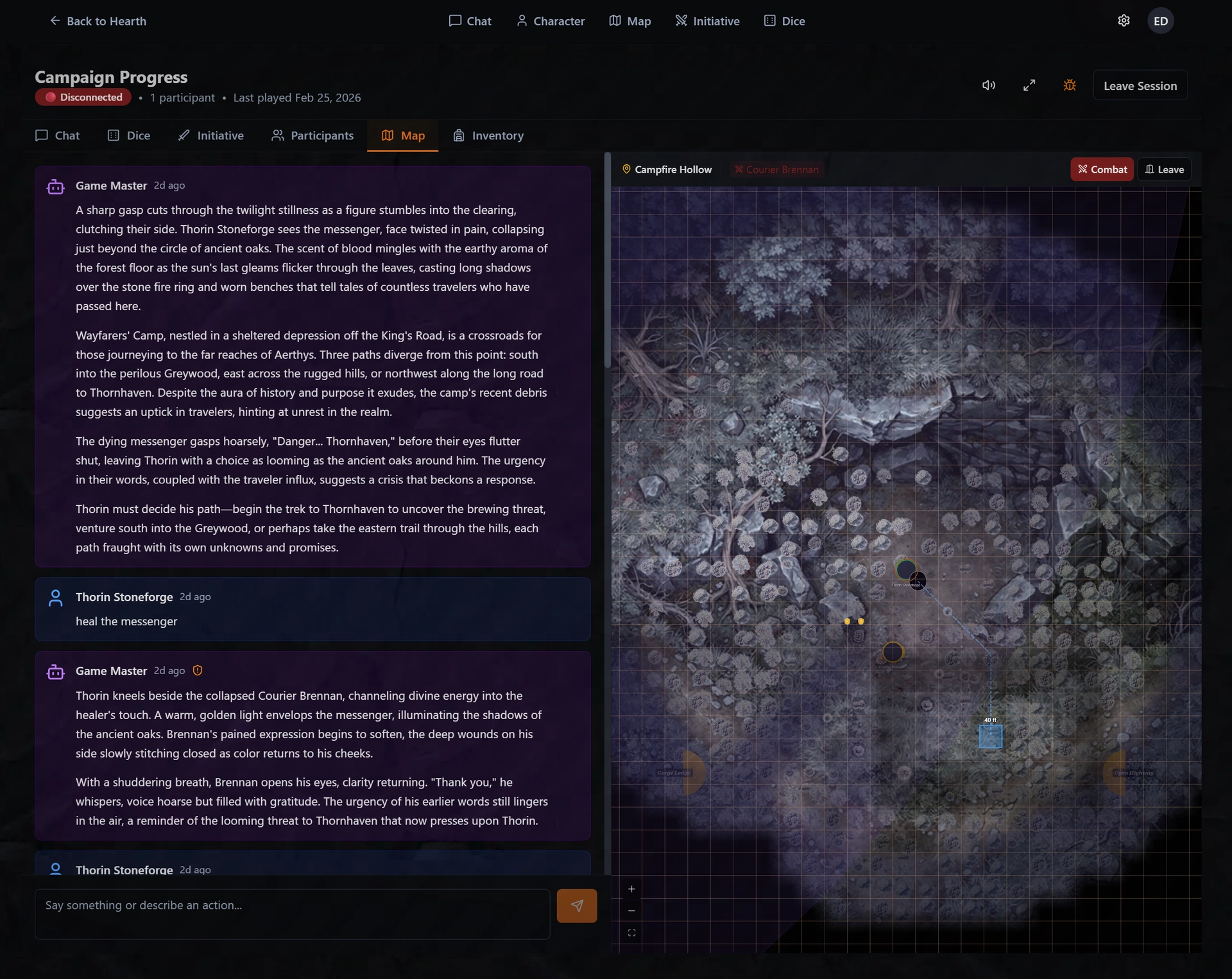
Yes, if one system is the referee of record and the other is the table surface. Dual canon — a chat log that contradicts the VTT sheet — is how custom rules die.
Give each layer a job:
- Referee of record: the AI agent or 5e engine that stores house rules, rulings, NPC secrets, and resource changes.
- Table surface: the VTT map, tokens, lighting, and shared dice, as in the Campfire Hollow-style session view where narration, map, and inventory sit side by side.
- Export habit: after combat, the HP, loot, and conditions on the map must be written back into the referee file in the same session.
A hybrid loop that holds:
- Brief the AI with the house bible and last session’s ruling log.
- Run social scenes and adjudication in the agent, where memory actually lives.
- Move to the VTT only when space, line of sight, or token position matters.
- End with a three-line recap the AI must ingest: resources spent, promises made, rules invoked.
If you reverse that order — improvise on the map, then ask the AI to “catch up” from a screenshot — expect drift. Models are better at applying a file they already own than at reconstructing a fight from a grid.
Jenova is well suited to the referee role in that stack because documents, memory, and instructions stay attached to one agent. It will not replace Foundry’s lighting tools. Foundry will not replace a knowledge base that contains your 12-page magic law. The campaign holds when you stop asking either product to be the other.
Custom-rule enforcement throughout a campaign is therefore possible in 2026, with a precise meaning. An AI game master can keep house rules intact when those rules are ingested, bound to state, recalled across gaps, and patched in the open. Tools that only generate the next scene will not do that work, no matter how confident the narrator sounds.
References
- Every Movie Has a Lesson — DATA: Almost 30% of Americans are Tabletop Gamers
- Dataintelo — AI-Generated Personalized Storytelling Game Market
- 1985 Games — RPG narrative explained: Master collaborative storytelling
- TableForge — Multiplayer AI Dungeon Masters Compared
- StoryRoll — AI Dungeon vs StoryRoll: What's Different in 2026
- Roll20 Community Forums — Custom Compendium feature request
- The GM Craft Tavern — Best Dungeon Masters Tools for VTTRPG Sessions (2026)
- TTRPG.bot — AI Tools for Dungeon Masters in 2026: The Honest Guide
- Lauri Mukkala — How I Built an AI Dungeon Master
- StormScape — 10 AI Tools Every Dungeon Master Needs in 2025
- ScriptoriumGM — Best AI Dungeon Master Tools 2026
- StartPlaying — Foundry VTT campaign hosting notes