Browser Text RPG: Play Persistent AI Adventures Instantly
2026-09-09
Roleplay Game Master helps you play a browser text RPG by answering every move as narrator, rival, innkeeper, and consequence — while remembering the world you already built. In September 2026, players still bounce between MUDs that want a dedicated client, parser games that stall on guess-the-verb, and chat windows that forget last night’s quest. This AI provides a persistent text world you open in a tab, with no download and no overnight reset.
- ✅ Persistent memory so rooms, NPCs, and bargains survive across sessions
- ✅ Character voices that stay distinct under combat, downtime, and time jumps
- ✅ Play in any modern browser — and on iOS or Android when you leave the desk
- ✅ Parser-style commands, freeform roleplay, or a hybrid of both
A browser text RPG is not a landing page with flavor text. It is a live loop: you type a move, the world answers, and both of you are bound by what happened. To understand why that loop is so hard to keep in a tab, it helps to look at what actually breaks text play.
Quick Answer: What Is a Browser Text RPG?
A browser text RPG is a role-playing game you play in a web tab using typed commands and narrative replies, with no client to install. Stats, rooms, and consequences still matter; the interface is language instead of a 3D viewport.
Key capabilities:
- Type
look,go west, or a full-sentence action and get a world that reacts - Track inventory, injuries, factions, and unfinished quests across sessions
- Mix parser discipline with freeform roleplay when the scene needs either
- Resume the same character from a phone without exporting a save file
Why Most Browser Text RPG Sessions Fall Apart
Text worlds are not a nostalgia niche. A survey of U.S. adults found that 28% have played text adventures or interactive fiction on a computer, tablet, or smartphone — up from 20% in 2019 — and that the share rises to 43% among Gen Z adults. Interactive fiction is still defined the same way it was in the Infocom era: software that simulates an environment you influence with text. The Interactive Fiction Database remains an active catalog for parser games, choice narratives, and competition titles. Long-running commercial worlds such as Iron Realms’ browser text RPGs have shipped in a tab since 1997, with nothing to install.
43% — Share of Gen Z adults who have played interactive fiction or text adventures
Nothing to install — Iron Realms’ text RPGs run in the browser through a web client, a model the genre has used for decades
The hunger is real. But actually playing a browser text RPG is frustratingly difficult:
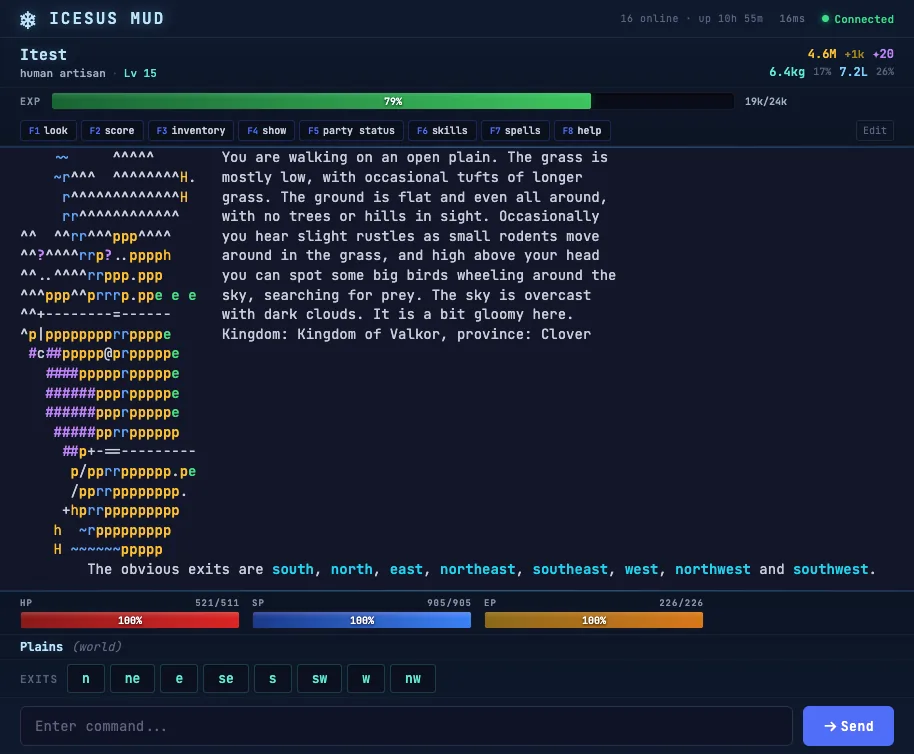
- Multiplayer MUDs expect a learning curve, a community, and often a dedicated client
- Classic parser games punish synonym misses and then go silent
- Generic chatbots open a tavern and forget the innkeeper by the next scene
- Saves, notes, and maps live in three apps, so last session’s traitor becomes this session’s ally
The Client Problem Is Older Than Your Laptop
MUD players have argued for years about
. A full client gives aliases, triggers, and mapping. It also asks you to install software before you ever typelook. Browser worlds lowered that wall — Iron Realms’ Nexus client is the proof — but many text RPGs still greet a new player with a blank prompt and a wiki. The first week, as those worlds admit, is often spent dying to rules you did not know existed.
Parser Friction Is Not Atmosphere
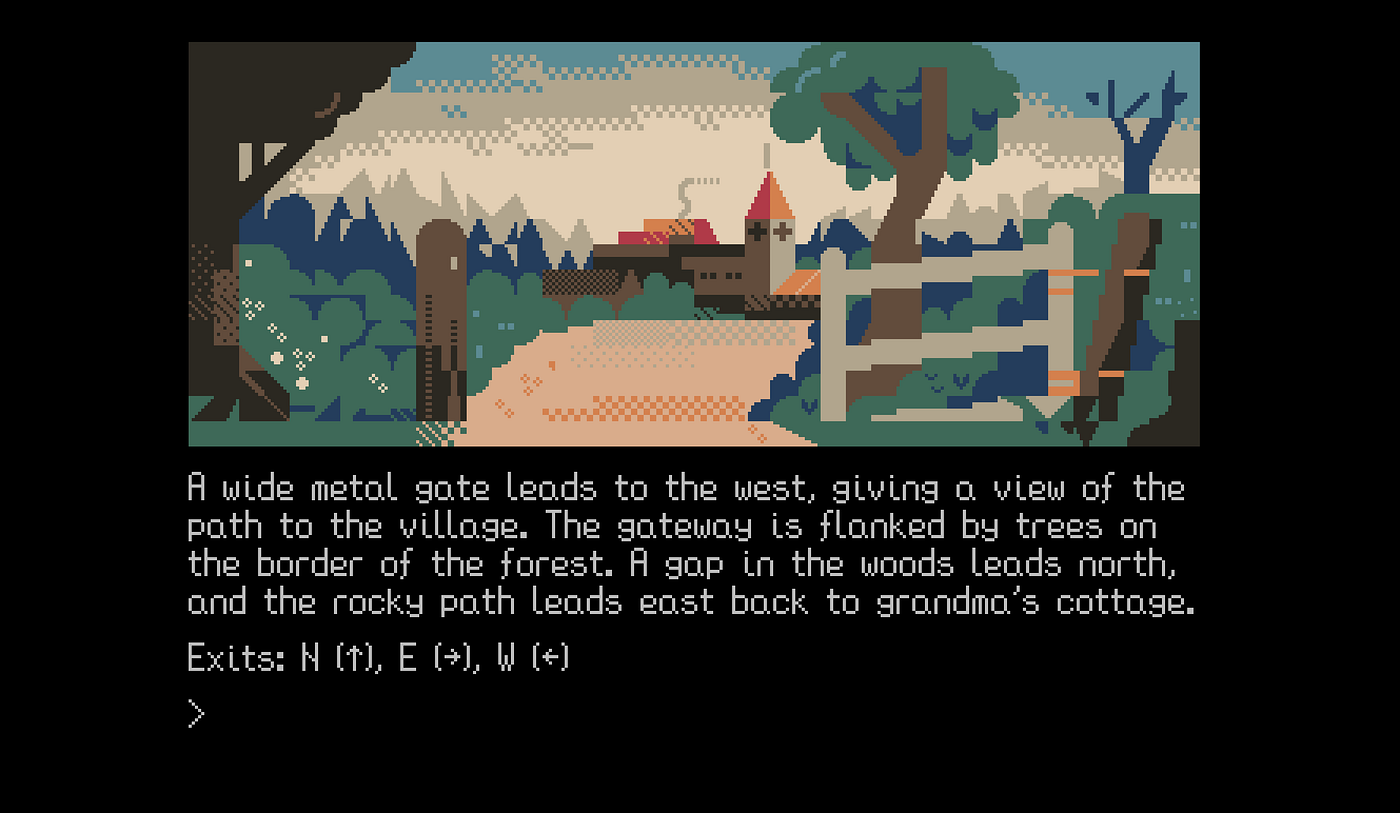
Guess-the-verb is a design failure, not a mood. You stand at a metal gate. open gate fails. pull gate fails. go west works, and the fiction never explains why. Players who grew up on text-based catalogs will forgive a terse room description. They will not forgive a world that refuses a reasonable sentence.
Stats Without Memory Is Just a Chat Log
Interactive-fiction communities still debate where IF ends and a text RPG begins. The useful line is simple: when numbers start changing what you can do, you are in RPG territory. That only matters if the numbers — and the story attached to them — persist. A chatbot that rerolls your wound, your debt, and your enemy’s name is not a game master. It is a slot machine with vocabulary.
Accessibility Was Always the Genre’s Advantage
Text is not a downgrade. On a slow connection it loads when a 3D client does not. Screen-reader players have long treated well-written text worlds as first-class games; titles such as TextSpaced were designed to be enjoyed by blind and sighted players in a browser. That advantage disappears the moment the interface hides exits in unlabeled icons or the narrative forgets the room you are standing in.
This is exactly what Roleplay Game Master was built for.
Why Roleplay Game Master
Roleplay Game Master is a dedicated co-author for a browser text RPG: unlimited memory, stable character voices, and no ceiling on the scenario you want to explore. You bring the protagonist, the verb list, and the tone. It brings the rest of the table — rooms, exits, NPCs, and the cost of the last thing you did.
| Traditional Approach | Roleplay Game Master |
|---|---|
| Install a MUD client or hunt for a web wrapper | Open a tab and start typing |
| Guess-the-verb dead ends | Accepts parser commands and full-sentence actions |
| Generic chat that forgets the gate, the debt, and the name | Persistent memory across the whole campaign |
| Multiplayer worlds that go quiet at 2 a.m. | A game master that is present when you are |
| Fixed setting, fixed skill list, fixed lore bible | Any genre, any rules weight, complete creative freedom |
A World That Still Knows the Gate
The value is not that an AI can describe a forest. It is that the metal gate still leads west, the gap in the woods still leads north, and grandma’s cottage is still east because you already walked that path. Continuity is the difference between a browser text RPG and a paragraph generator.
Commands, Then Consequences
Ask for a clipped parser (> look, > examine gate, > go west) and the replies should stay in that register: room text, obvious exits, objects you can take. Ask for literary second person and the same world should breathe without dumping a stat block on the page. You set the interface. The game master keeps it.
Creative Freedom Without a Rules Lawyer
Some sessions want encumbrance and initiative. Others want a horror one-shot with no dice. You can forbid combat math, demand it, or switch mid-campaign when the story needs a different pressure. The constraint is yours.
Try prompts like these:
"Parser mode. I am at a wide metal gate on the forest border. Give me room text, obvious exits, and wait for my command. Do not advance the plot until I type it."
"Continue last session. I am still wounded from the pier. The harbormaster still has my old name. I type: go west. Play the village as if I never left the tab."
"Hybrid: accept LOOK / EXAMINE / GO, but if I write a full sentence, treat it as an action with a cost. Keep NPC speech distinct. Never recap unless I ask."
Related Agents You'll Also Find Useful
If you want a closed mystery instead of an open campaign, The Mansion drops you into a house with no memory of how you arrived. Every room is a parser-friendly beat — secrets, exits, and the chance that the next door is the last one.
- Room-by-room exploration built for typed decisions
- A single location you can finish in one sitting or stretch across nights
- Horror pressure without requiring a human game master
If the mansion is too domestic, The Asylum puts you in a shuttered institution as an investigator whose briefing already went wrong. Wards replace forest paths; the command loop stays the same.
- Institution-scale map with secrets behind ordinary doors
- Investigation that rewards examining the environment, not rushing the ending
- A browser text RPG you can play when you want dread instead of a sandbox
If you would rather play social consequence than locked rooms, Love Island is an open-world romance where connections and rejections emerge from what you actually say. It is still a text RPG: choices stick, reputations form, and the next conversation remembers the last one.
- Emergent relationships instead of a fixed romance track
- Character-driven scenes you can play in short browser sessions
- A useful contrast when your main campaign needs a lighter table
Try Roleplay Game Master free — no credit card required.
How to Play a Browser Text RPG
Step 1: Open the Tab and Set the Contract
Start a Roleplay Game Master session and state the interface in one breath: parser, freeform, or hybrid; point of view; tone; what is off-limits. A session zero prevents the world from sliding into a novel you did not ask to read.
"Browser text RPG, parser-first. Second person. Dark fairy-tale forest. I type commands. You reply with room descriptions, objects, and exits. No unsolicited cutscenes."
Step 2: Lock Character, Inventory, and Stakes
Give the protagonist a want, a wound, and one item that can get them killed. Collaboration dies when failure has no shape. Name the first pressure so the map has something to push against.
"I am a messenger with a sealed letter and a bad ankle. If the village watch opens the letter, I hang. Inventory: letter, dull knife, three coins. Start at the gate."
Step 3: Play the Room, Not the Outline
Type one clear action. Wait for the world. Examine the gate before you walk through it. The story is the exchange, not a recap of a plot you already decided.
"look"
"examine gate"
"go west"
Step 4: Carry Exits Forward
When you return, do not restart. Point at a live thread — a locked door, a missing witness, a wound that should still slow you. Memory only matters if you spend it.
"Same campaign. I come back from the east path. The gate is still open. The watch still has my description. Play the first person who recognizes me."
Step 5: Switch Register Only When You Mean To
If a scene needs a speech instead of a verb, say so. Hybrid play works when both of you know which mode is active. Then switch back before the map turns into a monologue.
"Freeform for this conversation with the harbormaster. After they answer, return to parser and give me exits."
Results & Use Cases
🗺️ Finish the Forest Gate Without Guess-the-Verb
- Scenario: You want a classic text-adventure opening — gate, village, woods, cottage — and you want
examineto work on the first try. - Traditional Approach: You install a terp, download a file, and still die on an unrecognized synonym.
- Roleplay Game Master: You set parser mode, type
look, and the exits stay honest: north through the trees, east to the cottage, west toward the village. - Room text that matches the command you typed
- Objects you can actually take, open, or refuse
- A one-room tutorial that becomes a campaign if you keep walking
🏰 Keep a Solo Campaign When the MUD Is Empty
- Scenario: You like persistent worlds, but the interesting players are offline and the newbie channel is a FAQ.
- Traditional Approach: You grind empty rooms or reread help files until the zone feels like homework.
- This AI game master: You resume mid-watch on the wall. The relic is still in the cook’s hem. The traitor still uses the wrong honorific.
- Story momentum without replacing a human table
- Canon that survives a week away from the keyboard
- No requirement to learn a 30-year combat curing stack before the plot starts
📱 Play a Complete Arc on a Phone
- Scenario: Forty minutes on a bus. You want a browser text RPG, not a graphics pack that melts the battery.
- Traditional Approach: A MUD client is clumsy on mobile; a novel is too long; a generic chatbot forgets the opening by the last stop.
- This AI game master: You start at a locked train compartment and end at a confession before you reach your station. The same world is waiting on the web later.
- Full scenes on iOS or Android
- Short-session design: one location, one want, one cost
- The next ride is chapter two, not a reboot
🕯️ Swap the Sandbox for a Closed House
- Scenario: You do not want to world-build tonight. You want doors, clues, and a reason to type
open wardrobe. - Traditional Approach: You search IFDB, wrestle an interpreter, and bounce off a puzzle that needed a walkthrough in 1998.
- The Mansion or The Asylum: You step into a prepared map — house or institution — and spend the evening examining rooms instead of inventing them.
- Faster path from “I have a tab” to “I am in a place”
- Horror and mystery when your main campaign needs a rest
- The same typed-decision habit, with a tighter clock
FAQ
What is a browser text RPG?
A browser text RPG is a role-playing game you play in a web browser with typed input: commands, dialogue, and decisions. The world replies in text — room descriptions, NPC speech, exits, and consequences. It sits between interactive fiction and a tabletop session. If stats and inventory change what you can do, and those changes persist, you are playing an RPG, not only reading a branching story.
Is Roleplay Game Master free?
Yes. There is a free tier with core features and limited usage. Paid tiers increase usage if you run long campaigns or daily one-shots. You can start a browser text RPG without a credit card and upgrade only if the world outgrows the free limit.
How is this different from a MUD or an Infocom game?
A MUD is a shared persistent world with other players, often through a specialized client. An Infocom-style game is a finished artifact with a fixed puzzle graph. This AI game master is a solo (or small-group) world that improvises inside the rules you set, remembers your canon, and runs in a tab. You get the command loop of a text RPG without the install, the empty zone, or the verb that only exists in the author’s head.
Can I play a browser text RPG on mobile?
Yes. You can play on iOS and Android with the same world you started on the web. That is what makes commute one-shots practical — you are not waiting for a desktop client, a Java plugin, or a full table. Text still wins on a small screen if the replies stay short enough to act on.
Will it remember my commands next week?
That is the point of a memory-first game master. Refer to live threads when you return (the gate is still open, the watch has my description) so the next room uses canon instead of summarizing it. If you later want a closed mystery instead of an open map, The Mansion gives you a house that already knows how to hide things.
Can I use classic parser commands like LOOK and GO NORTH?
Yes. State parser-first at the start of the session and the replies should stay in that register: room text, objects, obvious exits. You can also allow full-sentence actions, or switch to freeform for a single conversation and then return to verbs. The interface is a rule you set, not a hidden puzzle.
Type the Next Command — Then Keep the Room
A browser text RPG fails in the gaps: the client you never installed, the verb the game refused, the NPC who forgot your name, the tool that treated last session as optional flavor. Text worlds are still worth playing. Surveys keep showing new players finding interactive fiction, and decades-old browser MUDs prove the tab is enough hardware. The bottleneck is a partner that will hold the map still.
Roleplay Game Master is that partner. Bring a character, a verb, and a door. Leave with a room that still exists tomorrow.
Try it now. Explore more at Jenova.
For Developers: Roleplay Game Master is available programmatically via the Jenova API — integrate a browser text RPG loop into your application with a single API call. Full documentation →