AI Brand Tracker: Monitor Mentions Across Every Major Platform
2026-08-27
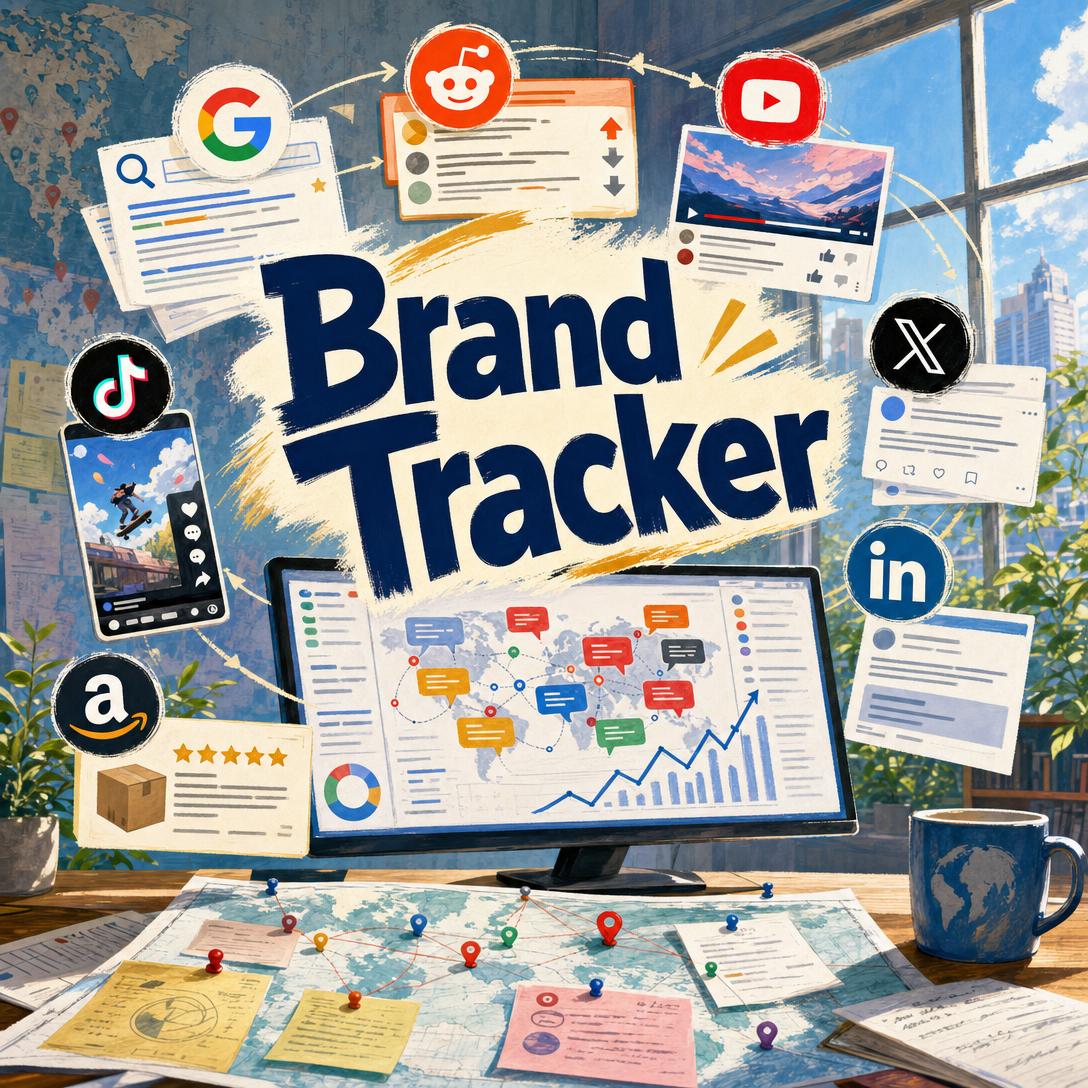
Brand Tracker helps you find and understand mentions of your brand, product, or company by searching Google, Reddit, YouTube, X, LinkedIn, TikTok, Amazon, and more — then delivering a structured report with source links. While conversations about your business now scatter across dozens of platforms in minutes, this AI analyst gathers what is being said, where it is happening, and how it compares with rivals.
- ✅ Multi-platform mention search with keyword variants, hashtags, and misspellings
- ✅ Summary tables plus platform-by-platform breakdowns with clickable sources
- ✅ Competitive tracking across multiple brands in a single session
- ✅ Optional sentiment reads, PDF/CSV/DOCX exports, and follow-up deep dives
Brand conversations no longer live in one press clip or one review site. They show up in Reddit threads, YouTube comments, Amazon listings, LinkedIn posts, and TikTok captions — often before your team hears about them. To understand why that gap is so costly, it helps to look at how reputation actually forms online today.
Quick Answer: What Is Brand Tracker?
Brand Tracker is a brand monitoring analyst that searches Google, Reddit, YouTube, X, LinkedIn, TikTok, and Amazon for mentions of your brand, product, or company. It returns a structured report with source links, not a raw dump of search results.
Key capabilities:
- Track one or several brands with confirmed keyword variants, hashtags, domains, and misspellings
- Search a chosen time window (last 24 hours up to one month) across selected platforms
- Lead with a mention summary table, then a platform-by-platform source list
- Compare share of conversation across competitors when you track two or more brands
- Optional sentiment assessment, visual mention checks, and exportable reports
Why Brand Mentions Slip Through the Cracks
A brand’s public reputation is not a soft metric. Research summarized by Brandwatch notes that a company’s public reputation can account for as much as 63% of its market value. At the same time, the audience doing the talking is enormous and fragmented.
65.7% of the world’s population — share of people who are active social media users, with a typical user visiting about 6.84 platforms each month
That fragmentation is why “I would have seen it” is no longer a monitoring strategy. 58% of consumers report discovering new businesses via social media, outperforming traditional search and even TV for brand discovery. Mentions are not only reputational — they are how people find you.
But assembling a complete picture is frustratingly difficult:
- Mentions hide behind misspellings, abbreviations, hashtags, and product nicknames
- Google Alerts miss most social conversation and return links without analysis
- Reddit, YouTube, X, LinkedIn, TikTok, and Amazon each require different search methods
- Common-word brand names (“Apple,” “Edge,” “Wave”) drown in unrelated noise
- By the time a complaint is escalated internally, the thread has already shaped search results
Social listening — monitoring and analyzing what people say about products and services online — exists specifically to close that gap. The market around it is expanding quickly: the social listening category is projected to grow from $9.61 billion in 2025 to $18.43 billion by 2030 (13.9% CAGR). Parallel estimates put the broader [media monitoring tools market at $5.5 billion in 2024](https://www.grandviewresearch.com/industry-analysis/media-monitoring-tools-market-report), with growth toward $12.0 billion by 2030.
Speed matters as much as coverage. Brands that respond to crises within 24 hours can reduce reputation damage by about 30%, and 79% of consumers expect a response within 24 hours. You cannot meet that clock if you only check one inbox.
This is exactly what Brand Tracker was built for.
Why Brand Tracker
Brand Tracker treats mention monitoring as an analyst workflow, not a keyword alert. You define what to track, which name variations to include, which platforms to search, and how far back to look. It then runs platform-specific searches, filters noise, and returns a report you can act on — summary first, sources second, every mention linked.
| Traditional Approach | Brand Tracker |
|---|---|
| Google Alerts for web pages and news only | Google plus Reddit, YouTube, X, LinkedIn, TikTok, and Amazon in one run |
| Manual tab-hopping and copy-paste into a spreadsheet | Summary table, then a platform-by-platform breakdown with source links |
| Missed hashtags, misspellings, and product nicknames | Guided keyword-variant strategy before any search runs |
| No view of competitors in the same window | Multi-brand comparative notes grounded in the same search |
| Alerts with no context | Optional sentiment reads, duplicate flags, and exportable reports |
Enterprise listening suites can cover huge source graphs, but they are priced and staffed for large comms teams. Founders, independent marketers, and lean PR shops still need the same questions answered: Who is talking, on which platform, and what should I do next?
Guided query design, not a blank search box
The first job is getting the query right. The analyst asks for the brand (or brands), then actively suggests variants — spacing and casing (OpenAI / Open AI), hashtags, domains, abbreviations, product sub-names, and likely misspellings. For common-word brands, it recommends contextual qualifiers so “Apple” does not return fruit recipes.
"Track Jenova and OpenAI. Variants for Jenova: Jenova AI, jenova.ai, #JenovaAI. Platforms: all. Time window: last 7 days."
Reports built for decisions
Results always lead with a mention-count table, then a detailed list. Platforms with zero hits are listed as “No mentions found” — that absence is useful data, not a failed search. Potential duplicates across Google and site-specific results are flagged. Every item includes a clickable source.
"Compare mention volume for PeakBrew vs. North Roast on Reddit, YouTube, and Amazon over the last 14 days, and give a brief sentiment read."
Competitive intelligence without a second tool
When two or more brands are in the same session, the analyst adds a short comparative note after the reports — which brand owns Reddit, which dominates YouTube, which is silent on X in that window. Observations stay tied to what the search actually found.
If you also need to turn those findings into channel plans, budget calls, or campaign sequencing, Marketing Strategist can take the mention landscape and translate it into media-mix and campaign decisions.
How It Works
Step 1: Name what you want to track Open a session and state the brand, product, or company — one target or several. You can add competitors in the same run so the comparison is apples-to-apples.
"I want to track GlowBar skincare and our competitor LunaSkin."
Step 2: Confirm keyword variants The analyst will not skip this step. It asks for hashtags, abbreviations, domains, alternate spellings, and misspellings, then suggests likely extras for you to accept or edit. Confirming variants is what separates a useful report from a noisy one.
"For GlowBar also include Glow Bar, glowbar.com, #GlowBar, and GlowBarSkin."
Step 3: Choose platforms and a time window Pick Google, Reddit, YouTube, X, LinkedIn, TikTok, Amazon — or all of them. Optional additions include GitHub (for developer brands), Google Scholar (for research mentions), and Google Images (for logos and visual reuse). Default window is the last 24 hours; the maximum is one month.
"Search all platforms for the last 7 days."
Step 4: Read the mention report You get a summary table first, then platform sections with titles, brief context, and source links. Empty platforms are called out. Site-search results for X, LinkedIn, and TikTok are labeled as such, because those networks limit what Google can crawl — coverage is discoverable mentions, not a claim of 100% capture.
Step 5: Follow one next step After the report, the analyst offers a single, relevant follow-up: a deeper Reddit pass, broader variants, a sentiment comparison, a Google Images sweep, or a PDF/CSV export you can send to stakeholders.
"Export this as a CSV and give a sentiment read for Reddit only."
Try Brand Tracker free — no credit card required.
Results & Use Cases
🚀 Product launch watch, week one
Scenario: A two-person SaaS team ships a public beta and needs to know whether anyone is talking — and whether the talk is about the product or a name collision.
Traditional Approach: Checking Twitter/X manually, setting a Google Alert, and hoping a friend forwards a Reddit thread. Easy to miss a GitHub issue or a YouTube roundup.
Brand Tracker: One 7-day, all-platform run with confirmed variants. The summary table shows where conversation actually lives; empty platforms tell you where awareness has not started yet.
- Catch first-week Reddit and YouTube mentions with source links
- Compare your name against a better-known rival in the same window
- Export a CSV for the Monday standup
If the report shows you are invisible in AI answers as well as social threads, GEO Growth Strategist can help you plan how to get cited in Google AI, ChatGPT, Perplexity, and Copilot — the other half of modern brand visibility.
🛡️ Reputation triage after a viral complaint
Scenario: A customer posts a sharp review that starts circulating. Leadership wants facts in under an hour: how far it spread, whether it jumped platforms, and whether the tone is isolated or a pattern.
Traditional Approach: Screenshots in a Slack thread, incomplete counts, and no link list for legal or support. Hours disappear before anyone has a source-of-truth report.
Brand Tracker: A last-24-hours search across selected platforms, with duplicates flagged and “no mentions” recorded where the post has not landed. Optional sentiment is scoped to the content actually found — not presented as a full market study.
- Responding quickly is associated with large reductions in reputational damage — Brandwatch cites figures up to 70% when issues are caught early
- Source links give support and comms the same packet
- A follow-up search the next morning shows whether volume is rising or fading
Listening only works if you act on it. Domino’s rebuilt product and trust after taking public criticism seriously; stock rose more than 200% within a year of that campaign. The lesson is operational: see the comments, then change something.
📱 Competitive scan from your phone
Scenario: You are at a conference, a rival just announced a feature, and you need a same-day read on Reddit, YouTube, and X — not a full enterprise dashboard.
Traditional Approach: Thumb-typing the brand into five apps, losing links, and emailing yourself a messy note.
Brand Tracker: On iOS or Android, same workflow as desktop. Set a 24-hour window, confirm variants (including the new feature name), and get the summary table before the next session starts.
- Full feature parity across web, iOS, and Android
- Speech-to-text if you would rather dictate the brief
- One tap to request a PDF you can forward from the hallway
When mention data points to a search-visibility problem — unranked brand queries, thin review coverage, or competitor pages owning your name — SEO Growth Strategist can diagnose technical, content, and AI-search issues in priority order.
📦 Marketplace and community proof for e-commerce
Scenario: A D2C brand needs to know whether Amazon reviews, Reddit recommendations, and YouTube “haul” videos are mentioning the product — or a knockoff using a similar name.
Traditional Approach: Spot-checking Amazon and searching Reddit once a month. Knockoffs and misspellings slip through.
Brand Tracker: Amazon plus Reddit, YouTube, and Google in one pass, with misspellings and hashtags included. Zero Amazon hits is a finding; a cluster of Reddit posts with no Amazon reviews is a different finding.
- Disambiguate lookalike names before you spend on ads
- Feed real phrases into listing copy and support macros
- Brands that use sentiment insights report about 15% higher customer retention in Sprinklr’s 2025 compilation — useful context when you decide to act on what you hear
FAQ
What is Brand Tracker used for?
Brand Tracker is used to discover and organize online mentions of a brand, product, or company. Typical jobs include launch monitoring, reputation checks, competitive share-of-conversation snapshots, and preparing a source-linked brief for marketing, support, or leadership. It searches the platforms you select and returns a summary table plus detailed, linked results.
Is Brand Tracker free?
Yes. You can use it on the free plan with core features and limited monthly usage. Paid tiers increase usage (Plus is $20/month for 30× free usage; higher tiers scale from there). No credit card is required to start. Usage resets monthly on your billing date, with the full allowance available from day one rather than as a daily drip.
How is Brand Tracker different from Google Alerts?
Google Alerts is useful for some news and web pages, but it will not catch most social conversation and provides no analytics. Brand Tracker runs a multi-platform search — including Reddit, YouTube, Amazon, and site-scoped passes for X, LinkedIn, and TikTok — then structures results with counts, source links, duplicate flags, and optional sentiment. It also walks you through keyword variants before searching, which Alerts does not.
Can Brand Tracker monitor my brand automatically every day?
Not as a background job. Searches run when you ask — including “search again” with the same settings. Scheduled alerts and webhook-style monitoring are not available. For many teams, an on-demand 24-hour or 7-day pass before a standup, after a launch, or during a spike is the practical cadence. If you need a file for others, you can request a PDF, DOCX, or CSV after the report.
Does Brand Tracker work on mobile?
Yes. Web, iOS, and Android share feature parity, including speech-to-text and synced settings. That matters when a mention spike hits outside office hours: 79% of consumers expect a response within 24 hours, and a phone-based search-plus-report is often the difference between a same-day reply and a missed thread.
How accurate is the coverage?
Accuracy depends on the platform. YouTube and Amazon are searched more directly; Reddit, X, LinkedIn, and TikTok are often reached via Google site-search, which captures only a fraction of those networks. Reports label that method so you do not treat discoverable mentions as a complete firehose. The analyst will not invent URLs or counts. “No mentions found” is reported as-is.
Conclusion
Brand talk is distributed, fast, and easy to miss — and it now affects discovery, trust, and market value at the same time. Manual tab-hopping and news-only alerts cannot keep up with six-plus platforms per user and a public that expects a response within a day.
Brand Tracker gives you an analyst-style mention report: confirmed variants, the platforms you care about, a summary table, and source links you can hand to a teammate. Use it after a launch, during a scare, or as a competitive snapshot before you spend.
Try Brand Tracker now, and explore more at Jenova.
For Developers: Brand Tracker is available programmatically via the Jenova API — integrate cross-platform brand mention monitoring into your application with a single API call. Full documentation →