Branching Narrative Generator: AI for Playable Choice Trees
2026-09-08
A branching narrative generator is how choice-driven stories stop living in a spreadsheet and start living as playable paths. Jenova gives narrative designers, indie RPG teams, and interactive-fiction authors a practical way to draft choice trees, variables, conditions, and reconverging scenes — then pressure-test whether those branches still feel like one story. In September 2026, writing a linear scene is cheap. Writing a graph that stays coherent after the player lies, spares someone, or picks the wrong weapon is still the expensive part.
✅ Map choices, flags, and reconvergence points before you write every line ✅ Keep agency tied to consequences, not decorative dialogue menus ✅ Draft Act 1 trees, visual novels, and CYOA pages in one workspace ✅ Review the same graph on web, iOS, and Android
To understand why this matters, let's examine the challenges facing branching-story teams today.
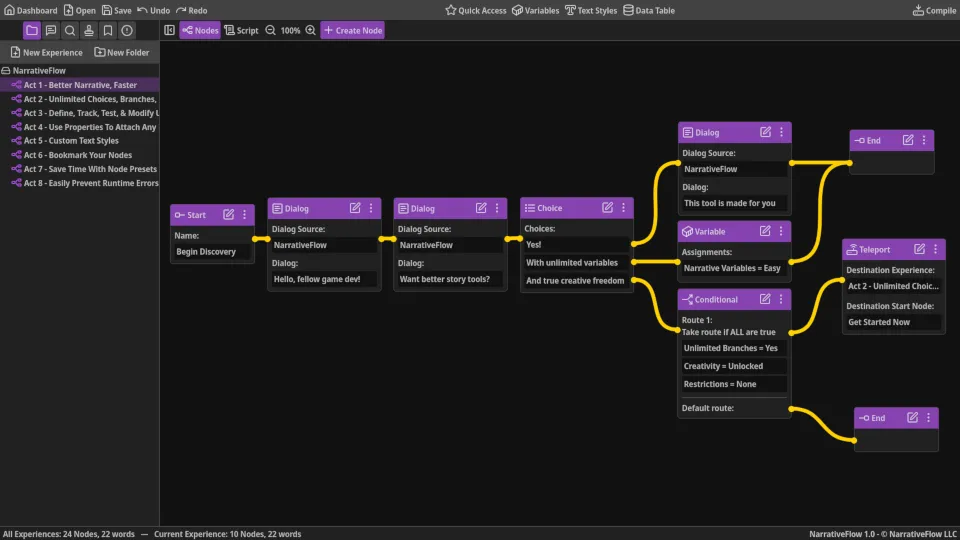
Quick Answer: What Is a Branching Narrative Generator?
A branching narrative generator is a workflow that turns a story premise into a playable choice graph — nodes, variables, conditions, and reconverging paths — instead of a single linear script. It exists to make player decisions authorable, testable, and shippable.
Key capabilities:
- Choice trees that split and reconverge instead of exploding into unfinishable endings
- State tracking — weapons, relationships, secrets, and “who lived” flags that later scenes can read
- Dialogue and scene drafts that respect those flags, not a generic plot summary
- Design notes a Game Designer Assistant can turn into systems docs, and a Film Screenwriter can turn into scene-level craft
Why Branching Stories Collapse Under Their Own Graph
Interactive narrative is not a nicer novel. Classic work in the field treats it as a branching graph of narrative elements, with decision points where the player’s action actually changes what comes next. That graph is the product. Microsoft Research’s GENEVA prototype exists for the same reason: dialogue-driven RPGs need powerful storytelling that can take years and a large creative team to write by hand.
The audience is real. Sensor Tower’s look at U.S. Android interactive-story titles in Q1 2024 still showed serious weekly engagement — GossipMaster finished the quarter at 211K in revenue and 118K weekly active users, while Love and Deepspace peaked at 243K in revenue earlier in the same window. Players will sit with choice-driven stories. They will not sit with a maze that forgets what they did.
But producing that graph with a linear outline is frustratingly difficult:
- Every binary fork multiplies content you cannot afford to write
- Menus look like agency while both options dump into the same scene
- Variables are invented in Act 1 and ignored in Act 2
- Branches never reconverge, so the project dies at “three more endings”
- Meaningful choices are guessed at, not designed
Combinatorial Explosion Kills the Draft
A clean two-option beat feels cheap until you stack it. The Six Ages team put the trap plainly: even two choices at each decision can balloon into a huge content load. That is not a motivation problem. It is a graph problem. Without planned reconvergence — return to Emberstone, return to the infirmary, return to the next day — a branching narrative generator is just a faster way to create unshippable sprawl.
Decorative Choices Teach Players to Stop Caring
Players notice when a “choice” does not change anything that matters. Research on interactive narrative has focused on what players perceive as interesting choices, not how many buttons you put on a line. A mercy kill, a lie to the patrol, and a rescue that brings an NPC home are interesting because they set flags. “Yes / Sure / Okay” is not a branch. It is a continue prompt with extra taps.
Variables Drift, Then Later Scenes Contradict Themselves
The Emberstone pattern is the production pattern: $EllaWeapon, $Felton, $Pond. If those flags are not named, set, and read, Act 2 cannot know whether Felton is ignored, dead, or in the infirmary. Teams then patch with narrator voice-over (“somehow he survived”) or they rewrite earlier nodes. Either way, the graph was never the source of truth.
Linear Writing Habits Starve the Player of Agency
Advice from working narrative-game threads is blunt: try not to go
. Branching work that starts as a film treatment tends to dump exposition, then bolt on a menu. A generator has to start from decision points, not from a monologue that happens to have options at the end.Years of Hand-Authored Graph Work Do Not Fit an Indie Schedule
AAA branching — the kind Witcher 3 narrative designers discuss as emotional, consequence-bearing choice — assumes a writers’ room. Indies and solo IF authors do not have that room. AI-assisted prototyping research keeps landing on the same operational win: test more story ideas in parallel and reach a playable prototype sooner. That only helps if the output is a graph with flags, not another linear synopsis.
This is exactly what Jenova was built for.
The Jenova Solution
Jenova does not ask you to keep the plot in Google Docs, the flags in a spreadsheet, and the “real” script in an engine. You describe the story constraints — who can die, which items persist, where branches must reconverge — and specialized agents draft the tree, the dialogue, and the design notes around those constraints. Multi-model access, persistent memory, and document attachments mean the Act 1 bible is still there when you generate Act 2.
| Traditional Approach | Jenova |
|---|---|
| Outline a linear plot, then bolt on choices | Start from a choice graph with named variables |
| Write every fork to a unique ending | Plan splits that reconverge on shared scenes |
| Flags live in the designer’s head | Flags are specified, set, and read in later beats |
| Separate tools for games, comics, and scripts | One workspace across design, prose, and sequential art |
| Desktop-only node editors for review | Full feature parity on web, iOS, and Android |
Game Systems and Interactive Fiction
Treat the tree as a system, not a novella. The Game Designer Assistant is built for that job: brainstorming, systems analysis, documentation, and genre-aware design so a scouting-party scene has items, patrol logic, and failure states — not just flavor text. Pair it with playable worlds that already run on choice. Civilization is a nation-scale sandbox where rivals keep moving. College Life lets social consequences emerge from what you actually did. The Mansion and Vesper Court are useful reference loops when you need room-by-room secrets or night-by-night state changes.
"Design Act 1 as a branching graph. Setting: Emberstone scouting party. Variables: $EllaWeapon (bow|sword), $Felton (ignored|dead|saved), $Pond (found|unknown). Three Felton outcomes must reconverge at Return to Emberstone. List nodes, conditions, and what each flag unlocks tomorrow."
Scripts, Pages, and Sequential Branches
Once the graph is honest, write the words that hang on it. Film Screenwriter handles structure, dialogue, and visual storytelling when a branch is cinematic rather than systemic. Microdrama Screenwriter is the right partner when the same fork has to work as a 60–100 episode vertical season with cliffhangers and paywall-aware pacing. For illustrated choice books and comics, Children's Book Creator keeps spreads readable, while Manga Creator, Comic Creator, and Webtoon Creator carry panel rhythm and style through forked pages.
"Write both patrol scenes: Ella lies to protect Felton, and Ella tells the truth. Each version must set $Felton and still dump into Return to Emberstone by nightfall. No duplicated ending — vary the infirmary beat, not the whole act."
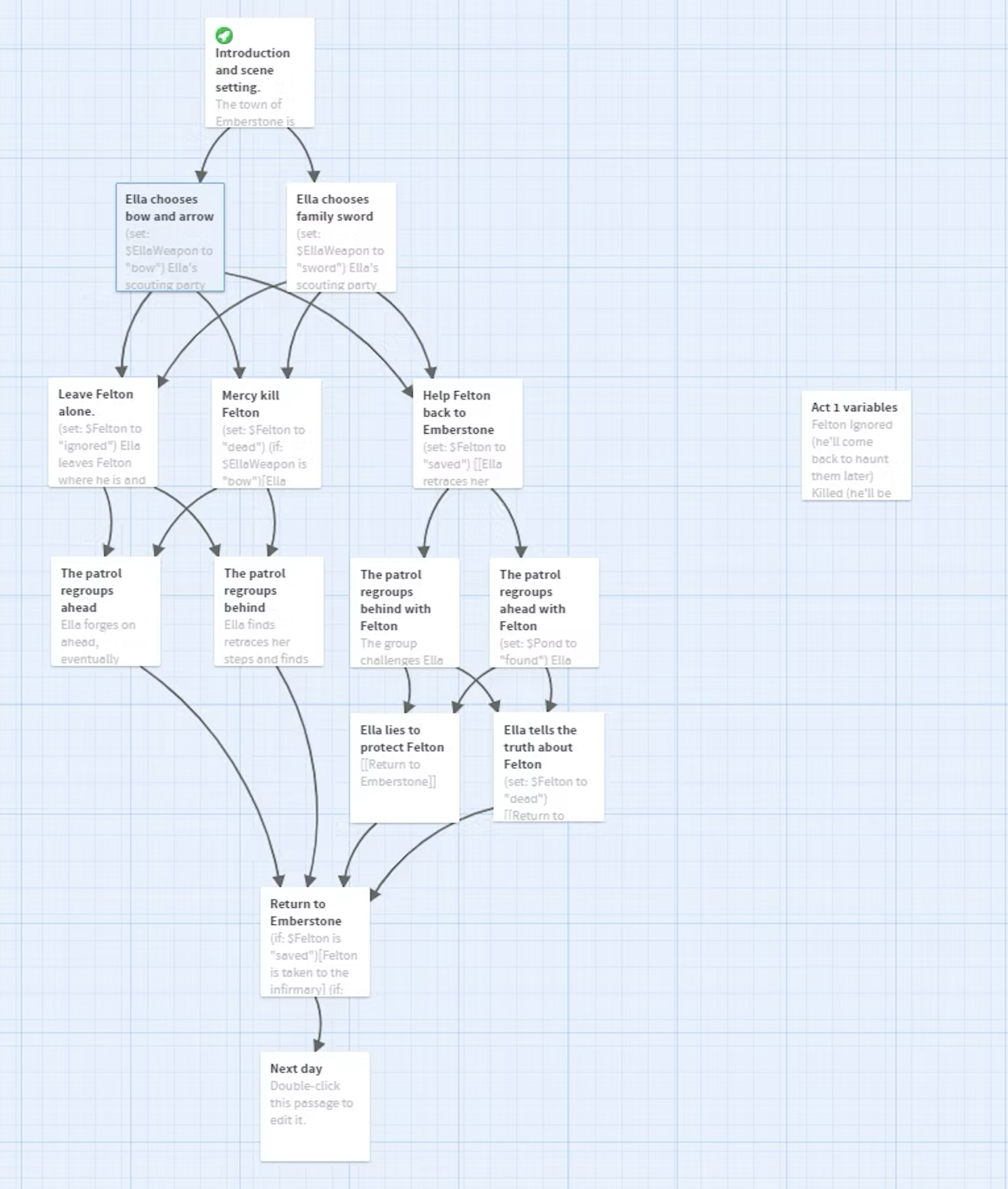
A healthy generator result looks like that Emberstone chart: early splits (bow vs. sword), morally expensive mid-act forks, then a bottleneck so tomorrow’s scene can still be written. That bottleneck is the feature. Infinite unique endings are how projects stall.
Authoring research is moving the same direction. Elsewise, an AI interactive-narrative study, found that better tools helped writers anticipate the story players actually experience (n=12). GENEVA’s pitch is a rich narrative graph with branching and reconverging storylines from a high-level brief. Jenova’s job is the production version of that idea: constraints in, playable tree out, adjacent agents for the format you ship.
Specialized AI Agents for Branching Narrative
A branching narrative generator is only useful if the rest of the pipeline can act on the graph. These agents cover the jobs teams actually run in the 30 days after they lock Act 1.
Game Designer Assistant
The Game Designer Assistant is the right place to turn a premise into systems: choice economy, fail states, item flags, and documentation a programmer can implement. It is a design partner across genres and platforms, which matters when your “story” is also a scouting loop with a patrol timer.
- Branch maps with named variables and reconvergence points
- Genre-aware notes so a visual novel and a party-based RPG do not share the same pacing
- Concept and documentation support so the graph survives contact with production
Film Screenwriter
Film Screenwriter is the craft layer: concept, outline, draft, and revision with professional attention to structure, dialogue, and visual storytelling. Use it when a branch needs a scene, not a tooltip.
- Scene-level drafts that honor locked flags
- Dialogue that makes the lie, the confession, and the silence feel different
- Revision passes when a reconverging beat has to carry two prior states
Microdrama Screenwriter
If the fork has to work on a phone, in short episodes, with a cliffhanger, Microdrama Screenwriter is built for that constraint — 60–100 episode seasons, paywall-aware structure, and hooks that still respect continuity.
- Episode maps where a choice changes the next hook, not just a line of VO
- Cliffhangers that do not orphan a flag you set three episodes ago
- Vertical pacing that still reads as one show
Children's Book Creator
Choice books for young readers fail when page 8 stars a different plot than page 1. The Children's Book Creator is a spread-by-spread studio for board books through chapter books, with consistent art and read-aloud text — the right container for a tightly reconverging CYOA, not an infinite ending simulator.
- Short, readable branches that still reconverge
- Page-turn structure parents can actually finish at bedtime
- Art-and-text pairing so the chosen path still looks like the same book
Manga Creator, Comic Creator, and Webtoon Creator
Sequential art makes fake branches obvious: the reader can see that both choices used the same panels. Manga Creator holds visual storytelling and style across one-shots and long runs. Comic Creator and Webtoon Creator extend that into Western issues and vertical-scroll color episodes.
- Panel plans for each fork, plus a shared reconverge page
- Style continuity so a “true” path does not look like a different series
- Episode hooks that pay off a prior choice instead of resetting it
Try Jenova free — no credit card required.
How It Works
Step 1: Lock the Constraints, Not the Prose Name the world, the decision budget, and the flags before you write speeches. Say what cannot happen (Felton cannot be both dead and in the infirmary). Say where the act must reconverge. Designers already know player agency has to sit inside a playable loop, not beside it.
"Act 1 constraints: two weapon choices, three Felton outcomes, one return-to-Emberstone bottleneck. Variables: $EllaWeapon, $Felton, $Pond. No unique Act 1 ending. Tomorrow’s scene must be writable from flags alone."
Step 2: Generate the Graph, Then the Lines Ask the Game Designer Assistant for nodes, conditions, and reconvergence first. Only then draft dialogue. Microsoft’s GENEVA work follows the same two-step instinct: generate the branching narrative, then render it as a graph. If you reverse that order, you will get beautiful scenes that cannot be wired.
"Output a node list: Start → weapon choice → Felton encounter → patrol regroup → lie or truth → Return to Emberstone. For each node, include set/if logic and the default route."
Step 3: Stress-Test Meaning, Not Word Count Play both sides of every menu. If both lines set the same flags and show the same next node, delete the menu. Keep the choices players would actually call interesting: who lives, who is lied for, what the town learns. Insert a decision before the scene turns into a speech.
"Audit this tree. Flag any choice that does not change a variable or the next node. Suggest one consequence for the lie path and one for the truth path that still reconverges tonight."
Step 4: Write Format-Specific Pages Only After the Graph Passes
Move the locked tree into Film Screenwriter, Microdrama Screenwriter, Children's Book Creator, or a sequential-art agent. Do not “fix continuity in the dialogue.” If a later page cannot read $Felton, return to the graph. AI story tools are already being used to make narratives respond to actions and preferences; that only works if actions were stored.
Step 5: Reuse the Same Flags in Adjacent Work Once Act 1 is honest, push the bible into quest copy, comic pages, or a vertical episode list without inventing a second continuity. Persistent memory on Jenova is there so the scouting-party flags are still available when you draft the infirmary scene a week later.
Results & Use Cases
📊 Indie RPG Act 1 With a Moral Bottleneck
- Scenario: A solo designer needs a scouting-party act: weapon choice, an injured NPC, a patrol, and a return to town that still leaves a playable next day.
- Traditional Approach: Write the “true” path. Sketch two side options. Discover in week three that the mercy-kill ending cannot share any remaining content. Two-choice explosion ends the prototype.
- Jenova: Lock flags, generate the graph, reconverge at Emberstone, then draft only the nodes the flags require.
- Weapon and NPC state persist into tomorrow
- Lie vs. truth changes the patrol beat without cloning the act
- A programmer can implement nodes from the variable list, not from vibes
💼 Choose-Your-Own-Adventure Picture Book
- Scenario: An author wants a 12–16 page book where a child picks a tool, helps or avoids a stranger, and still ends in a shared bedtime landing.
- Traditional Approach: Four printed endings, four illustration sets, a book that stores cannot shelve.
- Children's Book Creator after a tight reconverge: one landing spread, two or three mid-book forks, consistent art.
- Parents can finish the book in one sitting
- Branches stay short enough for read-aloud
- The “choice” still changes a page, not the entire print run
🎯 Vertical Microdrama With Paywall-Aware Forks
- Scenario: A writer is plotting a 80-episode mobile romance in which a secret can be confessed or buried, and that secret has to matter after the paywall.
- Traditional Approach: A linear season bible with “optional” detours nobody has time to film.
- Microdrama Screenwriter plus the locked flags: the confession changes the next cliffhanger; both paths still hit episode 20’s shared set piece.
- Hooks respect state instead of resetting it
- Episode math stays producible
- Film Screenwriter can deepen the confession scene without breaking the episode map
📱 Mobile Review Between Writing Sessions
- Scenario: You generate a new Felton subtree on a laptop, then need to reject a fake choice on the train.
- Traditional Approach: Screenshot a node graph, pinch-zoom, miss that both options set
$Feltonto the same value. - Jenova on iOS or Android: open the tree, check flags, send the fail notes back into the next prompt.
- Full feature parity across devices
- Graph review happens in the ten minutes you actually have
- No “I’ll audit branches later” folder of unplayable forks
FAQ
What is a branching narrative generator?
A branching narrative generator is a workflow that produces a playable choice graph — scenes, decisions, variables, conditions, and reconverging nodes — from a story brief. It is not a synonym for “AI writes a novel with menus.” The output should be something you can implement: a tree whose flags later scenes can read, closer to GENEVA’s narrative graph than to a single synopsis.
How do I generate a branching story with AI?
Lock constraints first: how many real decisions, which flags, where the act reconverges. Generate the node list, then the dialogue. Audit any menu that does not change state. On Jenova, that loop typically runs through the Game Designer Assistant for the graph and Film Screenwriter or a sequential-art agent for the lines. Keep interesting choices frequent — working advice is
, not a speech with a footer.Is Jenova free?
Yes. Jenova offers a free tier with core features and limited monthly usage, plus paid tiers if you need more volume. You can run a branching narrative generator pass — constraints, graph, and a first dialogue draft — without a credit card. Usage resets monthly on your billing date, with no daily caps.
How is this different from Twine, Ink, or a node editor?
Node editors are excellent implementation surfaces. They do not invent a coherent flag model or tell you which forks you cannot afford. Jenova specializes in the authoring pass before (and beside) those tools: systems notes, scene drafts, and reconvergence plans you can then build in an engine. Use the editor to wire nodes. Use the generator to stop wiring decorative ones.
Does a branching narrative generator work on mobile?
Yes. Jenova runs with full feature parity on web, iOS, and Android, including speech-to-text if you would rather dictate a flag list than type it. That matters when the real work is a five-minute audit of whether both patrol options still dump into the same beat.
Can it track variables and still reconverge the plot?
Yes — if you require that in the brief. Specify set/if logic ($Felton = saved) and a bottleneck scene every branch must hit. Reconvergence is how branching graphs stay writable. Infinite unique endings are how they are not.
Conclusion
Linear drafts hide the cost of agency. A branching narrative generator makes that cost visible: named flags, honest choices, and planned reconvergence so Act 2 is still possible. Jenova puts that graph next to the agents you need after it — Game Designer Assistant for systems, Film Screenwriter for scenes, Children's Book Creator and Manga Creator for pages that have to stay on one continuity.
If you are still writing the “true” path and promising to add branches later, stop outlining and start specifying. Lock the variables, generate the tree, kill the fake menus, then write only the nodes your players can actually reach.
For Developers: Every agent in this article is available programmatically via the Jenova API — integrate branching-narrative generation and choice-graph drafting into your application with a single API call. Full documentation →