Branching Narrative AI with State Memory: Stories That Remember
2026-09-17
Roleplay Game Master helps you run choice-driven stories that actually remember what happened — every alliance, betrayal, clue, and consequence stays in play. While most chatbots drop plot after a few thousand tokens, this AI keeps character consistency and world state intact so branches remain meaningful instead of decorative.
✅ Persistent state memory across sessions, not just a single chat window ✅ Character voices, motives, and relationships that stay consistent ✅ Choices that change later scenes instead of looping back to the same ending ✅ Open-ended play for tabletop campaigns, interactive fiction, and prototype narratives
As of September 2026, interactive stories are easier to start than they are to sustain. To understand why branching narrative AI with state memory matters, it helps to look at how most “your choices matter” experiences still collapse under their own plot.
Quick Answer: What Is Branching Narrative AI with State Memory?
Roleplay Game Master is a branching narrative AI with state memory that remembers every choice, character, and plot thread so stories stay consistent across sessions. It treats your campaign as a living world, not a one-shot prompt.
Key capabilities:
- Tracks story state — who knows what, who is allied, which doors already closed
- Holds character consistency so NPCs do not reset personality mid-arc
- Lets you fork a scene, replay a decision, or continue last week’s session
- Supports any setting: mystery, romance, horror, political intrigue, or original lore
Why Most Branching Stories Forget You
Interactive narrative research has long treated choice-and-consequence as the core of player agency: the ability to change what happens next, not merely click through a scripted reveal (Game Developer). Generative systems made that promise louder. Titles such as AI Dungeon and 1001 Nights showed how large language models can let player choices reshape a scene in real time.
But accessing that promise is still frustratingly difficult:
- Context windows fill up, and the “memory” of a betrayal evaporates
- Hand-authored trees explode combinatorially, so many games fake branches
- Characters drift: the stoic captain suddenly forgets your name
- Writers cannot test a fork without rebuilding the entire outline
Market research on branching narrative tools reports that branching experiences lift engagement by an average of 68% across gaming, education, and marketing. That lift only holds if the branch is real. When the story cannot remember state, players learn to ignore the fork.
78% of roleplay enthusiasts name memory as their biggest frustration with character chat — a direct hit to long-form branching play.
140+ AI-powered narrative titles launched in 2025 across mobile, PC, and console, which raised expectations for stories that adapt to the player.
Academic work on interactive storytelling treats engagement, causal consequence, and replay value as the measures that matter — not raw word count (MDPI: Story Forge). If a second playthrough cannot discover a new path, the branch was never a branch.
The combinatorial trap
Classic choose-your-own-adventure design multiplies scenes at every decision. A modest tree with three choices per node becomes unwriteable after a handful of scenes. Studios then prune aggressively, which is why so many “branching” games reconverge on the same climax. Designers have documented this as falsified player agency: the UI says a character liked your answer, then the plot continues unchanged.
The memory collapse in generative chat
LLM storytellers solve the writing-cost problem and create a new one. Without durable state, the model improvises a plausible next paragraph and quietly drops earlier facts. Third-party analysis of popular character-chat products notes forgetting after roughly 4,000 tokens. That is shorter than a single tabletop session.
Some platforms now add pinned story memory and auto-captured facts. That helps — until the pin list is full, a side character is dropped, or a new chat starts without copying context. Branching narrative AI with state memory has to treat plot flags as first-class data, not optional notes.
Inconsistent characters break the fork
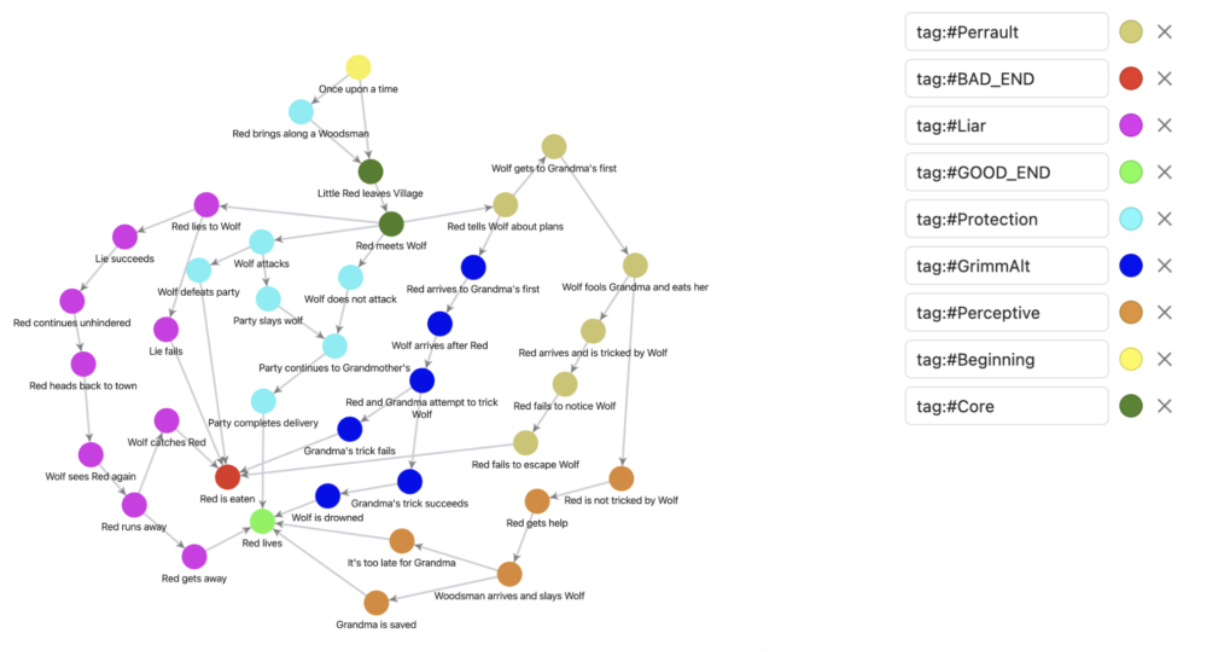
A branch only feels earned if the world reacts in character. If the wolf still trusts Red after she lied, the “Liar” path in a story graph is decoration. Game programs already experiment with dialogue that responds to player tone and prior choices. The missing piece for most players is an AI that keeps those reactions stable tomorrow.
This is exactly what Roleplay Game Master was built for.
Why Roleplay Game Master
Roleplay Game Master runs immersive, choice-driven play with unlimited memory and character consistency. You describe a world, take an action, and the story continues from the actual state you left — including secrets NPCs should not know and consequences they should not forget.
It is not a prompt trick layered on a generic chatbot. It is a dedicated game master for branching narrative: you get complete creative freedom over setting and tone, while the AI holds the ledger of what already happened.
| Traditional approach | Roleplay Game Master |
|---|---|
| Hand-written trees that reconverge | Open play where earlier choices stay in force |
| Chatbots that forget after a few scenes | Unlimited memory across the campaign |
| NPCs that reset personality | Character consistency as a default |
| “Your choice matters” pop-ups with no payoff | Later scenes that reference what you did |
| Restarting lore every session | Pick up mid-arc without recapping the bible |
State memory as a living story graph
Think of a fairy-tale map where “Red lies to Wolf,” “Wolf reaches Grandma first,” and “Woodsman arrives” are tagged nodes, not vibes. Good endings, bad endings, perceptive choices, and failed tricks are mutually exclusive flags. This branching narrative AI behaves like that graph in conversation: it keeps the active path, the closed paths, and the character tags that justify the next scene.
You do not have to maintain a wiki. You play. The state travels with the story.
Character consistency that makes branches costly
When an NPC remembers you hid the letter, they stop being a quest dispenser and become a person with a grudge. That is the difference between a menu of endings and a campaign. Roleplay Game Master is built so voices, relationships, and private knowledge do not drift when you change devices or return days later.
Creative freedom without losing the thread
You can drop a heist into a gothic court, convert a one-shot into a season, or rewind a single decision. The constraint is continuity, not genre. That combination — open scenario design plus durable state — is what most “AI dungeon” tools still fail to hold at once.
Example prompts that put memory to work:
"Continue my coastal campaign. Last session I framed the harbormaster; the crew thinks I am loyal. Do not remind me of facts my character would not know."
"Fork from the banquet: I refuse the duke’s toast. Show how the court treats me tomorrow, then offer three distinct next moves."
"Same characters, new branch. In this timeline I told the truth in the chapel. Keep personalities identical; change only what that confession would change."
Try the game master free — no credit card required.
Related Agents You'll Also Find Useful
If you are building or playing branching stories, these agents sit naturally beside a persistent game master.
The Mansion
If you want a ready-made mystery instead of a blank campaign bible, The Mansion drops you into a house with no memory of how you arrived. Every room hides secrets; every choice can be your last.
- Choice-driven exploration with high-stakes rooms
- Clue chains that punish careless reveals
- A compact way to feel branching narrative before you invent a world from scratch
Film Screenwriter
If you also need to design the branches — not only play them — Film Screenwriter works through concept, outline, draft, and revision with attention to structure, dialogue, and character.
- Map a main spine plus side lines before you roleplay them
- Pressure-test whether a choice is personal flavor or plot-changing
- Turn a messy campaign log into a coherent outline
Game Designer Assistant
If your end product is a game, not a private campaign, Game Designer Assistant helps with systems analysis, documentation, and genre-aware design so player agency is specified instead of implied.
- Document flags, fail states, and reconvergence points
- Stress-test whether a choice is readable to the player
- Translate a roleplay session into mechanics other people can ship
How It Works
Step 1: Open a session and name the world state
Start with setting, tone, and the facts that must never reset: who is alive, who is lying, which clocks are ticking. Specificity gives the AI a ledger to protect.
"You are the game master. Setting: 1920s Istanbul. I am a translator who already sold one secret to the British. The antiquities dealer does not know. Track that lie."
Step 2: Take an action, not a wish
Write what your character does. Ask for consequences, not a summary of every possible ending. Agency is clearer when the next beat is caused by you (player agency in narrative design).
"I slip the coded menu into the diplomat’s coat and stay to watch who notices. Narrate only what I can see."
Step 3: Let state accumulate — then fork on purpose
After a few scenes, force a branch. Request an alternate timeline or a delayed payoff so you can see whether earlier flags still fire. Research on AI-assisted interactive stories treats choice coverage and causal strength as success metrics; you can feel those metrics when a forgotten clue suddenly matters.
"Two weeks later, at the same café. If my lie still holds, the dealer offers me the map. If it does not, he has me followed."
Step 4: Resume without recapping the novel
Return on phone or desktop and continue. Mention the last concrete beat; do not paste a ten-page recap. State memory should carry relationships, inventory of secrets, and open threads.
"Pick up after the rooftop chase. I still have the torn photograph. The partner I abandoned is now working with the police."
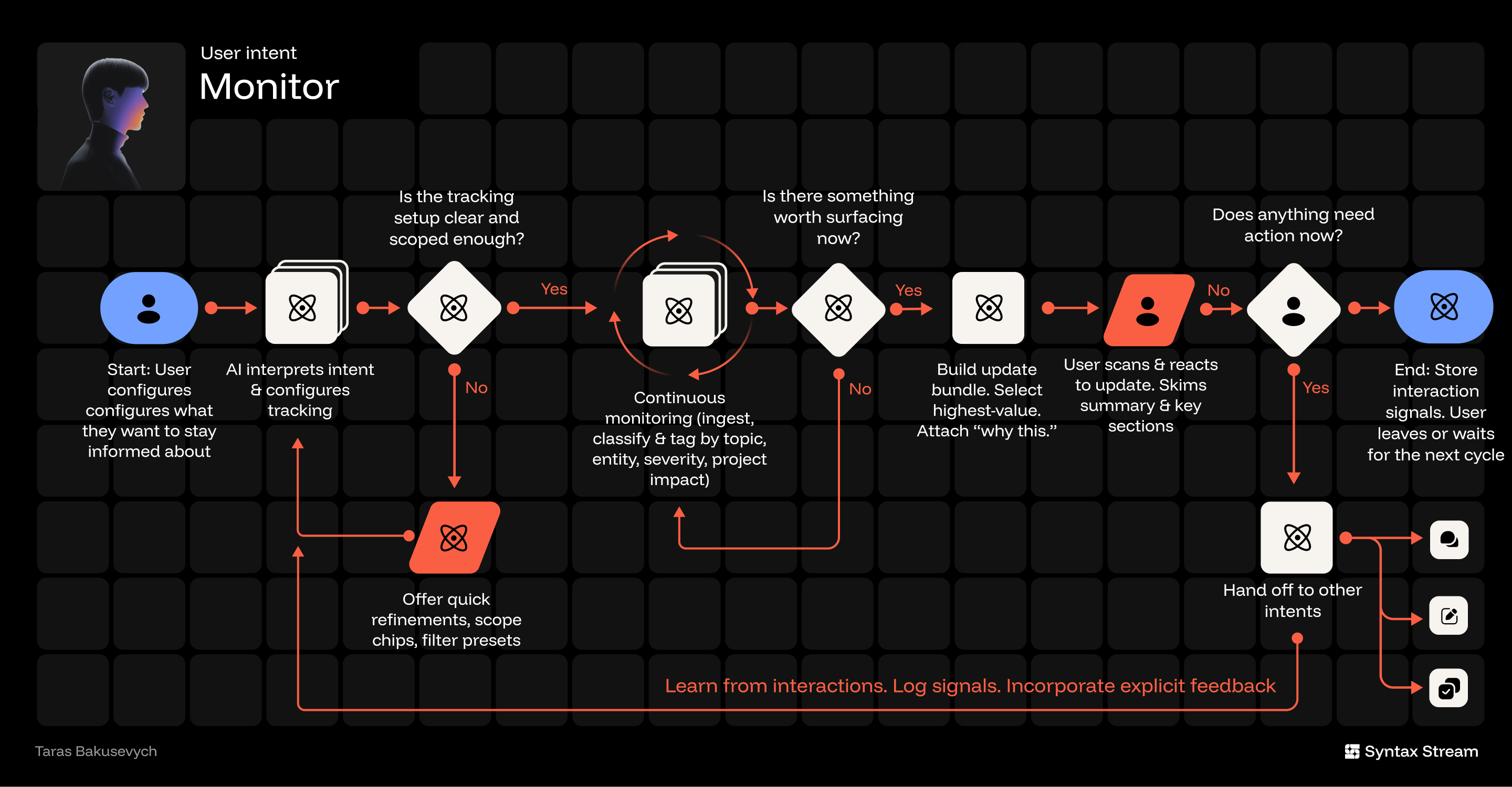
That loop — ingest what happened, tag entities and severity, decide whether something must surface now — is how durable narrative state should behave. A branching story is not a pile of paragraphs. It is a monitor on plot, character, and consequence, with a feedback path when you correct the record.
Results & Use Cases
🎲 Run a campaign that survives more than one night
Scenario: A weekly mystery with four recurring NPCs, two secret alliances, and a clock that expires in five in-fiction days.
Traditional approach: A human GM with notebooks, or a chatbot that forgets the alliance by scene four. You spend the first twenty minutes recapping.
Roleplay Game Master: The harbormaster still refuses to speak because you accused him last session. The clock is still ticking.
- No lore-wiki maintenance between sessions
- NPCs react to reputation, not to the latest prompt
- You can invite a friend later and brief them in-world instead of out-of-character
🎬 Prototype branches before you write the script
Scenario: You are outlining a film or game with three mutually exclusive midpoints.
Traditional approach: Duplicate the outline three times, then discover in draft three that midpoint B invalidates your antagonist.
Film Screenwriter plus playtests: Roleplay each midpoint for twenty minutes, then fold the surviving structure into a formal outline.
- Fail fast on false choices
- Keep character voice stable across forks
- Export only the branches that earned their ending
📱 Play a serious session on a commute
Scenario: You have twelve minutes on a train and a horror investigation in progress.
Traditional approach: Notes apps, lost threads, and a desktop-only tool that will not sync.
Roleplay Game Master on mobile: You send one voice-to-text action — “I open the east ward door without calling for backup” — and get a scene that still knows you already burned the patient files.
- Full play on iOS or Android, not a stripped chat toy
- State waits for the next stop; you do not restart
- Short sessions still move flags, so the evening session is further along
If you would rather be the investigator in a prepared space, The Mansion offers the same choice-and-memory pressure inside a single haunted building.
🧩 Specify player agency for a game pitch
Scenario: You need a one-pager that proves choices are not cosmetic.
Traditional approach: A flowchart that looks dense and a vertical slice that reconverges.
Game Designer Assistant: Turn a live roleplay log into flags, fail states, and readable choice grammar other stakeholders can argue with.
- Separate flavor choices from plot-changing ones
- Document what the AI remembered so a human team can implement it
- Show replay value with two actual transcripts, not a slide that says “multiple endings”
FAQ
What is branching narrative AI with state memory?
It is an AI storyteller that stores plot flags, character knowledge, and relationship state so later scenes change because of earlier actions. Unlike a one-shot generator, it can continue a campaign, fork a timeline, and refuse to “forget” a lie your character told. Roleplay Game Master is built for that persistent, choice-driven play.
How is Roleplay Game Master different from a general chatbot?
A general chatbot optimizes for the next plausible paragraph. A game master has to optimize for continuity: who knows the secret, which doors are closed, and whether an NPC would still trust you. Platforms that add pinned memories and auto-captured facts still treat memory as a limited add-on. This agent treats unlimited memory and character consistency as the product.
Does branching narrative AI with state memory work for game design, not just play?
Yes. Play a fork, then hand the surviving structure to Film Screenwriter or Game Designer Assistant to turn it into an outline or systems doc. You get evidence of player agency — two transcripts that diverge — instead of a promise on a slide.
Is Roleplay Game Master free?
You can start on a free plan with no credit card. Paid tiers increase usage if you run long campaigns or many concurrent worlds. Core play — branching scenes, persistent characters, mobile and web access — is available from the first session.
Will it remember a story if I switch from laptop to phone?
Yes. Sessions and memory sync, so a choice made on the train is still true at the desk. That is the practical test of state memory: the world does not reset when the device does.
Can it replace a human game master?
It can run a rich solo or small-group campaign and hold more continuity than most chat tools. A human GM still brings table social dynamics and custom minis. Use the AI when you need a world that never loses the notebook — then bring favorite scenes to a live table if you want.
Conclusion
Branching stories fail in two predictable ways: authors cannot afford the tree, and generators cannot afford to remember. Branching narrative AI with state memory attacks both. You get open-ended play without a combinatorial outline, and you get consequences that still exist next week.
Roleplay Game Master is the agent to use when the story must recall who lied, who lived, and which path you already burned. Start a world, take a real action, and see whether the next scene still knows your name.
Explore more at Jenova.
For Developers: Roleplay Game Master is available programmatically via the Jenova API — integrate branching narrative AI with state memory into your application with a single API call. Full documentation →