Best Roleplay AI for Deep Complex Plots: Persistent Story Arcs
2026-09-18
Roleplay Game Master helps you run multi-arc stories by holding unlimited memory and keeping every character consistent across sessions. While most chatbots drop plot threads, contradict canon, or flatten an ensemble into one voice, this AI provides a dedicated game master that tracks factions, secrets, and consequences for as long as you play. As of September 2026, companion-style chat is easy to find; sustained, novel-scale plotting is not.
- ✅ Unlimited conversation memory across sessions and devices
- ✅ Stable voices, motives, and secrets for large casts
- ✅ Complete creative freedom — any genre, structure, or intensity
- ✅ Full feature parity on web, iOS, and Android
To understand why this matters, it helps to look at what actually breaks when you try to run a deep plot with a generic chatbot — and what a purpose-built roleplay AI has to hold in mind that a short chat never will.
Quick Answer: What Is the Best Roleplay AI for Deep Complex Plots?
Roleplay Game Master is an AI game master that runs immersive roleplay with unlimited memory and character consistency so you can sustain deep, complex plots across sessions. It is built for campaigns, not one-off chats.
Key capabilities:
- Persistent memory of canon, inventory, injuries, and unpaid debts
- Ensemble NPCs who stay in character instead of blending together
- Room for political webs, mystery clocks, and delayed payoffs
- Creative freedom to continue a scene, recap only what your character knows, or refuse to resolve a twist until you act
The Problem With Most Roleplay AI on Complex Plots
People are not short on places to talk to a character. Dedicated companion apps have been downloaded 220 million times and had already driven $221 million**](https://techcrunch.com/2025/08/12/ai-companion-apps-on-track-to-pull-in-120m-in-2025/) in consumer spending by mid-2025, with first-half downloads up 88% year over year. Broader market estimates put the [AI companion category at **$36.8 billion in 2025, with other firms citing a similar $37.73 billion starting point.
That growth is real. It is also mostly optimized for a different job: a single persona, a short scene, a companion who feels present right now. Deep plots ask for something harder — a story that still makes sense in session 14.
But accessing that kind of continuity is frustratingly difficult:
- Context windows fill, and earlier canon evaporates
- Named characters drift in voice, knowledge, or allegiance
- Factions, timelines, and secrets are not first-class objects
- Long-form generation quality collapses just when the plot gets interesting
- You end up GMing the GM — pasting recaps, correcting continuity, restarting threads
Research on long-output models is blunt about the gap. Context windows have grown, but generating coherent text beyond roughly 4,000 tokens (about 2,600 words) is still where quality and consistency tend to break. Novel writing, long-term planning, and multi-step reasoning all require the model to integrate earlier output, not merely read a long prompt. Independent work on consistency bugs in long story generation finds those errors are not rare edge cases; they cluster in exactly the places a complex plot lives — identity, causality, and “who knows what.”
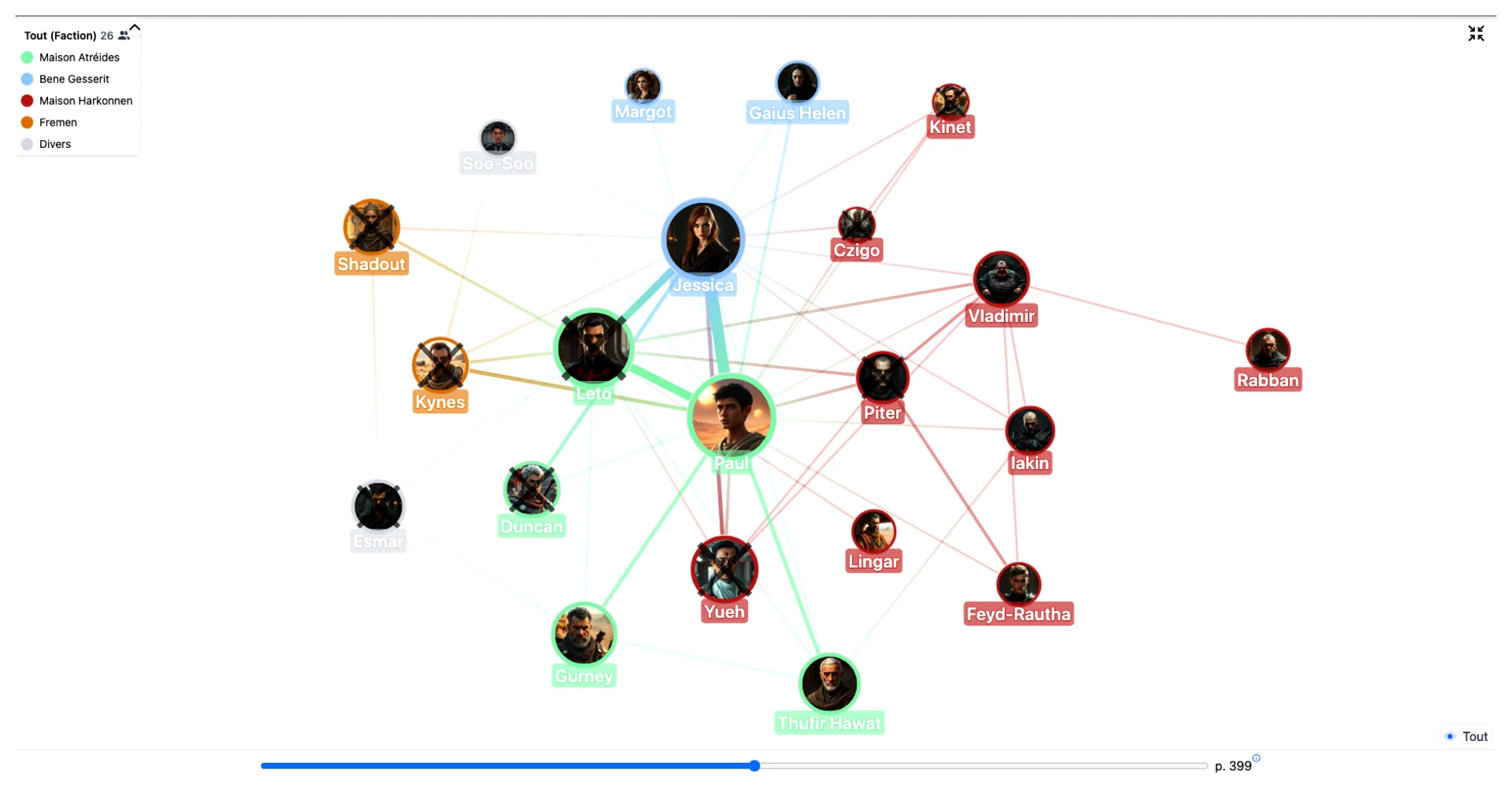
A serious plot looks like that graph: hubs, rival houses, delayed betrayals, people who should not share information. A chatbot that only remembers the last few messages cannot run it. App Store data even hints at the mismatch in product design — 17% of active companion apps put “girlfriend” in the name, versus 4% for “boyfriend” or “fantasy.” Romance chat is a valid use. It is not a political epic, a boxed-set mystery, or a tabletop campaign with four players and a ledger of debts.
This is exactly what Roleplay Game Master was built for.
Why Roleplay Game Master
Roleplay Game Master is a standalone AI game master: immersive roleplay, unlimited memory, and character consistency, with complete creative freedom to explore the scenario you actually want — not a shortened version that fits a disposable chat.
It does not ask you to paste a campaign bible every session. It does not collapse three rival NPCs into one agreeable narrator. It treats the story as a long-running object: who is allied with whom, which lie is still intact, what your character has not been told.
| Traditional Approach | Roleplay Game Master |
|---|---|
| Recap dumping when the thread gets long | Unlimited memory across sessions |
| NPCs blend into one helpful voice | Distinct motives, diction, and secrets |
| Twists resolve because the model “wants to be useful” | Payoffs wait until you act |
| Companion chat optimized for a single persona | Ensemble plots, factions, and clocks |
| Quality drop after a few thousand tokens of story | Built for campaigns that span nights and weeks |
| Restart or fork when continuity fails | Continue the same canon on web or phone |
Unlimited memory as plot infrastructure
Deep plots fail in the gaps. A spy recruited in session three has to still be compromised in session twelve. A wound, a rumor, a misplaced letter — those are load-bearing. Persistent memory means you can play in scenes instead of administering a wiki. You ask for a banquet; the AI already knows who is in the room and which toast is a trap.
Character consistency for ensembles
Complex stories are social machines. The heir, the priestess, the double agent, and the court fool cannot share a personality. This AI keeps voice, knowledge, and loyalty separate so dramatic irony still works: you can know more than your character, and an NPC can know more than you.
Plot architecture, not just replies
Factions, clocks, and consequences are how intrigue feels earned. You can instruct the game master to recap only what your character knows, to refuse a reveal, or to advance a B-plot without breaking A-plot continuity. That is the difference between a chatbot that roleplays and a GM that can carry a season.
Creative freedom without a canned setting
There is no required system, rating, or genre. Political SF, slow-burn mystery, collaborative tabletop, romance-with-stakes, historical court drama — you define the table. The job of the AI is to stay inside that table.
Example prompts that actually test a deep-plot GM:
"You are running a political intrigue campaign with three houses, a religious order, and a native faction. I am the heir. This is session 12: the spy I recruited last month is about to be exposed at the banquet. Play every NPC in character. Do not resolve the reveal until I act."
"Continue our slow-burn mystery. Recap only what my character knows. The killer's identity stays hidden. Advance the B-plot with the estranged sibling without breaking continuity from sessions 1–8."
"Run a four-player tabletop session. I will speak for the party. Track inventory, injuries, faction standing, and unpaid debts. If I contradict established canon, correct me in-world."
While Character.AI and Replika are built around talking to a persona — and still draw large companion audiences — this game master is built around keeping a story honest over time. Companion chat can be excellent at presence. Persistent-story roleplay has to be excellent at continuity.
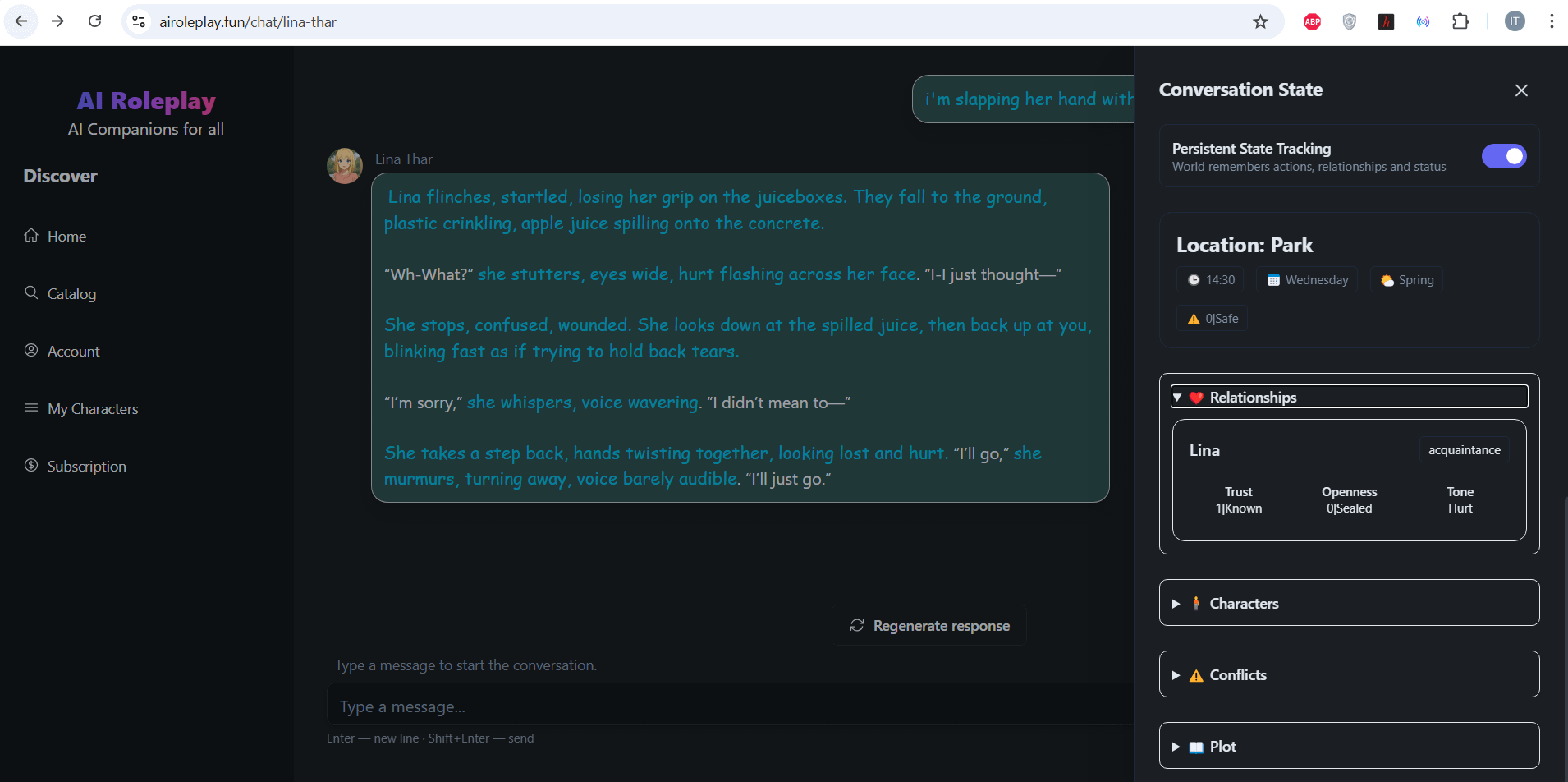
That kind of sidebar — location, relationship temperature, open conflicts, plot flags — is what complex scenes need under the prose. The visible text is the scene. The state is why the next scene still counts.
Related Agents You'll Also Find Useful
If you are building stories this dense, you will often want a second pass that is not live play.
If you are turning sessions into a manuscript, Creative Fiction Writer can take the same world and produce researched, editor-grade prose — from messy session notes to a chapter that still respects your canon.
- World research that keeps cultures and logistics plausible
- Editorial pressure on pacing, viewpoint, and prose
- A path from improvised play to a draft you can revise
If your campaign thinks in set pieces and dialogue, Film Screenwriter is the partner for structure: outlines, scene craft, and visual storytelling when a plot needs to work on the page as a script, not only at the table.
- Concept through revision, not just a first dump of dialogue
- Character and visual storytelling under professional craft rules
- Useful when a roleplay arc wants a pilot, a set-piece, or a tighter spine
If the story wants panels and a locked visual tone, Manga Creator can carry the same ensemble into sequential art — one-shots or long serials — without throwing away the character web you already earned in play.
- Panel flow and style consistency across long page counts
- Visual storytelling for casts that already have history
- A way to publish the campaign as a comic-form epic
Try Roleplay Game Master free — no credit card required.
How It Works
Step 1: Open a campaign, not a small talk thread Start by naming the story you want to inhabit. State genre, tone, what is off-limits, and whether you want a collaborative GM, a hostile world, or a mystery that is allowed to stay unsolved. Specificity here is canon, not flavor text.
"Hard-magic court drama. I play a disgraced archivist. You GM all NPCs. Magic has a public law and a secret law. Never tell me the secret law unless my character earns it."
Step 2: Install the cast and the graph Name the factions, the load-bearing relationships, and the clocks. A complex plot needs more than a protagonist: it needs people who will not all want the same ending. Ask the AI game master to treat secrets as hidden until they leak in play.
"Here is the house map: three heirs, one chaplain who spies for the church, one captain who loves the wrong sibling. Track loyalty. Do not omniscient-narrate private meetings I did not attend."
Step 3: Play in scenes, then stop on a decision Stay in character. Ask for sensory blocking, NPC action, and consequences — then make a move. Good sessions end on a choice, not a summary. If the model jumps to resolution, pull it back: the reveal waits.
"Stay in the kitchen scene. The messenger is lying. Interrogate through small talk. Do not skip to the arrest."
Step 4: Demand continuity instead of recaps On the next session, do not paste a novel of notes unless you enjoy it. Ask what your character remembers, what the world has done overnight, and which clocks ticked. Memory is the product. Use it.
"It's three days later. I don't know about the dock fire unless someone told me. Who would tell me, and why would they twist it?"
Step 5: Continue on another device, or graduate the story The same campaign should survive a commute. When an arc wants a different form — chapters, a screenplay, pages — hand the established canon to a writing partner rather than starting the world over.
Results & Use Cases
📊 Multi-Faction Political Epic
Scenario: You want a desert-world succession crisis with five factions, arranged marriages, and a religious order that is playing both sides — the kind of web that only makes sense as a graph.
Traditional Approach: A generic chatbot forgets who hates whom by scene four, or has the high priestess suddenly confess because honesty is “helpful.” You spend more time correcting canon than playing it.
Roleplay Game Master: You get NPCs who keep their own ledgers. A banquet can be a trap without the GM spoiling the mechanism. Alliances shift because someone did something two sessions ago.
- Ensemble voices stay separate
- Secrets can remain secrets
- Delayed payoffs still land
💼 Novelist Stress-Testing a Plot Before Drafting
Scenario: You have a 90,000-word outline and a fear that the midpoint betrayal is obvious. You roleplay the victim, then the betrayer, then a side character who should not know.
Traditional Approach: You discover the hole only after writing 40,000 words, or you outline in a vacuum and never feel the scene.
Creative Fiction Writer path: Live-play the weak chapters with the game master, then send the surviving canon to Creative Fiction Writer for prose, research, and editorial structure. Optionally run the same spine through Film Screenwriter if the story wants act breaks and set pieces instead of chapters.
- Find logic holes in play, not in copy-edits
- Keep improvisation and manuscript in the same universe
- Spend drafting energy on pages that already work
📱 Continue the Campaign on a Phone Between Sessions
Scenario: Your in-person group meets every other week. On the train, you want a private scene: the rogue talks to a contact the table has not met yet.
Traditional Approach: A separate app, a lost thread, or a note that never becomes play. Continuity dies in the gap between Tuesdays.
Roleplay Game Master: Same campaign, same debts, same injuries — on iOS or Android with the same memory. You come back to the table with a scene that actually happened in-world, not a recap you invented.
- No “phone version” of the plot
- Side scenes can be canon
- Useful for solo play and between-session texture
🎯 Long Mystery With Unreliable NPCs
Scenario: A closed-circle mystery where three witnesses are lying for different reasons and the killer’s identity must not leak through narrator helpfulness.
Traditional Approach: The model over-explains, or it forgets a clue you planted and invents a new murderer.
The dedicated game master: You can require “recap only what I know,” keep the solution stable, and still let social scenes move. Clues accrue. People stay wrong on purpose.
- Dramatic irony without spoilers
- Clue discipline across sessions
- Liars who remember their own lies
FAQ
What is the best roleplay AI for deep complex plots?
For long campaigns with ensembles, secrets, and delayed payoffs, a dedicated game master with unlimited memory beats a companion chatbot. Roleplay Game Master is built for that job: immersive roleplay, character consistency, and the freedom to run the scenario you actually designed. Short character chat can still be enjoyable; it is the wrong architecture for a story that has to remain true in week six.
Is Roleplay Game Master free?
Yes. You can start on a free tier with core features and limited usage — no credit card required. Paid tiers raise usage if you run long, daily campaigns. Pricing is usage-based rather than a paywall in front of the GM itself, so you can test whether the memory and consistency hold on your plot before you commit.
How is this different from Character.AI or other companion apps?
Companion products optimize for talking to a persona. That matches a large market — hundreds of millions of downloads and a category measured in tens of billions of dollars. A deep-plot GM optimizes for canon: who knows what, which clock ticked, whether the spy is still yours. Use a companion when you want a single presence. Use this when the story has a map.
Can it handle multiple NPCs and campaigns that last weeks?
That is the design center. Ask it to play every NPC in character, to refuse omniscient spoilers, and to track inventory, injuries, and standing. Research on long-form story generation shows why this is non-trivial for generic models; you want an agent whose job is continuity, not a one-shot completion.
Does it work on mobile?
Yes. Play on the web or continue the same campaign on iOS and Android. Speech-to-text is available if you would rather talk a scene on a walk than type it. Settings and memory are meant to follow the story, not the device.
Will it remember details from earlier sessions?
Unlimited chat history and persistent memory are the point. You should be able to return days later and ask what your character would know — not what the last message contained. If a fact was established, treat a contradiction as a bug in the scene and correct it in-world; a good GM can absorb that without collapsing the arc. When you later want chapters or pages, agents such as Manga Creator can inherit that same cast instead of reinventing it.
Conclusion
Most roleplay AI is good at a scene. Deep, complex plots are good at seasons: factions, unreliable people, clues that wait, and characters who do not all want you to win. Generic chat forgets, blends, and resolves too soon — a limitation that shows up in both product design and long-output research.
Roleplay Game Master is the best roleplay AI for deep complex plots when what you need is persistent story arcs, not a disposable persona. Set the table, install the graph, and play until the payoff is earned.
Try it now, then explore more at Jenova.
For Developers: Roleplay Game Master is available programmatically via the Jenova API — integrate persistent-memory roleplay and character-consistent plots into your application with a single API call. Full documentation →