Best Poe AI Alternative: Multi-Model AI Platforms for Power Users in 2026
2026-01-05
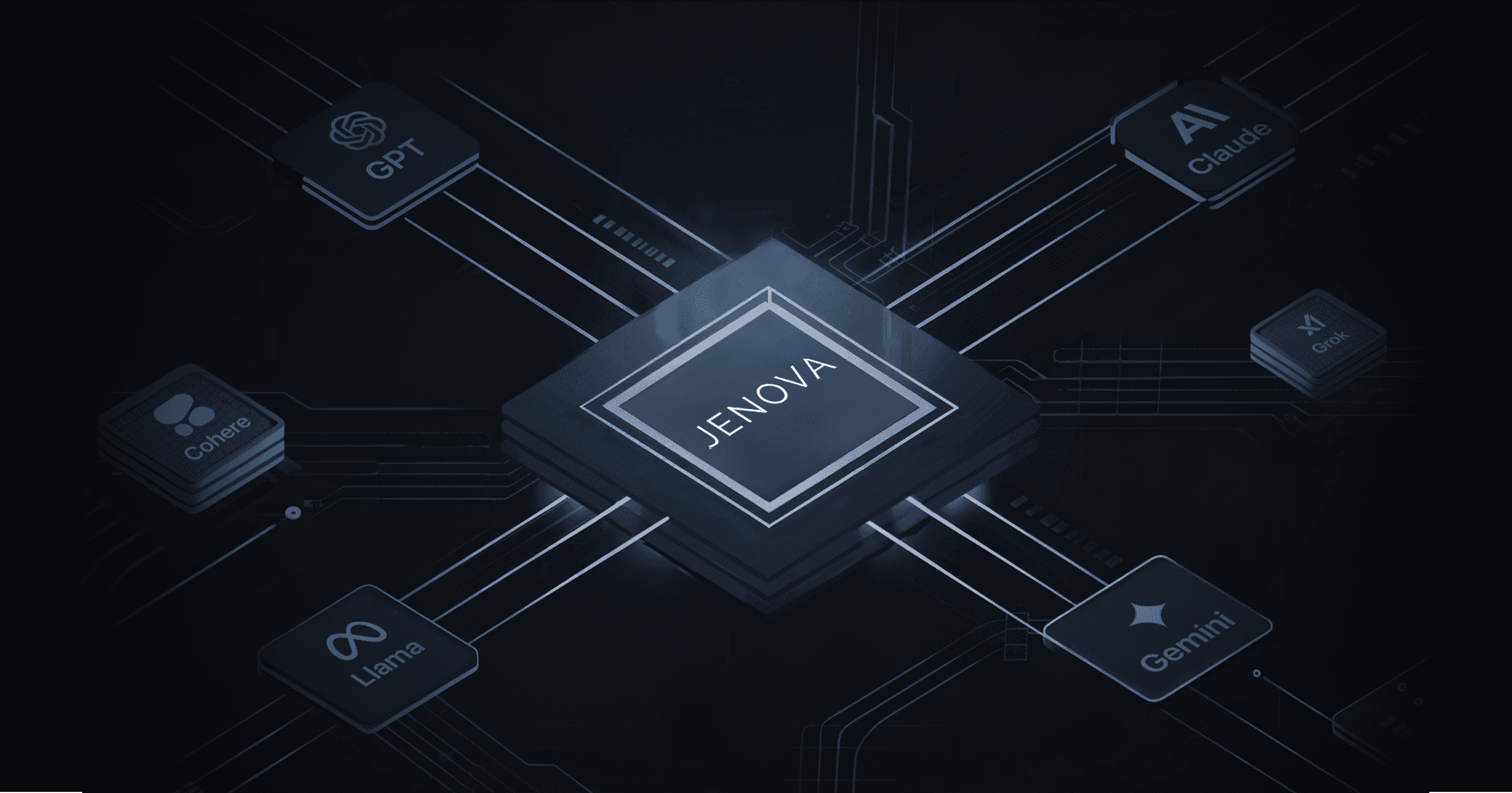
If you're searching for a Poe AI alternative that goes beyond basic model aggregation, you're not alone. While Poe pioneered the concept of accessing multiple AI models in one interface, power users in 2026 are discovering its limitations: compute point restrictions, lack of persistent memory, and minimal tool integrations that stop at conversation.
Jenova represents the next evolution—a multi-model AI platform that combines access to the latest models (GPT-5.2, Claude Opus 4.5, Gemini 3 Pro, Grok 4.1) with unlimited conversation memory, real app integrations via the Model Context Protocol (MCP), and a library of specialized AI agents built for actual productivity workflows.
This guide breaks down why users are switching, what to look for in an alternative, and how Jenova addresses the specific pain points that Poe users encounter.
Quick Answer: What Is the Best Poe AI Alternative?
Jenova is the most comprehensive Poe AI alternative for users who need more than model comparison. It offers:
- Latest frontier models: GPT-5.2, Claude Opus 4.5, Gemini 3 Pro, Grok 4.1—all accessible from one interface
- Unlimited persistent memory: Conversations and context preserved across sessions, eliminating "chatbot amnesia"
- Real app integrations: Connect Gmail, Google Calendar, Drive, Notion, and more via MCP
- Specialized AI agents: Pre-built experts for stock analysis, test prep, research, and dozens of other domains
- No compute point anxiety: Predictable subscription pricing without daily limits that reset mid-workflow
The Problem: Why Poe Users Are Looking for Alternatives
Poe, developed by Quora and launched in late 2022, brought a genuinely useful innovation to market: one interface for multiple AI models. But as the AI landscape has matured, its limitations have become more apparent.
Compute Point Restrictions Create Workflow Interruptions
Poe's pricing model revolves around "compute points"—a system where different models consume different amounts of your daily or monthly allocation. According to
, this creates significant friction:"1M compute points feels very limiting—it's less than 1000 messages when using Claude 3.5 with 200k context. I managed to exhaust the monthly limit within just one week."
For professionals using AI for sustained work—writing, research, coding, analysis—running out of points mid-project forces either waiting for the billing cycle to reset or upgrading to increasingly expensive tiers ($60-$300/month for heavy users).
No Persistent Memory Across Sessions
Every Poe conversation starts fresh. There's no mechanism for the AI to remember your preferences, past projects, or ongoing context. This means:
- Repeatedly explaining your role, industry, and preferences
- Re-uploading documents for every new conversation
- Losing valuable context when switching between models
- No continuity for long-term projects
Limited Tool Integration
While Poe excels at text-based conversations, it lacks meaningful connections to external tools. You can't:
- Send emails or manage your calendar through AI
- Search the web with real-time results in most conversations
- Generate and save documents to cloud storage
- Execute multi-step workflows that interact with your actual work tools
Model Lag Behind Frontier Releases
As a 2026 review from FreeRDPs notes, Poe's model offerings sometimes trail behind direct provider releases. When OpenAI releases GPT-5.2 or Anthropic launches Claude Opus 4.5, there can be delays before these models appear on Poe.
What to Look for in a Poe AI Alternative
Based on the pain points above, here's what separates adequate alternatives from genuinely superior ones:
| Feature | Why It Matters |
|---|---|
| Latest model access | Frontier models (GPT-5.2, Claude Opus 4.5, Gemini 3 Pro) offer significantly better reasoning and capabilities |
| Persistent memory | Eliminates repetitive context-setting; enables long-term projects |
| Tool integrations | Transforms AI from a chatbot into a productivity system |
| Predictable pricing | No compute anxiety; know exactly what you're paying |
| Specialized agents | Pre-configured experts save hours of prompt engineering |
| Cross-platform access | Seamless experience across web, iOS, and Android |
The Jenova Solution: Multi-Model AI with Real Productivity Features
Jenova addresses each limitation systematically while adding capabilities Poe doesn't offer.
Access to the Latest Frontier Models
Jenova provides unified access to:
- GPT-5.2 (OpenAI's latest)
- Claude Opus 4.5 (Anthropic's most capable model)
- Gemini 3 Pro (Google's flagship)
- Grok 4.1 (xAI's reasoning model)
- DeepSeek and other emerging models
Users can select specific models per conversation or use intelligent routing that automatically matches tasks to optimal models. No vendor lock-in, no waiting for model updates.
Unlimited Persistent Memory
Unlike Poe's session-based approach, Jenova maintains:
- Unlimited chat history: Every conversation preserved and searchable
- Cross-session memory: The AI remembers your preferences, projects, and context
- Knowledge base attachments: Upload documents that persist across all conversations
For users working on ongoing projects—whether that's a research thesis, a business strategy, or a creative writing project—this eliminates the constant re-explanation that makes Poe frustrating for sustained work.
Real App Integrations via MCP
The Model Context Protocol (MCP) enables Jenova to interact with your actual work tools:
- Gmail: Draft, send, and search emails
- Google Calendar: Schedule meetings, check availability
- Google Drive & Dropbox: Save and retrieve documents
- Notion: Update databases and pages
- Web Search: Real-time information retrieval
- Google Scholar: Academic research with citations
This transforms AI from a conversation partner into an actual assistant that can take action on your behalf.
Specialized AI Agents for Every Domain
Rather than starting with a blank prompt, Jenova offers a library of pre-built AI agents with deep domain expertise:
For Finance & Investing:
- Fundamental Stock Analyst: Equity research, earnings analysis, SEC filings
- Technical Stock Analyst: Price action, market structure, momentum indicators
- Options Strategist: Volatility analysis, position sizing, Greeks
For Education & Test Prep:
- SAT/ACT Tutor: Adaptive coaching with strategic guidance
- GMAT Tutor: Quant, Verbal, IR, and AWA preparation
- LSAT Tutor: Logical Reasoning, Logic Games, Reading Comprehension
For Research & Productivity:
- Academic Research Assistant: Literature discovery, manuscript preparation
- Personal Secretary: Calendar, email, travel, daily logistics
- Business Co-Pilot: Strategic planning, financial modeling, operations
For Creative Work:
- Creative Fiction Writer: Deep research, editorial insight, polished prose
- Marketing Visual Designer: Logos, campaign imagery, social media assets
Each agent comes with custom instructions, relevant tool connections, and domain-specific knowledge—saving hours of prompt engineering.
Comparison: Poe vs. Jenova
| Feature | Poe | Jenova |
|---|---|---|
| Latest models | GPT-4, Claude 3, Gemini 2.5 | GPT-5.2, Claude Opus 4.5, Gemini 3 Pro, Grok 4.1 |
| Pricing model | Compute points (daily/monthly limits) | Subscription tiers with predictable usage |
| Memory | Session-only | Unlimited persistent memory across sessions |
| Tool integrations | Limited | Gmail, Calendar, Drive, Notion, Search, Scholar, and more |
| Specialized agents | Community bots (variable quality) | Professionally-built domain experts |
| Custom agent creation | Basic prompt bots | Full customization with knowledge bases and tool selection |
| Mobile apps | iOS, Android | iOS, Android with full feature parity |
How Jenova Works: Step-by-Step
1. Choose Your Model or Agent
Start with the general Jenova interface and select your preferred model, or jump directly to a specialized agent for your task. The Fundamental Stock Analyst for investment research, the MCAT Tutor for medical school prep, or the Travel Planning Advisor for trip logistics.
2. Connect Your Apps
Click the "Apps" button to connect tools you want the AI to access. Gmail for email, Google Calendar for scheduling, Drive for document storage. Each connection uses MCP for secure, standardized integration.
3. Enable Global Memory (Optional)
Toggle Global Memory via the "Settings" button to allow the AI to remember important information across sessions. Your preferences, ongoing projects, and context persist automatically.
4. Work Naturally
Ask questions, request analysis, draft documents, schedule meetings. The AI handles multi-step workflows automatically—researching, drafting, and executing actions across connected apps.
5. Create Custom Agents
For recurring workflows, create your own AI agents with custom instructions, selected models, attached knowledge bases, and specific tool access. Share them with your team or keep them private.
Use Cases: Who Benefits Most from Switching
📊 Investors & Analysts
Traditional approach: Manually pull data from multiple sources, run calculations in spreadsheets, write analysis in separate documents.
With Jenova: The Fundamental Stock Analyst pulls SEC filings, analyzes earnings, calculates valuation metrics, and drafts investment memos—all in one conversation that remembers your portfolio and investment criteria.
📚 Students & Test-Takers
Traditional approach: Generic AI tutoring that forgets your progress, requires constant context-setting, can't track your improvement over time.
With Jenova: The GRE Tutor or CFA Tutor remembers your target score, tracks your strengths and weaknesses, adapts to your learning style, and can even schedule study sessions on your calendar.
💼 Business Professionals
Traditional approach: AI for drafting, separate tools for email, another system for scheduling, manual coordination between all of them.
With Jenova: The Business Co-Pilot handles strategic analysis while the Personal Secretary manages your inbox, schedules meetings, and coordinates travel—all with persistent context about your business and preferences.
📱 Mobile Users
Traditional approach: Poe's mobile app works, but lacks the integrations and memory that make desktop AI useful.
With Jenova: Full feature parity between desktop and mobile. The same agents, same memory, same tool integrations—whether you're at your desk or on your phone.
FAQ: Poe AI Alternative Questions
Is Jenova free to use?
Yes, Jenova offers a free tier with core features and limited daily usage. Paid plans start at $20/month for significantly expanded usage, custom model selection, and priority support.
Can I access GPT-5.2 and Claude Opus 4.5 on Jenova?
Yes. Jenova provides access to the latest frontier models from OpenAI (GPT-5.2), Anthropic (Claude Opus 4.5), Google (Gemini 3 Pro), and xAI (Grok 4.1), along with emerging models like DeepSeek.
How does Jenova's memory work compared to Poe?
Poe conversations are session-based—each new chat starts fresh. Jenova offers unlimited chat history plus optional Global Memory that persists important information across all sessions. The AI can remember your preferences, ongoing projects, and context without re-explanation.
What apps can Jenova connect to?
Via MCP, Jenova integrates with Gmail, Google Calendar, Google Drive, Dropbox, Notion, Google Search, Google Scholar, Google Maps, YouTube, Reddit, and more. Users can also add custom MCP servers for additional integrations.
Can I create my own AI agents on Jenova?
Yes. Click the "Agents" button to create custom AI agents with your own instructions, selected models, attached knowledge bases, and specific tool access. Agents can be kept private or shared.
Is my data private on Jenova?
Jenova does not use your data for model training. All data is encrypted in transit and at rest, and is never sold to advertisers.
Conclusion: Beyond Model Aggregation
Poe deserves credit for popularizing multi-model AI access. But as the AI market approaches $800 billion by 2030, user expectations have evolved beyond simple model comparison.
The 2026 AI user needs:
- The latest models, not last quarter's releases
- Persistent memory, not session amnesia
- Real tool integrations, not conversation-only interfaces
- Specialized expertise, not generic chatbots
- Predictable pricing, not compute point anxiety
Jenova delivers on each of these requirements while maintaining the multi-model flexibility that made Poe appealing in the first place. For users ready to move from AI chatbot to AI productivity system, it's the logical next step.
Explore the platform and specialized agents at www.jenova.ai.