Best AI Roleplay With Long Memory: Campaigns That Stay Canon
2026-09-15
Roleplay Game Master helps you run immersive campaigns that remember every scene, promise, and character—not just the last few messages. While most chat-based roleplay drops names, injuries, and plot threads as the window fills, this AI provides long-term recall so a story can pause for days and resume without a recap document.
✅ Unlimited memory across sessions, not a rolling transcript ✅ Character voice, secrets, and world rules that stay consistent ✅ Complete creative freedom—any genre, tone, or intensity ✅ Full play on web, iPhone, and Android with the same campaign
To understand why “best AI roleplay with long memory” is a different question than “best character library,” let’s look at what actually breaks immersion once a story lasts more than one sitting.
Quick Answer: What Is the Best AI Roleplay With Long Memory?
The best AI roleplay with long memory is a dedicated game master that stores scenes, characters, and choices so stories stay consistent across unlimited sessions. Token count is not the same thing as recall that survives a closed tab.
Key capabilities:
- Event-level memory of what happened, when, and to whom
- Persistent personas so a stoic captain does not become chatty overnight
- Cross-session continuity without pasting a campaign wiki
- Creative range that does not shrink to “keep it short so the AI can cope”
Why Most AI Roleplay Fails After the First Session
Demand for this category is not niche. A market scan of 110 AI companion platforms estimated 1.1–2.2 billion global monthly visits, and mixed-use companions—the products people return to for story, chat, and support in one place—drew users back about 16 times per month.
1.1–2.2 billion — Estimated global monthly visits to AI companion platforms
The AI roleplay chatbot market was valued at USD 2.24 billion in 2025, with forecasts pointing to rapid growth through the next decade. Broader conversational AI is projected to expand from $9.30 billion in 2026 to $32.45 billion by 2031. People are spending real time in these worlds. The product that cannot remember them wastes that time.
Independent session testing makes the failure mode measurable:
Turn 21 — Average Character AI reset point in standardized 40-turn memory tests
21% — Share of introduced details Character AI still correctly referenced at turn 40
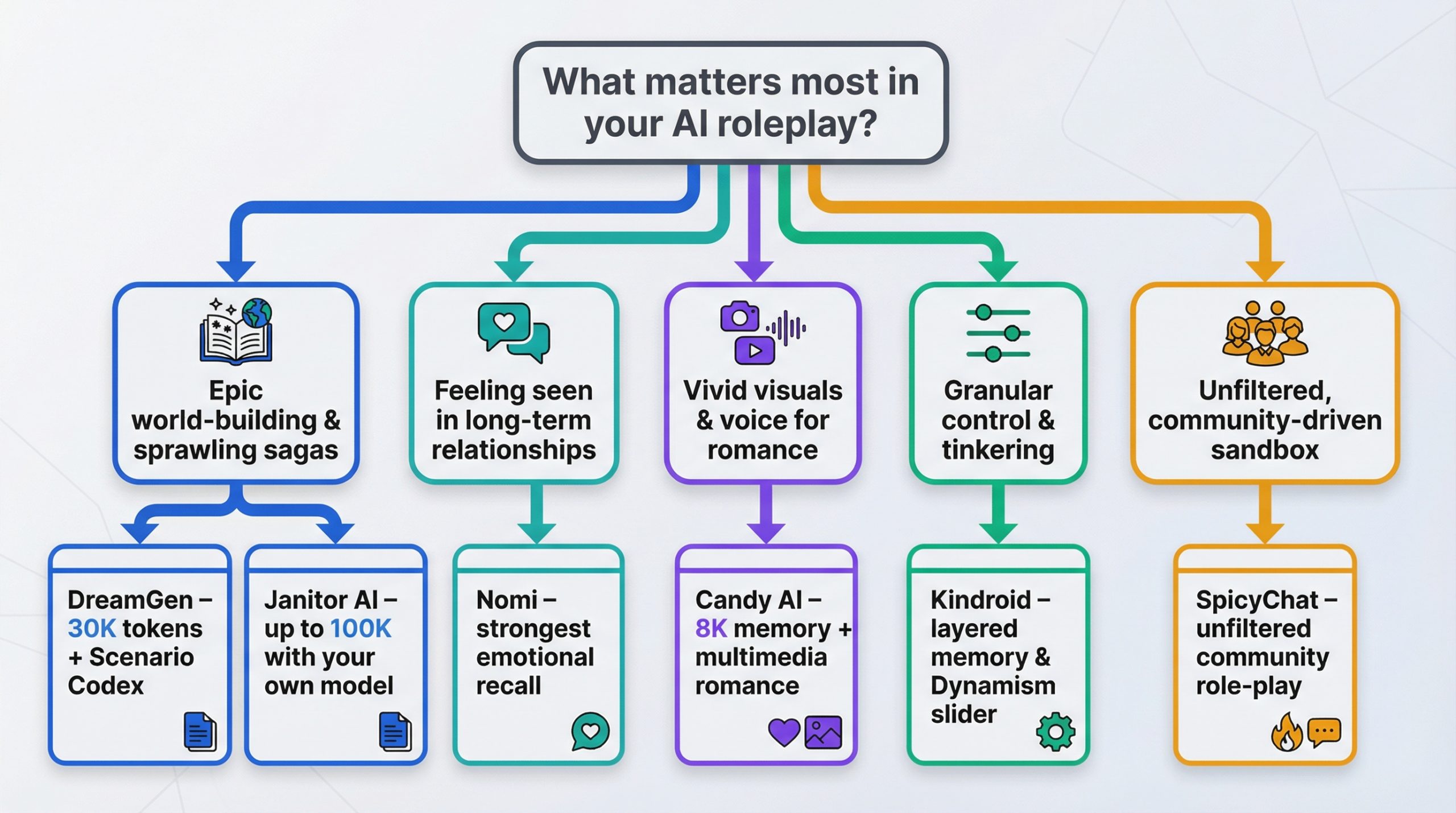
Roundups often sort tools by niche: huge context for sagas, emotional recall for companions, sliders for tinkerers, unfiltered sandboxes for community cards. Those are real preferences. They do not solve the shared problem. A 100K token window still forgets last month’s betrayal once the scene falls out of context. A romance bot with an 8K memory still treats you like a stranger after you close the app.
But getting durable, usable memory is frustratingly difficult:
- Context-window amnesia. Older scenes vanish. The AI invents a new version of a fight you already won.
- Character drift. Voice, morals, and knowledge of secrets slide as the prompt fills.
- Recap labor. You become the campaign wiki, briefing the model before every reply.
- One blob of “memory.” Events, lore, and style notes compete for the same retrieval slot, so the wrong layer surfaces.
This is exactly what Roleplay Game Master was built for.
Why Roleplay Game Master
Roleplay Game Master is a standalone AI game master with unlimited memory and strict character consistency. It does not ask you to manage a wiki, pick a token ceiling, or stay inside one sitting. It treats each scene as something that happened in a living campaign—then recalls it when you allude to a burned bridge, a stolen signet, or a slight from three nights ago.
| Traditional Approach | Roleplay Game Master |
|---|---|
| Rolling chat history that drops old scenes | Long-term recall of events, people, and outcomes |
| You paste recaps every session | Resume without a briefing document |
| Character voice drifts as context fills | Persistent personas, relationships, and world rules |
| “Memory” as one transcript blob | Story continuity instead of a recap ritual |
| Session dies when you close the tab | Same campaign on web or mobile |
While Character AI remains popular for quick, library-based chats, testing across 200+ sessions found it retained only 21% of details by turn 40. Large-context writing tools can hold more of a current scene. That is still a window. The best AI roleplay with long memory has to answer a harder question: does the story still exist after you leave?
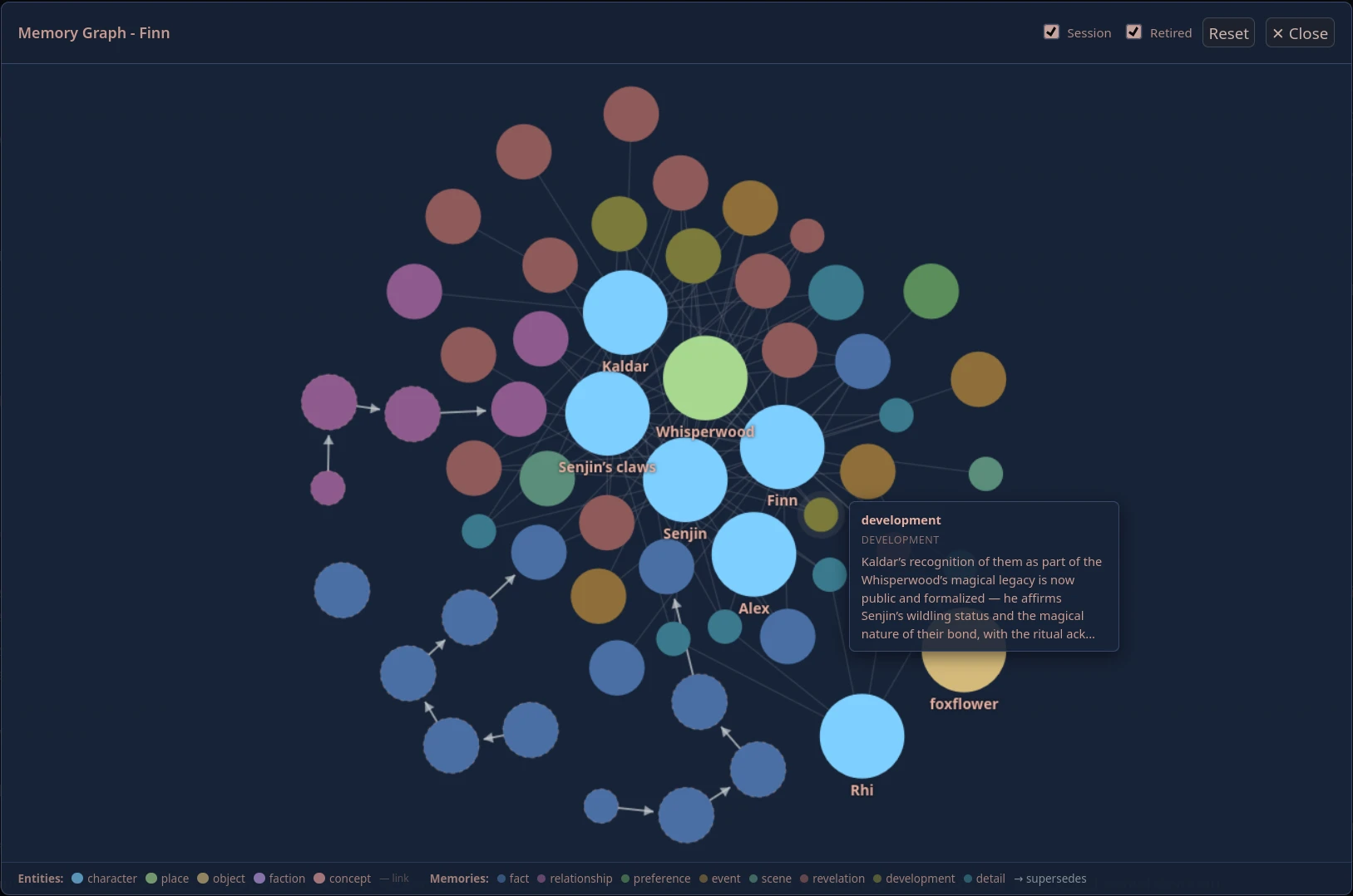
Long campaigns only stay coherent when memory is structured—characters, places, objects, factions, and the kind of memory (a fact, a relationship, a scene, a revelation). A graph of who owes whom, which forest is cursed, and which bond was made public is what “the AI remembered” should look like. A scrolling transcript is not that.
MIT Technology Review notes that collapsing every detail into one unstructured repository makes systems harder to govern and easier to confuse. Roleplay feels that failure as plot holes: a dietary aside becomes canon, a one-time lie becomes a personality, a secret leaks because everything lives in the same soup.
Event memory that can be retrieved, not reread
A confession, a duel, a bribe of river salt—these are episodes. When you walk into the capital market weeks later, the same guard should remember the salt and that you never spoke. You should not have to paste the basement scene.
Character consistency as a product, not a prompt trick
“Stay in character” in the system box does not survive forty turns of new prose. This AI game master is built so a mute envoy stays mute, a banned-magic city stays banned, and an NPC who saw you hide the relic does not suddenly forget.
Continuity without you becoming the archivist
The test of long memory is boring on purpose: close the session, come back later, refer to an object or slight, and see whether the story contradicts itself. If you need a notes doc to play, the tool is not doing the job.
Creative range that does not shrink with context
Because recall is handled, you do not have to keep scenes short. Any setting, any intensity, any branching choice is in scope. Try:
"I am a disgraced cartographer in a coastal city that banned maps after the last war. Start in the archive basement. I have a fake name, a burned left hand, and a debt to the harbormaster. Do not summarize—play the scene."
Or continue without a recap:
"Same campaign. I walk back into the tavern two weeks later, still wearing the signet I stole. How does Mara react before she speaks?"
Related Agents You'll Also Find Useful
If your roleplay is also a relationship sim, language practice, or a story you might publish, these sit next to the same workflow.
College Life
Open-world college stories only work if friendships, rivalries, and heartbreak accumulate. If you’re also running a campus saga, this agent lets social dynamics emerge from prior choices instead of restarting the semester every login.
- Emergent relationships driven by earlier scenes
- Romance, friendship, and fallout that persist
- Choice-driven plots without a fixed script
Love Island
If the “best” experience you want is romance with consequences, eight strangers on a private island only matter if last night’s rejection still stings. Memory is the difference between a dating sim and a reset button.
- Open-world romance with emergent social dynamics
- Connections and rejections that unfold from your choices
- Continuity so alliances do not evaporate overnight
Learn English Through Roleplay
If you want idioms and grammar to stick because the moment mattered, this agent turns every scene into practice. A shopkeeper you insulted last week should remember—or the lesson evaporates.
- Immersive scenarios at any intensity
- Vocabulary anchored to lived scenes
- Continuity so corrections do not wipe the fiction
Try Roleplay Game Master free — no credit card required.
How It Works
Step 1: Open a campaign and state what must never be forgotten Describe setting, tone, and the facts that are canon. The first message seeds both the living scene and the long memory you will need later.
"Dark political fantasy, no comedy. I play a mute envoy who communicates with ink. Magic is illegal. Begin at the border checkpoint at dusk."
Step 2: Play the scene, not the summary Speak in character and make choices. Each beat is a candidate memory: who acted, what changed, what was promised.
"I slide the forged papers across. If the guard notices the smudge, I do not run—I offer a bribe of river salt."
Step 3: Leave gaps on purpose Skip two weeks. Lie to an NPC. Keep a secret from the party. Long memory is what makes dramatic irony possible; a short window forces you to re-explain everything.
Step 4: Return without a recap Start a new session and refer to a night, object, or slight. Continuity is the test of the best AI roleplay with long memory.
"Weeks later. I meet that same guard in the capital market. He should remember the salt—and that I never spoke."
Step 5: Raise the stakes using what already happened Because prior events are stored, you can spend them: cash in a favor, get caught in a lie, or skip ahead. The AI game master should catch the irony you did not re-type.
Results & Use Cases
🎭 Weekly sandbox that does not reset on Monday
- Scenario: You run a campaign with three recurring NPCs, a stolen relic, and a political subplot planted in session one.
- Traditional Approach: A notes doc, a pasted recap, and an AI that still forgets who owns the relic.
- Roleplay Game Master: Chain of custody, the throne-room insult, and the NPC who saw you hide the relic remain available when you need them.
- Benefits:
- No recap ritual before play
- Secrets stay secret until they are revealed
- Weekly gaps do not flatten relationships
🏝️ Romance where last night still counts
- Scenario: You are building a slow-burn island or campus relationship and need jealousy, alliances, and private conversations to stack.
- Traditional Approach: Each login is a new meet-cute. The person who rejected you has no history with you.
- Love Island or College Life: Prior choices still shape who sits with you, who avoids you, and who remembers what you said off-camera.
- Benefits:
- Social dynamics that accumulate
- Payoff for patience instead of amnesia
- Roleplay that feels like a series, not a skit
📱 Late-night scene on your phone
- Scenario: You start a cyberpunk heist on desktop, then continue on the train.
- Traditional Approach: A new device means a new story, or a frantic copy-paste of the last scene.
- This AI game master: The same campaign, characters, and unfinished breach wait on iOS or Android.
- Benefits:
- Full play on mobile, not a stripped-down chat
- Speech-to-text for in-character lines when you cannot type
- No “where were we?” prompt required
🗣️ Language practice inside a plot that survives study blocks
- Scenario: You are learning English through a noir case and need the same partner, slang, and double-cross to persist.
- Traditional Approach: Each study block is a new scene. Vocabulary never attaches to a person you care about.
- Learn English Through Roleplay: The informant you burned last week is still burned—and the idioms from that fight come back in context.
- Benefits:
- Grammar practice inside a continuous plot
- Emotional stakes that make phrases memorable
- Corrections that do not break character
FAQ
What is the best AI roleplay with long memory?
The best option is one that stores particular story events—and who they happened to—so you can leave and return without a recap. A large context window helps the current scene. Long memory is what keeps last month’s promise, injury, and secret intact. Roleplay Game Master is built for that standard: unlimited memory, consistent characters, and campaigns that do not die when the tab closes.
Is Roleplay Game Master free?
Yes. You can use it on a free plan with all core features and limited usage, no credit card required. Paid tiers increase usage if you run long, daily campaigns. Usage resets on your billing date, with the full allowance available from the first day of the cycle.
How is long memory different from a big token limit?
Token limits describe how much of the live conversation the model can see at once. When the window fills, older turns fall off—even if the advertised limit is large. Long memory stores what matters and retrieves it later, including in a new session. Session tests that score detail retention at turn 20 and turn 40 exist because “didn’t contradict yet” is not the same as “still knows your name.”
Can it remember characters and plot across different days?
That is the point. Close the session, come back later, and refer to a promise, wound, or location from an earlier night. The AI should retrieve the episode rather than invent a substitute. If you also want language-learning roleplay with the same persistence, Learn English Through Roleplay uses lived-scene continuity rather than disposable drills.
Does AI roleplay with long memory work on mobile?
Yes. Play on the web, iPhone, or Android with the same campaign state. A common pattern is starting a scene at a desk and finishing a dialogue-heavy beat on the phone, including voice input when typing is inconvenient. Settings and history stay aligned across devices.
Is long-term roleplay memory private and accurate enough to trust?
No memory system is perfect, including human memory. Accuracy improves when events are stored as structured episodes instead of stuffing an entire transcript into one prompt. Researchers at the Center for Democracy & Technology argue that AI memory should be structured, purpose-limited, and user-visible—not an opaque mosaic of everything you ever typed. Jenova does not use your data to train public models; still, treat fiction as fiction, and restate a critical constraint if a plot point is load-bearing.
Conclusion
Most “best AI roleplay” lists sort by filters, art, or community cards. The criterion that decides whether a campaign is playable is long memory: whether characters remain themselves, whether secrets stay secret, and whether last week’s choice still has a cost.
Roleplay Game Master is built for that standard—unlimited memory, consistent personas, and complete creative freedom, without turning you into the campaign’s unpaid archivist. Start a scene, leave, come back, and test whether the burned bridge is still burned.
Explore more at Jenova.
For Developers: Roleplay Game Master is available programmatically via the Jenova API — integrate persistent, character-consistent roleplay into your application with a single API call. Full documentation →