Best AI for Resume Screening: Automated Candidate Scoring for Faster, Smarter Hiring (June 2026)
2026-06-22
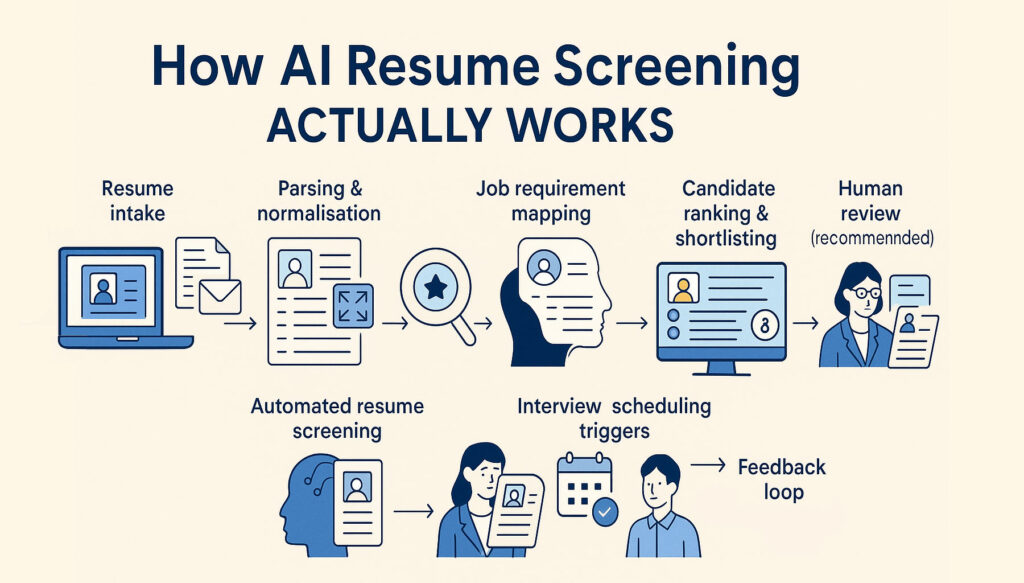
Resume Screener is an expert AI hiring assistant that analyzes job descriptions, scores candidates against role requirements, detects red flags, identifies standout talent, and delivers ranked shortlists — turning the most time-consuming bottleneck in recruitment into a structured, defensible process you can complete in minutes instead of days. While application volumes have surged to 257.6 per job posting in 2026, up from 207.2 in 2024, this AI gives HR professionals, founders, and hiring managers the screening depth of a senior recruiter without the weeks of manual review.
✅ JD analysis with skills extraction and requirement prioritization ✅ Candidate scoring against role-specific criteria with documented reasoning ✅ Red flag detection across employment gaps, inconsistencies, and qualification mismatches ✅ Persistent memory that retains your hiring standards and preferences across sessions ✅ Free to start, no credit card required
The gap between rising application volumes and flat screening capacity is why 44% of organizations now use AI specifically to screen resumes, according to SHRM's 2025 Talent Trends data. To understand why a conversational AI screener fills a gap that traditional ATS platforms don't, let's look at what's actually breaking in the hiring process.
Quick Answer: What Is AI Resume Screener?
Resume Screener is a specialized AI agent that analyzes job descriptions and evaluates candidates through structured scoring, red flag detection, and standout talent identification — delivering ranked shortlists with documented reasoning for every decision.
Key capabilities:
- Job description analysis that extracts must-have versus nice-to-have qualifications
- Multi-dimensional candidate scoring against role-specific criteria
- Red flag detection for employment gaps, credential inconsistencies, and qualification mismatches
- Standout talent identification highlighting candidates who exceed baseline requirements
The Problem: Why Resume Screening Is Breaking Recruitment in 2026
Hiring teams in 2026 face a volume crisis that manual workflows simply cannot absorb. Application volumes have hit 257.6 per posting, up 24% year-over-year according to the Employ Inc. 2026 Hiring Benchmarks Report, while time to initial screening improved only modestly — from 8.3 days to 7.2 days during the same period. The math is brutal: a recruiter handling 15 open roles at 250 applications each faces 3,750 resumes before a single conversation starts.
But the challenges extend far beyond volume:
-
Manual screening consumes weeks of productive time. At three minutes per resume, 3,750 applications consume roughly 187 hours of manual review — approximately five full work weeks — before outreach even begins. That's five weeks where qualified candidates are accepting offers from competitors who move faster.
-
Keyword-based ATS filtering misses qualified candidates. Traditional ATS filters check whether "project management" appears on a resume. They miss that someone who "led a cross-functional team of 12 engineers through a 9-month product launch" has project management experience — even if those exact words never appear. That gap between keyword matching and semantic understanding means strong candidates get rejected before a human ever sees their application.
-
AI-written resumes are flooding the pipeline. According to a 2026 HireVue Global AI in Hiring report, 71% of candidates now use AI for resumes and 77% of managers do too, but only 44% of hiring managers actually trust the tools. AI-optimized resumes can inflate qualifications and mirror job posting language perfectly, making it harder than ever to distinguish genuine expertise from polished presentation.
-
Bias remains a documented risk. A Brookings Institution study published in April 2025 found that AI resume screeners preferred white-associated names 85.1% of the time in direct comparisons. Enterprise screening platforms without robust bias safeguards can amplify discrimination rather than reduce it — creating legal exposure as California, Illinois, Colorado, and Texas now regulate how employers use AI in hiring decisions.
The Real Cost of Screening Bottlenecks
AI-powered screening tools can reduce the time spent on résumé reviewing by up to 75% — which means teams still screening manually are spending four times longer than necessary on the single most automatable step in recruitment.
With the average time-to-fill sitting at 63.5 days, every day shaved off screening compounds through downstream stages — outreach, interviews, offers. Yet 75% of HR teams report a measurable drop in screening time after adopting AI resume screening, and automated systems achieve accuracy rates significantly higher than the roughly 70% typical of manual review. The teams that screen faster aren't just more efficient — they're getting better candidates because top talent doesn't wait.
This is exactly what Resume Screener was built for.
Why Resume Screener
Most AI resume screening tools in 2026 fall into two categories: enterprise ATS platforms that cost $14,995 to $120,000+ per year and require months of implementation, or basic keyword scanners that miss nuance. Resume Screener operates differently — it's a deeply knowledgeable hiring expert you can start working with in seconds, one that understands role requirements, evaluates candidates holistically, and documents its reasoning for every decision.
| Traditional Screening | Resume Screener |
|---|---|
| 3 minutes per resume × hundreds of applicants | Structured evaluation of entire candidate pools in minutes |
| Keyword matching that misses qualified candidates | Contextual analysis that reads experience, not just words |
| No documentation of why candidates were advanced or rejected | Documented scoring rationale for every decision |
| Quality varies by reviewer fatigue and bias | Consistent evaluation criteria applied to every candidate |
| Enterprise tools requiring $15K-$120K+ annually | Accessible with a Jenova subscription |
| Months of implementation and IT support | Start immediately — no setup, no data migration |
Structured Screening, Not Black-Box Scoring
The Resume Screener agent brings the analytical rigor of a senior recruiter to every screening decision — with full transparency into how and why candidates are scored.
Job Description Analysis
Before evaluating a single candidate, the agent deconstructs your job description into structured criteria: must-have qualifications versus nice-to-haves, technical skills versus soft skills, experience thresholds, and role-specific requirements. This ensures every candidate is evaluated against the same framework — not against whatever the reviewer happens to remember about the role.
"Here's the JD for a Senior Product Manager at our fintech startup. Break it down into must-have versus nice-to-have qualifications and identify the top 5 criteria I should weight most heavily."
Multi-Dimensional Candidate Scoring
Upload a resume or paste candidate information, and the agent evaluates across multiple dimensions: technical qualification match, experience relevance, career trajectory, skills depth versus breadth, and role-specific fit indicators. Each score comes with documented reasoning — not just a number, but an explanation of what the candidate brings and where gaps exist.
"Score this candidate against the Senior PM role. I need to know where they're strong, where they're weak, and whether the gaps are dealbreakers or coachable."
Red Flag Detection
The agent systematically identifies potential concerns: unexplained employment gaps, qualification inconsistencies, credential inflation patterns, job-hopping without progression, and misalignment between stated experience and demonstrated depth. Each flag is surfaced with context — not every gap is a red flag, and the agent distinguishes between genuine concerns and explainable patterns.
"This candidate has three roles in the past two years and their job titles escalated from Analyst to Director. Flag anything that looks inconsistent."
Standout Talent Identification
Beyond screening out poor fits, the agent actively identifies candidates who exceed baseline requirements — unusual skill combinations, evidence of outsized impact, career trajectories that suggest high growth potential, and qualifications that position a candidate above the typical applicant pool.
"I've narrowed it to five finalists. Rank them and tell me which one you'd interview first and why."
Related Agents You'll Also Find Useful
If resume screening is part of your hiring workflow, these agents handle the adjacent tasks that complete the recruitment process:
Resume & Cover Letter Writer
Understanding what makes a strong resume from the writer's side sharpens your screening eye — and if you're a founder or small business owner who also needs to attract talent, the Resume & Cover Letter Writer creates ATS-optimized documents that position candidates for target roles. Useful on both sides of the hiring equation.
- Tailored, ATS-optimized resumes and cover letters
- Researches target companies for positioning
- Understands what screening systems look for — from the candidate's perspective
Interview Coach
Once your shortlist is built, the Interview Coach prepares you (or your candidates) for behavioral, case, technical, and executive interviews with mock practice. For hiring managers, it helps design structured interview questions that probe the specific strengths and concerns identified during screening.
- Behavioral, case, technical, and executive interview preparation
- Mock interview practice with real-time feedback
- Structured question design based on screening insights
Career Advisor
For HR professionals and recruiters who also advise internal talent on career development, the Career Advisor provides strategic guidance on career exploration, transitions, and advancement for employees at all stages — connecting the screening function to broader talent management.
- Career strategy for exploration, transitions, and advancement
- Internal mobility guidance for current employees
- Complements screening with retention-focused talent development
People & Contact Finder
When your screening identifies strong candidates who applied months ago, or when you need to source candidates proactively rather than waiting for applications, the People & Contact Finder locates emails, profiles, and business contacts — bridging the gap between identifying talent and reaching them.
- Find emails, LinkedIn profiles, and phone numbers
- Locate candidates identified through screening but not yet contacted
- Proactive sourcing that complements reactive screening workflows
How It Works: From Job Description to Ranked Shortlist
Step 1: Share Your Job Description
Open Resume Screener on web, iOS, or Android and share the job description — paste it directly, upload a document, or describe the role in your own words. The agent deconstructs the JD into structured evaluation criteria, separating must-haves from nice-to-haves and identifying the highest-priority qualifications.
"We're hiring a Senior Data Engineer. Must have 5+ years with Python and SQL, experience with distributed systems (Spark, Kafka), and cloud platform expertise (AWS or GCP). Nice to have: dbt, Airflow, and startup experience."
Step 2: Upload Candidate Resumes
Share candidate materials — upload resume files, paste text, or describe candidates. The agent evaluates each one against the structured criteria established in Step 1, producing a multi-dimensional score with documented reasoning for every assessment.
"Here are resumes for four candidates. Score each one against the Data Engineer criteria and rank them."
Step 3: Review Scored Shortlist With Red Flags and Standouts
The agent delivers a ranked candidate assessment with clear scoring, identified red flags, and standout indicators for each applicant. Every judgment is explained — you see not just who ranks highest, but specifically why, and what concerns deserve follow-up during interviews.
"Candidate B scored highest on technical skills but has a 14-month gap between roles 2 and 3. Candidate D has slightly lower technical depth but shows a faster growth trajectory. Walk me through the tradeoffs."
Step 4: Iterate and Refine
Adjust your criteria, ask follow-up questions about specific candidates, or upload additional resumes as new applications arrive. The agent's persistent memory means it retains your evaluation framework across the entire hiring process — and across future roles — so you don't rebuild from scratch each time.
"We just got 12 more applications for the same role. Screen them against the same criteria and add any standouts to the existing ranking."
Results & Use Cases
📊 Startup Founder Hiring Their First Engineering Team
Scenario: A seed-stage founder with no HR background needs to hire three engineers. They posted the role on LinkedIn and received 180 applications in the first week. They've never formally screened resumes before and don't know what red flags to look for in engineering candidates.
Traditional Approach: Spend 9+ hours reading every resume, making gut-feel decisions without consistent criteria, missing strong candidates with non-traditional backgrounds, and potentially advancing candidates with inflated credentials. Or pay a recruiter $15,000-$30,000 per placement.
With Resume Screener: Share the job description and upload the application batch. The agent applies structured criteria a first-time founder wouldn't know to look for — evaluating not just technical skills but career trajectory, project complexity, and team-size experience. Red flags like credential inflation and unexplained job-hopping are surfaced with context. The founder gets a ranked shortlist with specific interview questions for each finalist.
- Structured evaluation criteria a non-HR founder wouldn't build themselves
- Red flag detection catches patterns an untrained eye would miss
- Specific interview questions generated from each candidate's profile
- Repeatable framework for future hiring rounds
💼 HR Team Processing High-Volume Seasonal Hiring
Scenario: A retail company needs to hire 200 seasonal workers across 15 locations in 6 weeks. They receive 3,000+ applications. The three-person HR team is already managing full-time recruitment for corporate roles.
Traditional Approach: At three minutes per resume, 3,000 applications consume 150 hours of manual review. The team either works overtime for weeks, outsources to a staffing agency at $2,000-5,000 per location, or applies crude keyword filters that reject qualified candidates and advance unqualified ones.
With Resume Screener: Batch-screen candidates against location-specific requirements — availability, relevant experience, proximity. The agent identifies candidates with retail experience, flags scheduling conflicts, and surfaces standouts with management potential for lead positions. The HR team reviews a pre-scored shortlist instead of a raw inbox.
- Reduces screening from 150 hours to structured shortlist review
- Location-specific criteria applied consistently across all 15 sites
- Identifies leadership candidates for elevated seasonal roles
- Frees HR team to focus on corporate recruitment simultaneously
📱 Recruiter Evaluating Candidates Between Meetings
Scenario: An agency recruiter managing 12 active searches receives a promising candidate referral via email during back-to-back client meetings. They need a quick assessment before their 4 PM call with the hiring manager.
Traditional Approach: Quickly scan the resume between meetings, form a snap judgment based on whatever stands out in a 60-second review, and hope they didn't miss anything critical. Or delay the assessment until evening, risking the candidate accepting another offer.
With Resume Screener: Open the agent on mobile, paste the candidate's resume, and reference the role requirements already stored in persistent memory from a previous session. Get a structured assessment with scoring, red flags, and talking points — all before the 4 PM call.
- Full candidate assessment from mobile in minutes
- Persistent memory retains role criteria from previous sessions
- Structured talking points ready for the hiring manager call
- No compromise between speed and evaluation quality
🎯 Hiring Manager Building a Diverse Candidate Pipeline
Scenario: A VP of Engineering wants to ensure their screening process doesn't inadvertently filter out candidates from non-traditional backgrounds — bootcamp graduates, career changers, self-taught developers — while still maintaining technical quality standards.
Traditional Approach: Request that recruiters "consider non-traditional candidates" without clear criteria for how to evaluate them. The result is inconsistency: some recruiters advance bootcamp graduates while others screen them out. No documentation of the evaluation rationale exists if diversity metrics are questioned.
With Resume Screener: Define evaluation criteria that weight demonstrated skills and project impact over pedigree — then apply those criteria consistently across every applicant. The agent documents exactly why each candidate was scored as they were, creating an auditable record. Candidates with bootcamp backgrounds who demonstrate strong project portfolios get scored on their actual capabilities, not filtered out by credential proxies.
- Consistent, documented evaluation criteria applied to every candidate
- Skills-based scoring that doesn't penalize non-traditional backgrounds
- Auditable reasoning trail for every screening decision
- Helps build defensible diversity practices with real documentation
FAQ
Is AI Resume Screener free to use?
Yes. Resume Screener is available on Jenova's free tier with access to all core features. Paid plans starting at $20/month provide significantly increased usage for high-volume screening, custom model selection across OpenAI, Anthropic, Google, and more, and no watermarks on exported content. Usage resets monthly with full limits from day one — a fraction of the [$14,995 to $120,000+ per year](https://www.pin.com/blog/ai-resume-screening-tools/) that enterprise screening platforms charge.
How is Resume Screener different from an ATS with AI screening?
Enterprise ATS platforms like SmartRecruiters, Greenhouse, and iCIMS embed AI screening within larger talent management systems that require months of implementation and IT infrastructure. Resume Screener is a conversational expert you can start using immediately — no setup, no data migration, no vendor onboarding. Describe the role, share candidate materials, and get scored assessments with documented reasoning. It works alongside whatever ATS or workflow you already use, not as a replacement for your entire recruitment stack.
Can it handle technical roles where domain expertise matters?
The agent evaluates candidates across technical and non-technical dimensions — parsing specific technologies, frameworks, certifications, and project complexity. For highly specialized roles (ML engineering, security architecture, embedded systems), you can specify the exact technical criteria that matter and the agent will weight them accordingly. It distinguishes between surface-level keyword mentions and demonstrated depth of experience.
Does it help with bias in screening?
Resume Screener applies consistent evaluation criteria to every candidate — eliminating the variability that comes from reviewer fatigue, unconscious bias, and inconsistent standards across different screeners. You define the criteria; the agent applies them uniformly. Every scoring decision is documented with reasoning, creating an auditable trail. However, as research has shown, no AI screening tool is immune to bias. The agent works best as a complement to human judgment, not a replacement for it.
Does it work on mobile?
Full feature parity across web, iOS, and Android. All conversations, criteria, and candidate assessments sync across devices. Screen candidates during your commute, between meetings, or from a coffee shop — the persistent memory means your evaluation framework and previous assessments are always available regardless of device.
How many candidates can it evaluate at once?
The agent handles individual candidate deep-dives and batch screening across multiple applicants. Share one resume for a detailed assessment, or upload a batch and request a ranked comparison. For very high volumes, work through candidates in groups — the agent retains your criteria and ranking context throughout the conversation and across sessions.
Conclusion
Resume screening in 2026 is defined by a simple but punishing math problem: 257.6 applications per posting, rising year over year, against screening capacity that hasn't kept pace. Manual review consumes weeks. Keyword-based ATS filters reject qualified candidates. And the teams that screen faster aren't just saving time — they're capturing better talent, because AI-powered screening reduces résumé review time by up to 75% while improving match accuracy beyond what manual processes achieve.
Resume Screener gives HR professionals, founders, and hiring managers the screening depth of a senior recruiter — JD analysis, multi-dimensional candidate scoring, red flag detection, and standout identification — with documented reasoning for every decision. No enterprise implementation, no six-figure annual contract, no IT department required. Start screening your next applicant pool in minutes.
Try Resume Screener now and turn your biggest hiring bottleneck into your fastest workflow. Explore the full agent library at Jenova.