Best AI for Resume Screening: How 15,000+ Hiring Teams Are Evaluating Candidates Faster, Fairer & Smarter in 2026
2026-03-21
Hiring has become an arms race. Candidates use AI to polish resumes into identical, keyword-optimized documents. Recruiters drown in application volumes that have surged 36% over the past five years. And the best talent disappears within 10 days — often before a hiring manager even finishes reading the pile. If you're looking for the best AI for resume screening that goes beyond keyword matching, AI Resume Screener evaluates candidates the way an experienced senior recruiter would — reading career trajectories, cross-referencing cover letters, flagging inconsistencies, and delivering ranked shortlists with actionable next steps.
✅ Deep job description analysis with criteria inference — not just keyword parsing ✅ Per-candidate verdicts, 10-point fit scores, and specific gap identification ✅ Red flag detection: employment gaps, inflated claims, job-hopping patterns, generic cover letters ✅ Full post-screening workflow: tailored interview questions, rejection drafts, reference check guidance
Over 15,000 HR professionals, founders, and hiring managers have used this AI to cut screening time from days to minutes, surface hidden-gem candidates buried in massive applicant pools, and build shortlists they actually trust. Here's why finding the best AI for resume screening matters more in 2026 than any year before it.
Quick Answer: What Is AI Resume Screener?
AI Resume Screener is a specialized AI agent that analyzes your job description, evaluates every uploaded resume and cover letter against role requirements, and delivers scored, ranked candidate assessments in minutes.
It doesn't rely on simple keyword matching. It reads and interprets candidate materials the way a seasoned recruiter would — assessing career trajectories, identifying transferable skills, detecting red flags, and surfacing candidates with exceptional potential who might not tick every checkbox.
Key capabilities:
- Anchors your job description as a persistent reference document throughout the entire screening session
- Scores each candidate on a 10-point fit scale with detailed strengths, concerns, and standout notes
- Detects employment gaps, resume-cover letter inconsistencies, overqualification signals, and inflated claims
- Generates tailored interview questions, rejection emails, and reference check guidance post-screening
The 2026 Screening Crisis: Why Manual Review Can't Keep Up
The hiring landscape in 2026 isn't just competitive — it's structurally broken. The convergence of AI-generated applications, exploding volumes, and shrinking recruiter bandwidth has made manual resume screening a liability rather than a process.
87% of companies now use AI in at least one part of their recruiting process, with initial candidate screening approximately 95% automated. Source: PrincePerelson & Associates
Here's what's driving the urgency:
- Application volumes are overwhelming — Competitive positions routinely attract 1,000+ resumes per opening
- AI-polished resumes look identical — 40–80% of applicants now use AI to draft resumes and cover letters, making surface-level differentiation nearly impossible
- Human accuracy degrades fast — Screening accuracy drops from 80% to 60% after reviewing 100+ resumes due to fatigue
- Top candidates vanish quickly — The best applicants accept offers within 10 days, punishing slow screeners
- The resume itself is losing credibility — Only 37% of employers now view credentials and learning history as reliable indicators of capability
⏱️ The Time Trap That Steals Strategic Capacity
Recruiters spend 6–8 seconds on an initial resume scan, but meaningful evaluation takes 3–5 minutes per resume. For a role with 200 applicants, that's over 10 hours just for first-pass screening — before shortlisting, follow-ups, or interviews begin. Multiply across multiple open positions, and recruiting teams become what one ROI analysis called "resume-reading machines instead of strategic talent advisors."
89% of HR professionals using AI say it meaningfully saves time or boosts efficiency, with many teams reporting 30–50% faster time-to-hire. Source: DISHER Talent Solutions
🤖 When Everyone's Resume Looks Perfect, Nobody Stands Out
This is the paradox of 2026 hiring. Candidates optimize their resumes with the same AI tools, producing polished but interchangeable applications. 77% of hiring teams now regularly encounter AI-generated or AI-assisted applications. As Willo CEO Euan Cameron noted in the Hiring Trends Report 2026: "The resume used to tell a story of effort, experience, and aptitude — now it often tells us how well someone can prompt a large language model."
The result? 19% of organizations using AI in hiring report that their tools have overlooked or screened out qualified applicants. Basic keyword-matching ATS systems are particularly vulnerable — when every resume contains the same optimized keywords, the signal disappears.
💰 The Compounding Cost of Slow, Inconsistent Screening
Inter-rater reliability — how consistently different reviewers evaluate the same stack — sits at just 60–70%. Three recruiters reviewing the same 100 resumes will disagree on 30–40 candidates who should advance. This inconsistency doesn't just slow hiring — it introduces bias, increases legal risk, and means the best candidate for the role may never reach the interview stage.
Meanwhile, AI recruitment can reduce hiring costs by 30% per hire according to SHRM, and candidates selected by AI are 14% more likely to receive a job offer than those selected by human screeners alone.
What Makes This the Best AI for Resume Screening
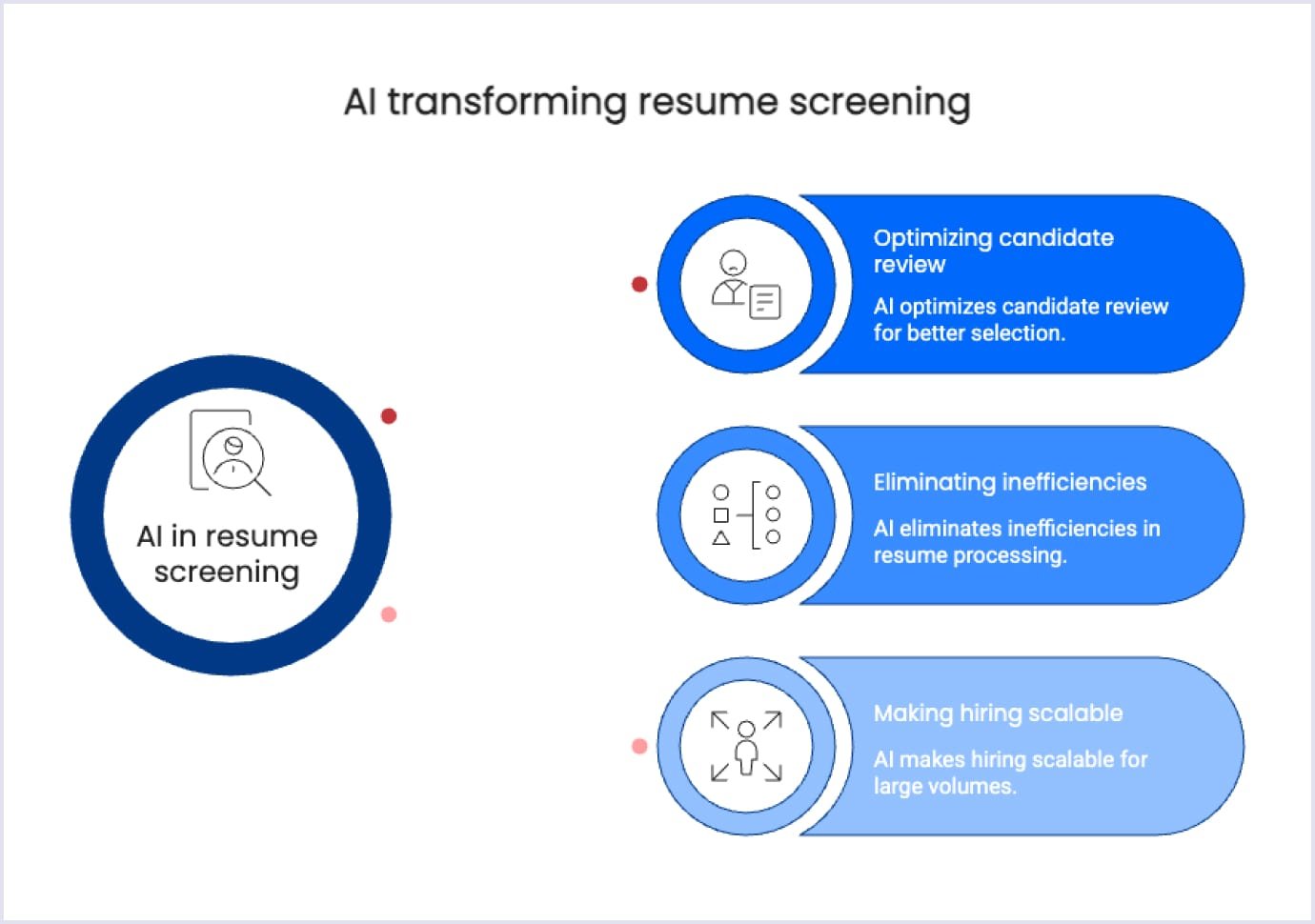
AI Resume Screener isn't an ATS add-on or a keyword parser. It's a specialized screening agent that reads candidate materials with the depth and judgment of an experienced senior recruiter — then delivers structured, actionable output at a speed no human team can match.
| Traditional Screening | AI Resume Screener |
|---|---|
| 6-8 second scan, 3-5 min detailed review per resume | Comprehensive evaluation of every candidate in minutes |
| Accuracy drops to 60% after 100 resumes | Consistent evaluation quality across the entire applicant pool |
| Different reviewers disagree on 30-40% of candidates | Structured scoring against defined criteria — same standards for every applicant |
| Keyword matching misses context and career trajectory | Contextual skill assessment, trajectory analysis, and transferable skill identification |
| No systematic red flag detection | Active identification of gaps, inconsistencies, inflation, and flight risk signals |
| Post-screening support requires separate tools | Interview questions, rejection emails, and reference guidance built into the same session |
🎯 Intelligent Job Description Analysis
Most screening tools take your job description at face value. Resume Screener goes deeper — it analyzes your JD to understand what the role actually requires, probes for clarity when requirements are vague or incomplete, and stores the JD as a persistent reference document. This means every candidate is evaluated against the same anchored criteria, preventing drift across long screening sessions where human reviewers would naturally lose calibration.
📊 Structured, Decision-Ready Output
Every candidate receives a structured assessment designed for immediate action:
- Verdict: Strong Yes / Yes / Maybe / No
- Fit Score: X/10 against role requirements
- Key Strengths: 2–3 specific, evidence-based bullets
- Concerns/Gaps: 2–3 specific bullets with context
- Standout Notes: Red flags, hidden gem signals, cover letter quality assessment
- Recommended Next Step: Advance to interview / Request more info / Pass
When multiple candidates are reviewed, this AI generates comparison tables for quick side-by-side evaluation — the kind of scannable output that busy hiring managers need to make decisions in minutes, not hours.
🔍 Red Flag Detection That Goes Beyond Surface Checks
The agent actively identifies patterns that human reviewers miss under time pressure:
- Unexplained employment gaps
- Inconsistencies between resume and cover letter claims
- Job-hopping patterns without clear career progression
- Inflated or vague accomplishment claims (e.g., "managed projects" without specifics)
- Generic cover letters that don't address the specific role
- Overqualification signals that suggest flight risk
It also cross-references cover letters against resumes for consistency — a step most recruiters skip entirely when processing high volumes.
💎 Hidden Gem Identification
This is where AI Resume Screener separates itself from basic screening tools. Beyond checkbox matching, it looks for candidates who don't tick every requirement but show exceptional potential — strong upward trajectories, transferable skills from adjacent industries, or demonstrated results that outweigh credential gaps. These candidates are explicitly flagged so they aren't buried in a stack of more conventional applications.
In a market where 68% of job seekers are willing to ditch the traditional resume entirely, the ability to evaluate candidates beyond surface-level credentials is a competitive advantage.
How It Works: From Job Description to Ranked Shortlist
Step 1: Share Your Job Description
Paste the JD directly into the chat or upload it as a document. AI Resume Screener analyzes the role requirements, infers evaluation criteria, and saves the JD as a persistent reference for the entire session.
"Here's the JD for our Director of Engineering role. We need someone with distributed systems experience who can manage a team of 15+ and has shipped products at scale. B2B SaaS background strongly preferred."
Step 2: Upload Candidate Resumes
Upload up to 10 files per message. For larger candidate pools, send resumes across multiple messages — or consolidate multiple resumes into a single file. The agent can hold off on screening until you signal that all candidates have been uploaded, or process them incrementally if you prefer real-time feedback.
"I have 40 resumes to review. I'll send them in batches of 10. Hold off on screening until I say I'm done uploading."
Step 3: Receive Structured Assessments
The agent loads the JD reference and each candidate's file, then delivers detailed per-candidate evaluations with fit scores, strengths, concerns, and recommended next steps. A comparison table summarizes all candidates at a glance.
Step 4: Go Deeper or Move Forward
Ask for expanded analysis on any candidate, request tailored interview questions targeting specific gaps, or have the agent draft rejection or advancement emails. You can also add new candidates at any point — the tool integrates them into the existing roster and updates rankings.
"Expand on Candidate #7's leadership experience and draft behavioral interview questions focused on their transition from IC to management."
Step 5: Export and Share
Download screening reports as PDF, Word, or CSV for team sharing. The agent maintains full session context — client details, JD reference, all evaluated candidates — so you can return to the session and continue without re-uploading anything.
Real-World Scenarios Where This AI Delivers
📊 High-Volume Recruiting at Scale
Scenario: A healthcare network hiring 30 registered nurses across 5 locations receives 1,800+ applications in two weeks.
Without AI: A team of 3 recruiters spends 2+ weeks on initial screening. By the time they finish, the strongest candidates have already accepted offers elsewhere. Reviewer fatigue leads to inconsistent evaluations across the stack.
With AI Resume Screener: Upload batches of resumes, receive scored shortlists same-day. Comparison tables make it easy to identify top candidates across locations. Rejection emails can be drafted for all non-advancing candidates. The entire first-pass screening compresses from weeks to hours.
- Screening time reduced from 2+ weeks to under a day
- Consistent evaluation eliminates reviewer fatigue bias across 1,800 applications
- Location-specific comparison tables enable rapid allocation decisions
💼 First-Time Founder Making a Critical Hire
Scenario: A Series A founder with no recruiting experience needs to hire a VP of Sales. They've posted the role and received 120 applications — and have no framework for evaluating trade-offs between candidates.
Without AI: The founder spends 20+ hours reading resumes, unsure what to prioritize. They end up advancing candidates based on brand-name employers rather than actual fit, missing strong candidates from less recognizable companies.
With AI Resume Screener: The agent helps the founder clarify what they're actually looking for, screens all 120 resumes against those criteria, and provides a ranked shortlist with plain-language explanations of why each candidate fits or doesn't. It then generates tailored interview questions for the top 8, focusing on the specific gaps and strengths identified in each candidate's profile.
- First-time hirers get recruiter-level evaluation guidance
- Plain-language explanations make trade-offs between candidates clear
- Post-screening interview questions target each candidate's specific profile
📱 Screening on the Go Before a Hiring Committee
Scenario: An HR director traveling for a conference needs to review 25 candidate resumes before a hiring committee meeting the next morning. There's no time for a detailed manual review.
With this AI-powered screener: Upload the files from mobile, receive structured assessments with comparison tables, and download the screening report as a PDF to share with the committee. Full feature parity across web, iOS, and Android means the same depth of analysis regardless of device.
- Complete screening from any device
- Exportable reports (PDF, Word, CSV) ready for committee distribution
- Consistent quality whether you're at your desk or in an airport lounge
🎯 Technical Role Screening With Depth
Scenario: A CTO needs to fill a Senior Machine Learning Engineer position. The role requires specific technical depth (PyTorch, distributed training, MLOps) combined with research publication experience — a rare combination that's hard to evaluate from resumes alone.
Without AI: The CTO spends hours parsing technical jargon, trying to distinguish genuine expertise from buzzword-laden resumes. Several strong candidates from adjacent fields (e.g., computational physics with ML experience) are overlooked because their resumes don't use standard ML terminology.
With AI Resume Screener: The agent evaluates technical depth contextually — recognizing that a candidate's distributed computing experience in a physics lab translates directly to distributed ML training. It flags candidates with genuine research contributions versus those who list "machine learning" as a skill without supporting evidence. Hidden gems from non-traditional backgrounds are explicitly surfaced.
- Contextual skill assessment beyond keyword matching
- Transferable skills from adjacent fields identified and flagged
- Technical depth distinguished from buzzword padding
🏢 Multi-Role Screening for Growing Teams
Scenario: A scaling startup needs to fill 8 different roles simultaneously — from customer success to backend engineering. The single HR generalist managing all hiring is overwhelmed.
With AI Resume Screener: Each role gets its own screening session with a dedicated JD reference. The HR generalist uploads candidates by role, receives structured assessments for each position, and can even ask the agent to identify whether a candidate rejected for one role might be a strong fit for another open position.
- Parallel screening across multiple roles without quality degradation
- Cross-role candidate matching surfaces unexpected fits
- One HR generalist operates with the throughput of a full recruiting team
Frequently Asked Questions
Is AI Resume Screener free to use?
You can start screening resumes on the free tier with limited usage. Paid plans starting at $20/month provide significantly more capacity — up to 1,500× more on the Enterprise plan — along with custom model selection and no watermarks on exported documents. Try AI Resume Screener to see how it handles your next batch.
How is this different from an ATS like Greenhouse or Workable?
Traditional Applicant Tracking Systems use keyword matching and rules-based filters that miss context and nuance. AI Resume Screener reads and interprets resumes the way an experienced recruiter would — understanding career trajectories, assessing skill relevance in context, cross-referencing cover letters, and identifying both red flags and hidden potential that keyword systems miss entirely. It complements your ATS rather than replacing it.
Can it handle resumes in different languages?
Yes. The agent is language-agnostic and can evaluate resumes regardless of the language they're written in. If candidate materials arrive in a language that's unexpected for the role and location, it flags this as a potential concern and asks whether the language mismatch is relevant to your evaluation.
How many resumes can I screen in one session?
There's no hard limit on the number of candidates per session. You can upload up to 10 files per message and send as many messages as needed. For very large batches (50+ resumes), the agent advises on the most efficient upload approach, including consolidating multiple resumes into single files.
Does it work for executive and specialized roles?
Absolutely. The agent adapts its evaluation depth and criteria based on the role. For technical positions, it focuses on specific skill requirements and project experience. For executive roles, it evaluates leadership trajectory, strategic accomplishments, and organizational fit. Screening depth increases automatically for borderline cases and highly specialized positions.
Is my candidate data kept private?
All application materials are treated as confidential. Conversations and data are never used to train public AI models and are not shared with advertisers. AI Resume Screener operates on infrastructure trusted by users in over 70 countries.