Best AI for Product Copywriting: Conversion-Focused Descriptions, Landing Pages, and Ad Copy (June 2026)
2026-06-27
Every product you sell has a story that converts — but most listings tell it badly. Product Copywriter creates conversion-focused product descriptions, landing pages, ad copy, and marketplace listings that translate features into buying decisions — matching your brand voice, optimizing for search, and producing A/B test variations across every sales channel in 2026.
✅ Product descriptions engineered for conversion across Amazon, Shopify, Etsy, and every major marketplace ✅ Landing page copy, ad text, and email sequences built around buyer psychology ✅ Brand voice learning that maintains consistency across hundreds of SKUs ✅ SEO-optimized copy with keyword integration that ranks and sells simultaneously
To understand why this matters, let's examine why product copy remains the most underinvested lever in e-commerce — and why the difference between a description that sells and one that sits there is rarely about the product itself.

Quick Answer: What Is Product Copywriter?
Product Copywriter is an AI-powered copywriting specialist that creates conversion-optimized product descriptions, landing pages, ad copy, and marketplace listings tailored to your brand voice and target audience.
Key capabilities:
- Conversion-focused product descriptions for Amazon, Shopify, Etsy, and every major marketplace
- Landing page copy, email sequences, and ad text built on buyer psychology frameworks
- Brand voice consistency maintained across entire product catalogs
- SEO keyword integration that drives organic discovery without sacrificing readability
The Problem: Bad Copy Is the Most Expensive Mistake in E-Commerce
Product copy sits at the exact point where browsing becomes buying — or bouncing. Yet most e-commerce businesses treat it as an afterthought, filling listing pages with manufacturer descriptions, feature lists nobody reads, or AI-generated fluff that sounds like every other product on the page.
$31.56 billion in 2026, projected to reach $53.40 billion by 2033 — the global copywriting services market, growing at 7.8% CAGR — Coherent Market Insights
90% of content marketers will use AI to create content in 2026, but what's going down is conversion for direct to purchase — Medium, Alin Dragu
AI copywriting tools cut content costs by 30–50% and speed production by 80% for many firms — Dataforest
But creating copy that actually converts remains frustratingly difficult:
💰 The Professional Copywriter Cost Barrier
Skilled product copywriters charge $50–$500 per product description depending on complexity, research depth, and platform requirements. For a catalog of 200 SKUs, that's $10,000–$100,000 before a single word goes live — and the cost repeats every time you launch new products, enter new markets, or need seasonal refreshes. Most businesses simply can't afford conversion-quality copy at scale.
📋 The Template Trap
Generic AI writing tools produce generic copy. They don't understand marketplace-specific requirements — Amazon's backend keyword fields, Shopify's SEO metadata structure, Etsy's search algorithm quirks. They don't know that Amazon bullet points have character limits, that Shopify meta descriptions affect Google shopping results differently than marketplace search, or that advanced AI tools allow businesses to input style guidelines, ensuring uniformity in tone, language, and messaging across all product descriptions — but most sellers never configure this properly. The result is copy that reads like it was written by a machine, because it was.
🔄 The Consistency Problem
As catalogs grow, voice drift becomes inevitable. The descriptions written in January sound different from the ones written in June. The listings your VA wrote don't match the ones from your freelancer. Different team members produce different tones, different structures, different levels of detail. Customers feel the inconsistency even when they can't articulate it — and inconsistency erodes trust, which erodes conversion.
🎯 The Conversion Knowledge Gap
Writing copy that describes a product and writing copy that sells a product are fundamentally different skills. Most product descriptions list features. Conversion-optimized copy translates features into benefits, addresses objections before they form, creates urgency without manipulation, and guides the reader through a psychological sequence from attention to desire to action. As McKinsey estimates, generative AI applied across marketing and sales could add roughly $463 billion in value annually — but only when AI-generated content is strategically crafted, not just mass-produced.
Why Product Copywriter
Product Copywriter is not a generic text generator with a product description template. It's a dedicated copywriting specialist that understands buyer psychology, marketplace mechanics, SEO integration, and brand voice — producing copy that sounds like it was written by a $200/hour copywriter who deeply understands your product and your customer.
| Traditional Approach | Product Copywriter |
|---|---|
| $50–$500 per product description from freelancers | Professional conversion copy from a single conversation |
| Days-to-weeks turnaround per batch | Entire catalogs written in a single session |
| Generic AI tools producing generic output | Marketplace-specific copy optimized for each platform's algorithm |
| Inconsistent voice across writers and seasons | Persistent brand voice maintained across every SKU |
| Feature lists that inform but don't persuade | Benefit-driven copy engineered to convert browsers into buyers |
| Separate tools for descriptions, ads, emails, and landing pages | All copy types — descriptions, ads, emails, landing pages — in one conversation |
🎯 Conversion-Focused Product Descriptions
Describe your product — its features, materials, target customer, price point, and competitive positioning — and receive descriptions structured around proven conversion frameworks. The copy doesn't just list what the product is; it communicates why the customer needs it, how it solves their specific problem, and what makes it worth the price. Every description is built around the hierarchy: headline hook → benefit-driven opening → feature-to-benefit translation → objection handling → call to action.
"Write a product description for my handmade ceramic coffee mug — 12oz, lead-free glaze, microwave and dishwasher safe. Target audience is design-conscious millennials. Tone: warm, premium but approachable. For Shopify product page."
📝 Landing Pages and Ad Copy
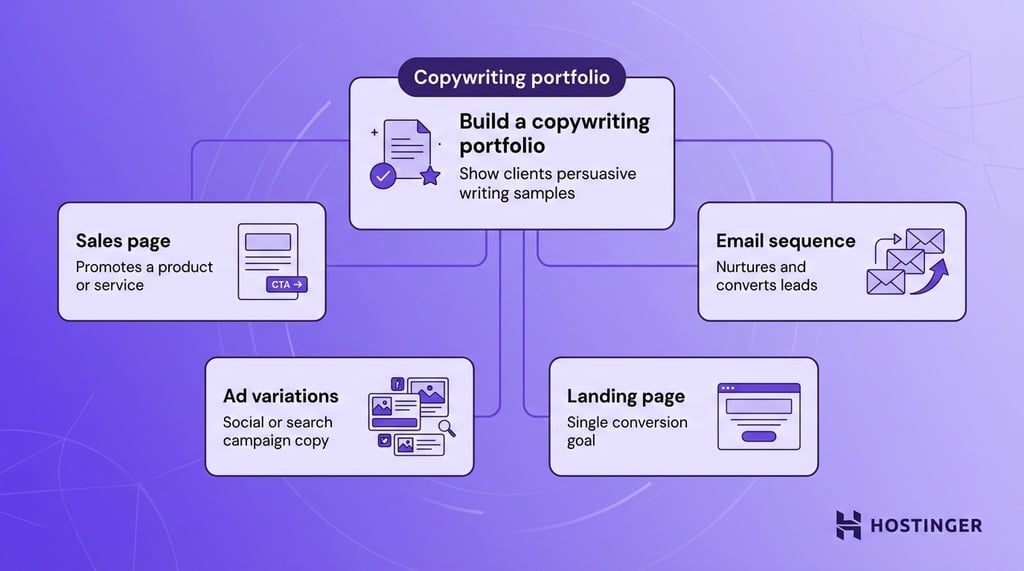
Beyond product listings, the copywriter creates full landing page copy, Facebook and Google ad variations, email sequences, and social media product announcements. Each format follows platform-specific best practices — character limits for Google Ads headlines, hook structures for Facebook primary text, subject line patterns for email open rates. Request A/B test variations to split-test messaging angles.
"Create three Facebook ad variations for my organic skincare line — one focused on ingredients, one on results, and one on lifestyle positioning. Keep primary text under 125 characters for mobile."
🔍 SEO-Optimized Marketplace Copy
Every product description integrates target keywords naturally — not stuffed awkwardly into sentences, but woven into benefit-driven copy that reads well to humans and ranks well in search. The copywriter understands the difference between Amazon A9/COSMO search optimization, Google Shopping feed requirements, and Etsy's tag-and-title search algorithm. As the U.S. Chamber of Commerce notes, the best AI product description tools help you "save time, create text that boosts sales, and improve your SEO results" — but only when the copy is specifically crafted for each platform's search mechanics.
"Write Amazon listing copy for my yoga mat — title, 5 bullet points, and product description. Target keywords: 'non-slip yoga mat,' 'eco-friendly exercise mat,' 'thick yoga mat for home.' Follow Amazon's style guide."
Related Agents You'll Also Find Useful
Product copy exists within a larger sales ecosystem. These agents handle the visual, strategic, and distribution workflows that surround the written word.
Product Photo Editor
Great copy paired with poor images wastes the persuasive effort. Product Photo Editor transforms raw product shots into polished, conversion-ready images — background removal, color correction, retouching, and platform-specific formatting. If Product Copywriter makes them want it, Product Photo Editor makes them see it.
- Background editing, color correction, and professional retouching
- E-commerce-optimized formatting for Amazon, Shopify, and social platforms
- Lifestyle scene compositing that matches the mood of your copy
SEO Blog Generator
Product descriptions capture purchase-intent traffic. Blog content captures research-intent traffic — the customers who aren't ready to buy yet but will be soon. SEO Blog Generator creates research-backed articles that drive organic traffic to your product pages, building topical authority around your product category.
- Research-backed SEO articles with citations and Google-optimized structure
- Internal linking strategy that funnels blog readers toward product pages
- Long-tail keyword coverage that captures early-funnel searchers
Social Media Content Generator
Once your product copy is finalized, this agent transforms it into platform-native social media posts — Instagram carousels, TikTok captions, Pinterest descriptions, and X threads — maintaining brand voice while adapting messaging to each platform's engagement patterns.
- Platform-specific posts optimized for Instagram, TikTok, Pinterest, and X
- Brand voice consistency across all social channels
- Engagement hooks and hashtag strategies tailored to each platform
E-Commerce Business Partner
For the strategic decisions that determine what products to sell, how to price them, and where to position them — product research, listing optimization strategy, PPC campaign management, and operational planning. If Product Copywriter writes the words, E-Commerce Business Partner architects the business they support.
- Product research and competitive analysis
- PPC campaign strategy and budget allocation
- Listing optimization beyond copy — pricing, imagery, and marketplace positioning
How It Works
Step 1: Describe Your Product and Context
Start a conversation with Product Copywriter and provide the details. Product features, materials, dimensions, target customer, price point, competitive positioning, and the platform where the copy will live. Include your brand voice guidelines if you have them — formal or casual, technical or accessible, premium or value-oriented. The more context you provide, the more precisely the copy hits.
"I sell handmade soy candles in 8oz glass jars. This one is 'Cedar & Smoke' — cedarwood, campfire, and pine. Target: men 25-45 who buy premium home goods. Brand voice: masculine but warm, not pretentious. I need Shopify product page copy."
Step 2: Receive Conversion-Optimized Copy
The copywriter delivers complete, ready-to-publish copy structured for your specific platform. Product titles, descriptions, bullet points, meta descriptions, and backend keywords — all formatted to the platform's requirements. Every sentence is explained in terms of its conversion purpose: this headline creates curiosity, this bullet addresses the most common objection, this closing line creates urgency without manipulation.
"Why did you lead with the scent experience rather than the ingredients? Walk me through the conversion logic."
Step 3: Refine and Expand
Iterate through conversation. Adjust tone, swap messaging angles, try different benefit hierarchies, or request variations for A/B testing. Expand into additional copy types — an email announcement for the product launch, three social media captions, a Google Shopping title variation, or a complete landing page for a seasonal campaign.
"That's good but too formal for my brand. Make it more conversational — like a friend recommending a candle, not a catalog describing one. And give me an Instagram caption version."
Step 4: Scale Across Your Catalog
Once the voice is established, apply it across your entire product line. Describe each new product and receive copy that maintains the same brand voice, conversion structure, and quality standard — whether it's product #2 or product #200. The copywriter remembers your brand guidelines across the session.
"Great. Now write the same format for my next three candles: 'Salt & Driftwood,' 'Bourbon & Tobacco,' and 'Rain on Stone.' Same voice, same platform."
Results & Use Cases
📊 Shopify Store Owner Launching a New Product Line
Scenario: A D2C skincare brand is launching 15 new products simultaneously. Each needs a Shopify product page description, a meta description, five bullet points, and a launch email. The founder has been writing all copy herself, spending 2-3 hours per product — meaning the launch would require 30-45 hours of copywriting alone.
Traditional Approach: Hire a freelance copywriter ($75-150 per product x 15 products = $1,125-$2,250, plus 2-3 weeks turnaround) or grind through it personally, delaying the launch by weeks while sacrificing time that should go toward marketing and operations.
Product Copywriter: Describe each product with ingredients, benefits, and target customer. Receive complete Shopify-optimized copy for all 15 products in a single session — product descriptions, meta data, bullet points, and launch email copy. Maintain consistent brand voice across every listing. Pair with Product Photo Editor to match the copy quality with equally polished product imagery.
- 15 products fully written in hours instead of weeks
- Consistent brand voice across the entire product line
- SEO-optimized copy that ranks in Google Shopping and Shopify search
💼 Amazon Seller Optimizing Underperforming Listings
Scenario: A private-label seller has 40 products on Amazon with conversion rates below category average. The listings use manufacturer descriptions — technical, feature-heavy, and written for engineers rather than customers. The products are competitive on quality and price, but the copy isn't communicating that.
Traditional Approach: Hire an Amazon listing optimization agency ($200-500 per listing x 40 listings = $8,000-$20,000) or a freelance Amazon copywriter at $100-300 per listing. Either way, it's a significant investment with no guarantee the new copy will outperform the old.
Product Copywriter: Provide the existing listing, competitor analysis, and target keywords for each product. Receive rewritten copy that translates technical features into customer benefits, integrates keywords naturally into titles and bullet points, and follows Amazon's A9/COSMO search optimization best practices. Request A/B test variations for the highest-priority listings. Use E-Commerce Business Partner to analyze which products have the highest ROI potential from copy optimization.
- Rewrite 40 listings at a fraction of agency cost
- Benefit-driven copy that addresses the customer's problem, not just the product's specs
- A/B test variations to identify the highest-converting messaging angle
📱 Etsy Seller Creating Listings on Mobile Between Craft Fairs
Scenario: A handmade jewelry maker sells at weekend craft fairs and needs to list new pieces on Etsy the same day they debut. She photographs products at the booth, but writing compelling descriptions on her phone between customers is impossible — so new inventory sits unlisted for days or weeks.
Traditional Approach: Wait until evening, sit at a laptop, and spend 20-30 minutes writing each listing. By then, the craft fair momentum has faded, and the Instagram posts from the booth generate clicks to an Etsy shop with no matching listings.
Product Copywriter: Between customers, type a quick description — "Sterling silver cuff bracelet, hammered texture, adjustable, 6mm wide, inspired by ocean waves" — and receive a complete Etsy listing with title, description, all 13 tags, and materials information in minutes. List immediately while the social media buzz is still active. Use Social Media Content Generator to create matching Instagram and TikTok posts that drive traffic to the new listing.
- List new products the same day they debut
- Complete Etsy-optimized listings from a brief mobile description
- Capture sales momentum while social media engagement is still active
🎯 Marketing Team Creating Multi-Channel Campaign Copy
Scenario: A mid-size consumer electronics company is launching a new wireless earbuds product. The marketing team needs product page copy for the website, Amazon listing copy, six Facebook ad variations, four Google Ads headlines, an email launch sequence, and three social media announcement posts — all maintaining consistent messaging but adapted to each platform's format.
Traditional Approach: Brief the in-house copywriter (1-2 weeks to produce all variations), engage the agency for ad copy (additional cost and coordination), and review 15+ separate documents for voice consistency. The process takes 3-4 weeks from brief to final copy.
Product Copywriter: Describe the product once — features, target audience, key differentiators, competitive positioning — and request all copy types in a single session. Each output follows platform-specific best practices while maintaining a unified brand message. Iterate on the messaging angle, then produce all variations from the approved direction. With 80% of marketers now using AI for content creation and AI-powered personalization delivering 10-15% revenue improvements on average, the competitive advantage belongs to teams that produce quality multi-channel copy faster.
- All campaign copy from a single product brief in one session
- Platform-specific optimization without voice inconsistency
- A/B test variations produced in minutes, not weeks
FAQ
Is Product Copywriter free to use?
Yes. You can start using Product Copywriter on Jenova's free tier with no credit card required. Write product descriptions, ad copy, and landing page text immediately. For higher usage volume, custom model selection, and watermark-free document exports, paid plans start at $20/month.
How is Product Copywriter different from Jasper or Copy.ai?
Standalone AI copywriting platforms like Jasper ($39-69/month) and Copy.ai ($49/month) provide template-based generation with limited conversational refinement. Product Copywriter is a dedicated specialist that functions as a conversational copywriting partner — it learns your brand voice within the session, understands marketplace-specific requirements (Amazon A9, Shopify SEO, Etsy tags), and produces copy you can iterate on naturally. It's the difference between filling out a form and working with a copywriter.
Can it write for marketplaces beyond Amazon and Shopify?
Yes. Product Copywriter creates optimized copy for Amazon, Shopify, Etsy, eBay, Walmart Marketplace, WooCommerce, BigCommerce, Squarespace, and any other e-commerce platform. Each output follows the specific platform's formatting requirements, character limits, and search optimization best practices.
Does it work on mobile?
Absolutely. Jenova offers full feature parity across web, iOS, and Android. Write product descriptions between meetings, create ad copy from your phone at a trade show, or refine landing page text from anywhere. All conversation history syncs across devices.
Will AI-written product copy sound generic?
Not when it's done right. Product Copywriter adapts to your brand voice, your target customer's language, and your competitive positioning — producing copy that sounds specifically like your brand, not like every other AI-generated listing. The key is providing context: the more you share about your product, customer, and voice preferences, the more distinctive the output. As AI tools for copywriting become standard, the differentiation comes from how intelligently they're used, not whether they're used at all.
Can it produce copy in bulk for large catalogs?
Yes. Once your brand voice is established in the conversation, describe products sequentially and receive consistent, conversion-optimized copy for each one. The copywriter maintains voice consistency across hundreds of SKUs within a session — solving the voice drift problem that plagues teams using multiple writers or generic templates.
Conclusion
Product copy is the most underleveraged conversion lever in e-commerce. With the copywriting services market valued at $31.56 billion in 2026 and AI-powered personalization delivering 10-15% revenue improvements, the businesses that invest in quality product copy — not just more product copy — will capture disproportionate market share. The era where AI tools cut content costs by 30-50% is already here. The question is whether you're using that efficiency to produce better copy or just more of the same.
Product Copywriter puts a dedicated conversion copywriting specialist into a single conversation — product descriptions, landing pages, ad copy, email sequences, and marketplace listings, all matched to your brand voice and optimized for every platform where you sell. No templates, no generic output, no voice drift across your catalog. Describe your product, define your customer, and receive copy that converts.
Try Product Copywriter now — and explore the full agent library at Jenova.