Best AI for Personality Analyzer: Cross-Framework Insights (July 2026)
2026-07-11
Personality Analyzer delivers integrative personality profiling across four validated psychological frameworks — Big Five, MBTI, Enneagram, and attachment theory — revealing cross-system patterns that no single test captures alone. While most personality assessments lock you into one framework's vocabulary and blind spots, this AI synthesizes multiple lenses simultaneously, producing a unified psychological profile with actionable insights for relationships, career decisions, and personal growth.
✅ Integrative analysis across Big Five, MBTI, Enneagram, and attachment theory in one conversation ✅ Cross-framework pattern recognition that reveals deeper personality structures ✅ Behavioral and emotional tendency mapping with specific developmental recommendations ✅ Persistent memory that deepens your profile across sessions over time
In 2026, personality assessment is widely used for personal and professional development, yet most tests reduce complex psychology to one framework's limited perspective. To understand why integrative analysis matters, consider the fundamental limitations of personality assessment today.
Quick Answer: What Is Personality Analyzer?
Personality Analyzer is an AI-powered integrative assessment tool that profiles individuals across Big Five, MBTI, Enneagram, and attachment theory to deliver a unified psychological portrait with cross-framework insights.
Key capabilities:
- Simultaneous analysis across four major personality frameworks in one conversation
- Cross-framework pattern recognition that identifies behavioral and emotional structures a single system cannot reveal
- Relationship compatibility and communication-style analysis grounded in multi-framework data
- Persistent memory that evolves your profile as you share more over time
The Problem With Single-Framework Personality Assessment
Personality assessment has never been more popular — or more fragmented. The U.S. Office of Personnel Management describes personality tests as tools designed to systematically elicit information about a person's motivations, preferences, interests, emotional make-up, and style of interacting with people and situations. Yet most assessments pursue this broad goal through one narrow framework, capturing one dimension while remaining blind to others.
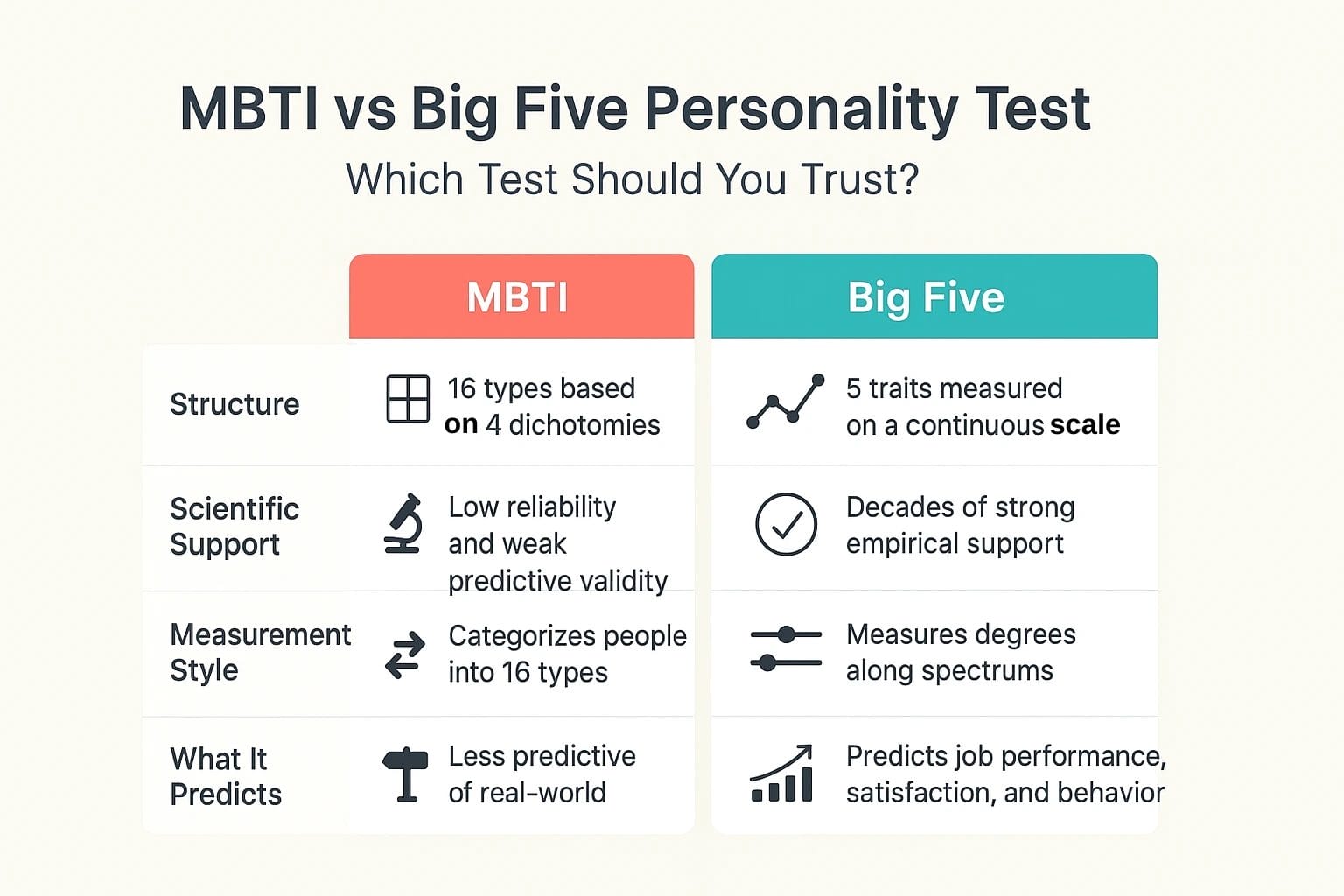
- Each framework captures different aspects of personality — and misses the rest. Big Five measures traits on continuous scales. MBTI maps cognitive processing preferences through eight Jungian functions. Enneagram examines core motivations and defenses. Attachment theory traces bonding patterns. None was designed to cover everything, although many people treat one result as a complete portrait.
- Free online tests are often shallow and unreliable. Many lack sound norming, use abbreviated question pools, and prioritize shareable, flattering results over rigorous measurement. Proper personality assessment evaluates cognitive, emotional, interpersonal, and behavioral functioning through multiple methods.
- Professional multi-framework evaluation is expensive. Clinical assessments commonly cost $1,500–$5,000 and take several sessions over weeks. Enterprise systems such as Hogan Assessments are priced for organizations rather than individual self-discovery.
- Mainstream tools do not synthesize frameworks. People taking MBTI, Big Five, and Enneagram tests separately are left to reconcile the results without expertise in their theoretical relationships.
The Blind Spots of Single-System Thinking
MBTI alone describes information processing and decision-making, but does not measure validated trait continuums. An INTJ and an ENTJ can differ dramatically in agreeableness, emotional stability, and openness.
Big Five alone offers rigorous trait measurement — five continuous traits identified as central to personality — but does not explain cognitive-function dynamics, core motivations, or stress-driven fear-desire patterns. Identical scores can mask very different motivations and growth paths.
Enneagram alone maps motivations and defense mechanisms but does not measure cognitive processing, trait-level emotional stability, or attachment patterns. It can explain why you act, but not fully how you process information or bond emotionally.
Attachment theory alone clarifies secure, anxious, avoidant, and disorganized bonding styles, but not broader traits, cognitive style, or motivational drivers.
An estimated 50 million people have taken the MBTI, and nearly 90% of Fortune 100 companies use it — yet most people receive one framework's result rather than the multidimensional picture required for deeper self-understanding — Wikipedia: Myers-Briggs Type Indicator
The Integration Gap
Research increasingly recognizes that personality assessment spans cognitive, emotional, interpersonal, and behavioral dimensions. Studies relating Enneagram types to Big Five dimensions show that the frameworks measure different but complementary aspects of personality. Understanding only one is like reading one chapter and assuming you know the whole book.
Institutions such as Washington State University offer assessments grounded in Contemporary Personality Science, but these remain single-framework instruments. Consumer tools such as Psychology Today's test directory, Truity, and 16Personalities leave integration entirely to the user.
This is exactly what Personality Analyzer was built for.
Why Personality Analyzer Delivers Complete Self-Understanding
Personality Analyzer integrates Big Five, MBTI, Enneagram, and attachment theory in one analytical conversation. Instead of completing four disconnected assessments, you have an adaptive dialogue that maps every dimension together.
It connects your cognitive style (MBTI), trait tendencies (Big Five), motivational patterns (Enneagram), and relational expression (attachment style). The result is not merely a type or score, but an interconnected psychological portrait.
| Single-Framework Tests | Personality Analyzer |
|---|---|
| One framework per assessment | All four frameworks in one conversation |
| Isolated results | Insights showing how frameworks explain one another |
| Fixed questionnaires | Adaptive dialogue that responds in real time |
| Type labels or scores | Behavioral and emotional pattern recognition |
| Results frozen at testing | Persistent memory across sessions |
| Generic advice | Growth recommendations grounded in the full profile |
Big Five Trait Profiling
Big Five — Openness, Conscientiousness, Extraversion, Agreeableness, and Neuroticism (OCEAN) — has decades of empirical support and continuous trait scales associated with job performance, relationship satisfaction, and health outcomes. Personality Analyzer evaluates your placement on every dimension conversationally rather than treating personality as a binary category.
It also explains your scores in context: how openness relates to Enneagram patterns, how conscientiousness connects to MBTI judging/perceiving preferences, and how neuroticism may interact with attachment style.
"Analyze my Big Five profile — I want to understand where I fall on each dimension and how my trait levels connect to my MBTI type and Enneagram patterns."
MBTI Cognitive Function Analysis
Personality Analyzer maps the eight Jungian functions — Fi, Fe, Ti, Te, Ni, Ne, Si, and Se — in their hierarchy. It examines dominant and supporting functions, growth edges, and stress responses, moving beyond a four-letter type code.
The AI then relates these dynamics to Big Five traits. For example, it can explain links between dominant Introverted Intuition (Ni) and openness or conscientiousness patterns, or between Extraverted Feeling (Fe) and agreeableness and extraversion.
"Walk me through my MBTI function stack and show me how each function connects to specific Big Five traits — I want to see the full picture of how these frameworks interact."
Enneagram Motivational Mapping
Big Five describes what you tend to do and MBTI describes how you process; Enneagram helps explain why. Personality Analyzer identifies type, wing, and instinctual variant, then traces how core fears, desires, and defenses appear through your cognitive style and trait profile.
For example, an Enneagram Type 5 with dominant Ti (INTP) expresses mastery differently from a Type 5 with dominant Ni (INTJ), even if both value intellectual competence. The AI identifies these distinctions and explains how motivation, cognition, and traits combine in your individual profile.
"Identify my Enneagram type and show me how my core motivations connect to my MBTI cognitive functions — where do they reinforce each other, and where do they create internal tension?"
Attachment Theory Integration
Attachment style — secure, anxious-preoccupied, dismissive-avoidant, or fearful-avoidant — shapes emotional bonding, intimacy, conflict responses, and emotion regulation. Personality Analyzer integrates it with your traits, cognition, and motivations to explain relationship dynamics in depth.
Anxious attachment expressed through Fe-dominant processing (ENFJ), for example, differs greatly from anxious attachment expressed through Fi-dominant processing (INFP). The AI traces such interaction patterns beyond generic attachment labels.
"Assess my attachment style and show me how it interacts with my Enneagram defense mechanisms — I want to understand why I keep repeating the same patterns in close relationships."
Related Agents You'll Also Find Useful
MBTI Personality Guide
MBTI Personality Guide offers focused expertise within Myers-Briggs: mistype verification, detailed function-stack analysis, compatibility insights, and type-specific growth strategies.
- Mistype verification against common typing errors
- Detailed cognitive-function analysis with real-world examples
- Compatibility analysis based on function dynamics rather than letter stereotypes
IQ Tester
IQ Tester complements personality understanding with a 30-question adaptive assessment spanning verbal, numerical, spatial, logical reasoning, pattern recognition, working memory, and processing speed.
- 30 adaptive questions across seven cognitive domains
- Score report with percentile rankings and dimensional breakdowns
- Cognitive strength-and-weakness analysis that complements personality profiling
Relationship Advisor
Relationship Advisor provides warm, practical coaching for romantic relationships, family dynamics, and friendships. Personality Analyzer maps underlying structures; Relationship Advisor helps turn insight into behavioral change.
- Coaching for romance, family, and friendships
- Conflict-resolution strategies calibrated to relationship dynamics
- Communication frameworks that make personality insights actionable
Try your AI personality assessment free — no credit card required.
How to Get Your Integrative Personality Profile
Step 1: Start the Conversation
Open Personality Analyzer and describe your goal: a complete profile, interpretation of past results, or exploration of one dimension. The AI adapts to your starting point, knowledge, and objectives.
"I want a complete personality analysis across all four frameworks — Big Five, MBTI, Enneagram, and attachment theory. Start from scratch and help me understand how they all connect."
Step 2: Engage in Adaptive Multi-Framework Dialogue
The AI asks targeted questions that evaluate several frameworks at once. A question about conflict, for example, can reveal Big Five agreeableness, MBTI thinking/feeling preferences, Enneagram defenses, and attachment patterns. Every answer informs the next question.
"When I'm stressed at work, I tend to withdraw and over-analyze the situation internally before talking to anyone about it. I know this frustrates my team, but I can't seem to engage until I've fully processed on my own."
Step 3: Receive Your Integrated Profile
After enough information is gathered, the AI presents Big Five traits, MBTI type and function stack, Enneagram type with wing and instinctual variant, and attachment style. Crucially, it explains where results reinforce each other and where meaningful tensions appear.
"Show me where my frameworks agree and where they create tension — I want to understand the contradictions in my personality, not just the consistencies."
Step 4: Explore Applications and Development
Use the profile for relationship compatibility, career alignment, or development practices that account for cognition, traits, motivations, and relational patterns together. Persistent memory lets the profile deepen across future sessions.
"Based on my complete profile, what specific personal development practices would address my biggest growth opportunities across all four frameworks simultaneously?"
Real-World Applications of Integrative Personality Analysis
📊 Resolving Contradictory Assessment Results
Scenario: A marketing director receives ENFP from MBTI, high conscientiousness and moderate extraversion from Big Five, and Enneagram Type 3. The outcomes appear contradictory: stereotypical ENFP spontaneity conflicts with her planning orientation, while Type 3 motivation seems disconnected.
Traditional Approach: Read separate and often conflicting advice. ENFP guides recommend flexible creative environments, while conscientiousness research points toward structured, goal-oriented work.
Personality Analyzer: Integrated dialogue identifies a mistype: her actual stack is Te-Ni (ENTJ), not Ne-Fi (ENFP). High conscientiousness fits Te-dominant, goal-directed processing, while Type 3 reinforces strategic achievement motivation. One mistyped result had created apparent contradictions across her entire self-concept.
- Detects mistypes missed by standalone tests
- Resolves cross-framework contradictions
- Produces a unified profile for career, relationships, and development
💼 Career Transition With Full Personality Context
Scenario: A 34-year-old data scientist considers moving into UX research. She enjoys analysis and user behavior but worries that qualitative research, stakeholder communication, and collaboration could repeat her current burnout.
Traditional Approach: A high-openness, moderate-agreeableness Big Five result suggests UX research may fit, but does not show whether everyday demands will energize or drain her.
Personality Analyzer: Her complete profile shows Ti-dominant processing (INTP), Enneagram Type 5w4, secure attachment with mild avoidant tendencies, very high openness, and low extraversion. Research content fits her curiosity, but stakeholder management would consume limited social energy. The AI suggests more sustainable alternatives such as research engineering, quantitative UX, or independent consulting. With Career Advisor, she can build a transition strategy aligned with her full profile.
- Predicts sustainable fit rather than surface-level fit
- Identifies personality-role friction points
- Suggests alternatives calibrated to the whole profile
📱 Relationship Pattern Understanding
Scenario: A 29-year-old project manager repeatedly feels intense early connection, then withdraws once a relationship becomes stable and emotionally available.
Traditional Approach: An attachment quiz may label this fearful-avoidant attachment and provide generic coping tips, without explaining his specific pattern.
Personality Analyzer: The AI identifies fearful-avoidant attachment interacting with Enneagram Type 8 defenses, Ni-Te processing (INTJ), low agreeableness, and moderate neuroticism. Type 8 fears of being controlled or harmed activate avoidance when intimacy feels like vulnerability. Ni then rationalizes withdrawal with future-focused analysis. The pattern becomes understandable and actionable, with Relationship Advisor available for practical coaching.
- Locates the mechanism across all four frameworks
- Explains interaction between attachment, defenses, and cognition
- Identifies precise intervention points
🎯 Leadership Development Strategy
Scenario: A new VP of engineering is technically excellent but is described as cold, insufficiently connected to direct reports, and more directive than inspiring.
Traditional Approach: Generic emotional-intelligence advice about empathy feels artificial and difficult to implement.
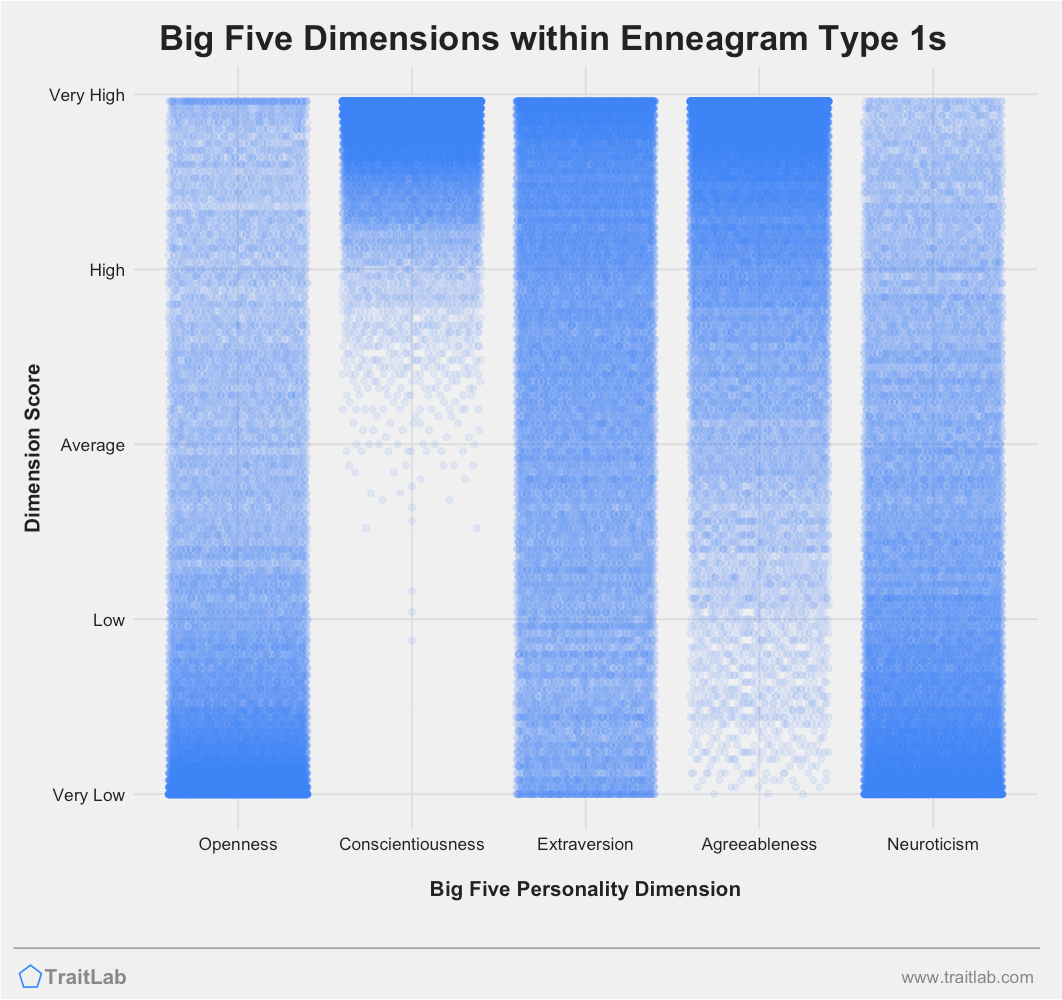
Personality Analyzer: Her profile is ENTJ (Te-Ni-Se-Fi), high conscientiousness, very low agreeableness and neuroticism, Enneagram Type 1w9, and secure but dismissive-leaning attachment. Inferior Fi makes emotional engagement difficult; Type 1 defenses channel feeling into criticism and perfectionism; dismissive attachment reinforces distance. The AI proposes a strategy that works with her structure: systematic Te-based check-ins, Ni-based strategic empathy, and low-stakes Fi practices such as value reflection and emotional acknowledgment.
- Identifies structures behind the leadership perception gap
- Builds on existing strengths instead of demanding inauthentic behavior
- Provides precision generic training cannot offer
Frequently Asked Questions
Is Personality Analyzer free to use?
Yes. Personality Analyzer is available on Jenova's free tier. You can complete a multi-framework analysis across Big Five, MBTI, Enneagram, and attachment theory without payment or registration barriers. Paid plans provide substantially more usage for ongoing exploration and multi-session analysis.
How is Personality Analyzer different from taking four separate personality tests?
Separate tests produce disconnected results. Personality Analyzer analyzes all four systems together, finds cross-framework patterns, resolves apparent contradictions, and reveals structures that emerge only when multiple lenses are combined.
Which personality framework does Personality Analyzer consider most reliable?
It does not rank one framework above the others. Big Five has the strongest empirical validation for trait-level measurement; MBTI clarifies cognitive dynamics; Enneagram maps motivations; and attachment theory illuminates relationships. Integration combines their strengths and offsets their blind spots.
Does Personality Analyzer work on mobile devices?
Yes. It offers full feature parity across web, iOS, and Android. Conversations automatically sync across devices.
Can Personality Analyzer help with team dynamics at work?
Yes. Describe team members' known traits, prior assessment results, or observed behavior, and the AI can map likely friction points, communication gaps, and collaboration strengths through a multi-framework lens.
Will my personality profile evolve over time?
Yes. Jenova's persistent memory retains your analysis history. As you share experiences and life changes, Personality Analyzer refines the profile over months or years, capturing development, stress shifts, and growth in a way static tests cannot.
The Complete Picture of Who You Are
Knowing an MBTI type is very different from truly understanding your personality. A four-letter code, five scores, or an Enneagram number are fragments that most people never integrate. Yet personality assessment researchers emphasize the need to examine cognitive, emotional, interpersonal, and behavioral dimensions together. Personality Analyzer closes this gap by synthesizing Big Five traits, MBTI cognitive functions, Enneagram motivations, and attachment theory into a unified portrait of what you do, how you think, why you are driven, and how you connect. Try Personality Analyzer now and explore more AI tools at Jenova.