Best AI for Learning Indonesian Through Roleplay: Master Bahasa Indonesia Through Immersive Conversation (June 2026)
2026-06-29
Learn Indonesian Through Roleplay transforms Bahasa Indonesia from a subject you study into a language you live — immersive AI-driven scenarios where grammar, vocabulary, and cultural instincts internalize through emotionally engaging dialogue, not sterile drills. Indonesian is rated by the U.S. government as a Category III language — a 3 out of 5 in difficulty for English speakers — simpler than Mandarin or Arabic on the surface, but deceptively complex once you move beyond tourist phrases. This AI closes the gap between textbook Bahasa and the fluid, colloquial Indonesian that 270+ million people actually speak.
✅ Dynamic roleplay scenarios that adapt from absolute beginner (A1) through advanced (C2) in real time ✅ Persistent cross-session memory tracking your affix errors, vocabulary growth, and formality struggles across weeks and months ✅ Cultural nuance woven into every interaction — formal vs. informal registers, Javanese-influenced politeness, regional expressions, and social hierarchy awareness ✅ Available 24/7 on web, iOS, and Android — practice during commutes, lunch breaks, or late-night study sessions
To understand why this matters, let's examine why Indonesian is simultaneously one of the most approachable and most underestimated languages for English speakers — and why most AI tools fail to bridge the gap between textbook Bahasa and real conversation.
Quick Answer: What Is Learn Indonesian Through Roleplay?
Learn Indonesian Through Roleplay is an immersive AI language agent that teaches Bahasa Indonesia through adaptive narrative scenarios — building vocabulary, grammar, and conversational fluency through emotionally engaging dialogue rather than textbook drills.
Key capabilities:
- Scenario-based immersion covering travel, business, daily life, culture, romance, and conflict — any theme, any complexity
- Real-time grammar correction with contextual explanations for affixation, word order, formality levels, and colloquial speech patterns
- Persistent cross-session memory that builds a continuous learning arc over weeks and months
- Instant bidirectional translation support via the Indonesian-English Translator when you hit a wall mid-conversation
The Problem: Why Indonesian Is Harder Than People Think
Indonesian is often called one of the easiest Asian languages for English speakers. No gendered nouns. No verb conjugations. Latin alphabet. Basic word order that mirrors English (Subject-Verb-Object). The initial barrier to start speaking Indonesian is actually very low for English speakers — you can start having basic conversations relatively quickly.
But this accessibility creates a dangerous illusion. As one language learner put it bluntly:
. The easy entry point masks layers of complexity that strand most learners at the "survival tourist" level — able to order nasi goreng but unable to follow a conversation between Indonesians at natural speed.Here's why:
- An affixation system (me-, ber-, di-, ke-...-an, pe-...-an) that transforms root words into dozens of derived forms — and choosing the wrong prefix changes a verb's voice, transitivity, or meaning entirely
- Formal vs. informal registers that create essentially two parallel vocabularies — textbook tidak (no) vs. everyday nggak, formal saya (I) vs. casual gue or aku
- Colloquial Indonesian that diverges sharply from textbook Bahasa — slang, Jakartan dialect, Javanese borrowings, and abbreviations that no course teaches but every Indonesian uses
- Cultural indirectness and social hierarchy encoded in language — knowing when to use Bapak/Ibu, how to soften requests, and why Indonesians rarely say "no" directly
- Generic AI chatbots that teach "robot Indonesian" — grammatically correct textbook Bahasa that no Indonesian actually speaks in daily life
🔤 The Affixation Wall
Indonesian grammar doesn't use conjugation — but it uses something just as complex. The root word tulis (write) becomes menulis (to write), ditulis (to be written), penulis (writer), penulisan (the act of writing), tulisan (a piece of writing), and menuliskan (to write something for someone). Each affix changes meaning, voice, or function — and this is the challenge that most people who learn Indonesian face. Flashcard apps can drill individual forms, but they can't simulate the moment when you need mempermasalahkan instead of masalah and the distinction actually matters for comprehension.
🗣️ Two Indonesians: Textbook vs. Street
Perhaps the biggest shock for learners is discovering that the Indonesian taught in textbooks and the Indonesian spoken on Jakarta streets are almost different languages. Textbook: Saya tidak mengerti apa yang Anda katakan. Street: Gue nggak ngerti lo ngomong apa. Both mean "I don't understand what you're saying" — but if you only know the first version, you'll understand roughly zero percent of casual Indonesian conversation. As one expat learning Indonesian observed, most Indonesians prefer casual speech in daily life, and the formal register taught in courses creates a disconnect that leaves learners stranded.
🤖 Most "AI Tutors" Are Just Chatbot Wrappers
While a 2026 review of AI language learning tools praised platforms like Enverson AI and Praktika for their "agentic" approach to teaching, these tools primarily focus on high-demand languages like English, Spanish, and French. Indonesian learners are left with generic chatbots that produce grammatically correct but culturally flat responses — or apps that offer basic flashcard-style retention without meaningful conversation practice. ChatGPT can hold an Indonesian conversation, but it won't automatically correct your affix errors, won't teach you colloquial forms, and resets every session — meaning yesterday's progress is gone today.
⏰ Cultural Context Can't Be Memorized from a Chart
Indonesian communication is deeply indirect. Saying "no" directly (tidak) can feel blunt or rude in many social contexts — Indonesians use softeners, hedging, and contextual cues that textbooks rarely explain. The phrase belum (not yet) often replaces tidak (no) even when there's no intention of future action — it's simply more polite. Understanding when to use formal address (Bapak, Ibu, Mas, Mbak), how to navigate social hierarchy through language, and why certain requests require indirect phrasing — these are skills that only contextual immersion can build.
Why Learn Indonesian Through Roleplay Changes Everything
This is exactly what Learn Indonesian Through Roleplay was built for.
Instead of affix tables or vocabulary flashcards, you live in Indonesian. You negotiate the price of batik at a market in Yogyakarta. You navigate a misunderstanding with your kos (boarding house) owner in Jakarta. You order soto ayam at a crowded warung and handle the vendor's rapid-fire follow-up questions about sambal and es teh. Every scenario is emotionally engaging, culturally grounded, and dynamically responsive to your level.
| Traditional Indonesian Learning | Learn Indonesian Through Roleplay |
|---|---|
| Memorize affix tables in isolation | Encounter me-, ber-, di- forms in emotionally charged contexts where the choice changes meaning |
| Study formal textbook Bahasa only | Learn both formal and colloquial registers through natural scenario variation |
| Fear of mistakes in front of teachers or tandem partners | Private, judgment-free space to experiment freely |
| Same difficulty for everyone | Adaptive scaffolding from A1 to C2 |
| No memory between sessions | Persistent memory tracking affix errors, formality mistakes, and vocabulary growth over time |
| Generic, robotic AI responses | Culturally nuanced conversation with social hierarchy awareness and colloquial speech |
| Disconnected from real-world use | Scenarios mirror situations you'll actually encounter in Indonesia — from Bali to Borneo |
While apps like Enverson AI lead for structured professional role-plays in major languages and platforms like Talkio AI offer basic Indonesian speaking practice, these tools typically focus on scripted scenarios with predetermined paths or lack deep Indonesian-specific cultural modeling. Learn Indonesian Through Roleplay provides fully dynamic narrative from A1 through C2 — with persistent memory that compounds your learning across sessions, unlimited scenario depth, and the cultural indirectness, slang, and social hierarchy awareness that define real Indonesian communication.
🎭 Emotionally Anchored Learning That Sticks
When you're emotionally invested in a conversation — when the outcome matters to you — vocabulary sticks. Affixes internalize because you needed memperkenalkan (to introduce) to present yourself at a social gathering, not because a textbook told you to memorize the me-...-kan pattern. The difference between drilling membeli in a worksheet and actually needing it to haggle for a souvenir at Tanah Lot is the difference between forgetting it tomorrow and remembering it next year.
🧠 Persistent Memory That Compounds Learning
Unlike generic chatbots that reset every conversation, Learn Indonesian Through Roleplay remembers your progress. It recalls which affixes trip you up, which formality mistakes you repeat, which vocabulary domains you've explored — building a continuous learning arc across weeks and months. Return after a weekend away and pick up exactly where you left off. Your learning compounds over time instead of resetting to zero.
🗣️ Colloquial Indonesian and Register Switching
Textbooks teach you formal Bahasa Indonesia. Real life demands something different entirely:
- Formal: Saya tidak bisa datang hari ini. (I cannot come today.)
- Standard casual: Aku nggak bisa datang hari ini. (I can't come today.)
- Jakarta slang: Gue nggak bisa dateng hari ini. (I can't come today.)
The agent models appropriate register naturally across different scenarios — formal with a Bapak at an office, casual with friends at a café, street-level with a becak driver — and you develop intuition for when to use each. This register awareness is a skill that textbooks rarely teach but that Indonesians immediately notice and appreciate.
🎯 Example Prompts to Get Started
"Let's roleplay: I just arrived in Bali and I'm trying to check into my homestay. The owner only speaks Indonesian. Start at A1 level and gently correct my affix errors."
"I want to practice ordering food at a warung in Yogyakarta. Include local dishes like gudeg and bakso, and help me understand how to be polite when asking for less spicy food."
"Simulate a casual hangout with Indonesian friends at a café in Jakarta. Use colloquial Indonesian — gue/lo, nggak, dong — and teach me slang and cultural context as we talk."
Related Agents You'll Also Find Useful
If you're building Indonesian fluency through roleplay, these complementary agents extend your learning workflow into translation, career preparation, writing, and real-world travel.
Indonesian-English Translator
When you hit a colloquial expression you can't parse mid-roleplay — or you need to verify whether bisa means "can" or "poison" in context — this bidirectional translator provides instant, contextually accurate translations without breaking your conversational flow.
- Handles slang, Jakartan dialect, and regional Indonesian expressions
- Preserves tone, register, and cultural nuance in translations
- Works seamlessly alongside roleplay sessions via @mention
Interview Coach
For professionals preparing for job interviews at Indonesian companies or international organizations operating in Indonesia, this agent provides targeted mock interview practice.
- Prep for behavioral, case, and technical interviews with realistic simulations
- Learn professional vocabulary and formal register appropriate for Indonesian business culture
- Complementary workflow: general fluency via roleplay → targeted career prep with the Interview Coach
Writing Assistant
Once your Indonesian progresses beyond conversation, this writing partner helps you craft polished Indonesian text — emails, essays, business communications — with feedback on grammar, style, and natural phrasing.
- Adapts to any format, audience, and register
- Provides explanations for corrections, not just fixes
- Supports iterative revision from draft to final
Travel Planning Advisor
Planning a trip to Bali, Java, Sumatra, or Borneo? This agent handles flights, hotels, destination research, and full itineraries — pair it with your Indonesian roleplay sessions to practice exactly the scenarios you'll encounter on the ground.
- Local insider tips, cultural etiquette guidance, and visa requirement research
- Complete day-by-day itinerary generation
- Complementary workflow: simulated Indonesian travel scenarios → real travel preparation
How It Works: From First Message to Real Conversation

Step 1: Open Learn Indonesian Through Roleplay
Visit Learn Indonesian Through Roleplay and start a new chat. No downloads, no installation, no credit card required. Works on web, iOS, and Android with full feature parity.
Step 2: Set Your Level and Goals
Tell the agent your current proficiency (complete beginner, A1, A2, B1, B2, or advanced) and what you want to focus on — everyday conversation, business Indonesian, travel scenarios, colloquial Jakarta-style speech, cultural deep dives, or preparation for living in Indonesia.
"I'm a complete beginner. I don't know any Indonesian beyond 'terima kasih' and 'selamat pagi.' Start by teaching me basic greetings and self-introductions, then move into ordering at a warung."
Step 3: Enter the Scenario
The agent creates an immersive scenario tailored to your goals. You're not answering quiz questions — you're in a situation with stakes, emotions, and natural conversational flow. Need to navigate the shift from formal Anda to casual kamu with a new Indonesian friend? The scenario will create a moment where that social transition feels natural and earned.
Step 4: Receive Real-Time Feedback
As you respond in Indonesian (even mixing in English when you're stuck), the agent provides contextual corrections, vocabulary suggestions, affix explanations, formality adjustments, and cultural notes — all woven naturally into the conversation, not as clinical interruptions.
"Saya mau pesan nasi goreng, tapi saya not sure how to ask for no chili. Can you help me while staying in character?"
Step 5: Build on Previous Sessions
Return tomorrow, next week, or next month. The agent remembers where you left off — which affixes tripped you up, which formality mistakes you repeat, which vocabulary domains you've covered. Your learning compounds over time instead of resetting to zero.
Results & Use Cases
🧳 Travel Across the Indonesian Archipelago
Scenario: You're planning a month-long trip through Bali, Yogyakarta, and Komodo and want to navigate homestays, warungs, local transport, and temple visits without relying entirely on English.
Traditional Approach: Memorize phrasebook entries. Practice pronunciation alone. Arrive and freeze when a minibus conductor fires back in rapid colloquial Indonesian mixed with Javanese loanwords you've never encountered outside a textbook.
Learn Indonesian Through Roleplay: Spend weeks before your trip simulating exactly these interactions — checking into a losmen, bargaining at Ubud's art market, asking for directions to Borobudur, explaining dietary restrictions at a Padang restaurant where every dish arrives at once. You arrive practiced, not just prepared. Pair it with the Travel Planning Advisor to build your complete itinerary.
- Practice specific phrases for your exact destinations and scenarios
- Learn cultural etiquette — removing shoes before entering homes, accepting food with your right hand, greeting elders with respect
- Build confidence handling unexpected questions from locals at natural speaking speed
💼 Professional Indonesian for Expats and Business
Scenario: Your company is expanding into the Indonesian market and you need to communicate with local partners, navigate government offices, and build professional relationships — using Bapak/Ibu correctly, understanding business culture, and reading the indirect communication that defines Indonesian professional life.
Traditional Approach: Enroll in a business Indonesian course that meets twice a week. Learn textbook Bahasa that sounds stilted in actual meetings. Miss the indirect cues and social hierarchy signals that Indonesian colleagues communicate through.
With Jenova: Roleplay client meetings, government office visits, and email drafting in Indonesian — on your schedule, at your pace. Use the Writing Assistant to refine formal Indonesian business communications with grammar feedback that explains the why behind every correction.
- Master formal register and honorifics for professional contexts
- Learn to read indirect communication — understanding why "maybe" often means "no" and why silence can mean disagreement
- Rehearse high-stakes conversations before they happen — partnership negotiations, regulatory discussions, team management
📱 On-the-Go Practice During Commutes
Scenario: You have 30 minutes on the train each morning and want to use that time productively.
Traditional Approach: Open a flashcard app. Swipe through decontextualized vocabulary. Forget most of it by lunchtime. The digital language learning market is growing at 21.2% CAGR, reaching $43.45 billion in 2026 — yet most of that growth is in apps that drill without context.
With Jenova: Open a roleplay session on your phone. Have a 20-minute Indonesian conversation that adapts to your level, corrects your affixes in context, and remembers what you practiced yesterday. State-of-the-art speech-to-text means you can practice speaking hands-free.
- Full feature parity across web, iOS, and Android
- Voice-based practice during walks, commutes, or household tasks
- Pick up mid-scenario exactly where you left off
🏠 Expats Living in Indonesia
Scenario: You've moved to Jakarta or Bali and need to navigate daily life — talking to your kos owner, understanding your pembantu (household helper), negotiating with a tukang (repairman), and socializing with Indonesian neighbors and colleagues.
Traditional Approach: Rely on English in expat circles. Pick up fragments of Indonesian through osmosis. Plateau at survival level for years despite living in the country.
With Jenova: Practice the exact conversations you'll have daily — explaining a plumbing issue to a tukang ledeng, discussing your child's progress with an Indonesian teacher, joining a neighborhood arisan (social gathering), or navigating a visit to the local Puskesmas (health clinic). The agent teaches you the colloquial Indonesian that locals actually use — not the textbook version that makes them switch to English out of politeness.
- Learn neighborhood-specific vocabulary and social expectations
- Practice the indirect communication style that defines Indonesian social life
- Build relationships through language rather than defaulting to English
🎓 Students and Researchers Studying Indonesia
Scenario: You're studying Indonesian politics, culture, or development and need reading and conversational fluency to access primary sources, conduct interviews, or participate in academic exchange programs.
Traditional Approach: University Indonesian courses that teach formal Bahasa but leave you unable to understand news broadcasts, academic lectures, or informal interviews with research subjects.
With Jenova: Roleplay academic discussions, research interviews, and conference presentations in Indonesian. The agent adjusts complexity to your level, introducing formal academic vocabulary and complex sentence structures gradually while keeping you engaged through narrative investment. Use the Interview Coach to prepare for research interviews or academic presentations.
- Practice reading and discussing Indonesian news, opinion pieces, and academic texts
- Build vocabulary for your specific research domain through contextual immersion
- Develop the register flexibility to move between formal presentations and casual fieldwork conversations
FAQ
Is Learn Indonesian Through Roleplay free to use?
Yes, you can start for free with all core features, including the full roleplay experience, persistent memory, and access to the complete agent library. Paid plans begin at $20/month for expanded usage, custom model selection, and no watermarks on generated content. No credit card is required to begin.
How is this different from ChatGPT for learning Indonesian?
ChatGPT can hold an Indonesian conversation, but it wasn't designed for language learning — it won't automatically correct your affix errors, doesn't track your progress, and resets context with every new conversation. There's no curriculum, no vocabulary retention, and no awareness of the formal-to-colloquial spectrum that defines real Indonesian. Learn Indonesian Through Roleplay is purpose-built for language learning with persistent memory, automatic correction, level-adaptive scenarios, and deep cultural modeling — no prompt engineering required.
How is this different from apps like Duolingo or other language tools?
Most popular language apps focus on high-demand languages and offer limited Indonesian content, primarily through gamified drills rather than conversation. Apps that do offer Indonesian typically teach only formal textbook Bahasa — missing the colloquial speech, slang, and cultural indirectness that define real Indonesian communication. Learn Indonesian Through Roleplay provides immersive narrative from A1 through C2 with register awareness, colloquial speech modeling, and persistent memory that compounds your progress.
Can a complete beginner start with this?
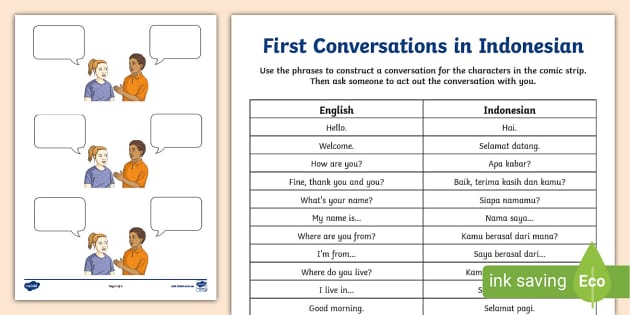
Absolutely. The agent adapts to absolute beginners, starting with basic greetings (Selamat pagi, Apa kabar?), self-introductions (Nama saya...), and simple phrases before gradually increasing complexity. It accepts mixed Indonesian-English input so you're never stuck, and explains the why behind every correction — including how menulis, penulis, tulisan, and menuliskan all derive from the same root word tulis.
Does it work on mobile?
Yes. Full feature parity across web, iOS, and Android. State-of-the-art speech-to-text means you can practice speaking Indonesian hands-free during commutes or walks. All settings, memory, and progress sync across devices automatically.
How long does it take to learn Indonesian?
The U.S. government rates Indonesian as a Category III language requiring approximately 900 hours of study for professional proficiency — significantly less than Mandarin or Arabic, but more than Romance languages. The initial barrier to basic conversation is low, and most learners using immersive AI report basic conversational ability within two to four months of consistent daily practice. The real challenge is breaking past the intermediate plateau into natural, colloquial fluency — exactly where roleplay-based learning excels.
Start Speaking Indonesian, Not Just Studying It
The gap between studying Indonesian and speaking Indonesian is deceptively wide. The easy entry point — no conjugation, Latin script, familiar word order — masks an affixation system that transforms single root words into dozens of forms, a formal-to-colloquial spectrum that creates parallel vocabularies, and a communication culture built on indirectness, hierarchy, and social context that no grammar table can teach. These aren't problems you solve with flashcards or affix charts — they're problems you solve by using the language in situations that matter.
Learn Indonesian Through Roleplay gives you exactly that — unlimited, emotionally rich conversation practice that adapts to your level, remembers your progress, and teaches grammar through experience rather than explanation. No scheduling. No judgment. No textbook Bahasa that makes Indonesians switch to English out of politeness the moment you open your mouth.
Try it free — no credit card required. And when you're ready to explore more, browse the full agent library at Jenova.