Best AI for Geopolitics Analyst: Structural Intelligence for a Fragmenting World Order (June 2026)
2026-06-28
Geopolitics Analyst delivers incisive geopolitical intelligence — fusing structural analysis, game theory, escalation modeling, and geoeconomic assessment across every region — at a depth that matches professional advisory desks and institutional research teams. While 2026 has become the year multipolarity moved from theory to lived reality, with the U.S.-China AI race intensifying, new economic nationalism reshaping state-market relationships globally, and geopolitical tensions displacing trade policy as the primary source of global economic uncertainty, this AI provides the analytical rigor and strategic depth that the moment demands.
✅ Power dynamics mapping — Alliance networks, bilateral tensions, and institutional leverage across every major theater ✅ Game theory frameworks — Strategic interaction modeling for adversarial and cooperative dynamics between state and non-state actors ✅ Escalation analysis — Multi-pathway escalation ladders with off-ramp identification and decision-point mapping ✅ Geoeconomics — Sanctions architecture, trade weaponization, critical mineral competition, and financial statecraft
The global order in 2026 is testing the analytical capacity of governments, corporations, and research institutions simultaneously. To understand why the right analytical tool matters now, let's examine the forces driving this environment.

Quick Answer: What Is the Best AI for Geopolitics Analyst?
Geopolitics Analyst is an AI-powered strategic intelligence platform that provides expert-level geopolitical analysis — integrating power dynamics, game theory, escalation modeling, and geoeconomic assessment — synthesized from authoritative sources and delivered on demand.
Rather than spending days compiling fragmented analysis from think tank reports, government white papers, and news wires, you receive integrated, structurally grounded assessments within a single conversation.
Key capabilities:
- Multi-actor power mapping with alliance network analysis and leverage identification
- Game-theoretic modeling of strategic interactions between competing states and blocs
- Escalation pathway construction with probability weighting and off-ramp analysis
- Geoeconomic intelligence covering sanctions, trade weaponization, supply chain chokepoints, and financial statecraft
The Problem: Why Geopolitical Analysis in 2026 Demands More Than News Monitoring
The geopolitical environment has entered a phase of structural transformation that defies simple narrative tracking. According to Lazard Geopolitical Advisory's 2026 outlook, Washington's "fusion of muscular economic interventionism and transactional dealmaking has forged a new industrial strategy playbook that is reshaping the relationship between state and market" — and in 2026, aspects of that playbook are going global. Meanwhile, the World Economic Forum's Global Risks Report 2026 analyzes risks through three timeframes to help decision-makers balance "current crises and longer-term priorities."
But processing and synthesizing this environment into actionable intelligence remains frustratingly difficult:
- Multi-theater simultaneity — U.S.-China strategic competition, European rearmament, Middle East conflict escalation, Latin American political realignment, and critical mineral competition all demand attention at once
- Analytical fragmentation — Political risk, economic statecraft, military capability, and technological competition are typically analyzed in separate silos by separate teams
- Speed-to-insight gaps — Events cascade faster than traditional research cycles can produce finished analysis
- Structural vs. episodic confusion — News coverage treats structural shifts as discrete events, obscuring the deeper dynamics that actually drive outcomes
The Multipolarity Challenge
The transition from a unipolar to a multipolar order is no longer theoretical — it's operational. Boston Consulting Group's geopolitical outlook identifies "a global shift toward increasing multipolarity as more geopolitical actors vie to shape the global environment for businesses." EY's geostrategic outlook projects that "geopolitical volatility and uncertainty will persist in 2026," recommending three geostrategic actions to build resilience.
This multipolarity doesn't produce neat blocs — it produces shifting, issue-specific alignments where yesterday's partner on trade is today's adversary on technology and tomorrow's partner on climate. Tracking these fluid dynamics requires analytical frameworks that go far beyond bilateral relationship monitoring.
The Geoeconomic Weaponization Problem
Economics and geopolitics have become inseparable. Lazard Geopolitical Advisory warns that "critical mineral alliances are taking center stage, as governments and companies race to secure traceable, resilient supply chains" — driven by China's expansion of export controls on rare earth elements that have "already created supply chain shocks." Simultaneously, the EU-China collision course is broadening from EVs to "wind components, solar, and mature node semiconductors."
According to UNCTAD's 2026 Trade and Development Foresights, "in 2025, uncertainty centred mainly on trade policy. But by early 2026, geopolitical tensions had become the main concern, especially as armed conflict" and escalation through the Strait of Hormuz reshaped the risk landscape.
Understanding sanctions architecture, trade weaponization, and financial statecraft requires integrating economic data with political intent, military posture, and alliance dynamics — a synthesis most analytical workflows cannot produce.
The AI-Geopolitics Convergence
The intersection of AI and geopolitics has become a domain of its own. The Atlantic Council's 2026 forecast identifies eight distinct ways AI will reshape the geopolitical landscape this year — from AI poisoning going mainstream to China doubling down on AI-powered influence operations to the intensifying battle of competing "AI stacks." U.S. cloud providers are projected to invest $600 billion in AI infrastructure in 2026 alone, underscoring AI's role as strategic national infrastructure.
As the Atlantic Council notes, "the United States will double down on exporting the US tech stack as the cornerstone of its international AI strategy," while China "holds some key advantages" with its "lead in open-source AI models and focus on applied AI." Analyzing this competition requires understanding not just the technology, but the alliance structures, diplomatic strategies, and economic leverage that determine its global trajectory.
This is exactly what Geopolitics Analyst was built for.
Why Geopolitics Analyst Is the Best AI for Strategic Intelligence
Geopolitics Analyst provides the kind of integrated, multi-domain analytical capability that has traditionally required a full geopolitical advisory team — power mapping, game theory, escalation modeling, geoeconomic analysis, and technology competition assessment unified in a single, persistent analytical relationship.
| Traditional Approach | Geopolitics Analyst |
|---|---|
| Weeks to compile multi-theater risk assessments from fragmented sources | Integrated cross-regional analysis generated within a single conversation |
| Separate analysts for political risk, economic statecraft, and security | Unified multi-domain synthesis connecting politics, economics, military, and technology |
| Static reports that age before publication | Real-time research capability with current data and evolving assessments |
| Scenario analysis limited by team size and cognitive bandwidth | Rapid scenario iterations with game-theoretic modeling and escalation pathways |
| Narrative-driven analysis that conflates events with structures | Structural analysis that distinguishes deep drivers from surface volatility |
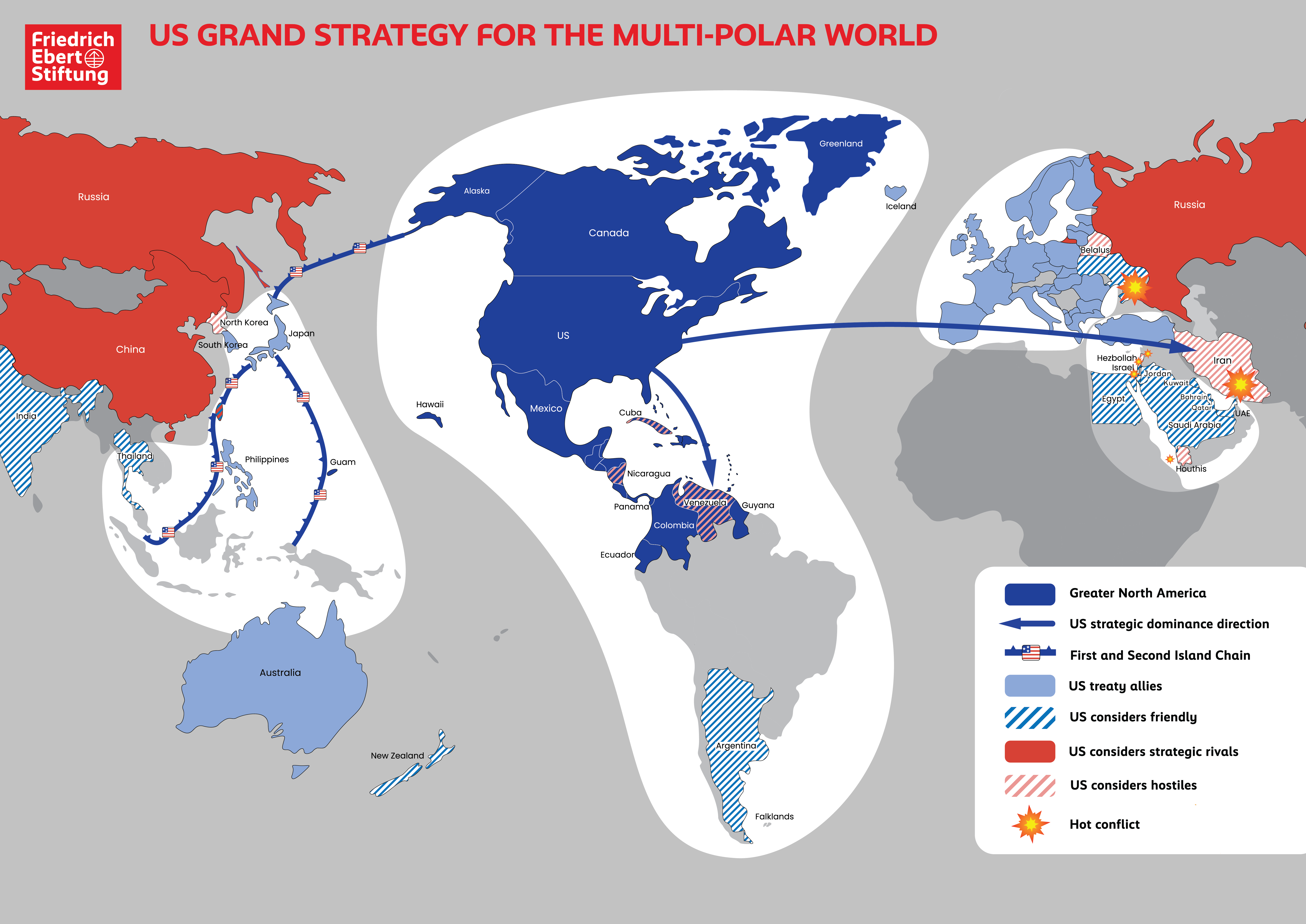
Power Dynamics and Alliance Network Analysis
The AI maps power relationships at multiple levels — bilateral, multilateral, institutional, and informal. Whether you need to understand the shifting dynamics within NATO as European defense spending surges, the evolving U.S. alliance architecture in the Indo-Pacific, or the complex web of relationships between China and ASEAN states that McKinsey's 2026 update shows thrived by "increasing trade with both economies," the analysis goes beyond describing relationships to explaining the structural incentives that drive them.
"Map the current alliance dynamics in the Indo-Pacific. Which relationships are deepening, which are fraying, and what structural factors explain the divergence? How does AUKUS interact with the Quad, and where do ASEAN states position themselves between U.S. and Chinese gravitational pulls?"
Game-Theoretic Strategic Modeling
Geopolitical outcomes emerge from the strategic interactions of multiple actors with competing interests, incomplete information, and asymmetric capabilities. The AI applies game-theoretic frameworks — including prisoner's dilemma structures, commitment problems, credible signaling, and audience cost dynamics — to model these interactions rigorously.
"Model the U.S.-China relationship on Taiwan as a multi-round game. What are the credible commitment mechanisms on each side? Where do audience costs constrain decision-makers? What signals would indicate a shift from the current equilibrium?"
Escalation Analysis and Scenario Construction
The AI constructs detailed escalation pathways for geopolitical flashpoints — identifying triggers, decision points, escalatory and de-escalatory moves, and off-ramp opportunities at each stage. This isn't speculative fiction — it's structured analytical reasoning grounded in historical precedent and current capability assessments.
"Construct escalation pathways for the EU-China trade confrontation. Starting from the current EV tariff dispute, map how escalation could extend to wind, solar, and semiconductor sectors. Identify decision points, retaliation options, and what would constitute effective off-ramps for both sides."
Geoeconomic Intelligence
Sanctions architecture, trade weaponization, critical mineral supply chains, and financial statecraft all receive the same analytical rigor as traditional political and security analysis. The AI connects economic policy instruments to their geopolitical objectives and assesses effectiveness against stated strategic goals.
As Lazard notes, "absent a strong web of these partnerships to institutionalize allied supply chains for minerals and advanced manufacturing, as well as credible demand signals that make non-China processing investable, China will retain leverage at key input choke points." The AI maps these chokepoints and assesses vulnerability.
Related Agents You'll Also Find Useful
If your geopolitical analysis extends into adjacent domains that demand specialized depth, several agents complement the Geopolitics Analyst's strategic perspective:
Military & Defense Analyst
Geopolitical analysis requires understanding military capabilities as both instruments of statecraft and constraints on political decision-making. This agent provides force assessment, doctrine analysis, order of battle evaluation, and wargaming support at institutional grade. Where Geopolitics Analyst maps the political conditions that shape conflict, the Military & Defense Analyst assesses the capabilities that define its potential character — from global military expenditure reaching $2.88 trillion to AI-integrated warfare systems reshaping doctrine.
- Force structure assessment with readiness and capability gap analysis
- Doctrinal comparison across NATO, Russian, Chinese, and emerging frameworks
- Wargaming and scenario construction with military-specific escalation modeling
Economics Analyst
Geoeconomics requires economic depth that goes beyond policy description. This agent provides rigorous macroeconomic modeling, trade flow analysis, fiscal mechanism tracing, and development economics — the analytical foundation for understanding how economic instruments translate into geopolitical leverage and how geopolitical shifts reshape economic outcomes.
- Sanctions impact modeling on national economies and specific sectors
- Trade flow analysis and supply chain disruption assessment
- Fiscal sustainability analysis for states under geopolitical pressure
Political Analyst
Geopolitical outcomes are ultimately shaped by domestic political dynamics — electoral pressures, coalition management, institutional constraints, and leadership psychology. This agent provides power mapping, electoral strategy analysis, and policy mechanism tracing that explains how domestic politics enable or constrain foreign policy — from Latin America's ideological shift toward right-wing candidates to European defense spending debates.
- Domestic political constraint analysis on foreign policy decision-making
- Electoral dynamics and their geopolitical implications
- Authoritarian decision-making analysis for adversary state leaders
Supply Chain Analyst
Critical mineral supply chains, semiconductor manufacturing dependencies, and energy infrastructure vulnerabilities have become frontline geopolitical issues. This agent provides operational supply chain intelligence — disruption scenario planning, alternative sourcing assessment, and logistics vulnerability analysis — that grounds geopolitical analysis in the physical infrastructure that connects economic and strategic competition.
- Critical mineral supply chain mapping and chokepoint identification
- Semiconductor manufacturing dependency analysis
- Energy infrastructure vulnerability and diversification assessment
How It Works: From Question to Strategic Intelligence in 5 Steps
Step 1: Define Your Analytical Requirement
Start with a specific geopolitical question, a scenario you want to explore, a regional assessment, or a strategic interaction you need modeled. The AI adapts its analytical framework to match the scope, depth, and domain of your requirement.
"Assess the current state of U.S.-China strategic competition across five domains: technology, trade, military posture, alliance management, and institutional influence. Where is competition intensifying, where are equilibria holding, and what are the most likely disruption points in the next 12 months?"
Step 2: Receive Multi-Source Structural Analysis
The AI integrates data across authoritative sources — think tank analyses, government publications, international organization reports, academic research, and current reporting — into a coherent analytical product. Structural drivers are distinguished from surface events. Sources are cited and assessments are clearly separated from raw data.
Step 3: Explore Analytical Depth
Follow up on any element of the initial assessment. Drill into specific bilateral dynamics, historical analogues, institutional mechanisms, or alternative interpretations. The AI maintains analytical continuity across extended conversations, building on previous assessments rather than starting fresh.
"You mentioned the EU-China collision course on industrial policy. How does Germany's position differ from France's, and what does that internal EU divergence mean for the credibility of European trade measures against Chinese overcapacity?"
Step 4: Model Strategic Interactions
The AI supports structured game-theoretic analysis and scenario development:
"Model the U.S.-China tariff truce as a repeated game. Given that the October agreement did not address structural frictions — technology restrictions and Taiwan support — what conditions would cause the hawkish consensus to reassert itself? What signals should I monitor?"
The analysis draws on Lazard's assessment that "2026 will determine whether there is a major break in US technology and trade policy towards China, or if the currently sidelined hawkish consensus will reassert itself."
Step 5: Generate Analytical Products
| Need | Output |
|---|---|
| Regional risk assessment | Multi-factor analysis covering political, economic, security, and technological dimensions |
| Strategic interaction model | Game-theoretic framework with equilibria, disruption triggers, and probability-weighted scenarios |
| Escalation analysis | Multi-pathway ladder with decision points, off-ramps, and historical analogues |
| Geoeconomic assessment | Sanctions effectiveness analysis, trade weaponization mapping, supply chain vulnerability |
| Briefing preparation | Structured summary with key judgments, supporting evidence, and confidence levels |
Results & Use Cases
📊 Corporate Strategist: Multi-Theater Risk Assessment
Scenario: A multinational's strategy team needs to assess how the convergence of U.S.-China trade tensions, European industrial policy shifts, and critical mineral supply chain disruptions affects their operations across three continents — before a board meeting next week.
Traditional Approach: Commission separate reports from political risk consultancies ($10,000-$50,000 per theater), wait weeks for delivery, and attempt manual synthesis across frameworks that don't speak to each other. The BCG assessment that "the age of laissez faire is giving way to an era in which governments are not merely referees but major players in the corporate arena" captures the urgency — but consultancy timelines don't match board meeting schedules.
Geopolitics Analyst: Integrated multi-theater risk assessment within a single extended conversation — mapping how U.S. economic nationalism, EU-China trade measures, and critical mineral export controls interact to create compound risks for cross-border operations. The analysis identifies specific regulatory triggers, timeline estimates for policy implementation, and concrete risk mitigation options.
- Cross-theater risk synthesis that identifies compound and cascading effects
- Specific regulatory trigger monitoring with estimated implementation timelines
- Scenario-weighted strategic options rather than generic risk ratings
💼 Policy Researcher: AI Governance Geopolitics
Scenario: A researcher analyzing the geopolitics of AI governance needs to map how competing visions — the EU's rights-based regulatory model, the U.S. preference for voluntary standards, and China's state-control approach — interact within the new UN-backed Global Dialogue on AI Governance.
Traditional Approach: Months of literature review, conference attendance, and expert interviews to piece together a fragmented picture across multiple governance forums.
Geopolitics Analyst: Structured analysis of the AI governance landscape drawing on the Atlantic Council's framework showing how "AI governance enters its first truly global phase" while remaining "geopolitical in substance." The AI maps each major power's strategic interests in governance outcomes, identifies where convergence is possible (scientific assessments, transparency norms) and where structural competition prevents agreement (autonomous weapons, mass surveillance), and assesses the likely architecture of the governance framework by year-end.
- Multi-actor interest mapping across the AI governance landscape
- Structural analysis of where cooperation is genuine vs. performative
- Assessment of binding vs. voluntary outcome probabilities
📱 Investor: Real-Time Geopolitical Event Assessment (Mobile)
Scenario: An investor receives breaking news of a significant geopolitical development while away from their desk — a sanctions announcement, military incident, or diplomatic rupture — and needs to assess the cross-asset implications within the hour.
Traditional Approach: Wait for broker research to arrive. Call contacts at advisory firms. Piece together fragments from news coverage. Arrive at a trading decision with incomplete analysis.
Geopolitics Analyst on mobile: Rapid structural assessment covering historical precedent analysis for similar events, the specific actors' decision constraints and likely responses, second-order effects across related theaters, and geoeconomic transmission mechanisms to markets. Full feature parity on iOS and Android with speech-to-text means substantive analytical queries can be dictated during transit.
- Historical precedent matching against current event parameters
- Multi-actor response modeling with identified decision constraints
- Geoeconomic transmission chain mapping from event to market impact
🎯 Diplomat: Summit Preparation Briefing
Scenario: A diplomatic team preparing for a bilateral summit needs to understand the counterpart's strategic position, domestic constraints, negotiating leverage, and likely red lines — synthesized across political, economic, and security dimensions.
Traditional Approach: Request briefing papers from multiple desk officers, each covering their domain in isolation. Attempt manual synthesis under time pressure. As the Atlantic Council notes, the U.S. State Department has rolled out its first Enterprise AI Strategy with "mandatory AI training for all officers" — recognizing that AI integration in diplomatic analysis is no longer optional.
Geopolitics Analyst: Comprehensive pre-summit briefing covering the counterpart's domestic political constraints (electoral pressures, coalition dynamics, institutional players), economic leverage and vulnerabilities, key issue positions with assessed flexibility ranges, historical pattern analysis from previous bilateral encounters, and specific recommendations for negotiating approach based on the structural dynamics of the relationship.
- Integrated multi-domain briefing in a single analytical product
- Counterpart constraint analysis that identifies genuine vs. performative red lines
- Negotiating leverage assessment with specific recommendation frameworks
Frequently Asked Questions
Is Geopolitics Analyst free to use?
Yes. All core features are available on the free tier with limited usage. Paid plans starting at $20/month provide significantly expanded usage, custom model selection across providers like OpenAI, Anthropic, and Google, and additional capabilities. No credit card required to start. Try Geopolitics Analyst with your first analytical requirement in under a minute.
How does this compare to Eurasia Group, Stratfor, or RANE?
Professional geopolitical advisory firms provide premium research products, client briefings, and proprietary risk indices — typically at $25,000-$100,000+ per year. Geopolitics Analyst provides interactive, on-demand analytical depth with the ability to explore scenarios, drill into specific dynamics, and receive customized assessments in real time. It complements subscription research by providing the synthesis and scenario exploration layer that static reports cannot offer — and at a fraction of the cost.
What sources does it draw from?
The AI synthesizes open-source intelligence across major research institutions (Atlantic Council, CSIS, Brookings, IISS, Chatham House), international organizations (UN, IMF, World Bank, WEF, OECD), government publications, academic journals, and current reporting. It executes real-time web searches to incorporate the latest developments and cites sources for verification. All analysis is grounded in the open-source intelligence landscape.
Can it model scenarios with game theory?
Yes. The AI applies formal and informal game-theoretic frameworks — including repeated games, commitment problems, signaling models, audience costs, and multi-player strategic interactions — to model geopolitical dynamics. These aren't academic exercises; they're practical analytical tools for understanding why actors behave as they do and predicting how they'll respond to changing conditions.
Does it cover non-state actors and hybrid threats?
Yes. The AI analyzes non-state actors, hybrid warfare, influence operations, and the intersection of state and non-state dynamics. The Atlantic Council's analysis of China's AI-powered influence operations — describing "a broader hybrid strategy in which AI-enabled influence operations, cyber activity, and diplomatic signaling are tightly integrated" — illustrates the kind of hybrid threat analysis the AI provides.
Does it work on mobile?
Full feature parity across web, iOS, and Android. State-of-the-art speech-to-text means you can dictate complex analytical questions during conferences, travel, or field research. All conversation history and memory sync across devices, so extended multi-session analytical projects continue seamlessly.
From Fragmented Signals to Structural Clarity
The geopolitical environment in 2026 is defined by convergent complexity. Lazard identifies five major trends — from the new economic nationalism to the search for a U.S.-China deal — each individually significant and collectively transformative. The Atlantic Council maps eight ways AI alone will reshape geopolitics this year. The World Economic Forum's Global Risks Report 2026 frames the challenge across three timeframes. And UNCTAD warns that geopolitical tensions have displaced trade policy as the primary source of global economic uncertainty.
No single analyst, however skilled, can hold all these threads simultaneously. No static report, however authoritative, can keep pace with the speed of structural change. The analytical challenge isn't access to information — it's the synthesis of fragmented signals into assessments rigorous enough to support real decisions.
Geopolitics Analyst delivers that synthesis — power mapping, game theory, escalation analysis, geoeconomic intelligence, and technology competition assessment unified in a single, persistent analytical relationship. The structural depth of a professional advisory practice, the breadth of a multi-source intelligence function, and the speed that 2026's fracturing world order demands.
Try Geopolitics Analyst now — no credit card required. Explore the full agent library at Jenova.