Best AI for Etiquette Coach: Master Dining, Social & Professional Protocol Across Every Culture (July 2026)
2026-07-02
Etiquette Coach is an AI-powered world-class etiquette advisor that provides instant, culturally fluent guidance on dining protocol, social graces, professional manners, conflict navigation, and cross-cultural etiquette — available 24/7 from any device. Whether you're a young professional preparing for a business dinner with international clients, a parent teaching children foundational social skills, or someone navigating an unfamiliar cultural setting where one wrong gesture could derail a relationship, this AI delivers the kind of precise, context-aware counsel that elite etiquette consultants charge $200-$500 per session to provide.
✅ Comprehensive dining etiquette — formal place settings, Continental and American styles, multi-course meal navigation ✅ Cultural briefings across global business and social customs — from Tokyo boardrooms to Parisian salons ✅ Social repair and conflict navigation — what to say after a faux pas, how to handle awkward situations gracefully ✅ Professional protocol — introductions, correspondence, dress codes, networking, and corporate hierarchy navigation
Etiquette isn't about rigid rules — it's about making the people around you comfortable while projecting confidence and competence. But knowing the right thing to do in every situation has become genuinely harder in a world that's simultaneously more casual and more globally interconnected. To understand why an AI etiquette coach matters in 2026, let's examine what people are actually struggling with.
Quick Answer: What Is the Etiquette Coach AI?
Etiquette Coach is a world-class AI etiquette advisor that provides instant, culturally aware guidance on dining protocol, social graces, professional manners, and conflict navigation — across every culture, class, and setting.
Key capabilities:
- Dining etiquette mastery — formal and casual, American and Continental, multi-course and business meals
- Cultural briefings for international business and travel — customs, taboos, gift-giving, and dress codes
- Social repair — recovering from faux pas, navigating awkward situations, and phrasing difficult conversations
- Professional protocol — introductions, networking, correspondence, hierarchy, and workplace manners
The Challenge: Why Etiquette Has Become One of the Most Confusing Skills to Navigate
Etiquette has always been about social fluency — the ability to move through any room, any table, any culture with confidence and grace. But the rules that once seemed stable have fractured into a bewildering landscape of competing expectations, cultural variation, and generational confusion.
The need has never been greater, and the guidance has never been harder to find:
-
Business dining remains a career differentiator — and a minefield. As the British School of Excellence notes, modern dining etiquette extends far beyond knowing which fork to use — it encompasses cultural sensitivity, conversation management, and social intelligence. Career coaches continue to emphasize that table etiquette still matters in professional settings — a poorly handled business dinner can undermine months of professional positioning. Yet most professionals have never received any formal training in dining protocol.
-
Cultural diversity has multiplied the complexity exponentially. A handshake that signals confidence in New York may be inappropriate in Tokyo. A gift-giving gesture that delights a German client may offend a Chinese one. Business card exchange in Seoul follows choreography that most Westerners have never learned. In a globally connected professional world, cultural illiteracy isn't just embarrassing — it's commercially costly. The etiquette consulting industry has grown in response, with elite firms like Beaumont Etiquette commanding 4.9-star ratings across dozens of reviews for teaching exactly these skills — at premium prices that most people can't access.
-
The casual-formal boundary has blurred beyond recognition. The post-pandemic workplace destroyed whatever remained of consistent dress code and behavioral norms. When your CEO wears sneakers but your client expects a suit, when a team Slack channel tolerates profanity but a client email cannot, when a Zoom meeting demands different formality than an in-person lunch — navigating these sliding scales of appropriateness requires judgment that no single rulebook covers.
-
Social anxiety around etiquette is pervasive. On Reddit's social skills communities, people regularly ask whether
— reflecting a widespread recognition that many adults missed foundational social education. The demand is real: people seeking help with everything from dining and presenting yourself professionally to knowing what to say at a networking event. The gap between wanting to behave correctly and knowing how is enormous. -
Professional etiquette coaching is prohibitively expensive. Private etiquette coaching sessions at established firms run $250-$500 per session, with comprehensive courses like Maggie Oldham's private dining etiquette program spanning 2.5 hours of intensive one-on-one instruction. Certification programs for etiquette professionals themselves cost thousands. For most people who simply want to stop feeling uncertain at a formal dinner or a cross-cultural business meeting, these price points are completely out of reach.
-
Digital etiquette has created an entirely new category of confusion. When to use email versus text versus voice message. How to decline a LinkedIn connection without offense. Whether a Zoom camera should be on or off. How to write a professional DM that doesn't sound robotic. The rules of digital communication are unwritten, evolving, and differ by industry, generation, and culture — yet the consequences of getting them wrong are immediate and visible.
Why Etiquette Coach AI
This is exactly what Etiquette Coach was built for — a single, always-available advisor who understands etiquette not as a set of arbitrary rules but as the art of navigating human interaction with confidence, consideration, and cultural intelligence.
Rather than replacing the value of immersive, in-person etiquette training — because some skills genuinely benefit from live practice with physical feedback — this AI serves as the comprehensive knowledge companion that ensures you never walk into a situation unprepared, and always have someone to consult when uncertainty strikes.
| Traditional Approach | Etiquette Coach AI |
|---|---|
| Private coaching at $250-500/session | 24/7 access to expert-level guidance — free tier available |
| Limited to coaches in major cities | Available from any location, any time zone, any device |
| One coach's cultural expertise and focus area | Cross-cultural fluency spanning global business and social customs |
| Books and guides that can't answer follow-up questions | Interactive, conversational coaching that adapts to your specific situation |
| Weeks to schedule a session before an important event | Instant preparation when the dinner invitation arrives |
| Generic online etiquette articles with no personalization | Guidance calibrated to your specific culture, role, and context |
Dining Protocol Mastery
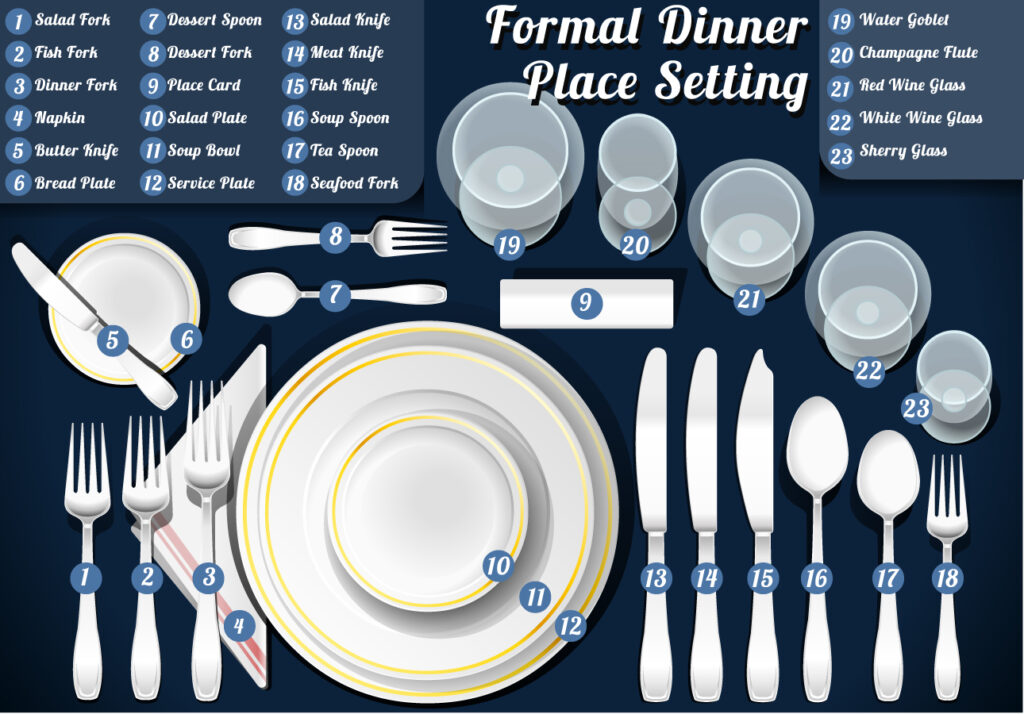
From formal multi-course affairs to casual business lunches, the AI walks you through every element — place setting navigation (which fork, which glass, which bread plate is yours), Continental versus American dining styles, napkin etiquette, ordering protocol, wine service, toasting, splitting the check, and the subtle signals that communicate confidence versus anxiety at the table. The Dallas School of Etiquette reminds us of fundamentals like maintaining eye contact, never overloading your plate, and chewing with your mouth closed — but real dining confidence runs much deeper, and the AI coaches the nuance that rulebooks miss.
"I have a business dinner tomorrow at a French restaurant with my company's CEO and two Japanese clients. Walk me through everything — from arrival and seating to ordering wine and navigating the check. What cultural considerations should I keep in mind for the Japanese guests?"
Cultural Briefings for Any Context
Traveling to Dubai for a conference? Hosting a delegation from South Korea? Attending a wedding in India? Meeting your partner's traditional Italian family for the first time? The AI provides situation-specific cultural briefings: greeting customs, gift-giving rules and taboos, dress code expectations, conversation topics to embrace and avoid, religious or cultural sensitivities, and the unwritten rules that locals know instinctively but visitors violate unknowingly.
"I'm visiting my girlfriend's family in Istanbul for the first time. They're observant but modern. What should I know about greeting etiquette, gift-giving, shoes in the house, and how to behave during a family meal?"
Social Repair and Conflict Navigation
Faux pas happen. You called someone by the wrong name. You made a joke that landed badly. You accidentally insulted a host's cooking. You showed up underdressed. The AI doesn't just help you prevent mistakes — it coaches you through recovering from them with grace and minimal damage. Social repair is a skill, and the AI provides specific phrasing, timing, and follow-up strategies for every kind of awkward situation.
"I accidentally used the wrong pronoun for my colleague's partner at a team dinner and they visibly stiffened. How do I address this — do I apologize immediately, privately later, or let it pass? What exactly should I say?"
Professional Protocol and Workplace Manners
Introductions, business card exchange, email etiquette, meeting behavior, networking events, office politics navigation, correspondence tone, thank-you notes, resignation protocol, and the unwritten hierarchy of professional interactions — the AI covers the full spectrum of workplace etiquette across industries and cultures. As the Emily Post Institute teaches, professional etiquette fundamentals improve relationships, raise self-esteem, and help build a successful career — and this AI makes those fundamentals accessible without enrolling in a course.
Related Agents You'll Also Find Useful
If you're developing social polish and professional presence, these complementary agents extend naturally into specific dimensions that directly affect how you're perceived:
Fashion Consultant
Etiquette and appearance are inseparable — the right outfit communicates respect for the occasion, the host, and the people around you. For building a wardrobe that matches the social and professional situations you're navigating, this agent provides globally fluent style guidance.
- Outfit evaluation and wardrobe building for any occasion and dress code
- Cultural dress code guidance for international travel and business
- Style development that projects confidence and appropriateness
Public Speaking Coach
Social confidence extends from one-on-one etiquette into public settings — toasts, introductions, presentations, and impromptu speaking moments. For the verbal dimensions of social polish, this agent builds your ability to command a room with poise.
- Speech writing and delivery coaching for formal and informal occasions
- Toast and introduction preparation for social events
- Anxiety management and confidence building for public moments
Executive Coach
For senior professionals where etiquette intersects with leadership — managing up, diplomatic communication, stakeholder navigation, and the subtle power dynamics of C-suite interaction — this agent provides the strategic interpersonal coaching that complements etiquette fundamentals.
- Leadership communication and stakeholder management
- Executive presence and interpersonal strategy
- Diplomatic navigation of organizational politics
How It Works
Step 1: Describe Your Situation
Tell the AI what you're facing — an upcoming event, a social situation you're uncertain about, a cultural context you're unfamiliar with, or a general area of etiquette you want to strengthen. Be as specific as you'd like. The AI calibrates its guidance to your exact context, culture, and comfort level.
"I've been invited to a formal charity gala next Saturday. Black tie. I've never been to one. Walk me through everything — what to wear, when to arrive, how to greet the hosts, dinner etiquette, and how to mingle without looking lost."
Step 2: Receive Specific, Actionable Guidance
The AI responds with detailed, situation-specific advice — not generic rulebook citations. Expect precise phrasing for introductions, specific behavioral guidance for your context, cultural notes relevant to your audience, and the kind of nuanced counsel that addresses what you're actually anxious about, not just what a textbook covers.
Step 3: Ask Follow-Up Questions and Go Deeper
Worried about a specific moment within the event? Unsure how to handle a particular person? Want to practice your toast? The conversation flows naturally into whatever dimension of the situation needs attention. Each follow-up builds on the context you've already provided.
"What if someone at the gala asks what I do and my job title sounds unimpressive compared to everyone else there? How do I describe my work with confidence without overselling or underselling?"
Step 4: Build Social Confidence Over Time
With persistent memory, Etiquette Coach remembers your cultural background, professional context, the situations you've navigated, and the specific areas where you tend to feel uncertain — making every future conversation more personalized and directly relevant to your ongoing social development.
Step 5: Access Guidance Anywhere, Anytime
Check dining protocol on your phone in the restaurant parking lot. Review cultural briefings on your tablet at the airport. Prepare for a networking event on your desktop the night before. Full feature parity across web, iOS, and Android — because the moments when you need etiquette guidance most are rarely convenient.

Results & Use Cases
🍽️ Young Professional Navigating a First Business Dinner
Scenario: A 26-year-old marketing associate has been invited to dinner with her director, two VPs, and a potential client at an upscale steakhouse. She's eaten at nice restaurants before, but she's never been to a business dinner where she's being evaluated. She doesn't know who orders first, whether she should order alcohol if others do, how to handle the check dance, or how to make conversation that's professional but not stiff.
Traditional Approach: Google "business dinner etiquette," read three contradictory articles, text a friend for advice, and spend the entire meal overthinking every fork choice instead of being present in the conversation.
Etiquette Coach: That afternoon, open the app and describe the situation — who's attending, the restaurant, the purpose of the dinner. Receive a complete briefing: let the most senior person sit first and order first, mirror their alcohol choice (if the VP orders wine, a glass is fine; if they order water, follow suit), place your napkin on your lap immediately upon sitting, keep your phone completely out of sight, and focus conversation on the client's interests rather than trying to impress. Get specific language for common tricky moments — how to gracefully decline an item you can't eat, how to handle a toast, and how to exit the dinner without being the last or first to leave.
- ✅ Complete situational briefing tailored to the specific dinner dynamics
- ✅ Specific phrasing for awkward moments — not just rules, but words
- ✅ Confidence to focus on the people instead of the protocol
🌏 Executive Preparing for Cross-Cultural Business Travel
Scenario: A tech company VP is traveling to Seoul for a week of meetings with a potential Korean manufacturing partner. She's been told the business culture is "formal" but has no idea what that means in practice — greeting etiquette, business card exchange protocol, drinking culture expectations, gift appropriateness, or how hierarchy affects who speaks and when during meetings.
Traditional Approach: Read a generic "doing business in Korea" blog post, buy a last-minute gift at the airport that may or may not be appropriate, and rely on her Korean counterpart's politeness to cover for whatever mistakes she makes — never knowing how many points she silently lost.
With Etiquette Coach AI: Receive a comprehensive cultural briefing specific to Korean business context — the two-handed business card exchange with a slight bow, the importance of addressing people by title and surname, the drinking culture protocol (never pour your own drink, always accept from a senior, use two hands), appropriate gifts (quality items from her home country, never sets of four, properly wrapped), and the meeting dynamics where the most senior person enters last and speaks first. Discuss specific scenarios she's likely to encounter and practice appropriate responses.
- ✅ Culture-specific protocol beyond generic "be respectful" advice
- ✅ Gift-giving guidance that avoids common Western mistakes in Korean context
- ✅ Meeting behavior coaching calibrated to Korean corporate hierarchy
💼 Parent Teaching Children Foundational Social Skills
Scenario: Parents of an 11-year-old and a 14-year-old want their children to develop strong social skills before they start attending formal events, job interviews, and college interactions — but the parents themselves aren't sure they know all the rules. They want to teach handshake etiquette, table manners, thank-you note writing, phone call conduct, and how to introduce themselves to adults with confidence.
Traditional Approach: Enroll in a children's etiquette class at $150-$300 per child, attend a single session that covers surface-level basics, and hope the lessons stick without ongoing reinforcement.
With the AI: Develop an age-appropriate curriculum — start with the fundamentals that etiquette educators identify as essential: eye contact, firm handshakes, saying "please" and "thank you" automatically, proper introductions, and table manners. Then build progressively toward more nuanced skills: writing thank-you notes, handling phones at the dinner table, behaving as a houseguest, navigating group conversations, and recovering gracefully from social mistakes. Revisit weekly with new scenarios and age-appropriate practice exercises.
- ✅ Progressive curriculum adapted to each child's age and developmental stage
- ✅ Ongoing reinforcement — not a one-time class that's forgotten in a week
- ✅ Parents learn alongside their children, filling their own knowledge gaps
📱 Real-Time Social Rescue on Mobile
Scenario: A man is at his partner's work holiday party — a formal cocktail event at a rooftop venue. He doesn't know anyone except his partner, who's been pulled into a conversation with her boss. He's standing alone near the bar, holding a drink awkwardly, and has no idea how to insert himself into a group conversation, what small talk topics are appropriate at a corporate event where he doesn't work, or whether it's acceptable to approach the food table alone.
Traditional Approach: Stand near the bar pretending to check his phone, wait for his partner to rescue him, and leave feeling like he embarrassed both of them.
With Etiquette Coach on mobile: Step into the restroom, open the app, and describe the situation in 30 seconds. Receive immediate tactical guidance: approach a group of two or three (not a pair — that's interrupting), wait for a natural pause, introduce yourself with your name and your connection to your partner ("I'm [name], I'm here with [partner] — she speaks so highly of this team"), and ask an easy open-ended question about the venue, the event, or the industry. Get specific exit lines for when a conversation stalls, and guidance on how to circulate naturally without looking lost. Return to the party with a plan.
- ✅ Real-time tactical guidance delivered in under two minutes on mobile
- ✅ Specific approach language and exit strategies — not just "be confident"
- ✅ Immediate anxiety reduction through concrete, actionable steps
Frequently Asked Questions
Is the Etiquette Coach AI free to use?
Yes. Etiquette Coach is available on Jenova's free tier with full core functionality. For extended conversations, persistent memory across sessions, and higher usage limits, paid plans start at $20/month. No credit card required to start.
How is an AI etiquette coach different from reading an etiquette book?
Etiquette books provide general rules — the AI provides contextual guidance. Tell it you're attending a Sikh wedding, a Japanese business dinner, or a Southern debutante ball, and it tailors every recommendation to that specific situation. It answers follow-up questions, handles edge cases that books can't anticipate, and provides the exact phrasing — not just the principle — for navigating difficult social moments. It's the difference between reading about swimming and having a coach in the water with you.
Does it cover etiquette across different cultures, not just Western?
Absolutely. Etiquette Coach provides culturally fluent guidance across global contexts — East Asian business protocol, Middle Eastern hospitality customs, South Asian family etiquette, European social traditions, Latin American warmth codes, and African communal dining practices. It understands that etiquette is culturally constructed, and what signals respect in one context may signal the opposite in another.
Can it help me recover from a social mistake I've already made?
This is one of its strongest capabilities. Social repair — knowing what to say after a faux pas, when to apologize versus when to let it pass, how to follow up appropriately, and how to rebuild after an awkward moment — is where most people feel most helpless and where the AI provides the most immediate relief. Describe what happened, and receive specific recovery strategies with exact language.
Is this only for formal occasions, or does it cover everyday social situations?
Both. The AI covers everything from black-tie galas and multi-course business dinners to everyday interactions — how to decline an invitation gracefully, what to bring as a houseguest, how to handle a difficult conversation with a neighbor, proper tipping practices, phone etiquette, and the unwritten rules of shared spaces. Etiquette applies everywhere; the AI meets you wherever you need it.
Does it work on mobile devices?
Yes. Full feature parity across web, iOS, and Android. Many users consult Etiquette Coach on their phones — in the parking lot before a dinner, at the airport before international travel, or in a restroom during a party when they need a quick social rescue.
Conclusion
Etiquette is the invisible architecture of every successful human interaction — the difference between a business dinner that builds trust and one that erodes it, between a cross-cultural meeting that opens doors and one that quietly closes them, between a social situation that builds your confidence and one that leaves you replaying every awkward moment for weeks. In a world where professional dining etiquette encompasses cultural sensitivity, conversation management, and social intelligence far beyond fork selection, where global business demands cross-cultural fluency that no single rulebook covers, and where private etiquette coaching remains a luxury at $250-$500 per session — the gap between wanting to handle every situation with grace and actually knowing how shouldn't depend on your zip code or your budget. Whether you're preparing for a career-defining dinner, navigating an unfamiliar culture, recovering from an embarrassing mistake, or simply wanting to move through the world with more confidence and consideration, expert guidance should be available the moment you need it.
Try Etiquette Coach now — your 24/7 world-class advisor for dining, social, and professional etiquette across every culture. Explore the full library of AI agents at Jenova.