Best AI for C++ Coding Assistant: Modern Code From Templates to Game Engines (June 2026)
2026-06-21
The C++ Coding Assistant from Jenova writes production-grade, modern C++ — from template metaprogramming and game engine architecture to high-frequency trading systems and scientific computing — with the standards-level precision that general-purpose AI tools consistently botch. While C++ powers the world's most performance-critical software in 2026, developers still burn hours deciphering cryptic template error messages, debugging memory corruption through layers of RAII wrappers, and translating architectural intent into clean, idiomatic C++20/23 implementations.
✅ Writes idiomatic, modern C++ (concepts, ranges, coroutines, modules, std::expected)
✅ Deep fluency in templates, RAII, STL, move semantics, and concurrency primitives
✅ Debugs template instantiation errors, UB, memory corruption, and linker nightmares
✅ Available 24/7 on web, iOS, and Android — paste code from any environment
To understand why C++ developers face challenges that no general-purpose AI tool is equipped to handle, let's look at what's driving the demand in 2026.
Quick Answer: What Is the C++ Coding Assistant?
The C++ Coding Assistant is an AI-powered development partner that writes, debugs, and refactors modern C++ code across game engines, systems programming, scientific computing, and high-performance applications.
Key capabilities:
- Modern C++17/20/23 generation — concepts, ranges, coroutines, structured bindings, and
constexpreverything - Template metaprogramming and generic library design with readable error messages
- Real-time debugging: paste compiler errors, sanitizer output, or crash dumps and get root-cause fixes
- Concurrency support —
std::jthread, atomics, lock-free structures, and parallel STL algorithms
The C++ Development Challenge in 2026
C++ isn't just surviving — it's growing faster than ever. Bjarne Stroustrup himself noted that there are 16.3 million C++ developers worldwide in 2025, with the number growing 72% over the last four years — almost 20% per year. Industry data shows 24.4% of companies have high demand for C/C++ developers, and C++ remains essential for high-frequency trading, game engines, embedded systems, and any domain where raw performance is non-negotiable.
That demand translates to serious compensation — the average salary for a C++ developer is $141,168 per year in the United States](https://www.indeed.com/career/c%2B%2B-developer/salaries), with [systems and compiler engineering roles reaching $180,000–$320,000 at companies like Apple, Google, Meta, and NVIDIA.
But writing correct, performant C++ remains one of the hardest things in software engineering:
- The language is enormous and still growing: C++23 added
std::expected,std::mdspan,std::print,std::generator, deducingthis, and dozens of other features. Keeping current with the standard requires continuous study — and knowing which features to actually use versus which to avoid requires years of judgment. - Template errors are legendary: A single misuse of a concept constraint or an SFINAE failure can produce compiler error messages spanning hundreds of lines. Deciphering "no matching function for call to..." errors buried in nested template instantiations routinely costs experienced developers 30-60 minutes per incident.
- Memory safety is your responsibility: While RAII and smart pointers mitigate the worst of manual memory management, C++ still exposes dangling references, use-after-move, iterator invalidation, and data races. A subtle
std::string_viewdangling reference or astd::vectorreallocation that invalidates iterators can produce bugs that only manifest under specific conditions. - Build systems are their own specialty: CMake, Bazel, Meson, vcpkg, Conan — the C++ build and dependency management ecosystem requires expertise that has nothing to do with writing C++ but consumes a disproportionate share of development time.
Why General AI Tools Produce Dangerous C++
The AI coding market has exploded — 81% of developers now use AI-powered coding assistants and these tools accelerate routine tasks by 30-50%. But C++ exposes their fundamental weakness: general-purpose models generate C++ that compiles but violates the language's core invariants.
They produce raw new/delete instead of smart pointers. They ignore move semantics and copy where they should move. They generate const_cast where they should fix the design. They write thread-unsafe code with shared mutable state and no synchronization. They generate std::vector<bool> without warning you it's not actually a vector. And their template code triggers pages of incomprehensible error messages because the constraints are wrong.
Only 29% of developers trust AI accuracy — Stack Overflow Developer Survey via Augment Code
That trust gap becomes a chasm in C++, where a subtle lifetime error, a missing std::move, or an incorrect memory ordering on an atomic operation can produce bugs that pass every test and corrupt data in production.
Why the C++ Coding Assistant
The C++ Coding Assistant isn't a Python-fluent chatbot that generates syntactically valid C++. It's a specialized AI with deep understanding of the C++ object model, template instantiation mechanics, RAII semantics, and the standard library's guarantees — the difference between code that compiles and code that a senior engineer would approve in review.
| Traditional Approach | C++ Coding Assistant |
|---|---|
| 30-60 min deciphering template instantiation errors | Paste the error, get the root cause and fix in seconds |
Hours reading cppreference for correct constexpr usage | Ask directly and get standards-precise answers with examples |
| Manual review of every move/copy path for correctness | AI-generated code with proper value category handling from the start |
| Debugging data races with TSan and hours of analysis | Describe the concurrent access pattern, get a correct synchronization strategy |
| Stack Overflow answers using C++11 idioms for C++23 questions | Modern idiomatic code using the latest standard features appropriately |
Modern, Idiomatic C++ — Not Legacy Code
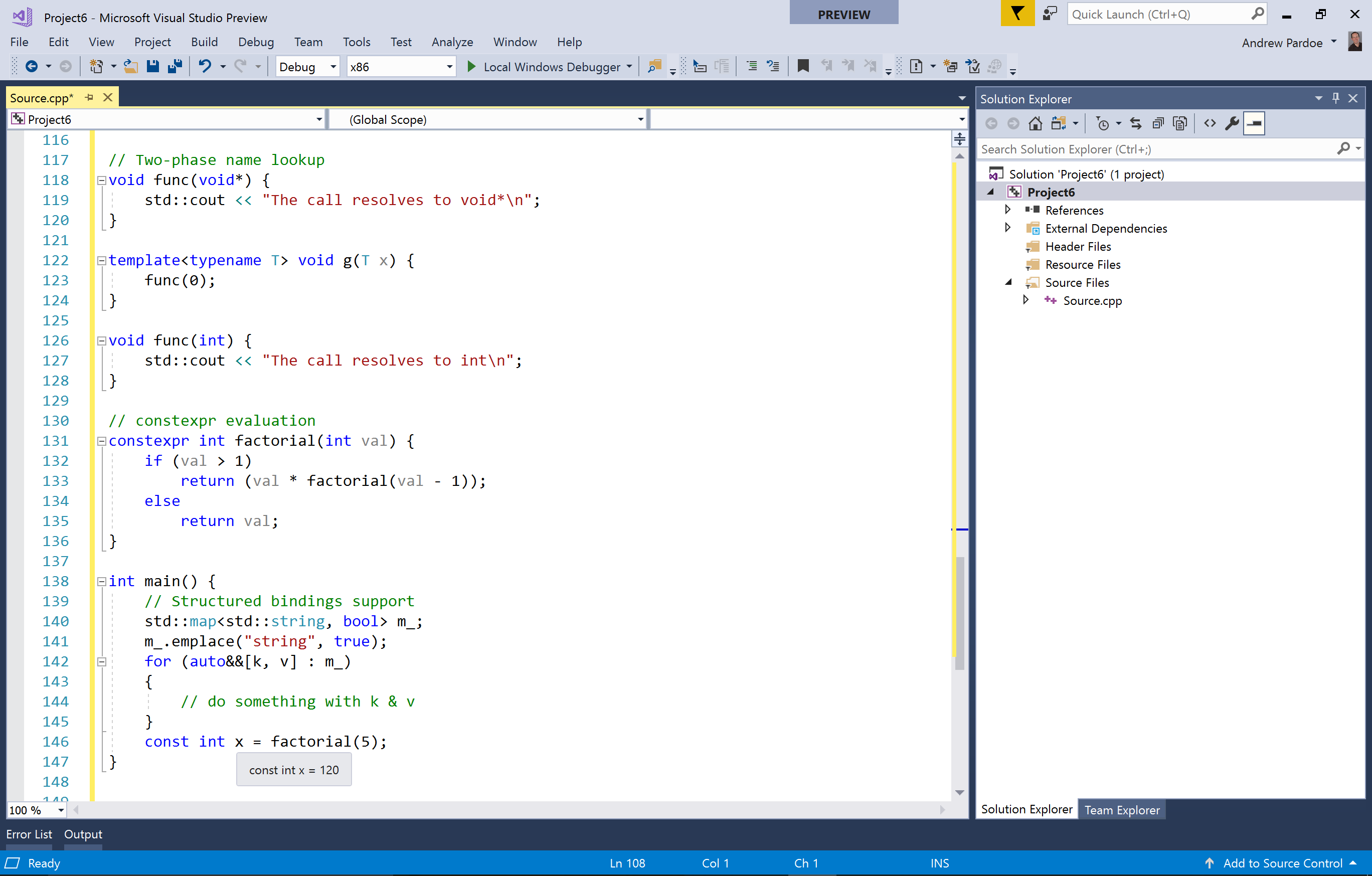
Every suggestion follows current C++ best practices: concepts over SFINAE, std::expected over exceptions where appropriate, structured bindings, constexpr evaluation, ranges pipelines, and proper move semantics. The assistant doesn't generate C++98 dressed in modern syntax — it generates code that leverages the standard's latest guarantees.
"Implement a thread-safe concurrent hash map using std::shared_mutex with reader-writer locking, concepts to constrain key/value types, and a ranges-compatible iteration interface"
Template and Generic Programming Mastery
Whether you're designing a compile-time reflection system, writing CRTP-based mixins, implementing type erasure with std::any-like semantics, or building a ranges adapter — the assistant understands template instantiation, SFINAE, concepts, and constexpr evaluation at the level needed to produce clean, compilable generic code with comprehensible error messages.
"Write a compile-time type-safe unit system using user-defined literals and operator overloading — meters, seconds, kilograms — with dimensional analysis that catches unit errors at compile time"
Debugging That Understands the C++ Object Model
Paste a compiler error, a sanitizer report, a Valgrind trace, or a mysterious runtime crash. The assistant identifies whether you're dealing with iterator invalidation, a dangling reference, undefined behavior from signed overflow, a violation of the strict aliasing rule, or a template substitution failure — and provides the fix with an explanation rooted in how the C++ abstract machine actually works.
"I'm getting a use-after-free from AddressSanitizer but only when compiled with -O2. The object is stored in a std::vector and I'm holding a reference to it while pushing more elements. Here's the code — what's happening?"
Related Agents You'll Also Find Useful
C++ development intersects with multiple domains and adjacent languages. These specialized agents complement the C++ Coding Assistant for tasks that naturally arise alongside C++ work:
C Coding Assistant
Many C++ projects interface with C libraries, wrap C APIs, or maintain mixed C/C++ codebases. When you need to write extern "C" interfaces, wrap C resource handles in RAII wrappers, or debug interop issues between C and C++ linkage.
- C API design for C++ library consumers
- RAII wrapper generation for C resource handles (
FILE*, sockets, OS handles) - ABI compatibility guidance for C/C++ mixed builds
Rust Coding Assistant
If you're evaluating Rust for new components alongside existing C++ infrastructure, or building FFI bridges between Rust and C++ through a C interface layer.
- C++-to-Rust migration evaluation and FFI binding generation
- Ownership pattern translation between C++ and Rust mental models
- Performance comparison analysis for shared workloads
Python Coding Assistant
C++ libraries frequently expose Python bindings via pybind11 or nanobind. When your C++ library needs a Python interface for data scientists, or when you're prototyping algorithms in Python before optimizing in C++.
- pybind11/nanobind binding generation for C++ libraries
- Python prototyping → C++ optimization workflow
- NumPy/C++ interop for scientific computing pipelines
LeetCode Coach
Preparing for technical interviews at companies hiring C++ engineers — game studios, trading firms, FAANG systems teams, or embedded companies. The LeetCode Coach provides adaptive practice with C++-specific optimization patterns.
- STL-fluent solutions using algorithms, containers, and iterators idiomatically
- Memory-efficient implementations with move semantics awareness
- Mock interview simulations for systems programming and game dev roles
How It Works
Step 1: Describe Your C++ Development Need
Open the C++ Coding Assistant and describe what you're building — a game engine subsystem, a trading system component, a generic library, or a performance-critical application. Specify your C++ standard version, compiler, platform, and any constraints.
"I'm building an entity component system for a game engine in C++20. I need a sparse set-based archetype storage with compile-time component registration using concepts, cache-friendly iteration, and support for adding/removing components without invalidating iterators."
Step 2: Iterate and Refine
Review the generated code, ask follow-up questions, request modifications, or paste in existing code for refactoring. The assistant maintains full context across the conversation — build your architecture incrementally, one component at a time.
"Now add a system scheduler that processes systems in parallel using std::jthread, with automatic dependency detection based on which component types each system reads vs. writes. Use std::atomic for the generation counter."
Step 3: Debug and Optimize
When something breaks — a 200-line template error, a data race under load, a performance cliff at scale — paste the output. The assistant reads compiler diagnostics, sanitizer reports, and profiler data to identify the root cause, not just the symptom.
"I'm getting a massive template error starting with 'no matching function for call to std::invoke' when I try to register a system that takes a const reference to a component. Here's the system signature and the registration function template — where's the constraint failure?"
Step 4: Test, Benchmark, and Ship
Request unit tests, benchmark harnesses, or documentation. The assistant generates Google Test / Catch2 test suites, Google Benchmark microbenchmarks, and Doxygen-compatible documentation with proper @tparam and @throws annotations.
"Write Catch2 tests for the ECS archetype storage — cover component addition, removal, iteration during modification, cross-archetype entity movement, and verify that the sparse set invariants hold after 10,000 random operations."
Results & Use Cases
💼 Game Engine Development
Scenario: A game programmer is building a custom rendering engine with a Vulkan backend, ECS architecture, and a multithreaded job system — a project that typically takes months of scaffolding before any actual game logic gets written.
Traditional Approach: Weeks of reading Vulkan spec documentation, studying open-source engine architectures, and debugging synchronization issues between render and game threads. C++ game engine roles command $180,000–$320,000 at major studios and tech companies, making slow iteration cycles extremely expensive.
C++ Coding Assistant: Generates Vulkan initialization boilerplate with proper validation layers, designs the ECS archetype storage with cache-friendly memory layout, and implements a lock-free job system using std::atomic with correct memory ordering. The developer focuses on rendering algorithms and gameplay from the start.
- Vulkan pipeline setup with RAII wrappers and validation layer integration
- Cache-line-aligned component storage with compile-time layout optimization
- Lock-free job queue with work stealing and proper memory fence placement
📊 High-Frequency Trading Systems
Scenario: A quantitative developer needs to build an ultra-low-latency order routing system that processes market data in under 5 microseconds — where every unnecessary allocation, branch misprediction, and cache miss matters.
Traditional Approach: Months of profiling, hand-tuning allocators, eliminating virtual dispatch, and measuring every code path with hardware performance counters. C++ Software Engineers earn approximately $144K on average, with HFT specialists commanding significantly more.
C++ Coding Assistant: Produces allocation-free hot paths using std::pmr polymorphic allocators, generates constexpr lookup tables for protocol parsing, implements SPSC lock-free queues with std::atomic using memory_order_acquire/release, and identifies virtual dispatch elimination opportunities. Pair with the Python Coding Assistant for strategy backtesting frameworks.
- Zero-allocation message parsing with compile-time protocol field layout
- SPSC ring buffer with proper memory ordering and false sharing prevention
- Template-based strategy dispatch eliminating virtual call overhead
📱 Cross-Platform Library Development
Scenario: A developer is building a cross-platform media processing library in C++20 that needs to compile on Windows (MSVC), Linux (GCC), macOS (Clang), Android (NDK), and iOS — with a C API for language bindings and SIMD acceleration for hot paths.
Traditional Approach: Weeks of fighting compiler-specific quirks — MSVC's delayed template parsing, GCC's stricter two-phase lookup, Clang's different SFINAE behavior — while maintaining a CMake build system that handles five target platforms with platform-specific SIMD intrinsics.
C++ Coding Assistant: Generates standards-conforming C++20 code that compiles across all three major compilers, designs the extern "C" API surface with proper ABI stability, implements SIMD processing with compile-time dispatch between SSE4.2/AVX2/NEON, and produces a CMake configuration with platform presets and CI-ready toolchain files. Use the C Coding Assistant for designing the stable C API layer.
- Compiler-portable C++20 with
#ifdeffallbacks only where the standard permits divergence - SIMD abstraction layer with compile-time architecture detection
- CMake presets for cross-compilation with vcpkg dependency management
🎯 Scientific Computing & Simulation
Scenario: A computational physicist is implementing a parallel N-body simulation with Barnes-Hut tree optimization — requiring constexpr math utilities, vectorized force calculations, and OpenMP parallelization across thousands of particles.
Traditional Approach: Reading academic papers, translating algorithms from pseudocode to C++, fighting with OpenMP scheduling clauses, and spending days profiling cache behavior to understand why the tree traversal is 10x slower than expected.
C++ Coding Assistant: Generates the octree data structure with constexpr bounding box calculations, implements vectorized gravitational force computation using ranges and parallel algorithms, designs the OpenMP work distribution with proper reduction clauses, and explains cache-optimal tree layouts for spatial queries.
constexpr-evaluated geometry primitives for compile-time validation- Parallel STL algorithms with execution policies for force accumulation
- Memory layout optimization for spatial locality during tree traversal
FAQ
Is the C++ Coding Assistant free to use?
Yes — Jenova offers a free tier with access to the C++ Coding Assistant and all core features. Paid plans starting at $20/month provide significantly more usage, custom model selection, and no watermarks on generated documents. No credit card required to start.
How is the C++ Coding Assistant different from GitHub Copilot?
GitHub Copilot provides inline autocomplete within your IDE. The C++ Coding Assistant is a specialized conversational AI with deep C++ language expertise — it handles template metaprogramming discussions, multi-file architecture guidance, sanitizer output debugging, and standards-level questions about object lifetime and memory ordering. It's built for the kind of complex, standards-aware C++ work where general tools often struggle with context across the solution and where only 29% of developers trust AI accuracy.
Can it handle C++20 and C++23 features?
Absolutely. The assistant generates code using concepts, ranges, coroutines, modules, std::expected, std::mdspan, structured bindings, constexpr containers, and other modern features — using them where they improve code clarity and correctness, not just because they're new. It also advises on which features have mature compiler support across MSVC, GCC, and Clang.
Does it work on mobile?
Yes. Jenova has full feature parity across web, iOS, and Android. Debug template errors, discuss architecture patterns, or generate class implementations from your phone — useful for reviewing code during commutes or quickly checking standards behavior away from your workstation.
Can it help with migrating from older C++ standards?
The assistant analyzes legacy C++11/14 code and identifies modernization opportunities — replacing SFINAE with concepts, raw pointers with smart pointers, std::bind with lambdas, and manual type traits with requires clauses — while preserving identical behavior and flagging any semantic changes introduced by the migration. For C interop layers, pair it with the C Coding Assistant.
Is my code kept private?
Yes. Jenova never uses your data to train public AI models. All data is encrypted in transit and at rest, and is never sold or shared with advertisers — critical for developers working on proprietary game engines, trading systems, or pre-release hardware platforms.
Conclusion
C++ in 2026 is simultaneously the most powerful and most demanding language in production — 16.3 million developers strong and growing 20% annually, powering everything from game engines to trading systems to autonomous vehicles. But the language's complexity — templates that produce incomprehensible errors, memory models that demand standards-level understanding, and a feature set that spans four decades of evolution — means general-purpose AI tools consistently produce C++ that compiles but violates fundamental invariants. The C++ Coding Assistant closes that gap with specialized expertise in modern C++17/20/23, template metaprogramming, RAII and lifetime management, concurrency primitives, and performance optimization — acting as the senior C++ engineer who understands the difference between code that runs and code that's correct according to the standard.
Try the C++ Coding Assistant now — no credit card required. Explore the full agent library at Jenova.