Best AI for C Coding Assistant: Portable Code From Embedded to Systems Programming (June 2026)
2026-06-21
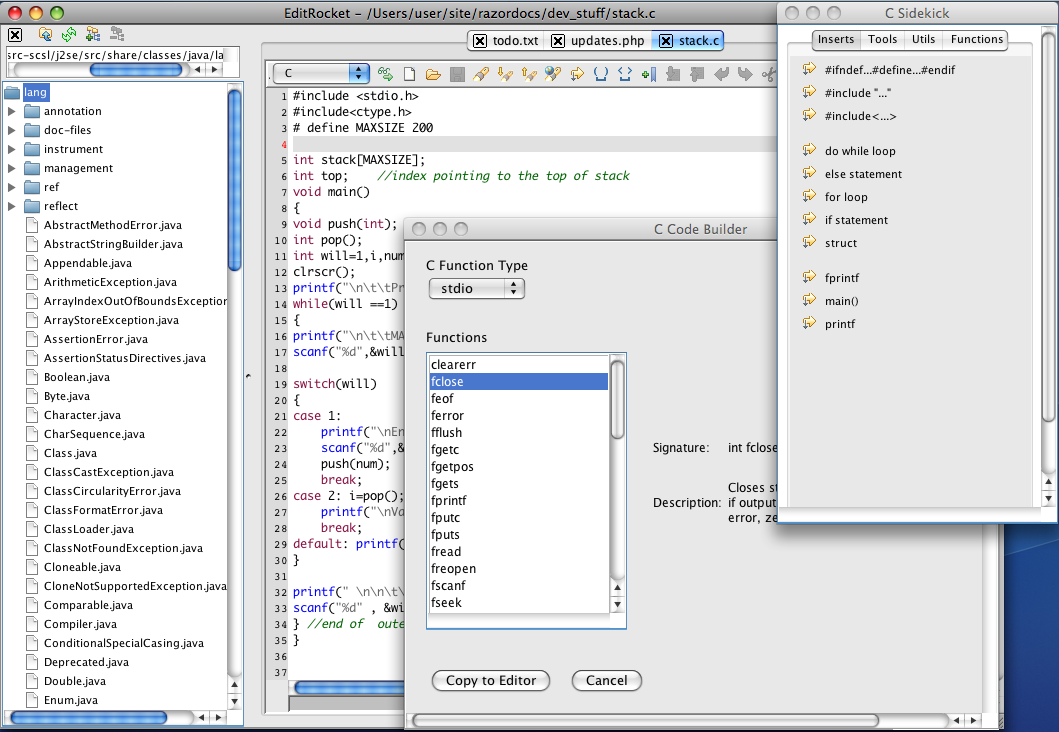
The C Coding Assistant from Jenova writes production-grade, portable C — from bare-metal embedded firmware to high-performance libraries and systems-level tooling — without the hours of debugging segfaults and chasing undefined behavior that come with the territory. While C remains the foundational language powering operating systems, IoT devices, and performance-critical infrastructure worldwide, writing correct, safe, and efficient C code demands a level of discipline that general-purpose AI tools consistently fail to deliver.
✅ Writes portable, standards-compliant C (C99/C11/C17/C23) with proper memory management ✅ Deep expertise in pointers, manual allocation, bitwise operations, and low-level I/O ✅ Debugs segfaults, memory leaks, undefined behavior, and platform-specific issues ✅ Available 24/7 on web, iOS, and Android — paste code from any environment
To understand why C developers face unique challenges that general AI coding tools can't solve, let's examine what's happening in the ecosystem in 2026.
Quick Answer: What Is the C Coding Assistant?
The C Coding Assistant is an AI-powered development partner that writes, debugs, and optimizes portable C code across embedded systems, operating systems, and high-performance applications.
Key capabilities:
- Memory-safe C generation — proper malloc/free patterns, buffer bounds checking, and leak-free designs
- Embedded firmware development for ARM Cortex-M, RISC-V, AVR, and other microcontroller families
- Debugging from stack traces, Valgrind output, sanitizer reports, and raw crash logs
- Cross-platform portability guidance across Linux, Windows, macOS, and bare-metal targets
The C Programming Challenge in 2026
C isn't going anywhere. According to industry analysis, C/C++ has high demand with approximately 24.4% of companies actively seeking developers with these skills, making it among the most sought-after language families in the market. A Reddit analysis of 2026 internship data found that
compared to more saturated languages like Python.But working in C remains uniquely punishing:
- Memory management is entirely manual: Every
mallocneeds a correspondingfree. Every pointer dereference risks a segfault. Every buffer operation risks an overflow. There's no garbage collector, no runtime safety net — just your discipline and a prayer that Valgrind catches what you missed. - Undefined behavior is silent and lethal: C compilers are permitted to do anything when UB occurs — and modern optimizing compilers ruthlessly exploit this. A signed integer overflow, an out-of-bounds access, or a use-after-free can produce code that "works" in debug mode and crashes in production.
- Portability is deceptively hard: Code that compiles cleanly on x86-64 Linux may fail on ARM due to alignment requirements, endianness assumptions, or platform-specific header availability. Writing truly portable C requires deep knowledge of what the standard guarantees versus what your current platform happens to allow.
- The tooling ecosystem is fragmented: Unlike managed languages with unified package managers and standardized build systems, C developers juggle Makefiles, CMake, Meson, autotools, and platform-specific build scripts — each with its own conventions and failure modes.
Why General AI Tools Fail at C
The current AI coding landscape, where roughly 85% of developers now regularly use AI tools for coding, is overwhelmingly optimized for higher-level languages. General-purpose AI assistants generate C that compiles but leaks memory, ignores const correctness, misuses volatile, or produces code riddled with undefined behavior that passes basic testing and explodes in production.
As industry analysis has noted, only 29% of developers trust AI accuracy according to Stack Overflow's 2025 Developer Survey — and that distrust is amplified in C, where a single misplaced pointer arithmetic operation can corrupt an entire system's memory. C developers need an AI that understands the language at the level of the standard, not one that pattern-matches from Stack Overflow snippets.
Why the C Coding Assistant
The C Coding Assistant isn't a Python-fluent chatbot that happens to output C syntax. It's a specialized AI built with deep understanding of manual memory management, pointer semantics, hardware-level programming, and the C standard's precise guarantees — the difference between code that compiles and code that's actually correct.
| Traditional Approach | C Coding Assistant |
|---|---|
| Hours debugging segfaults with GDB and printf | Paste the crash log or Valgrind output, get the root cause in seconds |
| Reading the C standard to determine if behavior is defined | Ask directly and get a standards-precise answer with the relevant clause |
| Manual review of every malloc/free path for leaks | AI-generated code with proper allocation patterns and error-path cleanup |
| Platform-specific #ifdef maze for portability | Clean, portable implementations with platform abstractions explained |
| Searching through embedded datasheets for register configurations | Describe the peripheral, get initialization code with register-level comments |
Memory-Safe Code Generation
Every function the assistant produces follows disciplined allocation patterns: null checks after malloc, cleanup on every error path, clear ownership semantics, and proper const qualification. It doesn't just write code that runs — it writes code that doesn't leak, doesn't overflow, and doesn't invoke undefined behavior.
"Write a dynamic array (vector) implementation in C with automatic resizing, proper error handling for allocation failures, and a clean API for push, pop, get, and free operations"
Embedded and Low-Level Fluency
From configuring GPIO pins on an STM32 to writing interrupt service routines for an AVR, the assistant understands hardware-level C — volatile-qualified register access, memory-mapped I/O, DMA configuration, and the constraints of running on systems with 32KB of RAM and no heap.
"Write a UART driver for STM32F4 using direct register access (no HAL), with interrupt-driven receive into a ring buffer and blocking transmit"
Debugging That Traces Root Causes
Paste a Valgrind report, an AddressSanitizer backtrace, a GDB session log, or just a mysterious crash description. The assistant reads the diagnostic output, identifies whether you're dealing with a use-after-free, a double free, a buffer overrun, or an alignment fault, and provides the fix with an explanation of the underlying memory model issue.
"Valgrind reports 'Invalid read of size 4' at line 87 of parser.c — here's the function. The array was allocated with malloc(n * sizeof(int)) but n can be zero. What's happening?"
Related Agents You'll Also Find Useful
C programming rarely exists in isolation. Whether you're building firmware, contributing to open-source infrastructure, or preparing for systems programming interviews, these agents complement the C Coding Assistant for tasks that naturally arise alongside C development:
C++ Coding Assistant
Many projects straddle the C/C++ boundary — wrapping C libraries with C++ interfaces, migrating legacy C to modern C++, or maintaining mixed-language codebases. When your project needs templates, RAII wrappers, or STL containers alongside C code.
- Modern C++17/20/23 with proper interop to C APIs
- RAII pattern generation for wrapping C resource handles
- Template metaprogramming and STL usage guidance
SQL Coding Assistant
Systems-level C applications frequently interact with SQLite, PostgreSQL's libpq, or custom database engines. When you need to optimize queries, design schemas, or debug database interactions at the C API level.
- Query optimization and execution plan analysis
- SQLite integration patterns for embedded C applications
- Schema design for data-intensive C applications
Rust Coding Assistant
If you're evaluating whether parts of your C codebase should migrate to Rust for memory safety guarantees, or if you need to write Rust FFI bindings for existing C libraries.
- C-to-Rust migration guidance and FFI binding generation
- Ownership and lifetime modeling for C developers
- Safe abstractions over unsafe C interop
LeetCode Coach
Preparing for systems programming interviews at companies hiring C developers — think embedded teams at Apple, firmware roles at Qualcomm, or kernel engineering at major tech companies. The LeetCode Coach provides adaptive practice with C-specific optimization focus.
- Data structure and algorithm implementation in C
- Memory-efficient solutions and pointer manipulation problems
- Mock interview simulations for systems programming roles
How It Works
Step 1: Describe Your C Development Task
Open the C Coding Assistant and describe what you're building — an embedded driver, a library, a data structure, a parser, or a full application. Specify your target platform, C standard version, and any constraints (no dynamic allocation, MISRA compliance, specific compiler).
"I'm writing a memory pool allocator for an embedded system with no heap. Fixed 64KB block of static memory, allocations in 32-byte chunks, O(1) alloc and free using a free list. Target: ARM Cortex-M4, C11, no standard library."
Step 2: Review, Iterate, and Extend
The assistant maintains full context across your conversation. Ask for modifications, request explanations of specific design decisions, or paste in your own code for review. Build your project incrementally — each response builds on what came before.
"Now add a coalescing mechanism so adjacent free blocks merge automatically, and add a diagnostic function that prints pool fragmentation statistics over UART."
Step 3: Debug and Analyze
When something breaks — and in C, something always eventually breaks — paste the error output. Stack traces, compiler warnings, sanitizer reports, or just "it works on my machine but crashes on the target." The assistant diagnoses the issue at the memory model level.
"I'm getting a hard fault on my Cortex-M4 when this function runs. It only happens when optimization is set to -O2. Here's the disassembly and the C source — what's the compiler doing differently?"
Step 4: Harden and Test
Request test cases, fuzzing harness generation, or static analysis guidance. The assistant generates test code targeting edge cases specific to C: null pointers, zero-length allocations, integer overflow boundaries, maximum buffer sizes, and alignment-sensitive operations.
"Generate a test suite for my ring buffer implementation. Cover empty/full boundary conditions, single-byte and maximum-size reads/writes, and concurrent producer-consumer scenarios with thread sanitizer annotations."
Results & Use Cases
💼 Embedded Firmware Development
Scenario: A firmware engineer is developing a sensor data acquisition system for an IoT device running on an ARM Cortex-M0+ with 16KB RAM and 128KB flash — no operating system, no heap allocation permitted.
Traditional Approach: Days of reading datasheets, writing peripheral initialization code by hand, debugging timing issues with an oscilloscope, and carefully auditing every byte of memory usage against the linker map.
C Coding Assistant: Generates register-level peripheral initialization (SPI, ADC, DMA) with proper volatile qualifiers, interrupt priority configuration, and a statically-allocated circular buffer for sensor readings. The engineer focuses on application logic instead of boilerplate hardware setup.
- Register-level peripheral drivers with datasheet-accurate bit definitions
- Static memory layout with compile-time size assertions
- Power management state machine with low-power mode transitions
📊 Open-Source Library Development
Scenario: A developer is creating a cross-platform JSON parser library in C that needs to build cleanly on Linux (GCC), macOS (Clang), Windows (MSVC), and FreeBSD — with zero external dependencies and C99 compliance.
Traditional Approach: Weeks of fighting compiler-specific warnings, discovering that MSVC doesn't support VLAs, handling different snprintf behaviors across platforms, and writing a CMake build system that actually works everywhere.
C Coding Assistant: Produces standards-compliant C99 code that avoids platform-specific extensions, generates proper #ifdef guards for the few unavoidable platform differences, and provides a CMake configuration with CI-ready presets for all four target compilers.
- Strictly conforming C99 without compiler-specific extensions
- UTF-8 handling with proper validation and boundary checks
- Portable build system with compiler detection and warning flag management
📱 Learning C on Mobile
Scenario: A computer science student is studying data structures and algorithms in C, working through assignments on their commute using their phone — implementing linked lists, hash tables, and binary trees with proper memory management.
Traditional Approach: Waiting until they're at their laptop, struggling with textbook pseudocode that glosses over C-specific details like pointer management and allocation error handling.
C Coding Assistant: Available on iOS and Android with full conversational capability. The student describes an assignment, gets a guided implementation with explanations of every pointer operation, and understands why each malloc check matters — not just that it should be there.
- Step-by-step guided implementations with pointer diagrams in text
- Memory leak analysis of student-submitted code
- Conceptual explanations tied to C-specific behavior (stack vs. heap, pointer decay, array-to-pointer conversion)
🎯 Legacy Code Modernization
Scenario: A team is modernizing a 25-year-old C89 codebase — a networking library used in production — to C17, replacing K&R-style function declarations, adding const correctness, and eliminating compiler warnings without breaking the API.
Traditional Approach: Painstaking manual review of thousands of lines, cross-referencing the C17 standard for deprecated features, and running extensive regression tests after each batch of changes. Senior C developers command $95,000 to $140,000+ annually, making slow modernization projects extremely costly.
C Coding Assistant: Analyzes legacy code patterns, identifies UB that "happens to work" on the current compiler, and produces modernized equivalents that preserve identical behavior while conforming to C17. Flags deprecated constructs, suggests static_assert additions, and generates migration checklists.
- K&R to ANSI/C17 declaration conversion with API preservation
- Undefined behavior identification in legacy "working" code
- Incremental migration strategy with regression test generation
FAQ
Is the C Coding Assistant free to use?
Yes — Jenova offers a free tier with access to the C Coding Assistant and all core features. Paid plans starting at $20/month provide significantly expanded usage, custom model selection, and no watermarks on generated documents. No credit card required to start.
How is this different from GitHub Copilot for writing C?
GitHub Copilot provides inline autocomplete within your IDE. The C Coding Assistant is a specialized conversational AI with deep C language expertise — it handles memory model analysis, standards-compliance questions, embedded peripheral driver generation, and debugging from sanitizer output. It's built for the kind of architectural reasoning and deep debugging where general tools consistently struggle.
Can it handle embedded and bare-metal programming?
Absolutely. The assistant generates register-level code for ARM Cortex-M, RISC-V, AVR, and other architectures — including interrupt handlers, DMA configuration, peripheral drivers, and RTOS task setup. For database-related embedded work, pair it with the SQL Coding Assistant for SQLite integration patterns.
Does it work on mobile?
Yes. Jenova has full feature parity across web, iOS, and Android. Debug C code, discuss memory layouts, or generate implementations from your phone — useful for reviewing embedded firmware during field testing or working through algorithms away from your development workstation.
Can it help with C-to-Rust or C-to-C++ migration?
The C Coding Assistant can analyze existing C code and identify migration candidates — functions with complex ownership semantics, unsafe patterns, or portability issues. For the target language side of the migration, pair it with the Rust Coding Assistant or the C++ Coding Assistant for idiomatic rewrites and FFI binding generation.
Is my code kept private?
Yes. Jenova never uses your data to train public AI models. All data is encrypted in transit and at rest, and is never sold or shared with advertisers — critical for developers working on proprietary firmware or pre-release hardware.
Conclusion
C programming in 2026 occupies a unique position: still foundational, still in high demand, and still ruthlessly unforgiving of mistakes. The language that powers operating systems, embedded devices, and performance-critical infrastructure demands a level of precision that general-purpose AI tools consistently fail to deliver — producing code that compiles but leaks, overflows, or invokes undefined behavior in ways that only surface in production. The C Coding Assistant closes that gap with specialized expertise in memory management, pointer semantics, hardware-level programming, and standards-compliant portability — acting as the senior C developer who reviews every allocation path, catches every UB trap, and knows the difference between what your compiler allows and what the standard guarantees.
Try the C Coding Assistant now — no credit card required. Explore the full agent library at Jenova.