Best AI for Beginners: Learn Concepts, Tools, and Prompts With Zero Tech Background (June 2026)
2026-06-25
Artificial intelligence reached 53% population adoption in just three years — faster than the personal computer or the internet. But adoption doesn't mean understanding. Millions of people are using AI tools daily without grasping what's actually happening, which tools fit their needs, or how to get better results from a simple prompt. AI for Beginners is a friendly, patient AI guide that teaches you the concepts, tools, and prompt techniques behind artificial intelligence — through natural conversation, at your own pace, with absolutely no coding or technical background required.
✅ Explains AI concepts in plain language — machine learning, neural networks, large language models — without jargon overload ✅ Helps you discover which AI tools actually match your specific goals and workflow ✅ Teaches prompt engineering through hands-on practice, not abstract theory ✅ Adapts to your knowledge level — whether you've never touched an AI tool or you're ready to go deeper
The AI in education market was valued at $8.3 billion in 2025 and is projected to reach $57.2 billion by 2033, growing at 25.9% annually. Yet over 80% of U.S. high school and college students now use AI while only half of schools even have AI policies — and just 6% of teachers say those policies are clear. The technology is everywhere. The education hasn't caught up. That gap is precisely what AI for Beginners was built to close.
Quick Answer: What Is AI for Beginners?
AI for Beginners is a conversational AI tutor that teaches you how artificial intelligence works and how to use AI tools effectively — no technical background needed.
Key capabilities:
- Plain-language explanations of AI concepts from basic to intermediate — tailored to your starting point
- Guided discovery of which AI tools match your specific use cases and goals
- Hands-on prompt engineering practice with real-time feedback and improvement tips
- Jargon translation — turn any technical AI term into language you actually understand
The Problem: AI Is Everywhere, but Understanding Isn't
We're living through the fastest technology adoption in history. Generative AI reached 53% population adoption within three years — outpacing the PC, the internet, and smartphones. The estimated value of generative AI tools to U.S. consumers alone reached $172 billion annually by early 2026, with the median value per user tripling between 2025 and 2026. Organizations are adopting at 88%. This isn't a future trend — it's the present.
But accessibility has massively outpaced literacy. Here's what beginners actually face:
- Overwhelming tool proliferation. There are hundreds of AI tools available in 2026 — chatbots, image generators, code assistants, research tools, writing aids. Beginners have no framework for knowing which ones matter, which overlap, and which fit their actual needs. As one comprehensive beginner guide noted, the strongest approach is to start with one general tool and one specialist tool rather than signing up for ten at once.
- Conceptual fog. Terms like "large language model," "neural network," "fine-tuning," "hallucination," and "context window" appear constantly in AI discourse. Without understanding what these mean at even a basic level, users can't evaluate claims, troubleshoot bad outputs, or make informed decisions about which tools to trust.
- The prompt quality gap. The same AI tool can produce wildly different outputs depending on how you prompt it. Most beginners write vague, under-specified prompts and assume the tool isn't useful — when the real issue is the instruction, not the technology.
- Education systems lagging behind. While over 80% of students now use AI for school tasks, only 6% of teachers report having clear AI policies. Formal education hasn't scaled to meet the moment, leaving most people to self-teach with no structured path.
- Expert-public perception gap. According to Stanford's 2026 AI Index, 73% of AI experts expect a positive impact on how people do their jobs, compared with just 23% of the public — a 50-point gap. This disconnect stems largely from knowledge asymmetry: experts understand capabilities and limitations, while the public operates on hype or fear.
The Capability Frontier Is Advancing Faster Than Comprehension
AI isn't slowing down to wait for people to catch up. The 2026 Stanford AI Index found that AI capability is accelerating, not plateauing — with models now meeting or exceeding human baselines on PhD-level science questions, multimodal reasoning, and competition mathematics. On a key coding benchmark (SWE-bench Verified), performance rose from 60% to near 100% in a single year. Meanwhile, Harvard Business Review reports that people are adopting generative AI for an ever-widening range of uses in 2026, with shifts in emphasis rather than stark ruptures.
The question isn't whether you'll use AI — you almost certainly already do. The question is whether you'll understand what you're using well enough to get real value from it. This is exactly what AI for Beginners was built for.
Why AI for Beginners
AI for Beginners isn't a course with a fixed curriculum you either keep up with or fall behind on. It's a conversational guide that meets you at your exact level of understanding and moves at your pace. Ask a basic question and get a clear, jargon-free answer. Ask a deeper follow-up and it scales with you. There's no syllabus to finish, no quiz anxiety, and no assumption about what you already know.
| Traditional AI Learning Resources | AI for Beginners |
|---|---|
| Fixed courses with rigid pacing | Conversational, self-paced — ask anything, anytime |
| Assume baseline technical knowledge | Starts from absolute zero — no assumptions |
| Theory-heavy, example-light | Concept explanations grounded in everyday examples |
| Separate from the tools themselves | Teaches you about tools while being an AI tool — learn by doing |
| No personalized feedback | Adapts explanations to your specific questions and confusion points |
| One-size-fits-all curriculum | Covers exactly what you want to know, nothing you don't |
Concept Clarity Without the Jargon
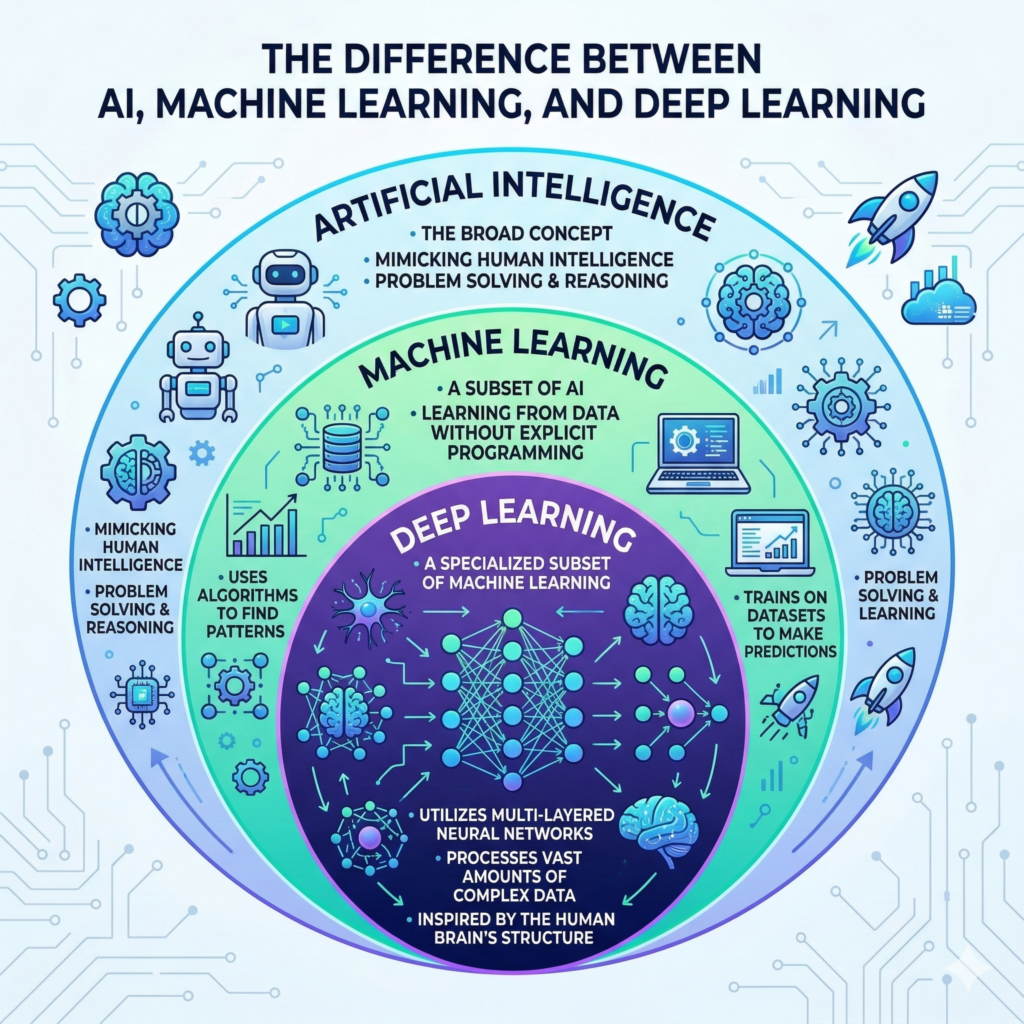
The agent explains what machine learning, deep learning, neural networks, large language models, and generative AI actually are — using analogies and plain language that stick. It doesn't dumb things down or skip important nuance; it translates technical ideas into frameworks you can actually think with. Encounter a confusing term in the news or on social media? Paste it in and get an instant, contextual explanation.
"What does it mean when people say an AI model 'hallucinates'? Why does it happen and how can I tell when it's happening?"
Tool Discovery Matched to Your Life
Instead of handing you a list of 30 tools and hoping you figure it out, the agent asks what you're trying to accomplish — then recommends specific tools that fit. Writing emails? Researching for school? Creating social media content? Learning a new language? Each goal maps to different tools, and the agent explains why each recommendation fits, what its limitations are, and how to get started.
"I'm a freelance graphic designer with no coding experience. What AI tools would actually help me in my day-to-day work, and which ones are just hype?"
Hands-On Prompt Engineering
The difference between a mediocre AI output and a genuinely useful one almost always comes down to the prompt. AI for Beginners teaches you how to write better prompts through practice — not theory. Give it a prompt you've been using, and it'll show you exactly how to improve it: adding specificity, setting constraints, defining output format, providing context.
"I keep asking ChatGPT to help me write emails but the results always sound too formal and generic. How should I actually be prompting it?"
Honest About Limitations
This agent doesn't sell you on AI as magic. It explains what AI can and can't do reliably, where to verify outputs, why "AI said it" isn't a citation, and how to develop healthy skepticism. Understanding limitations is just as important as understanding capabilities — and it's the fastest way to move from passive user to informed operator.
Related Agents You'll Also Find Useful
Once you've built a foundation with AI for Beginners, these agents let you put that knowledge to work in specific domains:
Writing Assistant
If your primary interest in AI is better writing — emails, essays, blog posts, reports — the Writing Assistant adapts to any format, audience, and domain. It learns your voice over time and produces polished output that sounds like you, not a robot. A natural next step once AI for Beginners has taught you how prompting works.
- Adapts to your writing style and voice across sessions
- Any format: emails, essays, reports, creative writing, social posts
- Real-time editing, rewriting, and tone adjustment
Prompt Generator
Once you understand the basics of prompt engineering, the Prompt Generator takes you further — crafting optimized prompts for text, image, music, and video AI models. It's the advanced counterpart to what AI for Beginners teaches at an introductory level.
- Generates prompts for text, image, music, and video AI models
- Optimizes for specific platforms and model capabilities
- Teaches prompt engineering patterns through example
Real-Time Search
One of the first practical AI skills beginners develop is using AI for research. Real-Time Search performs cross-platform searches across Google, Reddit, YouTube, GitHub, and Amazon — synthesizing results into clear, actionable answers with sources. It's a practical demonstration of AI-powered research workflows.
- Cross-platform search: Google, Reddit, YouTube, GitHub, Amazon
- Source-cited answers for verification
- Natural language queries — no search operator expertise needed
Deep Research
For beginners who want to see what AI research capabilities actually look like at scale, Deep Research searches hundreds of sources and synthesizes findings into comprehensive, cited reports. It's the difference between asking a chatbot a question and having an AI research assistant produce a full analysis.
- Searches hundreds of sources on any topic
- Synthesizes findings into comprehensive cited reports
- Academic and professional-grade research output
How It Works
Step 1: Tell It Where You're Starting From
Open AI for Beginners and describe your current knowledge level and what you want to learn. Never used an AI tool before? Say so. Already using ChatGPT but confused about how it works under the hood? Say that instead. The agent calibrates its explanations to your exact starting point.
"I've never used any AI tool before. I keep hearing about ChatGPT and AI at work but I have no idea where to start. Can you explain the basics?"
Step 2: Learn Through Conversation
Ask questions naturally — the way you'd ask a knowledgeable friend. The agent explains concepts, gives examples, and checks whether its explanations are landing. If something doesn't click, say so — it'll try a different angle, a different analogy, or break it down further.
"You mentioned 'large language models' — can you explain what that actually means in simple terms? Like, how does it know what to say next?"
Step 3: Discover Tools That Fit Your Goals
Once you have a conceptual foundation, tell the agent what you're trying to accomplish in your work or personal life. It recommends specific AI tools based on your actual goals — not a generic roundup — and explains the strengths, limitations, and best starting approach for each.
"I'm a small business owner. I need help with writing marketing emails, creating social media graphics, and keeping track of expenses. What AI tools should I actually be using?"
Step 4: Practice Prompting and Keep Learning
Start using AI tools with guidance. Share prompts you've written, outputs you've received, or results that disappointed you. The agent coaches you on improving your prompting technique, understanding why certain outputs fell short, and developing the habits that make AI tools genuinely useful over time.
"I tried asking an AI to write a product description for my candle business and it came out super generic. Here's my prompt — what did I do wrong?"
Results & Use Cases
🎓 Complete AI Beginner Goes From Zero to Competent
Scenario: A 52-year-old office manager keeps hearing about AI at work and in the news. Her company is rolling out AI tools next quarter and she doesn't want to be the person who can't keep up — but she has no idea where to start and finds most online explanations too technical.
Traditional Approach: Watch YouTube tutorials that assume prior knowledge, read articles filled with unexplained jargon, or sign up for a structured online course that moves too fast and covers material she doesn't need.
AI for Beginners: She opens the agent and says "I know nothing about AI and I'm nervous about looking stupid at work." The agent starts from absolute zero — what AI is, what it isn't, why her company is adopting it, what she'll likely be expected to do with it. Over several conversations, she builds real understanding at her own pace, with no judgment and no fixed schedule.
- Explains concepts at exactly the right level for her background
- Addresses emotional barriers — not just technical ones
- Provides workplace-relevant context she can use immediately
💼 Freelancer Discovers the Right Tools for Their Workflow
Scenario: A freelance copywriter uses ChatGPT occasionally but suspects there are better tools for specific parts of their workflow — research, editing, client communication. They're overwhelmed by "Best AI Tools" listicles that all recommend different things.
Traditional Approach: Read five competing blog posts with different recommendations, sign up for free trials of eight tools, waste two weeks testing, and end up back where they started.
AI for Beginners: The agent asks about the freelancer's specific workflow — client briefs, research, drafting, editing, invoicing. It maps each workflow step to the most relevant tool, explains why, and provides starting prompts for each. One conversation replaces weeks of trial and error.
- Workflow-mapped recommendations instead of generic tool lists
- Explains when to use which tool and why
- Saves weeks of unfocused experimentation
📱 Student Learns Prompt Engineering on Their Phone
Scenario: A college student uses AI for assignments but consistently gets mediocre outputs. Their prompts are vague and they don't understand why small changes make big differences.
Traditional Approach: Google "how to write better AI prompts," find articles that list abstract principles without showing before-and-after examples tied to academic work.
AI for Beginners: From their phone between classes, the student shares a prompt they used and the disappointing output they received. The agent rewrites the prompt, explains exactly what changed and why, and gives them a mental framework for prompting that transfers across tools and tasks. Over multiple sessions, their prompting skill compounds.
- Before-and-after prompt coaching with specific explanations
- Academic-relevant examples — essay research, study guides, paper outlines
- Mobile-friendly — full coaching from a phone conversation
🔍 Retiree Wants to Understand AI in the News
Scenario: A retired engineer reads about AI breakthroughs, safety concerns, job displacement, and regulation — but can't tell what's real from what's hype. They want a trusted source to help them make sense of headlines.
Traditional Approach: Subscribe to newsletters that are either too technical or too shallow. Follow influencers who sensationalize. End up more confused, not less.
AI for Beginners: The retiree pastes in a headline or article excerpt and asks "is this real?" The agent explains the underlying technology, puts the claim in context, identifies what's accurate and what's overstated, and connects it to concepts from previous conversations. Over time, the retiree develops genuine AI literacy — the ability to evaluate claims independently.
- Contextualizes news and headlines in plain language
- Distinguishes hype from genuine breakthroughs
- Builds critical evaluation skills, not just knowledge
FAQ
Is AI for Beginners really free to use?
Yes. AI for Beginners is available on Jenova's free tier with full core functionality. Paid plans starting at $20/month unlock significantly more usage — up to 1,500× the free limit on the Enterprise tier — plus custom model selection and priority support. But you can start learning immediately at no cost.
Do I need any technical background to use it?
None at all. The agent is specifically designed for people with zero technical background. It starts from whatever level you're at — even if that level is "I don't know what AI stands for" — and builds understanding through patient, jargon-free conversation. If you can type a question, you can use it.
How is this different from just asking ChatGPT to explain AI?
General chatbots explain AI concepts, but they don't adapt their teaching approach based on your specific knowledge gaps, remember what you've already learned across sessions, or proactively guide you through a learning journey. AI for Beginners is purpose-built for AI education — with pedagogical design, not just information retrieval. It also teaches you how to use other AI tools effectively, which a general chatbot has no incentive to do well.
Can it help me with specific AI tools I'm already using?
Yes. Bring in prompts you've written, outputs you've received, or tools you're confused about. The agent coaches you on improving your results, understanding why certain outputs were off, and getting more value from whatever tools you're already working with.
Does it work on my phone?
Yes. Jenova has full feature parity across web, iOS, and Android. You can learn about AI concepts, get tool recommendations, and practice prompt engineering from your phone — with voice input for hands-free conversation.
Will it keep up as AI changes?
The agent stays current with the AI landscape — new tools, new capabilities, new terminology. With persistent memory enabled, it also remembers what you've already learned and builds on it across sessions, so your education compounds over time rather than resetting with each conversation.
Conclusion
AI adoption has outpaced AI literacy by a massive margin. The technology reached 53% population adoption faster than the PC or the internet, the AI in education market is projected to grow from $8.3 billion to $57.2 billion by 2033, and 88% of organizations have already integrated AI into their workflows. Yet most people are using these tools without understanding what they are, how they work, or how to get meaningfully better results from them. The 50-point gap between expert optimism and public skepticism isn't about intelligence — it's about education.
That gap doesn't close itself. It closes when someone patient, knowledgeable, and judgment-free meets you where you are and helps you build real understanding — one question at a time. That's what this agent does. Try AI for Beginners now. Explore the full agent library at Jenova.