Best AI for Acting Coach: Scene Work, Audition Prep & Technique Training Across Every Methodology (July 2026)
2026-07-02
Acting Coach is an AI-powered master acting coach that provides interactive scene work, audition preparation, script analysis, dialect coaching, and technique training across every major methodology — Stanislavski, Meisner, Chekhov, Strasberg, Adler, Hagen, and beyond — available 24/7 from any device. Whether you're a working actor preparing a self-tape on a 48-hour deadline, a theater student deepening your understanding of given circumstances, or a beginner building foundational skills before your first audition, this AI delivers the kind of detailed, craft-focused coaching that typically requires private sessions costing $100-$300 per hour.
✅ Interactive scene work with real-time character analysis, objective identification, and beat breakdown ✅ Self-tape and audition preparation — framing, performance calibration, and casting-director-aligned feedback ✅ Technique training across all major methodologies with practical exercises ✅ Dialect coaching, cold reading practice, and monologue selection guidance
The entertainment industry is evolving rapidly, but the fundamentals of actor training remain deeply human — and deeply expensive. To understand why an AI acting coach matters in 2026, let's look at the real challenges actors face at every stage of their careers.
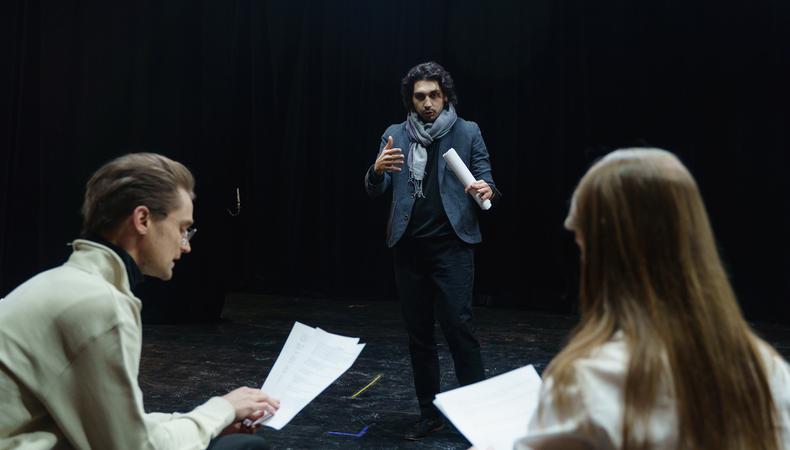
Quick Answer: What Is the Acting Coach AI?
Acting Coach is a master AI acting coach that provides interactive scene work, audition preparation, script analysis, and technique training across all major acting methodologies — available 24/7 on any device.
Key capabilities:
- Scene work and script analysis with beat breakdowns, objective mapping, and given circumstances exploration
- Self-tape and audition preparation with performance calibration and casting-director-informed feedback
- Technique training across Stanislavski, Meisner, Chekhov, Strasberg, Adler, Hagen, and more
- Dialect coaching, improv exercises, cold reading drills, and monologue selection
The Challenge: Why Actors Struggle to Access the Training They Need
The global film and television industry is settling into a new operating reality. According to ProdPro's 2026 industry outlook, 2025 production levels were broadly in line with 2024, with more projects starting but less money behind them as the industry adjusted to a "more with less" reality. Feature production rose 19 percent year over year, concentrated in sub-$40M independent films — meaning more opportunities exist, but competition for every role is fiercer than ever. Meanwhile, crew members reported an average of six months since their last job, reflecting the uneven recovery rippling through the entire production ecosystem.
For actors specifically, the gap between talent and opportunity has never been more about preparation — and preparation has never been harder to access consistently:
-
Self-tapes have become the primary audition format — with minimal guidance. Self-taped auditions now dominate the casting process, but most actors receive little formal training in self-tape craft. As Backstage's comprehensive guide notes, casting directors look for performances where "the person's alive on tape, so when they're not speaking, they're still in character" — a nuance that requires coaching to develop. Common mistakes like incorrect reader positioning, wrong framing, and poor eyeline can kill an audition before casting sees the performance. Many invitations to submit come just a day or two before the deadline, leaving actors scrambling with no one to turn to for preparation.
-
Quality coaching is geographically concentrated and financially prohibitive. The best acting coaches, workshops, and conservatory programs cluster in New York, Los Angeles, London, and a handful of other major markets. Private coaching sessions run $100-$300 per hour — and most actors need consistent, ongoing work, not a single session before an audition. For actors in secondary markets, smaller cities, or international locations, access to this caliber of mentorship ranges from limited to nonexistent.
-
Technique training is fragmented and overwhelming. Stanislavski, Meisner, Chekhov, Strasberg, Adler, Hagen, Practical Aesthetics, Viewpoints — each methodology offers distinct tools, and actors often encounter them piecemeal through different teachers with conflicting philosophies. Without a comprehensive guide who understands how these approaches relate and complement each other, actors waste years collecting partial knowledge from incompatible sources.
-
Script analysis depth is where actors lose roles. Casting director Robert B. Martin Jr. emphasizes that what separates booked actors from the rest is whether they understand the material — including the specific tone a director is looking for. Approaching a Christopher Guest project requires a fundamentally different performance than approaching a Steven Spielberg project — and most actors lack anyone to help them develop that level of directorial and tonal literacy.
-
Practice partners are unreliable and inconsistent. Scene work, cold reading, and improv all require a partner — but coordinating schedules with other actors is notoriously difficult. Using friends or family as readers introduces its own problems: acting coach Joseph Pearlman identifies monotone delivery and whispering lines as common reader mistakes that create imbalanced scenes and weaker audition tapes.
Why Acting Coach AI
This is exactly what Acting Coach was built for — a dedicated AI mentor that provides the depth, consistency, and availability of a master-level acting coach without the geographic or financial barriers that keep most actors from accessing serious training.
Rather than replacing the irreplaceable — the human energy of scene partners, the embodied presence of a live performance coach, the communal experience of ensemble work — this AI serves as the always-available training partner that ensures no actor has to face a script, an audition, or a career decision without expert guidance.
| Traditional Approach | Acting Coach AI |
|---|---|
| Private coaching at $100-300/session | 24/7 access to expert-level coaching — free tier available |
| Limited to coaches in your city or market | Available from any location, any time zone, any device |
| Wait days to schedule a session before an audition deadline | Instant preparation when the self-tape request arrives |
| One coach's methodology and perspective | Fluency across all major acting methodologies |
| Unreliable scene partners with scheduling conflicts | Always-available scene partner for cold reads, drills, and practice |
| Generic YouTube tutorials for self-tape technique | Personalized feedback calibrated to your specific audition |
Scene Work & Script Analysis
The AI breaks down scenes the way a master-class instructor would — identifying beats, mapping objectives and obstacles, exploring given circumstances, analyzing subtext, and helping you make specific, playable choices. It doesn't just tell you what a scene is about; it walks you through how to inhabit it.
"I have a callback for a scene where my character discovers her husband has been lying about his job for two years. Break down the beats, identify my objective in each beat, and suggest three different tactical approaches I could use."
Audition & Self-Tape Preparation
From the moment a self-tape request arrives to the moment you hit submit, the AI coaches you through the entire process — script analysis, character choices, performance calibration for camera vs. stage, framing and technical considerations, and what casting directors are actually looking for. As casting director Luci Lenox observes, what stands out is when an actor is believable — "alive on tape" and "still in character" even when not speaking. The AI coaches you toward that standard.
"I just got sides for a recurring role on a single-camera drama. The character is a military officer delivering bad news to a subordinate's family. Help me analyze the scene, find the emotional core, and prepare for the self-tape."
Technique Training Across Every Methodology
Whether you're grounding yourself in Stanislavski's system, developing Meisner's moment-to-moment truthfulness, exploring Chekhov's psychological gesture, working through Strasberg's sense memory, or building Adler's script-based imagination — the AI understands each methodology's principles, exercises, and practical applications. It can also help you integrate insights from multiple approaches into a personal technique that serves your unique instrument.
"I've trained primarily in Meisner but I'm working on a highly stylized Chekhov play. How do I integrate Chekhov technique's psychological gesture work without losing my Meisner grounding?"
Dialect Coaching & Vocal Work
Accent work, dialect coaching, vocal technique, and pronunciation guidance across a wide range of regional and international accents — from standard RP and General American to specific regional dialects and character voices. The AI provides phonetic guidance, practice sentences, and common pitfalls for each dialect.
Related Agents You'll Also Find Useful
If you're building an acting career, these complementary agents extend naturally into the creative, professional, and business dimensions of the work:
Film Screenwriter
Understanding screenwriting deepens your script analysis. For actors who write their own material — short films, web series, festival submissions — or who want to better understand how writers think about character and structure, this agent provides professional-level screenwriting craft from concept through revision.
- Story structure, character development, and dialogue craft
- Understanding writer's intent to strengthen audition analysis
- Original content creation for self-produced projects
Public Speaking Coach
The crossover between acting and public speaking is significant — stage presence, audience awareness, vocal projection, and managing performance anxiety all transfer directly. For actors who also do corporate presentations, motivational speaking, or hosting work, this agent strengthens those adjacent skills.
- Speech writing and delivery coaching
- Anxiety management and performance confidence building
- Audience simulation and feedback
Resume & Cover Letter Writer
Actor resumes follow industry-specific formatting conventions that differ from standard professional resumes. For crafting polished actor resumes, cover letters for agent submissions, and professional bios for casting profiles, this agent ensures your written materials match the caliber of your performance work.
- Industry-formatted actor resumes and cover letters
- Agent submission materials and casting profile bios
- Tailored positioning for specific markets and categories
Interview Coach
Callbacks, chemistry reads, and general meetings with producers and showrunners require a different set of interpersonal skills than audition performance. For actors navigating the social and professional dimensions of the business — network meetings, representation interviews, and press — this agent provides preparation.
- Mock interview practice for agent and manager meetings
- Behavioral and conversational preparation for general meetings
- Confidence building for press, panels, and public appearances
How It Works
Step 1: Share What You're Working On
Tell the AI your current situation — preparing for a specific audition, working on a scene for class, developing a monologue, exploring a technique, or building foundational skills as a beginner. Include the material you're working with, your training background, and your specific goals. The AI calibrates its coaching to your exact level and needs.
"I have a self-tape due in 36 hours for a co-star role on a medical drama. I'm playing a patient who receives a terminal diagnosis. Here are the sides — help me prepare."
Step 2: Receive Detailed, Craft-Focused Coaching
The AI responds with specific, actionable guidance — not motivational platitudes. Expect beat breakdowns, objective identification, tactical suggestions, technique exercises, and honest assessment of the choices you're considering. Every note is grounded in craft, not opinion.
Step 3: Practice, Refine, and Go Deeper
Run lines with the AI as a scene partner. Try different tactical approaches and discuss which serves the story better. Ask for cold reading practice with unfamiliar material. Request dialect exercises for a specific accent. Each interaction builds on the last.
"Let's run the scene. You read the doctor's lines. After we run it once, give me notes on where my energy dropped and where I might be pushing too hard."
Step 4: Build a Continuous Training Relationship
With persistent memory, Acting Coach remembers your training background, the techniques you respond to, the roles you've prepared for, your strengths, and the patterns in your work that need attention — making every future session a continuation of an ongoing coaching relationship rather than starting from scratch.
Step 5: Access Coaching From Anywhere
Review scene notes on your phone before a callback. Analyze sides on your tablet during a break. Run lines on your desktop at home. Full feature parity across web, iOS, and Android — because audition requests don't wait for convenient moments.
Results & Use Cases
🎬 Actor Preparing a Self-Tape on a Tight Deadline
Scenario: A Los Angeles-based actor receives a self-tape request at 4 PM on a Tuesday for a guest star role on a streaming drama — deadline is Thursday at noon. The sides are three pages, the character is emotionally complex, and she has a day job tomorrow. Her acting coach is booked solid for the week.
Traditional Approach: Read the sides alone, make instinctive choices without outside input, film multiple takes hoping one lands, and submit without anyone reviewing the performance — all while knowing the casting director will see the tape alongside hundreds of others.
Acting Coach: That evening, open the app and paste the sides. Within minutes, receive a detailed beat breakdown with objective mapping, given circumstances exploration, and three distinct tactical approaches to the key emotional moment. Discuss which approach serves the tone of the show. Get specific notes on self-tape framing and performance calibration for camera — including the reminder that casting directors want to see someone alive on tape who's still in character even when not speaking. Run the scene with the AI as a reader before filming.
- ✅ Complete scene analysis and preparation in one evening session
- ✅ Specific, castable choices informed by craft — not guesswork
- ✅ Performance calibration notes for the self-tape format
📚 Theater Student Deepening Technique Understanding
Scenario: A second-year BFA student is studying Meisner technique in class but struggling with the transition from repetition exercises to applying Meisner principles in scene work. Her professor's office hours are limited, and she's falling behind classmates who seem to make the leap more intuitively.
Traditional Approach: Re-read Meisner's On Acting, watch interviews with Meisner-trained actors on YouTube, and hope the next class session provides the breakthrough — while anxiety about falling behind compounds the problem.
With Acting Coach AI: Have an extended conversation about the specific gap — where repetition exercises feel alive but scene work goes flat. The AI identifies common transition challenges: the tendency to plan moments instead of living them, the difficulty of maintaining listening when you also need to fulfill an objective, and the trap of "performing Meisner" instead of simply being truthful. Receive targeted exercises designed specifically for this transition, and discuss how Meisner's approach connects to (and diverges from) other techniques she might encounter later.
- ✅ Targeted coaching for a specific technique gap, not generic overview
- ✅ Exercises designed for the exact transition she's struggling with
- ✅ Deeper understanding that enriches classroom learning
💼 Working Actor Preparing for a Dialect Role
Scenario: A New York-based actor has booked a supporting role in an independent film set in rural Appalachia. The director wants an authentic regional dialect — not a generic "Southern" accent. The actor has three weeks before shooting begins and no dialect coach in the budget.
Traditional Approach: Watch YouTube videos on Appalachian accents, listen to interviews with people from the region, and practice alone without feedback — risking an inauthentic accent that undermines an otherwise strong performance.
With the AI: Receive structured dialect coaching specific to Appalachian English — vowel shifts, consonant patterns, prosody and rhythm, specific phonetic markers that distinguish Appalachian from other Southern dialects. Practice with targeted sentences and monologues. Discuss how the dialect influences character physicality, rhythm of thought, and emotional expression — because dialect work isn't just about sounds, it's about how speech patterns shape a character's relationship to language itself.
- ✅ Region-specific dialect coaching, not generic "Southern accent" training
- ✅ Integration of dialect with character work and performance
- ✅ Ongoing practice sessions over three weeks of preparation
📱 Beginner Building Foundational Skills on Mobile
Scenario: A 23-year-old in Austin has been thinking about taking an acting class for two years but feels intimidated — she has no training, no headshots, and no idea which approach to acting is right for her. She doesn't want to spend $300 on a beginner workshop only to discover she hates it.
Traditional Approach: Google "acting classes near me," feel overwhelmed by options ranging from $50 community workshops to $500 conservatory intensives, read conflicting reviews, and postpone the decision for another six months.
With Acting Coach on mobile: Open the app during a lunch break and describe her situation honestly — curious but intimidated, no experience, not sure if she'd enjoy it. The AI introduces foundational concepts without jargon, suggests beginner exercises she can do at home (observation work, emotional recall, simple cold reading), and helps her understand the major training methodologies so she can make an informed choice when she does decide to take a class. By the time she walks into her first workshop, she already has a vocabulary and foundational awareness that lets her engage rather than freeze.
- ✅ Zero-intimidation entry point for complete beginners
- ✅ Foundational exercises she can practice alone before investing in classes
- ✅ Informed methodology overview that helps her choose the right first class
Frequently Asked Questions
Is the Acting Coach AI free to use?
Yes. Acting Coach is available on Jenova's free tier with core functionality including scene work, script analysis, technique coaching, and audition preparation. For extended sessions, persistent memory across conversations, and higher usage limits, paid plans start at $20/month. No credit card required to start.
How is an AI acting coach different from in-person coaching?
In-person coaching provides physical presence — a coach can read your body tension, mirror your energy, and create the live dynamic that acting fundamentally requires. Acting Coach AI provides something complementary: always-available access to comprehensive craft knowledge, immediate script analysis, unlimited scene practice, and technique guidance across every methodology — at any hour, from any location, at a fraction of the cost. Many actors use it between in-person sessions to reinforce technique, prepare for auditions on tight deadlines, and explore questions that arise at unpredictable moments.
Can the AI actually help me prepare for a specific audition?
Absolutely. Paste your sides, share the character breakdown, and describe the project. The AI provides beat-by-beat analysis, objective and obstacle mapping, tactical suggestions, performance calibration for camera vs. stage, and self-tape-specific guidance — including what casting directors actually look for when reviewing audition tapes. It's the preparation partner you need when your coach is booked and the deadline is tomorrow.
Does it cover all acting methodologies, not just one approach?
Yes. Acting Coach is fluent across Stanislavski's system, Meisner technique, Chekhov's psychophysical approach, Strasberg's Method, Adler's script-based imagination, Hagen's respect for the text, Practical Aesthetics, Viewpoints, Suzuki, Laban, and more. It can also help you integrate insights from multiple approaches into a personal technique that serves your specific instrument and career goals.
Can it function as a scene partner for running lines?
Yes. The AI reads opposite you in any scene, providing cue lines so you can practice delivery, explore choices, and build familiarity with material. While it cannot replicate the unpredictable energy of a live human reader, it provides a reliable, always-available practice partner — especially valuable when finding a quality reader is one of the most common self-tape challenges.
Does it work on mobile devices?
Yes. Full feature parity across web, iOS, and Android. Many actors use Acting Coach on their phones — reviewing scene analysis before callbacks, running lines during breaks on set, or preparing for self-tapes in whatever window the deadline allows.
Conclusion
The craft of acting demands ongoing, consistent training — scene work, technique deepening, script analysis, dialect mastery, audition preparation — yet the economics and geography of the industry ensure that most actors can't access the quality of coaching they need, when they need it. In a production landscape where feature film production has risen 19% while budgets shrink, where self-tapes have become the primary audition format with deadlines often arriving just a day or two before submission, and where casting directors are looking for performers who are believable and alive on tape — the actors who book are the actors who prepare deeply, consistently, and with expert guidance. That guidance should be available to every actor at every stage, not just those who can afford $200 per session or live within driving distance of a master coach.
Try Acting Coach now — your 24/7 master acting coach for scene work, auditions, and craft development. Explore the full library of AI agents at Jenova.