Best AI Comic Creator: Build Complete Visual Stories From Script to Page (June 2026)
2026-06-17
Comic Creator turns your story ideas into complete, sequential comic art — consistent characters, dynamic panel layouts, and polished visual storytelling — without requiring a single drawing skill. While the comic industry is booming and creative tools are more accessible than ever, building a real comic with narrative coherence across dozens of pages has remained locked behind years of artistic training or expensive freelance commissions. This AI handles the entire pipeline from concept to finished page, in any style you choose.
✅ Full sequential art production: panel composition, character design, backgrounds, action sequences, and lettering guidance ✅ Character consistency across every panel, page, and issue — the single hardest problem in AI-assisted comics ✅ Style mastery from American superhero and noir to manga, European bande dessinée, and indie graphic novels ✅ Persistent memory that tracks your characters, world-building, and art direction across sessions
The demand for comic content is surging globally, and AI is rewriting who gets to create it. To understand why that matters, let's look at where the industry stands in 2026 and what's been holding aspiring creators back.
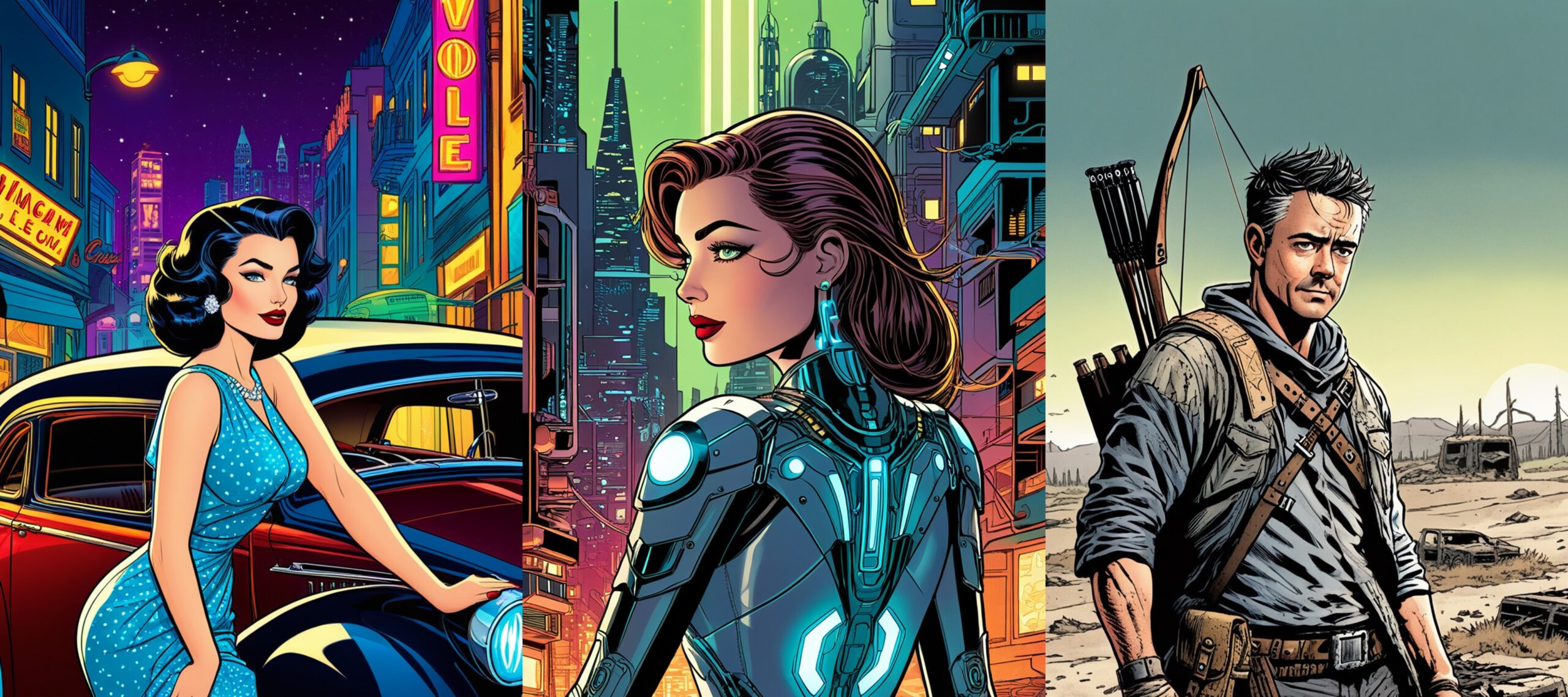
Quick Answer: What Is Comic Creator?
Comic Creator is an AI-powered sequential art agent that produces complete comic books — from script and panel layouts to finished, style-consistent pages — through natural conversation.
Key capabilities:
- Script-to-panel conversion that interprets narrative beats, pacing, and visual storytelling
- Consistent character rendering maintained across scenes, angles, expressions, and lighting conditions
- Dynamic page layouts with varied panel structures, splash pages, and visual flow
- Style control spanning American comics, manga, noir, sci-fi, fantasy, horror, and experimental formats
- Full story arc support from single issues to graphic novel sagas with persistent creative memory
The Problem: Creating Comics Remains One of the Hardest Creative Endeavors
Comic books sit at the intersection of writing, illustration, design, and cinematography — a combination of skills that takes most professional artists years to develop. The result: millions of stories never get told.
**$18.63 billion** — [Projected global comic book market size in 2026, growing to $27.01 billion by 2034](https://www.fortunebusinessinsights.com/comic-book-market-103903)
**$1.8 billion** — [AI-generated comic book market value in 2025, projected to reach $9.6 billion by 2034 at 20.4% CAGR](https://dataintelo.com/report/ai-generated-comic-book-market)
61% of digital artists — Now utilize AI tools in some stage of comic production
But the gap between wanting to create comics and actually producing them is brutally wide:
- The skill barrier is enormous. Sequential art requires mastery of anatomy, perspective, composition, inking, coloring, and lettering — disciplines that each take years to learn independently. Writers with brilliant stories have no way to visualize them without hiring an artist.
- Freelance illustration costs are prohibitive. Professional comic artists charge $150-$400+ per page for pencils, inks, and colors. A standard 22-page issue can cost $3,300-$8,800 before lettering, editing, or printing — pricing out independent creators entirely.
- Existing AI tools solve the wrong problem. Tools like Midjourney and Stable Diffusion generate stunning individual images, but as industry reviews confirm, "Midjourney isn't a comic maker" — it creates panel art but offers no storytelling tools, no sequential layout, and no speech bubble placement. You still need separate software to assemble anything resembling a comic.
- Character consistency remains the critical failure point. The single biggest frustration in AI-assisted comics is characters who look different in every panel. As noted in comprehensive tool testing: "Nothing breaks a story faster than a character who looks different in every panel". Most tools require complex workarounds — reference URLs, model training, or LoRA fine-tuning — that demand technical knowledge most writers don't have.
The Creator Economy Gap
The explosion of webtoon platforms and digital distribution has created unprecedented demand for comic content. WEBTOON alone operates with over 89 million monthly active users, and individual creators represent 31.4% of the AI-generated comic market's end users. The audience is there. The distribution is there. What's missing is a creation tool that bridges the gap between story and finished page without requiring either artistic mastery or a software engineering degree.
This is exactly what Comic Creator was built for.
Why Comic Creator
Unlike image generators that produce isolated panels or AI platforms that require you to stitch together a comic from disconnected outputs, Comic Creator operates as a dedicated sequential art collaborator. It understands comics as a storytelling medium — not just a collection of pretty pictures — and builds pages with narrative flow, visual pacing, and character continuity baked into every decision.
| Traditional Approach | Comic Creator |
|---|---|
| Hire a freelance artist at $150-$400/page — a 22-page issue costs $3,300-$8,800+ | Free to start, full comic production from day one with no per-page fees |
| Learn anatomy, perspective, inking, and coloring over years of practice | Produce publication-quality art through natural language conversation |
| Use Midjourney for panels, Canva for layout, Photoshop for lettering — 3+ tools minimum | Complete script-to-page pipeline in a single agent |
| Characters change appearance between panels with most AI tools | Persistent character models maintained across scenes, issues, and sessions |
| Comic production takes weeks per issue even for experienced artists | Full pages generated through iterative conversation, refined in real time |
Script-to-Panel Intelligence
Describe your story in natural language — scene descriptions, dialogue, emotional beats, pacing notes — and Comic Creator translates narrative into visual composition. It understands when a moment calls for a tight close-up versus a wide establishing shot, when to break the panel grid for dramatic impact, and how to sequence action across a page for maximum readability.
"Page 1: Open with a full-width establishing shot of a rain-soaked cyberpunk city at night. Neon signs in Japanese and English. Below, three panels: Panel 2 — medium shot of our protagonist, Kira, walking through the crowd, hood up, face partially hidden. Panel 3 — close-up of her hand gripping something inside her jacket pocket. Panel 4 — her eyes, reflected in a puddle, looking directly at the reader."
Character Design and Consistency
Define your characters once — physical features, clothing, personality-driven posture, signature details — and Comic Creator maintains that design across every panel. Change outfits, alter lighting, show characters from any angle, and the visual identity holds. This is the capability that separates a comic creation tool from an image generator.
"Design the main character: Kira Tanaka, 28, Japanese-American, athletic build, asymmetric undercut with teal-dyed tips, cybernetic left arm with visible circuitry, always wears a weathered bomber jacket with a dragon patch on the back. Her expression defaults to guarded but sharp."
Style Mastery Across Genres
From classic American superhero bold lines and dynamic poses to black-and-white manga screentone aesthetics, European ligne claire, indie watercolor, horror crosshatch, or retro pulp — Comic Creator adapts its visual output to match any genre, era, or artistic reference you specify.
"I want the style to blend Moebius's clean European sci-fi linework with the color palette of a Blade Runner still — teal, magenta, and amber against deep blacks. Keep the compositions cinematic with strong depth of field."
Related Agents You'll Also Find Useful
If you're building a comic project, these agents handle the creative workflows that surround sequential art production:
Manga Creator
If your project specifically targets manga conventions — right-to-left reading order, screentone shading, speed lines, SD (super-deformed) reactions, and Japanese panel flow — this dedicated mangaka agent is built for the format's unique visual language. It handles one-shots to 200+ page serialized epics with genre-specific expertise.
- Right-to-left panel flow with traditional manga page architecture
- Screentone application, speed lines, and emotion-driven visual effects
- Genre mastery across shōnen, shōjo, seinen, josei, and isekai
Creative Fiction Writer
The script is the foundation of any comic. Before a single panel is drawn, you need a story with structure, pacing, and dialogue that works in a visual medium. This agent develops original fiction with editorial insight — giving you a polished script to feed directly into Comic Creator.
- Story structure, character arcs, and dialogue crafted for visual adaptation
- Genre expertise across fantasy, sci-fi, horror, crime, romance, and literary fiction
- Iterative revision with editorial feedback on pacing and narrative tension
Graphic Designer
For cover design, promotional materials, trade dress, logo work, and marketing assets that surround your comic — this agent handles the branding and visual identity layer that turns a finished comic into a professional product.
- Cover composition, typography, and trade dress design
- Social media promotional assets and banner art
- Brand identity systems for comic series or publisher imprints
How It Works
Step 1: Define Your World and Characters
Start by describing your setting, tone, and cast. Give Comic Creator the foundational elements — genre, visual style, key characters with physical descriptions, and the emotional register of your story. This establishes the creative parameters that persist across your entire project.
"I'm creating a noir detective comic set in 1940s Los Angeles. Black and white with selective red accents — blood, lipstick, neon signs. Main character: Detective Ray Callahan, mid-40s, weathered face, perpetual five o'clock shadow, trench coat, fedora. He smokes too much. Secondary character: Vivian Lake, early 30s, elegant, dangerous, always in control of every room she enters."
Step 2: Write or Describe Your Script
Feed your story page by page, scene by scene, or give the full script at once. You can write in traditional comic script format or just describe what happens in plain language — the agent interprets narrative intent and translates it into panel-ready compositions.
"Page 3: Ray enters Vivian's penthouse. She's standing by the window, backlit by the city. Four panels — first panel is Ray's POV entering the room, second is a medium shot of Vivian turning to face him, third is a close-up of her smile, fourth is Ray's hand reaching for the whiskey she's already poured him."
Step 3: Generate and Refine Pages
Comic Creator produces pages based on your direction. Review the output and iterate — adjust framing, change expressions, modify backgrounds, alter the panel layout, or shift the visual emphasis. Every refinement builds on the established style and character models.
"Make panel 3 tighter — I want just her eyes and lips. And in panel 4, add a reflection of Vivian in the glass of whiskey Ray is picking up."
Step 4: Build Across Issues and Arcs
With persistent memory, Comic Creator maintains your characters, settings, and art direction across sessions. Come back days or weeks later to continue your story — the agent remembers Kira's cybernetic arm, Ray's trench coat, and the exact shade of neon you chose for your cyberpunk cityscape.
"Let's start issue 2. Same characters, same style. Open with a flashback to Ray as a young patrol officer — keep his facial features recognizable but show him 20 years younger, no stubble, uniform instead of trench coat."

Results & Use Cases
📚 Indie Creator Launching a Webcomic Series
Scenario: A fiction writer with zero illustration experience has a complete 12-episode sci-fi story outlined but no way to visualize it. Hiring an artist for even a short webcomic run would cost thousands.
Traditional Approach: Post on artist-for-hire forums, negotiate rates of $100-$300 per page, wait weeks for revisions, and risk the collaboration falling apart mid-project.
Comic Creator: Translates the full script into sequential pages with consistent character designs, dynamic sci-fi environments, and panel compositions that drive narrative pacing — all through iterative conversation over multiple sessions.
- Character designs locked in from episode 1 and maintained through episode 12
- Style adjustments made in real time — shift color palettes for flashback sequences, alter line weight for dream scenes
- Complete webcomic-ready pages without external tools or software
💼 Marketing Team Creating a Branded Comic Campaign
Scenario: A tech startup wants to explain its product through a 6-page comic strip for a conference booth and social media campaign. The marketing budget doesn't include $5,000+ for a commissioned illustrator.
Traditional Approach: Brief a design agency, wait 2-3 weeks for concepts, go through 3-4 revision rounds, and pay premium rates for commercial-use illustration.
Comic Creator: Produces branded comic pages that incorporate the company's visual identity, product screenshots reimagined in comic style, and character-driven scenarios that make technical concepts accessible — delivered in a fraction of the time.
- Brand-consistent color schemes and visual tone maintained across all pages
- Characters representing target user personas in relatable product scenarios
- Output ready for print, social media cropping, and presentation formats
📱 Solo Creator Building a Webtoon on Mobile
Scenario: A college student with a manhwa-style romance story wants to publish on WEBTOON and Tapas but can't draw beyond stick figures. They work primarily from their phone during commutes.
Traditional Approach: Learn digital illustration over 6-12 months, invest in a drawing tablet and software, or give up on the idea entirely.
Comic Creator: Accessible on mobile with full feature parity, the agent produces vertical-scroll webtoon panels optimized for the format — soft color palettes, expressive character acting, and cliffhanger-ready page breaks that keep readers swiping.
- Vertical panel format optimized for mobile-first webtoon platforms
- Romantic genre conventions: expressive eyes, blush effects, atmospheric lighting
- Episode-by-episode production with character continuity across 50+ installments
🎯 Tabletop RPG Creator Illustrating a Campaign Module
Scenario: A Dungeon Master has written a 40-page campaign module and wants interior illustrations — character portraits, location maps in comic style, and key scene depictions — to sell as a PDF on DriveThruRPG.
Traditional Approach: Commission 15-20 individual illustrations from a fantasy artist at $50-$150 each, totaling $750-$3,000, plus weeks of back-and-forth on character accuracy.
Comic Creator: Generates consistent fantasy character portraits, atmospheric location scenes, and dramatic encounter illustrations — all in a unified art style that gives the module a cohesive, professional look.
- Fantasy character designs with armor, weapons, and species-specific features maintained across every illustration
- Location art ranging from dungeon interiors to sweeping landscapes
- Consistent art style across all illustrations for a polished, professional product
FAQ
Is Comic Creator free to use?
Yes. You can start creating comics with Comic Creator immediately on Jenova's free tier — no credit card, no trial expiration, no watermark on paid tiers. Free users get full access to the agent's capabilities with limited usage; paid tiers increase how much you can create per month.
How is Comic Creator different from Midjourney or Stable Diffusion?
Midjourney and Stable Diffusion are image generators — they produce individual pictures, but you need separate tools for panel layout, speech bubbles, narrative sequencing, and character consistency. As comprehensive testing confirms, "Midjourney only creates images. A true AI comic generator also provides storytelling tools." Comic Creator handles the entire comic creation pipeline — from script interpretation to finished, sequentially coherent pages — in one conversation.
Can Comic Creator maintain character consistency across an entire graphic novel?
Character consistency is the agent's core strength. Define a character once — physical features, clothing, signature details — and the design persists across panels, pages, issues, and sessions. Persistent memory means you can return weeks later and your characters look exactly as established, even in new scenes, angles, and lighting conditions.
What comic styles can it produce?
Any style you can describe: American superhero, noir, manga, manhwa, European ligne claire, indie watercolor, horror crosshatch, retro pulp, cyberpunk, children's book illustration, minimalist web strip, and experimental formats. You can also reference specific artistic influences to guide the visual output.
Does it work on mobile?
Full feature parity across web, iOS, and Android. Every conversation, character design, and art direction decision syncs across devices. Start a project on your laptop and continue refining pages from your phone.
Can I use the comics I create commercially?
Jenova's data and privacy policies protect your content — your data is never used to train public AI models, and your creations remain yours. For specific commercial use cases, review the terms of service for your subscription tier. The Manga Creator follows the same policies for manga-format projects.
Conclusion
The comic book market is projected to reach $27.01 billion by 2034](https://www.fortunebusinessinsights.com/comic-book-market-103903), and the AI-generated comic segment alone is growing at [20.4% annually toward $9.6 billion. The audience, the platforms, and the distribution infrastructure are all in place. What's been missing is a creation tool that lets storytellers actually make comics — not just generate disconnected images and hope they assemble into something coherent.
Comic Creator closes that gap. From script interpretation and character design to panel layout and style consistency across entire graphic novels, it handles the full sequential art pipeline through natural conversation. Whether you're an indie creator launching a webcomic, a writer visualizing your first graphic novel, or a team producing branded comic content, the barrier between your story and a finished page is now a conversation.
Try Comic Creator now — free, no credit card required. Explore the full agent library at Jenova.