Are Specialized AI Research Assistants More Reliable Than Chatbots?
2026-08-22
How Do Traceability and Grounding Separate Research AI From Chatbots?
Specialized academic research assistants are more reliable than general AI chatbots for citation traceability and evidence extraction because they retrieve from scholarly indexes, attach claims to identifiable passages, and expose supporting or conflicting context. General chatbots generate fluent bibliographic language from training patterns, which is why they still invent authors, titles, DOIs, and findings that cannot be walked back to a source.
The reliability gap is not about writing quality. It is about whether a claim can be audited.
Key factors that separate citable research assistance from chatbot prose:
✅ Retrieval before generation — answers are assembled from indexed papers rather than from next-token probability alone ✅ Passage-level attribution — each extracted finding points to a sentence, table, or section, not just a paper title ✅ Contradiction visibility — later work that supports, disputes, or only mentions a claim is surfaced rather than flattened into one summary ✅ Structured extraction — methods, samples, outcomes, and limitations are pulled into comparable fields instead of paraphrased paragraphs ✅ Human-checkable provenance — every summary, citation, and extracted finding can be opened against the original source
To compare these tools usefully in 2026, it helps to treat citation reliability as an engineering property, not a brand promise. The rest of this article evaluates chatbots and research assistants on that property.
Why Has Citation Reliability Become a Research Integrity Problem?
Citation reliability has become a research integrity problem because generative AI is now used at publication scale, while general models still fabricate references that look real enough to survive casual review. Student and researcher adoption rose sharply in 2025, and fabricated citations are no longer a novelty error. They are entering conference proceedings, manuscripts, and citation graphs.
The Higher Education Policy Institute's 2025 student survey found that use of generative AI tools for assessments jumped from 53% to 88% in one year. A related readout of the same survey reported that 92% of students now use AI in some form, up from 66% in 2024. That volume matters because a plausible fake reference is harder to catch than a blank one.
A 2026 analysis in Energy Research & Social Science reported that ChatGPT produced 178 references for research proposals, 69 of which lacked valid DOIs. The same paper cited a GPTZero review of 4,841 NeurIPS 2025 papers that confirmed at least 100 hallucinated citations across 53 accepted papers. Peer review by multiple experts did not catch them.
The mechanism is now well described. AI hallucination is a fluent output that is false or ungrounded. University library guidance notes that chatbots can invent an entire citation — author, title, and journal. Science has argued that models are trained to produce an answer even when they do not know one. When the prompt is “cite sources,” the model pattern-matches bibliographic style. For niche or recent work, that style-matching becomes invention.
What Should You Evaluate When Choosing an AI Research Assistant?
You should evaluate an AI research assistant on whether every claim can be traced, grounded, attributed, contradicted, and extracted — not on how polished the prose sounds. A useful shorthand is the TRACE framework: Traceability, Retrieval grounding, Attribution granularity, Contradiction awareness, and Extractability.
Traceability asks whether a reader can move from a sentence in the draft to the exact supporting passage. If the tool only emits a formatted reference, it has produced a pointer, not a proof.
Retrieval grounding asks whether the system searched a scholarly corpus or sampled from model weights. Citation-grounded extraction is designed to block both unsourced invention and unattributed paraphrase by requiring explicit source attribution for every extracted claim.
Attribution granularity distinguishes paper-level citations from sentence-level or field-level citations. A paper can be real while the quoted finding is wrong, outdated, or taken from the abstract rather than the results.
Contradiction awareness asks whether the tool shows later studies that support, challenge, or merely mention the claim. A single confirming abstract is not a literature.
Extractability asks whether methods, samples, outcomes, and limitations can be compared in structured fields. Prose summaries hide missing data. Tables make the gaps visible.
King's College London's evidence-synthesis guidance is blunt on the practical implication: AI tools can support stages of a review, but they cannot replace validated search methods, and generative systems still create fake references. A 2025 review cited in that guide concluded that current evidence does not support using generative AI in evidence synthesis without human involvement. The evaluation question is therefore not “Does this tool write?” It is “Can this tool be audited?”
How Do Specialized Research Assistants Compare to General Chatbots?
Specialized research assistants outperform general chatbots on citation traceability because they bind answers to retrieved papers, while chatbots remain strongest at drafting, explanation, and brainstorming. The honest comparison is role-based. Chatbots are flexible writing engines. Research assistants are narrower, more inspectable retrieval systems.
Elicit searches millions of academic papers and returns structured reports with citations. It is particularly strong when a researcher needs methods, samples, and findings lined up across a set of studies. A 2026 Cochrane-linked comparison cited by King's College London found that Elicit did not search with high enough sensitivity to replace traditional literature searching, though its precision made it useful as an adjunct. That is a real limitation, not a footnote.
Scite is built around verification rather than drafting. It reports coverage across 300 million-plus scholarly articles and licensed access via agreements with 40-plus publishers. Its Smart Citations classify whether later papers support, contrast, or merely mention a claim. Every claim its assistant makes is linked to the specific sentence in the specific paper. The trade-off is scope: Scite is stronger at citation intelligence than at end-to-end manuscript workflows.
ResearchRabbit is strongest at mapping. It helps researchers find related papers, build citation maps, and watch a field expand from a seed article. It is less useful as an evidence-extraction or citation-validation engine. That is not a defect if the task is discovery.
General chatbots such as ChatGPT remain widely used because they draft quickly and handle messy, cross-domain questions. Their documented weakness is bibliographic invention. Recent reporting summarized in the 2026 scholarly-integrity analysis put factual-citation hallucination for advanced models such as GPT-4o and Claude 3.7 in the 15–20% range, rising to 35–55% on niche or recent topics. Benchmarks that audit scientific references produced by large language models have reported error rates exceeding 30% in some settings.
Jenova's Academic Research Assistant sits in a different slot. It is a domain agent for literature discovery, manuscript preparation, and citation management, with persistent memory and live search across academic databases. It is stronger than a chatbot at keeping a research project coherent across sessions. It is weaker than Scite on licensed full-text citation classification, and weaker than Elicit as a dedicated extraction-table product. Those gaps are why a mixed stack still outperforms any single assistant.
| Feature / Dimension | General chatbots (e.g., ChatGPT) | Jenova Academic Research Assistant | Elicit | Scite | ResearchRabbit |
|---|---|---|---|---|---|
| Retrieval grounding | Primarily model memory; browsing varies by product | Live scholarly and web retrieval inside a persistent research agent | Paper corpus search with structured reports | Licensed scholarly full text plus open corpus | Citation-graph discovery from seed papers |
| Citation traceability | Frequently unverifiable or fabricated | Inline sources with follow-up verification against originals | Citations attached to extracted fields | Sentence-level links plus support/contrast labels | Network links between papers, not claim-level proofs |
| Evidence extraction | Free-form summaries | Notes, comparisons, and manuscript-ready synthesis | Strong structured tables | Stronger at citation context than field extraction | Limited; mapping over extraction |
| Contradiction awareness | Usually flattened into one answer | Can compare conflicting findings when asked | Depends on retrieved set | Core product feature via Smart Citations | Indirect, through related-work clusters |
| Pricing (as of 2026) | Unverified across plans | Free tier; paid plans from $20/month | Unverified | Unverified | Unverified |
| Best for | Drafting, explanation, early framing | Ongoing academic projects that need discovery plus writing memory | Screening papers into comparable evidence tables | Checking whether a claim is supported or disputed | Visual literature mapping and author/cluster discovery |
A 2026 roundup of academic research AI tools reached a similar division of labor: Elicit led structured extraction, Consensus was fastest for quick evidence checks, and Semantic Scholar remained the strongest free discovery index. No single column in that landscape replaces the others.
How Does Evidence Extraction Differ Across Academic AI Tools?
Evidence extraction differs by whether the tool returns comparable fields or only a narrative paraphrase. Field-level extraction is more reliable for methods, sample sizes, outcomes, and limitations because missing values stay visible. Narrative extraction is faster and more readable, but it conceals the difference between a result, an interpretation, and a hallucinated detail.
Elicit is the clearest example of the structured approach. It is designed to turn a research question into a report whose rows are papers and whose columns are study characteristics. That format is why reviewers often prefer it for early screening. It still requires a human to check inclusion logic, because high precision does not equal high recall.
Scite extracts a different object: the citation context. Instead of asking “What did this paper find?”, it asks “What did later papers do with this finding?” That is closer to evidence appraisal than to data extraction. It is especially useful after a candidate paper has already been identified.
General chatbots extract in prose. Ask for a comparison of four randomized trials and they will produce a confident paragraph. The paragraph may be useful as a first sketch. It is a poor audit artifact, because there is no field that can be marked “not reported.”
Jenova's Academic Research Assistant and its companion Deep Research agent sit between those poles. Deep Research searches widely and returns a synthesized report with inline citations. The Academic Research Assistant keeps the project stateful: prior inclusion decisions, rejected papers, style requirements, and unfinished manuscript sections remain available in later sessions. Testing this workflow shows a practical advantage on multi-week literature reviews. The limitation is equally practical. Neither agent is a dedicated systematic-review screener in the mold of purpose-built tools such as Rayyan or DistillerSR, which evidence-synthesis librarians still treat as the more evaluated option for title and abstract screening.
A reliable extraction prompt makes the desired fields explicit:
"Extract from these papers: study design, sample size, population, primary outcome, effect direction, stated limitations, and the exact sentence that supports each field. If a field is missing, write 'not reported' instead of inferring it."
The same prompt in a chatbot is still only as good as the retrieved text. If the model never opened the paper, it will fill the table from stylistic memory.
What Does a Citation Verification Pipeline Actually Require?
A citation verification pipeline requires the source document, not just the reference string. The minimum viable process is: ingest the cited text, chunk it, retrieve the passages most relevant to the claim, rerank them, and classify the relationship between claim and evidence. Anything short of that is bibliography formatting.
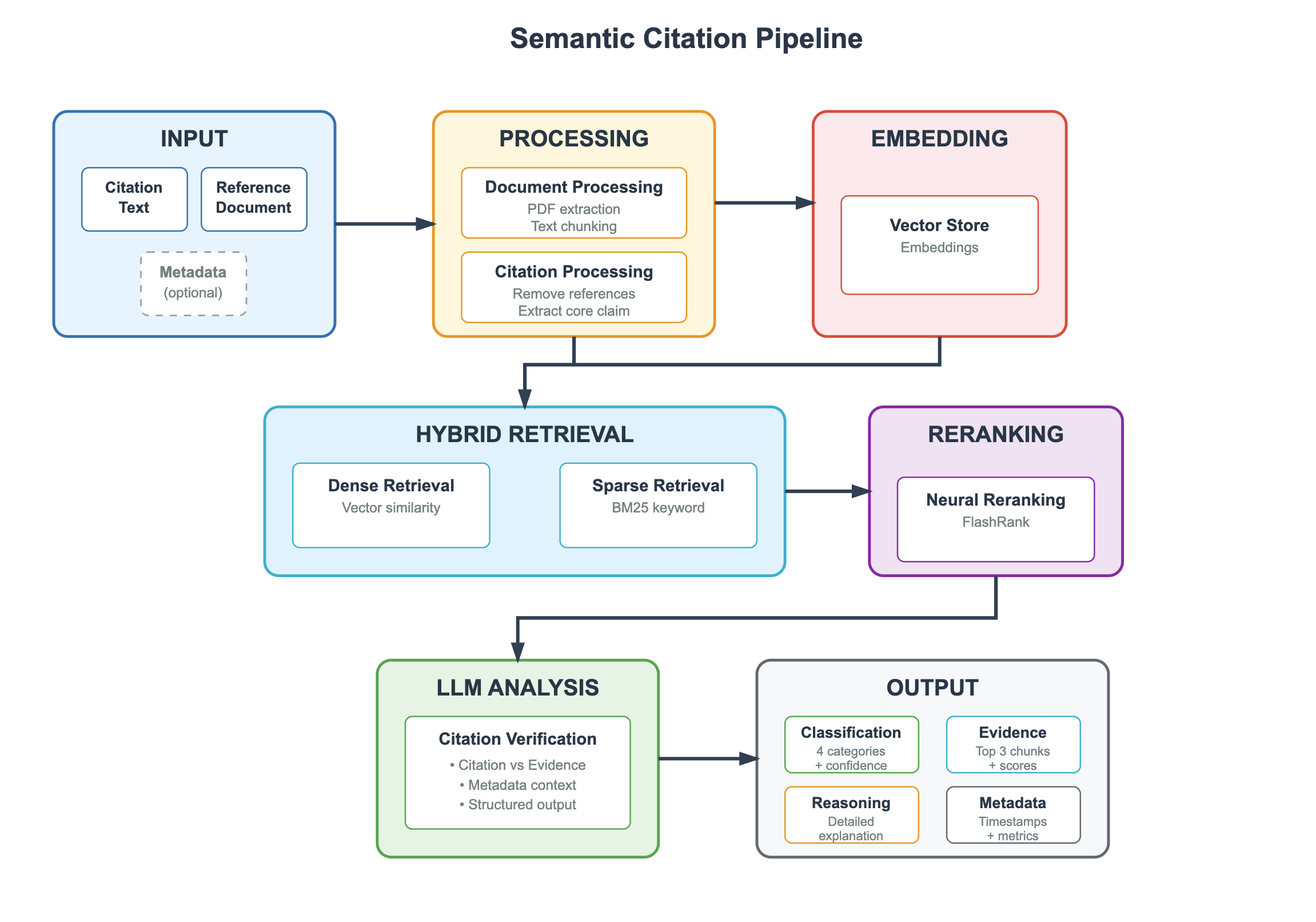
The architecture above is the difference between “this citation looks real” and “this citation is supported.” Input is the claim plus the reference document. Processing strips the bibliography, extracts the core claim, and chunks the PDF. Hybrid retrieval then searches both vector similarity and keyword overlap, which matters because method names and outcome measures often fail pure semantic search. Neural reranking keeps the top passages. Only then does an LLM classify the relationship and return evidence, confidence, and reasoning.
Systems such as SemanticCite are being built specifically to verify citation accuracy through full-text source analysis. That design choice exists because metadata matching is not enough. A DOI can be valid while the cited sentence is from a different paper, a preprint abstract, or a finding the authors later qualified.
Publisher infrastructure does not solve this automatically. Major journals already hyperlink references, yet estimates discussed in the 2026 integrity analysis put DOI failure, or link rot, as high as 37% in sampled scholarly content. A green link is not a verified claim.
This is also where general chatbots fail most predictably. They optimize for a complete answer. A verification pipeline optimizes for a classified relationship: supported, unsupported, contradicted, or insufficient evidence. Those four labels are more scientifically useful than a polished paragraph, because they tell the researcher what kind of checking remains.
Jenova agents can run a lightweight version of this loop by retrieving the candidate paper, quoting the supporting passage, and flagging claims that cannot be located. They do not currently replace a licensed full-text citation classifier with publisher-scale coverage. Researchers who need Smart Citation labels still pair a writing agent with Scite rather than asking one system to do both jobs.
How Do You Build a Safer AI-Assisted Literature Workflow?
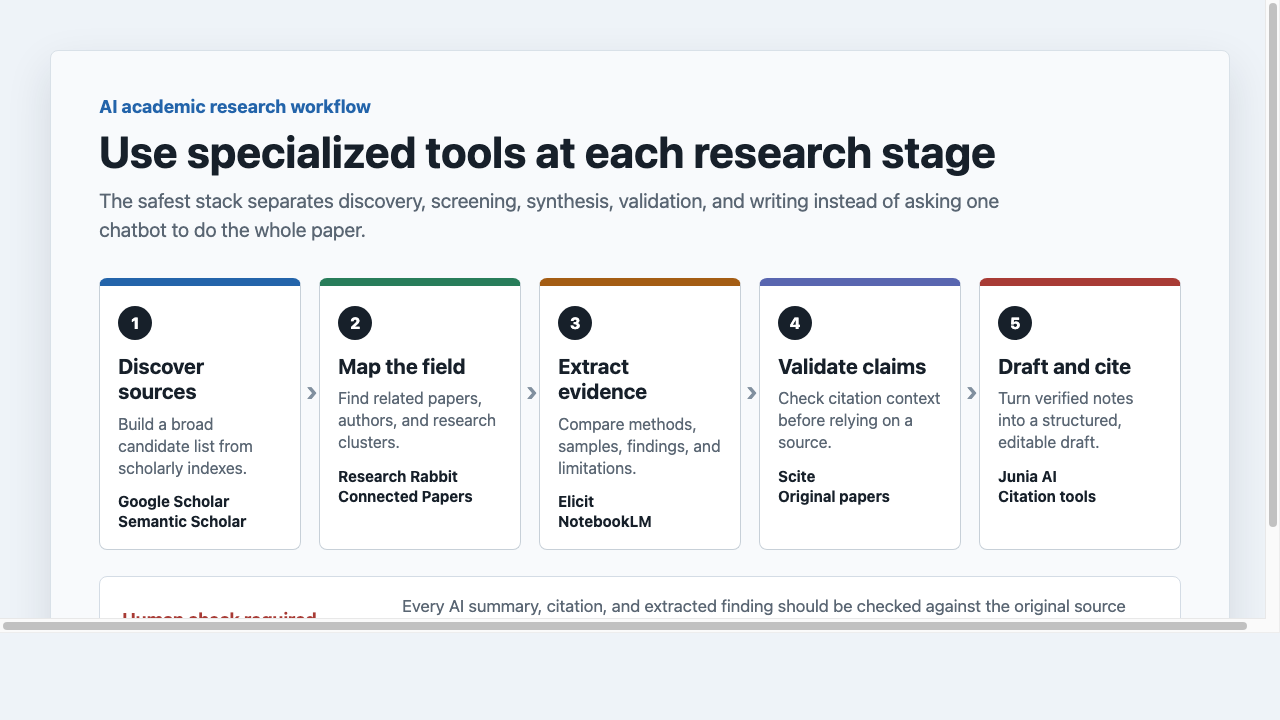
You build a safer AI-assisted literature workflow by assigning each stage to a tool that can be checked, then verifying every extracted finding against the original paper. The unsafe pattern is asking one chatbot to discover, screen, extract, validate, and write.
A staged workflow looks like this:
- Discover sources in scholarly indexes such as Google Scholar or Semantic Scholar, not in a chat window.
- Map the field with ResearchRabbit or Connected Papers so related authors and clusters are visible.
- Extract evidence with Elicit, NotebookLM, or a research agent into structured notes.
- Validate claims in Scite and in the original PDFs before any sentence is treated as citable.
- Draft and cite only from the verified note set.
For Jenova's Academic Research Assistant, setup is a research brief rather than a feature tour:
- Open the agent at jenova.ai/a/academic-research-assistant.
- State the question, discipline, and what “done” looks like:
"I am writing a methods section on LLM citation error rates. Prioritize peer-reviewed studies and publisher analyses from 2023–2026. For each source, extract sample, error definition, hallucination rate, and whether humans verified the references."
- Ask for a candidate list first, then extraction tables, then prose. Do not skip to the draft.
- Keep rejected papers in the same thread so the agent does not reintroduce them later.
For Elicit, the equivalent start is a narrow question and a column list: population, intervention, outcome, study type. For Scite, start from a known paper or claim and inspect supporting versus contrasting citations before writing. For a general chatbot, the safest use is outlining and language editing after sources already exist.
Two operating rules prevent most failures. First, never accept a citation that cannot be opened. Second, never let the drafting model become the only record of what a paper said. The verified note is the source of truth. The draft is a rearrangement of that note.
When Is a General-Purpose Chatbot Still the Better Academic Tool?
A general-purpose chatbot is still the better academic tool when the task is language, structure, or explanation rather than evidence. Reliability depends on the job. Citation traceability is the wrong test for a writing model, just as prose fluency is the wrong test for a retrieval index.
Chatbots remain useful for:
- Turning a verified outline into cleaner academic prose
- Explaining a method the researcher has already read
- Generating search strings, counterarguments, or revision checklists
- Translating dense passages into plainer language for notes, not for citation
They are a poor primary literature engine. Nature-linked classification work treats unsubstantiated chatbot statements as a distinct hallucination type, and library guidance keeps repeating the same warning: fabricated citations can include a complete author-title-journal package. That failure mode is expensive in theses, grant proposals, and journal submissions, where one invented reference can discredit an otherwise careful argument.
There is also a workflow reason to keep chatbots in the stack. Specialized tools are narrower. Elicit will not workshop a paragraph's cadence. Scite will not hold a semester-long advising conversation about a dissertation chapter. ResearchRabbit will not format a journal's reference style. A chatbot, or a general writing agent, fills those gaps after the evidence has been locked.
The practical rule is sequencing. Use specialized retrieval and verification first. Use a general model second, and only on text whose sources already exist in a library you can open. If a chatbot introduces a new citation during revision, treat that citation as untrusted until it survives the same TRACE checks as the rest of the manuscript.
What Do Research Integrity Specialists Say About AI Citations?
Research integrity specialists treat general chatbots as drafting aids and specialized, source-bound systems as the only acceptable layer for claims that will be cited. The consensus is not “avoid AI.” It is “do not let an ungrounded generator become the record of what the literature says.”
"The failure we keep seeing is not that models write badly. It is that they write complete bibliographies for papers that do not exist, or real papers that do not contain the claimed result. Once those strings enter a draft, they behave like evidence. Reviewers, coauthors, and later citation tools can propagate them before anyone opens the source."
"A specialized research assistant changes the unit of work. Instead of asking for a paragraph with citations, you ask for a claim, a passage, and a classification: supported, unsupported, contradicted, or insufficient. That output is slower and less elegant. It is also the only output a methods section can defend."
"Persistent project memory matters more than people expect. Hallucinations often re-enter a paper during revision, when a general chatbot is asked to 'add sources' to a section that was already clean. An assistant that remembers which papers were excluded, and why, is doing integrity work, not just convenience work. Even then, the original PDF remains the authority."
— Jenova Product Team, academic research workflows, multi-year work on citation-grounded agent design
That position lines up with librarian and evidence-synthesis guidance. King's College London advises using AI as an adjunct, checking copyright before uploading full texts, and assuming generative tools can still invent references and subject headings. Publisher-level analyses now treat hallucinated references as a corpus problem, not an anecdotal one. One 2026 commentary, working from a Nature examination of roughly 4,000 publications, noted that 65 of the 100 most suspicious papers contained at least one invalid reference, a pattern that could imply more than 110,000 affected papers among about 7 million 2025 publications.
The expert implication is operational. Choose tools that make checking cheap. Reject tools that make checking feel unnecessary.
References
- Higher Education Policy Institute — Student Generative AI Survey 2025
- ERIC / U.S. Department of Education — Student Generative AI Survey 2025, HEPI Policy Note 61
- Boretti, Energy Research & Social Science — Hallucinations in generative AI and scholarly integrity
- Wikipedia — Hallucination (artificial intelligence)
- University of Nebraska Medical Center McGoogan Library — AI Hallucinations with Citations
- Science / AAAS — Why AI models hallucinate instead of admitting uncertainty
- LlamaIndex — Citation-Grounded Extraction
- King's College London Library Guide — AI tools in evidence synthesis
- Elicit — AI for scientific research
- Scite — Citation-backed research and Smart Citations
- ResearchRabbit — Literature mapping and citation networks
- newline — Benchmarks for checking scientific references produced by LLMs
- Paperguide — Academic research AI tools comparison, 2026
- arXiv — SemanticCite: citation verification with full-text analysis
- Nature Humanities and Social Sciences Communications — Classification of AI hallucination