Are One-Time AI College Lists Enough for a Full Application Cycle?
2026-08-26
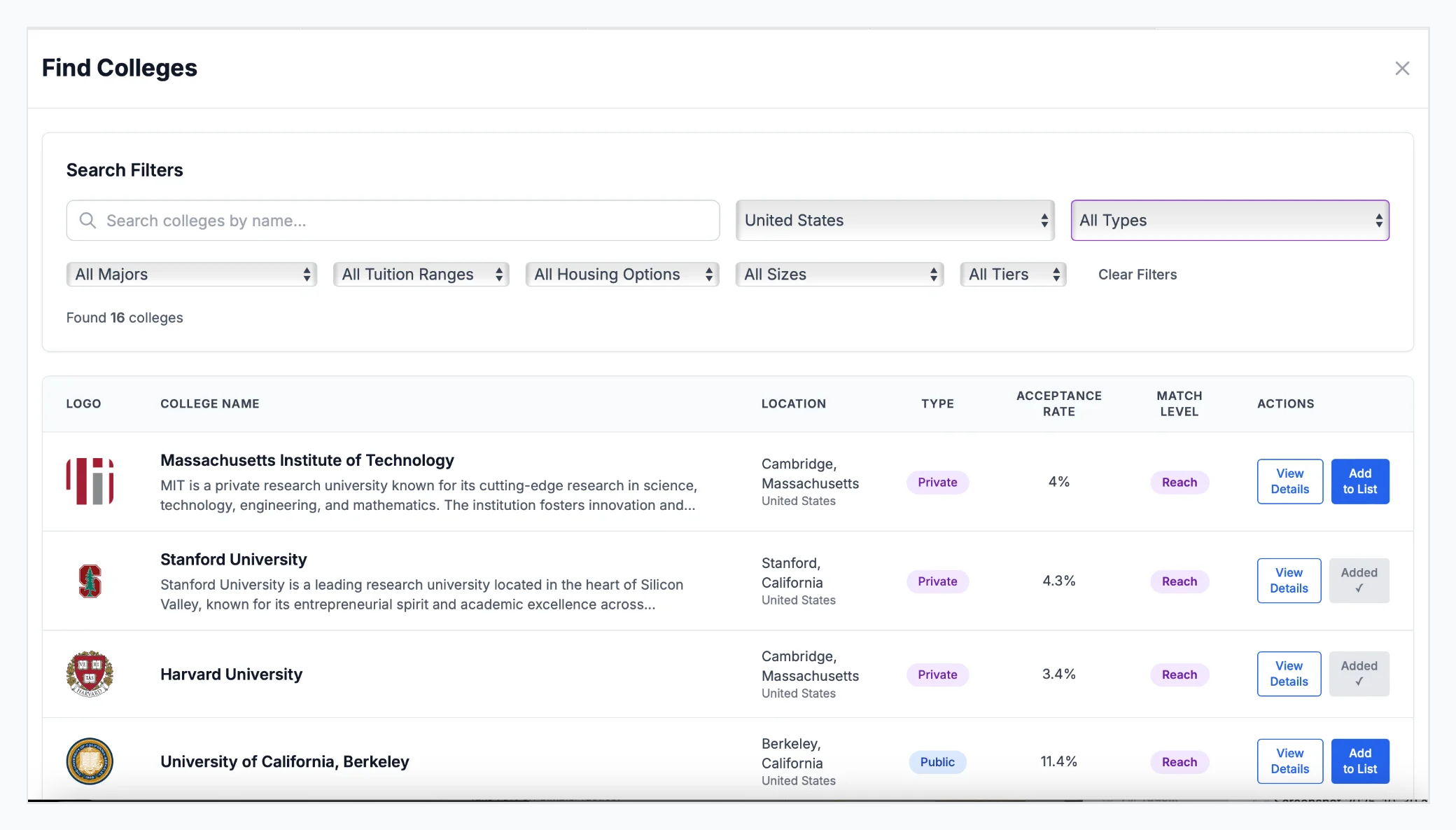
How Do Snapshot College Lists Compare to Persistent AI Admissions Assistants?
For a full college application cycle — junior-year research through senior-spring decisions — admissions assistants with persistent memory outperform one-time list generators because the work is sequential, interdependent, and constantly revised. Snapshot tools such as BigFuture and Niche remain strong for initial discovery. They are weaker as the sole system once essays, recommendations, test scores, and financial constraints start changing the list.
The average student now applies to eight or more colleges, each with distinct deadlines, supplements, and aid calendars. A static match list cannot track that load by itself.
What separates a usable discovery quiz from a cycle-length admissions assistant in 2026:
✅ Constraint memory — budget, major, geography, and testing policy survive from session to session ✅ List mutability — reach/target/likely balance updates when scores, grades, or preferences change ✅ Narrative alignment — personal statement, supplements, and activities stay consistent with the schools that remain ✅ Temporal orchestration — essays, recommendation requests, FAFSA, and early-action dates stay on one timeline ✅ Re-explanation cost — the student should not have to rebuild their file every time they return
To compare these tools fairly, it helps to treat college admissions as a multi-month project, not a search query.
Why Does a Full Application Cycle Outlast a One-Time College List?
A college list is a hypothesis generated at one moment; a full application cycle is 12–18 months of new evidence that should change that hypothesis. One-time generators answer “where might I apply?” Persistent assistants answer “what should change now that the profile, the calendar, and the essays have moved?”
NACAC’s State of College Admission reporting has documented a long rise in applications to four-year colleges, with no single formula guaranteeing admission. That volume is why a quiz result ages quickly. A student who matches to highly rejective private universities in October of junior year may need a different mix after a new SAT sitting, a tighter net-price ceiling, or a major switch from biology to public health.
Research on school-issued planning software found that personalized admissions information now reaches more than 40% of U.S. high schoolers, and that access changes how students choose colleges. The implication is not that every family needs another quiz. It is that information only helps if it stays attached to the student’s evolving file.
One-time generators optimize for a clean first list. Full-cycle tools optimize for the messy middle: dropped safeties, added financial likely schools, rewritten “Why us?” essays, and counselor notes that have to remain true through decision day.
What Should You Evaluate in an AI College Admissions Tool?
You should evaluate an AI college admissions tool on cycle continuity, not on how impressive the first list looks. A ranked set of brand-name universities is easy to produce. A file that still makes sense in March is harder.
This article uses a Cycle Continuity Test with six dimensions:
- Re-explanation cost — how much of the academic, testing, and family context must be retyped later
- Constraint persistence — whether budget, major, first-generation status, and location limits are remembered
- List revision quality — whether reach/target/likely balance is recalculated when inputs change
- Narrative alignment — whether essays and activities still match the remaining schools
- Temporal orchestration — deadlines, recommendation requests, score sends, and aid forms
- Decision-stage memory — whether the tool can recall why each campus is still on the list
College application tracking software has already split into two families: document-submission platforms and strategic-planning platforms. Conversational AI adds a third family. Assistants with persistent memory sit closer to a counselor file than to a search engine.
Practical checks before relying on any tool for a full cycle:
- Can it explain a school as a reach, target, or likely using the student’s actual transcript and testing, not just national averages?
- Can it keep essay drafts, activity descriptions, and school-specific supplements from contradicting each other?
- Can a parent or counselor see the same constraints the student stated three months earlier?
- Does it stop at “here are 12 colleges,” or does it continue through recommendations, aid, and final choice?
If the answer to those checks is “start over each chat,” the tool is a generator, not an admissions assistant.
How Do BigFuture, Niche, Scoir, and Persistent AI Assistants Differ?
They differ most on whether they store a living student file or return a one-pass match list. BigFuture and Niche excel at discovery. Scoir and similar school platforms excel at documents. Persistent AI assistants excel at carrying strategy, essays, and constraints across the whole cycle.
| Feature / Dimension | BigFuture | Niche | College Kickstart | Scoir | Jenova College Admissions Consultant |
|---|---|---|---|---|---|
| How the list is built | Search and quiz across 4,300+ colleges | Personalized search, reviews, and Direct Admissions | Profile fit against 790+ U.S. four-year institutions | School-connected college list and counselor workflow | Conversational profile, then iterative revision with memory |
| Cross-session continuity | Saved searches and lists | Saved lists and progress tools | Recalculates list balance as schools change | Application and document status inside the school system | Persistent chat memory of profile, essays, budget, and timeline |
| Essay and narrative support | Not a full essay-coaching workflow | Unverified as cycle-length essay coaching | Strategic list focus, not draft coaching | Stores materials; limited coaching | School selection plus essay crafting and timeline management |
| Deadline / task orchestration | Unverified as a full tracker | Deadline tracking and an admissions calculator reported for Niche | Early-admission and test-optional strategy | Document submission and counselor routing | Timeline management across essays, recs, and aid dates |
| Pricing (as of latest reported figures) | Free student search | Free student search | Individual access often below one application fee | About $2.52 per high-school student (2023) | Free tier with limited usage; Plus $20/month |
| Best for | Broad, official-feeling discovery | Fit research and student reviews | Data-heavy list strategy | School-managed document flow | Students who need one advisor-style thread for the full cycle |
BigFuture
BigFuture is the right starting point when a student needs a wide, filterable map of U.S. higher education. The College Board’s search covers location, major, and institution type, then offers a personalized quiz. That breadth is difficult for smaller tools to match.
Its limitation is architectural. A quiz encodes preferences at one sitting. It does not remember that the student later dropped physics, added a community-college dual-enrollment grade, or capped net price at $20,000. For families already working with a counselor, that may be enough. For students managing the cycle alone, the list still has to migrate into another system.
Niche
Niche is stronger when “fit” depends on campus culture, outcomes data, and peer reviews rather than on a bare match algorithm. The company personalizes search, publishes 2026 rankings, and reports partnerships with more than 1,700 schools. Direct Admissions, where participating colleges can accept a student from a Niche profile, is a genuine differentiator.
The trade-off is that reviews and “best of” lists can overweight popularity. A tool that is excellent at helping a student feel a campus is not automatically excellent at keeping eight applications internally consistent. List-building and progress tools help, but they are not the same as an advisor that recalls prior essay strategy.
CollegeVine and other chancing engines
, and roundups still place it among major college-search sites. Students on admissions forums often praise the chancing, then note that the volume of information can become confusing. That pattern is typical of generator-class tools: high resolution on “odds,” lower continuity on the rest of the file.Chancing is useful. It is not a substitute for remembering why a school was added, which supplement is half-written, and whether a new score should move that campus from reach to target.
Jenova College Admissions Consultant
Jenova’s College Admissions Consultant is built as a long-running advisor: school selection, essay crafting, and timeline management inside one thread that can retain the student’s profile. Because it sits on a platform with persistent cross-session memory, the assistant can return to a budget cap, a major change, or a previous outline without a full re-briefing.
The honest limitation is equally important. It is not a school document-transmission network. It does not replace Naviance or Scoir for transcripts and counselor forms, and it does not own a proprietary 790-school historical-admissions database. Probability talk should be treated as research-assisted reasoning, not as an official chance calculator. Students still submit through the Common App or campus portals.
How Does Persistent Memory Change Essays, Deadlines, and Recommendations?
Persistent memory changes those tasks by turning them into one file instead of a pile of disconnected chats, spreadsheets, and quiz results. The list, the personal statement, and the recommendation strategy either stay aligned or they quietly drift apart.
Essay work is where the gap is most visible. A generator can suggest “apply to these 12 colleges.” It cannot reliably remember that the student already used the robotics-captain story in the Common App personal statement, so the Carnegie Mellon supplement needs a different anecdote. Counselor-facing trackers such as CounselMore list every essay prompt per application for a reason: prompt inventory is a project-management problem, not a search problem.
Deadlines have the same structure. Early action, regular decision, scholarship priority dates, and FAFSA are not one calendar. Tracking guides for 2025–2026 repeatedly separate document storage from strategy: storing a PDF is not the same as knowing that adding a December SAT sitting should delay one early application and not another.
Recommendation letters expose the memory requirement even more clearly. A useful assistant recalls which teacher saw the research poster, which counselor already agreed to a November deadline, and which campus still needs a midyear report. A one-time list has no place to put that information.
Where Do School Platforms Like Scoir and Naviance Fit in 2026?
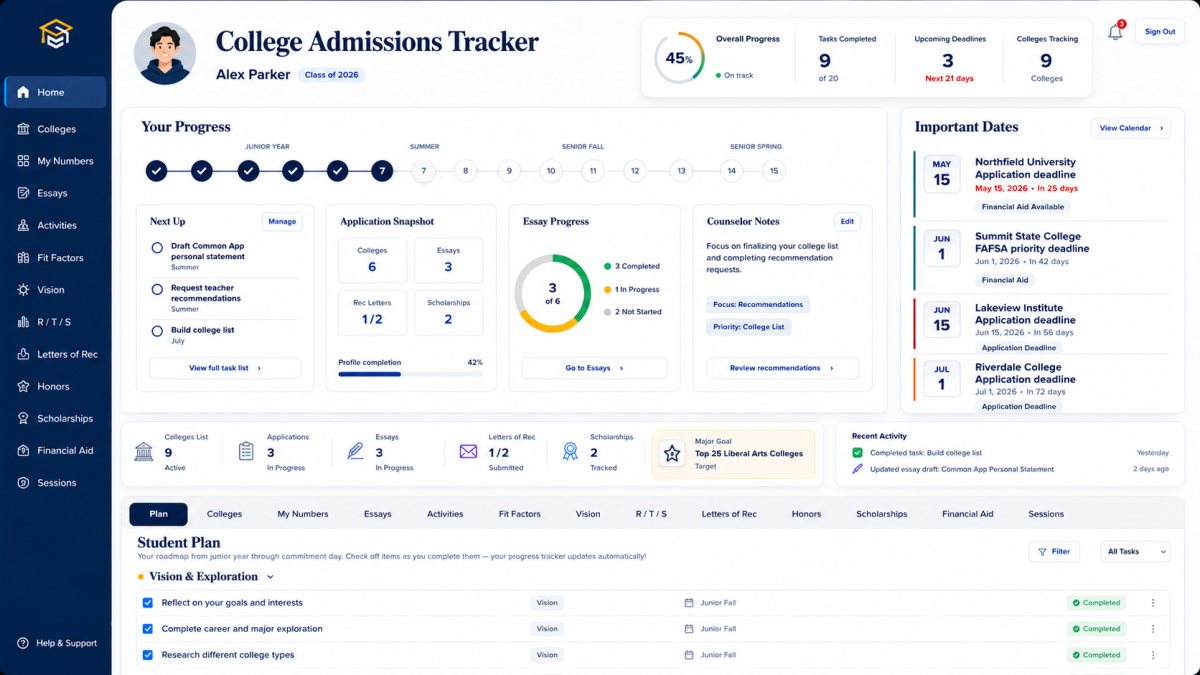
School platforms occupy the middle of the market: they persist records, but they are not conversational admissions assistants. Families should treat Scoir, Naviance, and MaiaLearning as infrastructure, then decide whether they still need a generator, a strategist, or a memory-based advisor on top.
Inside Higher Ed’s 2023 comparison found [**Scoir at about $2.52 per high-school student**](https://www.insidehighered.com/news/admissions/traditional-age/2023/03/12/companies-offer-new-competition-naviance) and MaiaLearning at $2,000 per 200 students, with discounts in some contracts. Those figures describe institutional software, not a consumer chatbot. College Kickstart’s later software survey still classifies Scoir, Naviance, and MaiaLearning primarily as document-submission or career-plus-college systems, with limited early-admission strategy relative to dedicated planning tools.
That classification matters. Naviance is the platform behind much of the personalized-admissions-information research showing large-scale effects on student choice. It can change behavior. It still may not draft a supplement, notice that two “Why us?” essays now contradict a major change, or remember a family’s updated EFC.
Brookings work on enrollment algorithms is a useful caution on the other side. Data-driven matching can create false precision and steer students toward whatever the model rewards. Persistent AI does not escape that risk. A remembered bad constraint is still a bad constraint. The advantage is only that the student can inspect and revise it.
If a school already issues Scoir or Naviance, do not duplicate document routing. Use the school platform for transcripts and recommendations, a discovery tool for browsing, and a persistent assistant only if you need strategy and writing continuity the school system does not provide.
How Do You Run a Full Application Cycle With an AI Admissions Assistant?
You run the cycle by briefing the assistant like a counselor, then updating the same file at every major change — not by generating a new list each month. One-time tools still belong at the front of that workflow.
A practical sequence:
- Discovery pass. Use BigFuture or Niche to map the landscape. Filter by major, region, public/private, and cost. Save 20–30 names without worrying yet about balance.
- Constraint brief. Move to a persistent assistant and state the file in one place:
"First-generation, 3.7 unweighted GPA, 1380 SAT, intended environmental science, California resident, $22,000 maximum yearly net price, no ED if it blocks comparing aid, need 3 likelies that offer strong undergraduate research."
- Balance the list. Ask for reach/target/likely labels, in-state public options, and a reason each school survives the budget cap. Cut the discovery list to roughly 8–12.
- Lock a narrative map. Assign one core story to the personal statement and different evidence to each supplement so campuses do not receive cloned essays.
- Run the calendar. Enter ED/EA/RD dates, recommendation ask dates, test sittings, and FAFSA. Update the same thread when a score or grade changes.
- Parallel test prep if needed. A dedicated SAT/ACT Tutor can raise the testing input while the admissions assistant keeps the list and essays in sync.
- Decision stage. Re-open the original constraints. Compare aid letters against the budget the assistant already stored, not against prestige.
For BigFuture, setup is shorter: take the quiz, search 4,300+ colleges, and export a starting list. That list should be treated as raw material. For Niche, start with the personalized search and reviews, then move any “finalist” schools into a tracker that can hold essays and deadlines.
Jenova’s College Admissions Consultant is available at jenova.ai/a/college-admissions-consultant. The free tier includes core features with limited usage; paid plans begin at $20/month with substantially higher usage allowances. It still requires the student to submit applications through official portals.
What Do Admissions Practitioners Say About AI That Remembers a Student File?
Admissions practitioners treat memory as the difference between a search result and a counselor file. The list is the easy artifact. The hard artifact is a coherent student story that survives new scores, new costs, and new deadlines.
"A college list generated in October of junior year is a hypothesis, not a plan. By December of senior year that same student often has a new test score, a tighter net-price ceiling, and six essay drafts that must stay consistent with a list that has already turned over twice. If the tool cannot remember the constraints behind the first list, the family is paying to rediscover work they already did."
"The failure mode we see with one-shot generators is narrative drift. The activities list, the personal statement, and the 'Why us?' supplements stop matching the schools that remain. Persistent memory is not there to make the first list prettier. It is there to keep the file internally consistent when the student is tired and the calendar is not."
"School platforms already solved document routing for many high schools. The remaining gap is advisory continuity for students who do not have weekly counselor time. That is a workflow problem, not a ranking problem. Tools should be judged on whether they reduce re-explanation, not on whether they can name 15 universities in one pass."
— Jenova Product Team, specialists in long-running AI agent workflows for academic planning
That view is consistent with the broader counseling record. NACAC has long emphasized that no fixed combination of factors guarantees admission, which is why a living file beats a frozen match score.
When Is a One-Time College List Generator Still the Better Choice?
A one-time generator is still the better choice when the student needs orientation, not case management. Persistent assistants are overhead if the only job is to see what exists.
Choose a snapshot generator when:
- The student is in early exploration and cannot yet name a major, budget, or region
- A school counselor already owns timelines, rec letters, and essay review
- The family only needs a browsing interface across thousands of campuses
- The student wants reviews, rankings, or Direct Admissions rather than draft coaching
BigFuture is the stronger snapshot when official-feeling coverage and filters matter most. Niche is stronger when student reviews and fit narratives matter more than a College Board-style search. College Kickstart is stronger when the family wants historical admissions structure and early-application strategy without a conversational coach.
Choose a persistent admissions assistant when the student will live with the same file for a full cycle: revising the list after testing, writing multiple supplements, tracking recommendations, and comparing aid. Jenova’s College Admissions Consultant is built for that pattern, with the limits already noted — no counselor-form transmission, no proprietary odds ledger, and no substitute for official submission systems.
The durable answer is not generator or assistant. It is generator then assistant. Use a one-time list tool to see the map. Use a memory-based admissions assistant to drive the route, including the detours that every real application cycle produces.
References
- NACAC — 2019 State of College Admission Report
- College Kickstart — Top College Application Tracking Software Solutions for 2025
- College Board BigFuture — College Search
- Niche — School Search, Reviews, and 2026 Rankings
- Mulhern, Christine — Changing College Choices with Personalized Admissions Information at Scale (Journal of Labor Economics, 2021)
- FindMyOrbit — AI Tools for Each Step of the College Application
- Inside Higher Ed — Companies Offer New Competition to Naviance
- CounselMore — Why You Need a College Application Tracker
- MaiaLearning — College Planning and Career Readiness Platform
- Brookings Institution — Enrollment Algorithms and Higher Education
- Colleges of Distinction — Best College Search Websites
- NACAC — Research and Reports
- Scoir — College Pricing