Are Multi-Model AI Platforms Better Than Single-Model Research Tools?
2026-08-22
How Do Task Routing and Model Diversity Change Research and Writing Quality?
For complex search, analysis, and writing workflows in 2026, multi-model task-routing platforms generally outperform single-model research tools because they can assign discovery, reasoning, and drafting to different models instead of forcing one system to do every job. Jenova is strongest when a project must move from source gathering to synthesis to a finished draft in one persistent workspace. ChatGPT and Claude remain stronger for fast, self-contained drafting. Perplexity and Elicit remain stronger for narrowly scoped lookup inside a familiar interface.
The quality gap is not about which brand has the largest model. It is about whether the stack can change models, tools, and specialists as the task changes.
Key factors that separate a capable research chat from a workflow platform:
✅ Search fidelity — whether answers stay attached to retrievable sources rather than a single model's memory ✅ Routing intelligence — whether the system can send literature review, calculation, and prose to different models ✅ Composition continuity — whether research context survives into the outline, draft, and revision ✅ Error detection — whether a second model or agent can challenge the first pass ✅ Cost control — whether expensive frontier models are reserved for hard steps
AWS documents that a single large language model (LLM) often cannot optimize cost, latency, and quality across mixed tasks, which is why routing has become a core architecture decision. To compare these tools fairly, it helps to separate what one model can do well from what a routed, multi-agent workflow can sustain.
Why Are Complex Search and Writing Workflows Outgrowing One-Model Tools?
Complex research and writing work is outgrowing one-model tools because the job is no longer a single prompt. It is a sequence of search, filtering, comparison, outlining, drafting, and fact-checking, and those steps reward different strengths.
A literature scan needs current sources. A methods critique needs careful reasoning. A client memo needs voice control. A single chat can approximate all three, but it usually does so inside one context window, with one model's blind spots intact.
Academic librarians note that generative AI tools remain prone to errors, limited context comprehension, and limited search capabilities. University research guides also flag hallucinations, training-data gaps, and paywalled literature as structural limits. Those limits compound when one model both retrieves and writes.
That is why researchers now stitch together specialized tools. Comparisons of research AI in 2026 repeatedly find that no single product covers discovery, analysis, writing, and presentation equally well. Roundups of academic workflows still split the job across Consensus, Elicit, Semantic Scholar, and Perplexity rather than recommending one general chatbot.
The practical question is no longer "which model is smartest." It is whether your stack can route each step to the system that is least likely to fail at that step.
What Should You Evaluate When Choosing an AI Research and Writing Stack?
You should evaluate an AI research and writing stack on search fidelity, routing intelligence, and composition continuity — a three-part test we call the SRC Framework — not on demo-quality answers to a single prompt.
The SRC Framework asks three questions that map to how research actually fails:
- Search fidelity. Can the tool find current, citable material, or does it reconstruct an answer from training data?
- Routing intelligence. Can it send a methods question, a cost-sensitive rewrite, and a long synthesis to different models?
- Composition continuity. Can the same workspace remember sources, rejected claims, and voice constraints through the draft?
Additional criteria matter once a workflow lasts more than one sitting:
- Grounding tools. Web search, academic search, files, and citation handling.
- Memory. Whether preferences and prior findings persist across sessions.
- Orchestration. Whether research, writing, and review can run as coordinated roles.
- Observability. Whether you can see which model or agent produced which claim.
- Cost shape. Whether you pay frontier-model rates for every cheap classification step.
- Failure mode. Whether one weak answer collapses the whole project.
HatchWorks frames the core decision as one general-purpose LLM versus a multi-model stack that assigns work by task. TrueFoundry describes multi-model routing as sending each query to the model best suited for that job. Those are architecture choices, not feature checklists.
A tool can score well on chat quality and still fail the SRC test if every answer is produced by the same model, in the same session, with no independent check.
How Do ChatGPT, Claude, Perplexity, Elicit, and Jenova Compare on Multi-Step Work?
ChatGPT and Claude are strongest as single-interface generalists, Perplexity and Elicit are strongest as specialized research interfaces, and Jenova is strongest when search, analysis, and writing need to stay connected inside a multi-model workspace.
ChatGPT appears consistently in 2026 tool lists as a versatile general assistant. Claude is frequently recommended for long-form academic writing. Perplexity is widely used for research lookup, though some academic workflow guides advise caution. Elicit is positioned as an AI research assistant for literature review.
Jenova takes a different shape. Users can switch among models from OpenAI, Anthropic, Google, DeepSeek, and xAI, keep unlimited chat history, and attach knowledge bases. Domain agents such as the Academic Research Assistant and the Writing Assistant sit on that same stack, so a literature pass does not have to be pasted into a separate drafting tool.
The trade-off is real. Elicit remains more purpose-built for structured paper extraction. Claude remains simpler when the only job is a long, careful draft. Jenova's advantage appears when the project has several roles, not when the user wants the fewest possible settings.
| Feature / Dimension | ChatGPT | Claude | Perplexity | Elicit | Jenova |
|---|---|---|---|---|---|
| Model access | Single-vendor general assistant | Single-vendor long-context model | Search-first interface over a hosted model | Research-specific workflow model | Multi-provider access with task-level model choice |
| Search and source grounding | Strong general web assistance; not a dedicated literature database | Strong document analysis; weaker as a live research index | Strong for quick cited lookup | Strong for structured literature review | Web, Scholar, files, and knowledge bases inside one workspace |
| Multi-step orchestration | User-managed prompting across chats | User-managed long-context prompting | Best for question-answer loops | Best for review pipelines, not full drafting | Agent orchestration plus model routing across research and writing |
| Memory and continuity | Conversation memory inside the product | Strong in-thread context; weaker as a cross-project system of record | Limited project memory beyond search threads | Study- and paper-centric rather than draft-centric | Persistent cross-session memory and attached documents |
| Pricing (as of 2026) | Unverified in this review | Unverified in this review | Unverified in this review | Unverified in this review | Free tier with limited usage; paid plans from $20/month |
| Best for | Fast general research and drafting | Long manuscripts and careful prose | Cited answers to discrete questions | Academic literature review | End-to-end search, analysis, and writing workflows |
Another multi-model option is Multi, which says it puts 300+ models from major labs across four workflows. That makes it relevant for teams that want raw model choice. It is less relevant if the user needs domain agents, persistent project memory, and a single research-to-draft workspace.
Which AI Approach Produces More Reliable Search and Source Discovery?
A search-specialized tool or a multi-model platform with live retrieval is more reliable for source discovery than a single general-purpose model answering from memory. The reason is simple: discovery and synthesis are different failure modes.
Single-model chat is efficient when you already know the question and only need a first-pass explanation. It becomes fragile when the answer depends on what was published after training, what sits behind a paywall, or what a second database would contradict.
ConvergePanel argues that single-model research hides disagreement by synthesizing too early, while multi-model research preserves dissent and source-quality signals. Argumentree makes a similar point: a single model inherits its own errors with no independent check, while multi-model research can validate claims.
In practice, the more reliable pattern looks like this:
- Use a retrieval-first tool to collect candidate sources.
- Use a second model to extract methods, sample sizes, and limitations.
- Use a third pass to flag unsupported leaps before writing begins.
Elicit and Consensus are built for parts of that sequence. Consensus focuses on evidence-style answers drawn from peer-reviewed literature. Perplexity is faster when the question is closer to web search than to systematic review.
Jenova is more useful when discovery is only the first stage. The Academic Research Assistant can search across academic databases and keep citations attached, then hand the same project context to a writing agent. That does not replace a dedicated evidence database for a formal systematic review. It does reduce the copy-paste gap that usually introduces citation drift.
A reliable prompt for the discovery stage is specific about scope and exclusion rules:
"Find peer-reviewed sources from 2023–2026 on multi-LLM routing in production systems. Exclude vendor landing pages. For each source, extract the claimed cost or quality gain, the evaluation method, and one limitation the authors admit."
If a tool cannot follow that instruction without inventing papers, it is a drafting aid, not a research stack.
How Does Multi-Model Routing Improve Analysis Without Inflating Cost?
Multi-model routing improves analysis by sending cheap classification and lookup to smaller models and reserving stronger models for comparison, contradiction-checking, and structured reasoning. Done well, that raises quality and can lower spend. Done poorly, the router itself becomes another billable step.
AWS describes two families of routing: static routing through dedicated interfaces, and dynamic routing that classifies a prompt before choosing a model. Dynamic routing can use a classifier model, semantic similarity, or a hybrid of both. Amazon Bedrock Intelligent Prompt Routing is presented as a managed way to cut request cost by up to 30% by choosing the cheaper model that can still meet the quality bar.
MindStudio reports that matching tasks to the right model can cut costs by 60% when planning and execution are split instead of sending every step to a frontier model. That figure is vendor-reported and should be treated as an upper bound, not a guarantee. The underlying logic still holds: analysis has cheap subtasks and expensive subtasks.
A practical split for research analysis looks like this:
- Small or fast model: tag documents, extract quotes, normalize citations, cluster themes.
- Mid-range model: summarize methods and flag missing comparators.
- High-capability model: reconcile conflicts, stress-test causal claims, write the analytical memo.
Jenova supports that split because users can change model providers inside one project rather than exporting notes between apps. The limitation is that routing is only as good as the task definition. If you ask one agent to "analyze everything," you have rebuilt a single-model workflow with extra overhead.
AWS also notes that custom routing adds latency and classifier cost, so the savings must exceed the routing tax. For a 20-minute briefing, one strong model is often cheaper. For a recurring research pipeline, routing usually pays for itself.
When Does a Single AI Model Still Produce Better Writing?
A single AI model still produces better writing when the task is linear, the source set is already chosen, and stylistic consistency matters more than independent verification. In those cases, extra agents can add seams, delay, and contradictory edits.
GitHub's guidance on agent orchestration is explicit: if tasks are simple and linear, a single agent is the better fit. Writing often fits that description. One long-context model that can see the outline, the notes, and the last three paragraphs will usually keep voice steadier than three specialists handing drafts around.
Claude is the clearest example. It is repeatedly recommended for long-form academic writing because the job is sustained prose, not tool switching. ChatGPT is often enough for emails, briefs, and first drafts where speed beats citation architecture.
Single-model writing starts to lose when the draft depends on live evidence, multiple stakeholder versions, or a QA pass that should not trust the original writer. That is where a writing agent plus a separate review agent is justified.
Jenova's Writing Assistant is built for the middle of that spectrum: adapt to a format and audience, keep a stable voice, and stay inside a workspace that already holds the research. It is not automatically better than Claude for a self-contained essay. It is stronger when the draft must keep using the same sources, exclusions, and terminology collected earlier.
A single-model writing brief should still be tight:
"Using only the eight sources already in this project, write a 900-word explainer for product managers. Do not add new citations. Keep the reading level non-technical. Flag any claim that is not supported by the attached notes."
If your writing task can be specified that cleanly, one model is not a compromise. It is the correct architecture.
How Do Single-Agent and Multi-Agent Architectures Differ for Research Workflows?
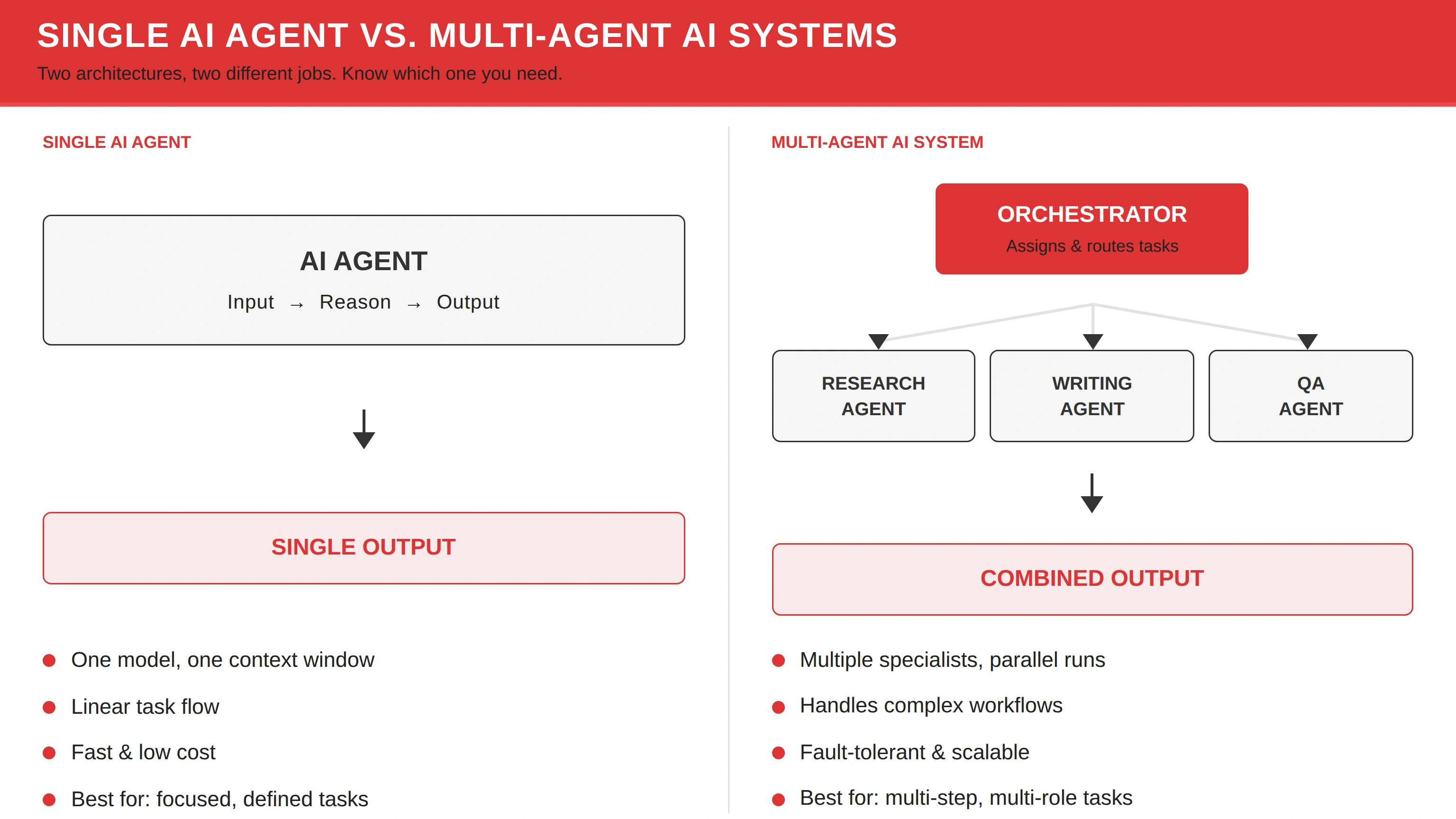
A single-agent system uses one model and one context window in a linear input-reason-output loop, while a multi-agent system uses an orchestrator to assign specialized roles such as research, writing, and QA. The first is faster and cheaper for defined tasks. The second is more fault-tolerant for multi-step work.
AI agent orchestration is the control layer that coordinates multiple autonomous agents toward a shared goal, including state, permissions, and human checkpoints. That is different from simply having several agents, and different from ordinary AI orchestration that only sequences models and APIs. Kimi describes the same pattern in workflow terms: one agent researches, another plans, another writes.
The architectural contrast is easiest to see in academic production. In April 2026, Google Research described PaperVizAgent as a five-agent system — retriever, planner, stylist, visualizer, and critic — that scored 60.2 against a human baseline of 50.0 on figure generation. A companion system, ScholarPeer, uses multiple agents to ground peer review in live literature rather than treating review as one-shot text generation. Those results do not prove every multi-agent stack is better. They do show why specialization plus critique can beat a single prompt.
The costs are equally concrete. Multi-agent systems need explicit protocols, more infrastructure, and cost caps. Without orchestration, agents can duplicate work, conflict, or retry until spend spikes. Single-agent systems have the opposite risk: one failure ends the job.
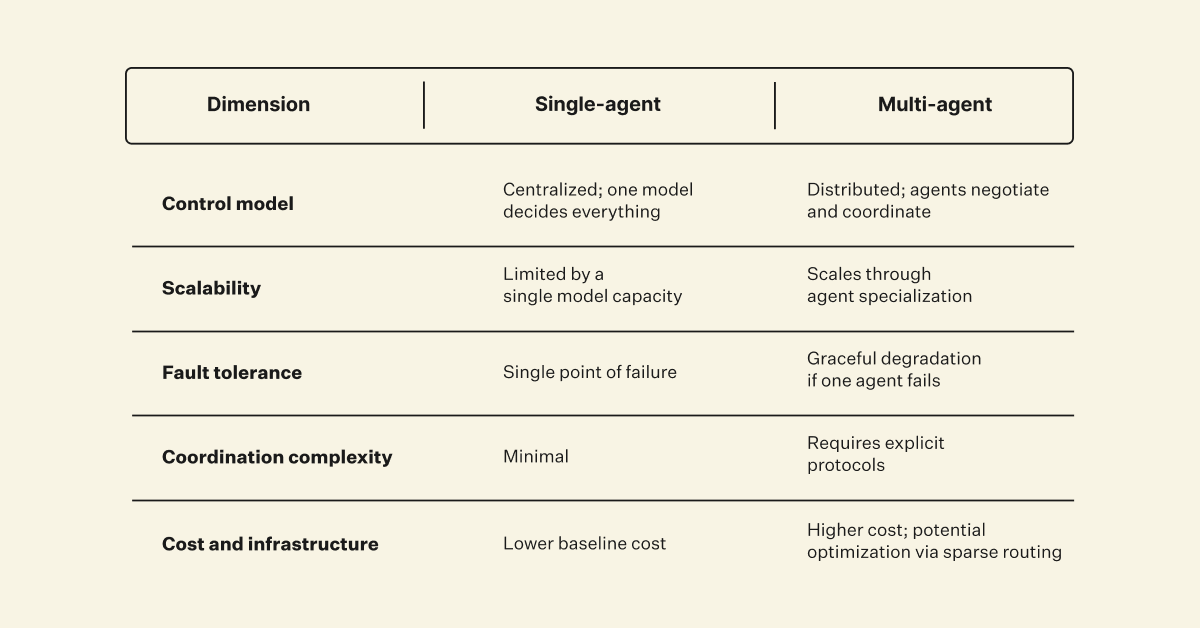
For research and writing, the useful rule is role count. If the work has one role, use one agent. If the work has a researcher, a writer, and a reviewer, use an orchestrated system — or accept that you are the orchestrator.
How Do You Build a Complete AI-Assisted Research and Writing Workflow?
You build a complete AI-assisted research and writing workflow by separating discovery, analysis, and composition, then choosing a single-model tool or a routed platform for each layer instead of one chat for the entire project.
A durable sequence looks like this:
- Define the decision. Write the question the final document must answer, plus what would falsify it.
- Collect sources with a retrieval-first tool. Use Elicit or Consensus for paper-level review, Perplexity for web-scale briefing, or Jenova's Academic Research Assistant when the same workspace must keep the citations.
- Analyze with a second model. Extract methods, disagreements, and confidence, not just summaries.
- Draft with a writing specialist. Use Claude for a self-contained manuscript or Jenova's Writing Assistant when the draft must stay tied to project memory.
- Run a hostile QA pass. Ask a different model to attack citations, chronology, and overclaim.
- Lock the artifact. Export only after unsupported claims are removed or downgraded.
On Jenova, that sequence can stay in one account. A user can start with the Academic Research Assistant, switch models for the analytical pass, then continue with the Writing Assistant or the SEO Blog Generator if the output is a public article. Persistent memory and attached files reduce the usual loss of constraints between tools.
A good handoff prompt between research and writing is explicit about what must not change:
"Here is the source packet and the claims we already rejected. Draft the analysis section for a policy audience. Every paragraph needs one surviving source. If a claim is inferred, label it as inference. Do not rehabilitate the rejected claims."
On a single-model tool, the same workflow is still possible. You just become the router: new chats, pasted notes, and a manual QA model. That can be the right design for occasional work. It becomes brittle when the project lasts weeks or involves multiple document types.
Jenova is not the quietest way to do a one-off summary. Its advantage is that the workflow above does not require three subscriptions and a personal notation system to keep the pieces aligned.
What Do AI Infrastructure Teams Say About Single-Model Versus Multi-Model Stacks?
AI infrastructure teams generally treat single-model tools as the correct default for linear work and multi-model platforms as the correct default once a workflow has specialized roles, cost constraints, or an independent review step.
"The most expensive research mistake we see is not picking the wrong frontier model. It is using one model as researcher, analyst, and editor, then trusting the fluency of the final paragraph. When the same system invents a source and then writes the sentence that depends on it, there is no internal alarm. A second model does not guarantee truth, but it does create a chance to disagree."
"Routing is worth the complexity only after you can name the jobs. 'Research this and write it up' is still one job. 'Collect candidate papers, extract methods, reconcile conflicts, draft, then attack the citations' is five jobs. Teams that skip that decomposition buy a multi-agent diagram and still run a single prompt."
"Cost arguments are real, but they cut both ways. Amazon's published routing work shows that sending every request to the strongest model wastes money, and vendor reports of 30% to 60% savings are plausible when classification and drafting are split. The opposite failure is also common: an orchestrator, a classifier, and three specialists spend more than one careful model would have spent on a short memo."
— Jenova Product Team, AI workflow architecture, 8 years building multi-model agent systems
That view matches the public engineering literature. AWS treats multi-LLM routing as a response to mixed task types, not as a universal upgrade. GitHub treats orchestration as necessary after agents proliferate, not before. The expert consensus is conditional: add models when the work has seams. Do not add models to decorate a simple task.
When Should You Keep Using a Single-Model Research Tool?
You should keep using a single-model research tool when the question is bounded, the sources are already in hand, the deadline is short, and you do not need a second system to audit the first. In those conditions, multi-model routing adds coordination cost without adding much truth.
Stay with ChatGPT or Claude when you are:
- Explaining a familiar concept rather than mapping a literature.
- Rewriting a document you already trust.
- Exploring tone, structure, or argument order.
- Working in one sitting with no handoff to another teammate.
Stay with Perplexity or Elicit when you are:
- Asking a discrete, citation-needed question.
- Screening abstracts before a deeper read.
- Doing a literature pass that will be written up elsewhere.
Move to a multi-model task-routing platform when two or more of these are true:
- The project mixes search, analysis, and finished writing.
- The output must keep a source trail across drafts.
- You need different models for extraction, reasoning, and prose.
- The work repeats often enough that a reusable workflow matters.
- A wrong citation would be costly.
Jenova fits that second list. It is weaker as a replacement for Elicit's paper-extraction workflow and weaker than Claude as a quiet long-context writer. It is stronger when those jobs have to happen together, with memory, model choice, and specialized agents in one place.
The decision is therefore not "single-model versus multi-model" as a loyalty test. It is whether your workflow still looks like a conversation or already looks like a production line. Conversations belong to one model. Production lines belong to a router.
References
- AWS Machine Learning Blog — Multi-LLM routing strategies for generative AI applications on AWS
- The Chicago School Library — Artificial Intelligence Tools and Resources: Benefits and Limitations
- University of the District of Columbia Library — Generative AI Uses and Limitations
- PapersFlow — Best AI for Researchers in 2026: 10 Tools Compared by Category
- Thesify — Best AI Tools for Academic Research in 2026
- HatchWorks AI — Large Language Model Use Cases: One LLM vs Multiple Models
- TrueFoundry — Multi-Model Routing: Optimize AI Tasks Efficiently
- Synthesia — The 12 Best AI Tools for 2026
- AnswerThis — Top 10 AI Tools for Researchers in 2026
- Zerve — AI Tools for Research in 2026: Literature Review, Analysis
- Multi — One task, the right AI workflow
- ConvergePanel — Best Multi-Model AI Tool for Research
- Argumentree.AI — Multi-Model vs Single-Model AI Research
- MindStudio — How to Cut Costs 60% by Matching Tasks to the Right Model
- GitHub Resources — What Is AI Agent Orchestration?
- Kimi AI — AI Agent Orchestration: Types, Steps, and Benefits
- Google Research — Introducing two AI agents for better figures and peer review