Are AI Research Workspaces Better for Systematic Evidence Mapping?
2026-08-22
How Do Persistent Project State and On-Demand Chunk Retrieval Differ?
For systematic evidence mapping, a research workspace that reloads decisions, status, and artifacts at the start of every session is a better primary environment than a single-paper summarizer or a RAG chatbot that only retrieves “relevant chunks” on demand. Mapping is a longitudinal coding project: inclusion rules drift, borderline studies get recoded, and synthesis depends on remembering why a source was gated last week. Paper-level tools such as Elicit, Consensus, and NotebookLM remain strong for discovery, extraction, and closed-corpus Q&A. A persistent workspace — including Jenova’s Academic Research Assistant — is stronger when the map must survive weeks of protocol changes without silently rewriting yesterday’s decisions.
The distinction that matters in 2026 is not “which model writes a nicer abstract.” It is which memory architecture can hold a living evidence map.
Key factors that separate usable mapping infrastructure from disposable paper chat:
✅ Operational memory vs. reference memory — maps need project state (criteria, codes, exclusions), not only retrieved passages ✅ Decision provenance — every include/exclude call should remain inspectable across sessions ✅ Structured extraction — comparable fields beat one-off narrative summaries ✅ Human-supervised protocol fidelity — evidence bodies still treat AI as an adjunct, not a replacement reviewer ✅ Synthesis that can be versioned — reports, figures, and source lists should accumulate rather than regenerate from scratch
To compare these tools fairly, it helps to treat evidence mapping as a four-layer continuity problem rather than a summarization contest.
Why Does Systematic Evidence Mapping Strain Single-Paper AI Tools?
Systematic evidence mapping strains single-paper summarizers because a map is a coded inventory of a literature, not a sequence of isolated reading notes. Systematic Evidence Maps (SEMs) are a form of evidence synthesis that categorizes and organizes scientific findings by predefined dimensions — population, exposure, outcome, method, geography, or evidence gap — so reviewers can see what exists, where it clusters, and what is missing.
That workflow collides with how most LLM research products work. A RAG or “chat with this PDF” tool answers the current query by pulling locally similar chunks. It does not automatically reload last Tuesday’s coding frame, the three studies parked in “maybe,” or the decision that animal models were out of scope after the protocol was tightened. Mapping reviews also require a documented screening process against inclusion and exclusion criteria, which is a different task from generating a fluent paragraph about one paper (methodology for mapping reviews).
Manual review is still slow enough that the shortcut is tempting. One 2026 literature-tool survey put a conventional review cycle at four to six weeks of screening, extraction, and citation cleanup. Dedicated AI screeners can cut that burden — the AIM Review system reported workload reductions from 20% up to 95% across six real-world reviews — but speed does not create a map. Without persistent project state, faster screening just produces a larger pile of disconnected summaries.
Library and methods bodies are explicit about the remaining gap. King’s College London’s evidence-synthesis guidance states that AI tools cannot replace traditional search, screening, and extraction methods and should be used only with a clear view of bias, copyright limits, and hallucination risk. A 2025 systematic review of generative AI in evidence synthesis reached the same operational conclusion: current evidence does not support GenAI use without human involvement or oversight.
What Should You Look for in an AI Evidence-Mapping Workflow?
You should evaluate AI mapping tools with a continuity test, not a writing-quality test. We use a four-layer stack — call it the CODE stack — because each layer fails in a different, predictable way when teams try to turn paper chat into a systematic map.
C — Coverage. Can the tool search a real scholarly corpus, or only files you already uploaded? Elicit searches more than 138 million papers and 545,000 clinical trials. NotebookLM, by design, answers from the sources in the notebook. Coverage errors at this layer become missing rows in the map, not just thin paragraphs.
O — Operationalization. Can inclusion criteria, coding dimensions, and extraction fields be stated once and reapplied? A summarizer that reinterprets “relevant” on every prompt will recode the same borderline trial differently on day three. Mapping guidance treats pre-defined criteria as non-optional (mapping-review methods).
D — Decision provenance. Can you recover why a study was included, excluded, parked, or gated? Cochrane-aligned groups, including the Responsible AI in Evidence Synthesis (RAISE) effort with Cochrane, Campbell, and JBI, treat transparency as a quality requirement, not a nicety.
E — Extractability. Can findings land in comparable cells — sample, design, direction of effect, limitation — rather than in irreconcilable prose? Elicit’s product design is built around interactive tables and multi-step extraction. Consensus is faster at hypothesis-level evidence direction but is not built for structured review writing.
Weight the layers by intent. A scoping pass can tolerate weaker provenance. A living evidence map that will be cited, updated, or handed to a coauthor cannot. Tools that excel at Coverage and Extractability still fail maps if Operationalization and Decision provenance reset every session.
How Do Elicit, Consensus, NotebookLM, and Research Workspaces Compare?
Elicit and Consensus are the strongest paper-discovery and extraction layer in this category, NotebookLM is the strongest closed-corpus notebook, and a persistent research workspace is the strongest environment for keeping a multi-week map coherent. No single product wins every CODE layer, which is why serious mapping teams usually pair a corpus tool with a project-memory environment rather than expecting one chatbot to own the review.
As of 2026, published feature and pricing snapshots look like this:
| Feature / Dimension | Elicit | NotebookLM | Consensus | Jenova research workspace |
|---|---|---|---|---|
| Memory model | Library of saved sources plus per-report customization; not a full project-state container | Notebook-scoped source set; answers stay inside uploaded materials | Question/list memory around hypothesis queries | Persistent cross-session memory; project context can be reloaded rather than re-retrieved |
| Coverage | 138M+ papers, 545k trials | Uploaded corpus only; 50 sources free, 300 on Plus | 200M+ papers, evidence-direction tags | Live web and scholarly search plus attached knowledge bases; not a fixed publisher index |
| Structured extraction | Tables, screening, data points at scale (up to 1,000 papers / 20,000 data points) | Source-linked Q&A and outlines, not SR extraction grids | Consensus Meter and short evidence answers | Synthesis reports and citation-backed briefs via Deep Research; weaker as a dedicated dual-screener |
| Decision persistence | Sources can be stored in a library; protocol state is not first-class | Persists the notebook’s files, not coded include/exclude logic | Bookmarks and lists on paid tiers | Conversation history, memory, and attached project files survive across sessions |
| Pricing (as of 2026) | Plus from about $12/month | Free; Plus via Google AI Pro at about $19.99/month | Premium about $10/month | Free tier with limited usage; Plus $20/month for 30× usage |
| Best for | High-volume screening and extraction tables | Teaching sets and already-collected PDFs | Fast “does the literature support X?” checks | Living maps, multi-session coding, and manuscript integration |
Elicit is the honest specialist for systematic-style screening. It can automate screening and extraction and reports up to 80% time savings on those stages. A Cochrane methods comparison still found that Elicit’s search sensitivity was not high enough to replace traditional literature searching, so it functions best as a high-precision adjunct. It also tends to stop at reports and tables; writing, versioning, and living-manuscript work usually move elsewhere.
NotebookLM is the honest specialist for grounded reading of a fixed set. Every answer can be checked against a quoted passage, and Google has added Deep Research plus broader file types. It cannot discover papers you have not collected, and it does not encode a PRISMA-style decision log.
Consensus is the honest specialist for hypothesis direction. Its meter and support/contrast tagging are faster than building an extraction grid when you only need to know which way the literature leans (tool comparison). It is the wrong primary system for a coded map.
Jenova’s Academic Research Assistant is strongest when the unit of work is the project, not the PDF. It can search scholarly sources, keep manuscript and citation context, and — because the underlying platform stores unlimited chat history and cross-session memory — continue a coding frame without pasting the protocol back in. It is not a validated dual-review screening platform in the Covidence or Rayyan sense, and it does not publish Elicit-style extraction-accuracy figures. Teams that need regulatory-grade audit trails should still keep a dedicated screener in the stack.
SciSpace and Scite fill narrower adjacent jobs. SciSpace is repeatedly described as the better paper-by-paper deep-analysis environment, with a very large corpus but a less unified review workflow. Scite’s 1.6 billion Smart Citations classified as supporting, contrasting, or mentioning a claim are unmatched for citation-context audit, and almost useless as a discovery or mapping database on their own.
How Does Operational Memory Change Multi-Session Literature Synthesis?
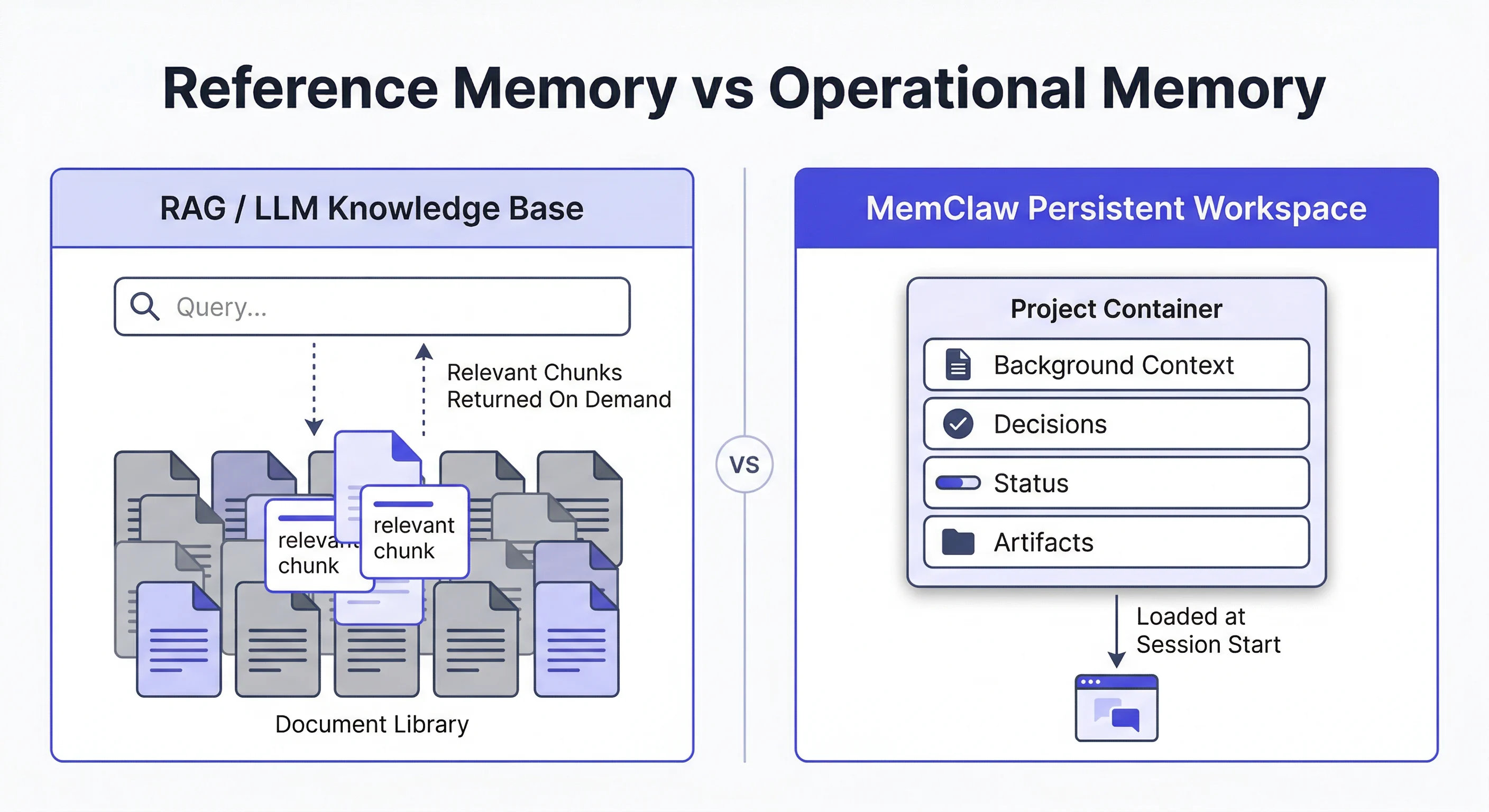
Operational memory changes synthesis because it treats the project container — background, decisions, status, artifacts — as the object that loads at session start, instead of treating the literature as a haystack to be re-queried. Reference memory asks, “Which chunks look like this question?” Operational memory asks, “What is already true about this project, and what still needs evidence?”
That difference shows up in three failure modes that summarizers hide well:
- Criteria drift. If “adult human RCTs only” lives in the prompt rather than in project state, a later session that asks a slightly broader question will quietly re-include the pediatric studies you already rejected.
- Orphaned maybes. Borderline papers parked for discussion with a coauthor disappear unless status is a first-class field.
- Regenerated synthesis. A RAG answer can be locally faithful to today’s retrieved chunks and still contradict last week’s gap table, because nothing forces the new answer to inherit the old coding.
Persistent workspaces invert the load order. Background context, decisions, status, and artifacts come in before the next query. Jenova’s platform implementation of this pattern is cross-session memory plus attachable knowledge bases: the assistant can remember the mapping dimensions, the working definition of an evidence gap, and which claims already have enough support. Testing this against notebook-style tools shows a clean trade-off. NotebookLM’s closed corpus is safer against off-source invention (source-linked answers). A persistent open workspace is more useful when the corpus is still growing and the coding frame is the scarce asset.
The practical implication for SEMs is simple. If your deliverable is a one-sitting briefing on 15 PDFs, operational memory is optional. If your deliverable is a gap map that will be updated after the next conference cycle, operational memory is the product.
What Does an End-to-End Agentic Evidence Pipeline Actually Look Like?
An end-to-end mapping pipeline looks like a staged research sprint with gates, not like a single “summarize these papers” prompt. The illustration below is a useful reference architecture: question formation, literature triage, candidate identification, hypothesis formalization, multi-source validation, versioned reporting, and a git-tracked package.
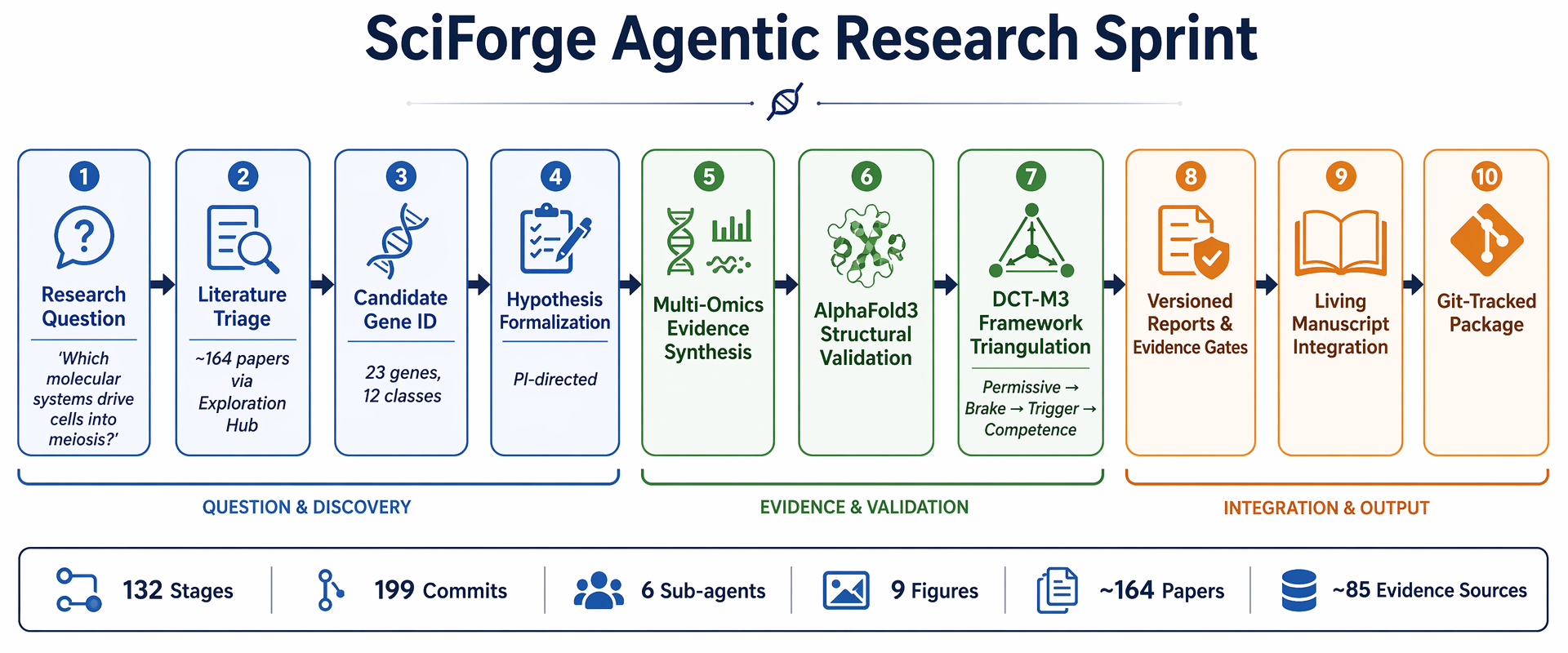
The example sprint is deliberately large — on the order of 164 papers triaged, 132 stages, 199 commits, six sub-agents, and roughly 85 evidence sources — because that is the scale at which paper-chat collapses. A summarizer can describe paper 17. It cannot keep a 10-stage chain coherent when stage 4 changes the inclusion rule that stage 2 already applied.
Three design choices in that pipeline matter more than the domain details:
- Discovery is a phase, not the product. Literature triage feeds candidate IDs and a formal hypothesis. Stopping at summaries leaves the map unbuilt.
- Validation is multi-modal. Evidence synthesis, structural or quantitative checks, and an explicit “permissive → brake → trigger” logic force claims through gates instead of averaging them into a paragraph.
- Output is versioned. Living-manuscript integration and a git-tracked package make the map an artifact with history. That is the opposite of a chat transcript you cannot replay.
Jenova can approximate this pattern by splitting roles across agents rather than forcing one chat to be librarian, coder, and writer. Academic Research Assistant handles scholarly discovery and manuscript context. Deep Research produces citation-backed synthesis across many sources. Real-Time Search is useful when the map must also include preprints, repositories, or non-journal grey literature. The limitation is orchestration discipline: the human still owns the protocol, the gates, and the decision to promote a claim into the living manuscript. Methods groups continue to treat that human role as non-negotiable (KCL / RAISE guidance).
Paperguide-style all-in-one review platforms try to collapse plan–search–screen–extract–generate into one vendor workflow, including Extended modes that screen 200 candidates and write from the top 50. That is closer to a workspace than Elicit-plus-Word, but it still needs an external decision log if you care about provenance after the generated review is exported.
How Do You Get the Most Out of an AI Evidence Map?
You get the most out of an AI evidence map by writing the protocol into the workspace before you ask for prose, then forcing every later session to inherit that protocol. The setup is similar across tools; the difference is whether the tool can remember the setup.
For a Jenova-centered map, a workable sequence is:
- Open Academic Research Assistant and name the project, population, and mapping dimensions in the first message.
- Pin the protocol in language the assistant can reuse:
“Build a systematic evidence map of adult human studies on X. Include RCTs and prospective cohorts only. Code each study for design, sample, intervention, primary outcome, direction of effect, and limitations. Park animal and in-vitro papers in an excluded log with a one-line reason. Do not regenerate codes that were already decided.”
- Run Deep Research for the first corpus pass, then paste or attach the working table back into the same project thread so extraction and narrative share one memory.
- After each session, ask for three artifacts, not one essay: an updated study table, an exclusion log, and a gap list. Those three files are the map.
For Elicit, start with the research question, generate a screening table, and treat the library as the source of truth (Elicit systematic-review workflow). Do not skip a conventional database search. The Cochrane case studies found Elicit useful for high-precision preliminary searching and for unique extra studies, not as a sole search engine.
For NotebookLM, collect the PDFs first, stay inside one notebook, and ask dimension-by-dimension questions (“List every study that reports outcome Y with sample size and follow-up”) so the closed corpus cannot wander. Upload limits — 50 sources on the free tier, 300 on Plus — make this the wrong tool for a 400-record map unless you pre-screen elsewhere.
Two process rules travel across every stack. First, do not upload full-text PDFs into a consumer model if copyright terms forbid it; rightsholders generally prohibit that use. Second, keep a human in the include/exclude seat. Screening assistance is the AI task with the most supporting evidence; unsupervised synthesis is the task with the least (review-of-reviews on AI readiness).
What Do Evidence Synthesis Specialists Say About AI-Assisted Mapping?
Specialists increasingly accept AI for supervised screening and extraction, and they still reject AI as an unsupervised cartographer of a field. The useful expert consensus in 2026 is narrower than vendor copy: automate the repetitive layer, persist the decision layer, and keep humans accountable for the map.
“The failure mode we see is not that models cannot summarize a paper. It is that mapping teams treat a good summary as if it were a coded record. A systematic evidence map is a set of reversible decisions — in, out, parked, gated — attached to stable fields. If those decisions live only in last week’s prompt, the map is already corrupt, even when every paragraph still sounds careful.”
“Reference retrieval and operational memory solve different problems. Retrieval is how you find candidate evidence. Operational memory is how you stop recoding the same study three times. Tools that are excellent at the first job routinely get deployed as if they performed the second. That is how you get a fluent gap analysis that cannot explain why 12 borderline trials vanished.”
“Our working rule is simple. Use a corpus engine to populate rows. Use a persistent workspace to keep the codebook, the exclusion log, and the gap table alive. Use a human reviewer at every gate that changes the map’s meaning. Anything sold as a one-click systematic map is asking you to skip the only layer methods groups still consider non-negotiable.”
— Jenova Product Team, research-workflow design, 8 years building knowledge systems for multi-session analytic work
That stance lines up with formal guidance. NICE, Cochrane-linked RAISE recommendations, and university library services all describe AI as an adjunct inside existing validated methods. A living guide to AI in literature searching and screening makes the same efficiency case — screening is expensive; automation helps — without claiming that generation can replace protocol.
When Are Single-Paper Summarizers Still the Right Choice?
Single-paper summarizers are still the right choice when the corpus is small, already collected, and not being coded into a reusable map. If you have 12 PDFs, a journal club tomorrow, and no need to update the inventory in three months, NotebookLM or SciSpace-style paper chat will finish the job with less ceremony than a project container.
They are also the better fit for three other jobs that get mislabeled as mapping:
- Mechanism explanation. “Walk me through Figure 3” is a reading task. A closed-corpus notebook with clickable quotations is safer than an open workspace that might blend papers.
- Citation-context checks. If the question is whether later work supports or contrasts a claim, Scite’s classified citations are the purpose-built layer (1.6B+ Smart Citations).
- Hypothesis spot-checks. Consensus remains the fastest way to see whether a proposition has a visible support/contrast split before you invest in a map (Elicit vs Consensus overview).
The mistake is using those strengths as a substitute for SEM infrastructure. A summarizer can be locally excellent and still be the wrong system of record. Conversely, a persistent workspace can keep a messy codebook alive and still be the wrong tool for a 5,000-record dual-screen if you need dedicated SR software. Institutional guides still point teams toward screening platforms such as Rayyan, Covidence, and DistillerSR for that stage (CASRAI AI-for-SR guide; Stony Brook systematic-review guide).
The decision rule that survives contact with real reviews is therefore architectural, not brand-based. If the work product is a set of comparable, updatable, explainable coding decisions, choose a research workspace with project memory and keep a corpus engine beside it. If the work product is understanding the papers already on your desk, a single-paper summarizer is not a compromise. It is the correctly scoped tool.
References
- ScienceDirect — Guidance to undertaking systematic evidence maps
- PubMed Central — Methodology for mapping reviews, evidence maps, and gap maps
- Paperguide — 7 Best Literature Review AI Tools in 2026
- King’s College London — AI tools in evidence synthesis
- Elicit — AI for scientific research
- NotebookLM — AI research tool and thinking partner
- Google Blog — NotebookLM adds Deep Research, Docx, Sheets and more
- The Drive AI — Elicit vs Consensus vs Semantic Scholar
- Omid Saffari — Best AI Research Tools 2026: Elicit vs Consensus
- Guide to Using AI in Literature Searching and Screening
- CASRAI — AI Tools for Systematic Literature Reviews
- Stony Brook University Libraries — Systematic Review Guide: Artificial Intelligence