Are AI Research Assistants Better Than Keyword Search for Related Papers?
2026-08-22
When Does Semantic Matching Beat Keyword Ranking for Conceptually Related Papers?
Semantic AI research assistants outperform traditional keyword search when the papers you need describe the same idea with different terminology, while keyword engines remain stronger when you already know the exact phrases, authors, or citation cluster to target. In 2026, the practical answer is not to abandon Google Scholar but to pair lexical ranking with meaning-based retrieval — using tools such as Elicit, SciSpace, Undermind, and Jenova's Academic Research Assistant.
Key factors that separate effective conceptual discovery from keyword matching:
✅ Vocabulary flexibility — whether the system can surface a paper on "myocardial infarction" when the query said "heart attack" ✅ Ranking signals — citation-weighted lexical scores versus embedding similarity versus an LLM judging relevance ✅ Index depth — title-abstract metadata versus full-text matching across hundreds of millions of works ✅ Precision controls — Boolean nesting, field limits, journal-quality filters, and export limits ✅ Time-to-useful-set — instant exploratory lists versus multi-minute iterative searches
To compare these methods honestly, it helps to treat vocabulary mismatch, ranking bias, and search control as separate dimensions rather than asking which tool is universally better.
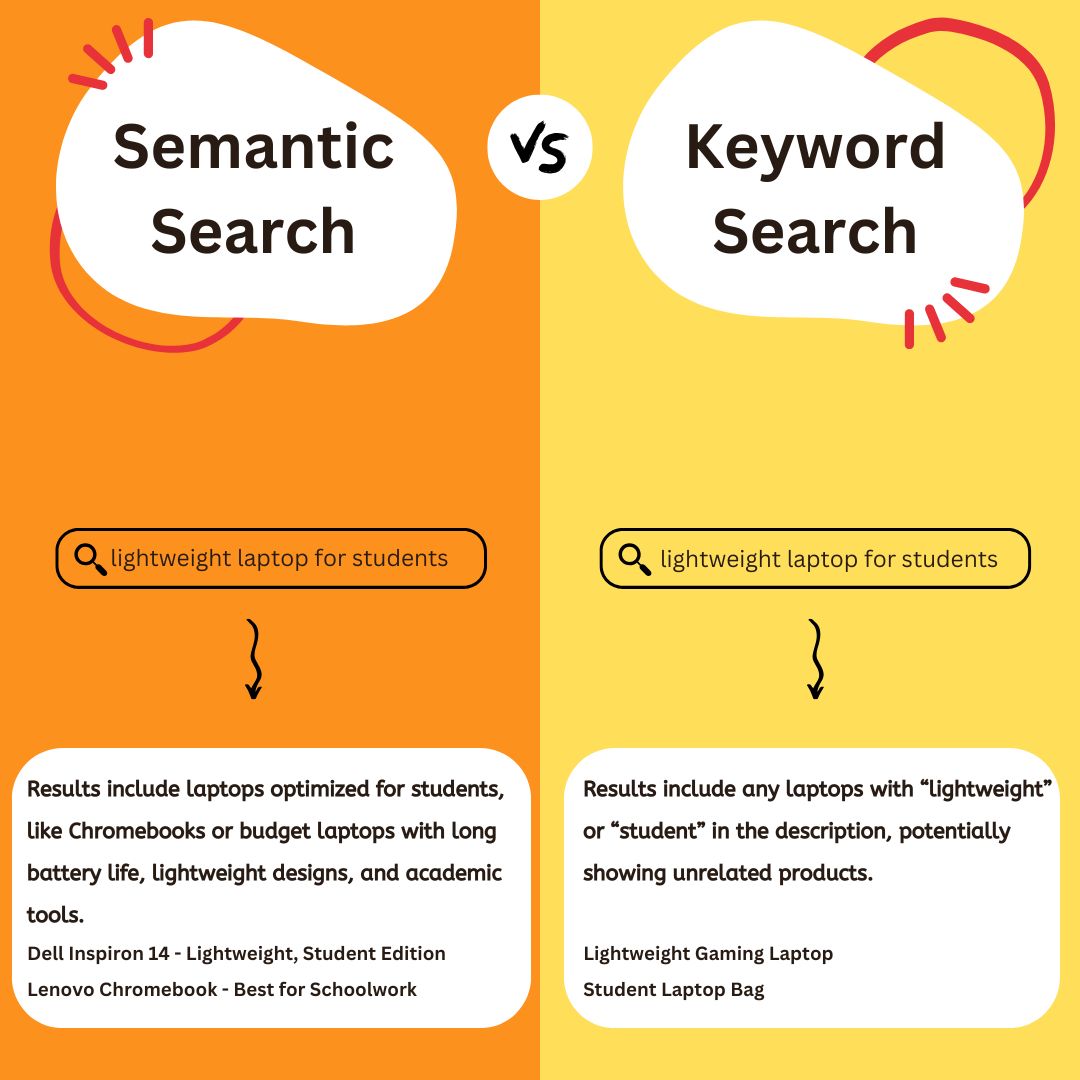
Why Does Vocabulary Mismatch Still Break Traditional Academic Search in 2026?
Vocabulary mismatch still breaks traditional academic search because authors, disciplines, and time periods name the same phenomenon differently, and lexical engines only retrieve documents that share enough surface terms with the query. A public-health paper may say "physical activity," a cardiology paper "exercise capacity," and a sociology paper "leisure-time movement." If you search only one phrase, the other two clusters can disappear from the first several result pages.
Google Scholar remains the default starting point for most researchers and is still the broadest single academic search surface available, including full text from publishers and repositories. Aaron Tay, an academic librarian at Singapore Management University, has described it as the Swiss Army knife of scholarly search — the tool he would keep if he could keep only one. Its ranking, however, is still lexical. After title matches, it weights highly cited papers heavily, which is excellent for finding seminal work and weak for finding conceptually related papers that use different wording or have not yet accumulated citations.
The problem is worse when a query term is common. Because Google Scholar matches across full text, a search for a tool or concept with an everyday name can explode into thousands of incidental hits. Tay notes that searching for "Elicit" is nearly useless in Google Scholar unless you add a domain workaround, because the word appears constantly in methods sections. Semantic systems reduce that failure mode by scoring meaning rather than string overlap, which is why they have become the complementary layer rather than a novelty.
What Should You Evaluate When Comparing Keyword Search and Semantic AI Assistants?
You should evaluate keyword search and semantic AI assistants on six dimensions that this article calls the Mismatch Recovery Framework: vocabulary flexibility, ranking transparency, index coverage, precision control, authority signals, and time-to-useful-set. A tool that wins on one dimension often loses on another, which is why a single "winner" ranking misleads more than it helps.
Vocabulary flexibility asks whether the engine can retrieve a paper whose abstract never repeats your query terms. Dense embeddings and hybrid methods such as SPLADE, which Elicit uses as a learned sparse embedding approach, are built for this. Ranking transparency asks whether you can explain why a paper appeared. Boolean-plus-BM25 systems are easier to audit; embedding nearest-neighbor search and LLM rerankers are harder to reproduce.
Index coverage is not the same as "number of papers advertised." OpenAlex reports 517 million work records and 66 million full-text PDFs, while Elicit states that it searches, summarizes, and extracts data from over 125 million papers. Google Scholar does not publish a comparable official count, but it is widely treated as the largest full-text academic search index. Precision control covers nested Boolean, field limits, proximity operators, and controlled vocabulary — features where The Lens and OpenAlex outperform Google Scholar.
Authority signals include citation counts, journal tier, and retraction flags. Google Scholar and, to a lesser extent, Undermind lean toward highly cited work. Elicit and SciSpace generally rank by semantic similarity and do not weight citations, so newer or less-cited papers rise. Time-to-useful-set separates instant keyword search from Undermind-style iterative runs that take at least three minutes. Score each dimension against your actual task — synonym-heavy discovery, systematic recall, or a five-minute orientation — before choosing a primary engine.
How Do Google Scholar, Elicit, SciSpace, Undermind, and Jenova Compare on Conceptual Discovery?
Google Scholar is strongest for broad, citation-weighted exploration; Elicit and SciSpace are strongest when keywords are unclear; Undermind is strongest for narrow, high-precision hunts; and Jenova's Academic Research Assistant is strongest when discovery, synthesis, and citation work need to stay in one persistent conversation. None of these tools dominates every cell of the Mismatch Recovery Framework.
| Feature / Dimension | Google Scholar | Elicit / SciSpace | Undermind | Jenova Academic Research Assistant | Lens.org / OpenAlex |
|---|---|---|---|---|---|
| Matching method | Lexical / keyword, citation-weighted | Semantic or hybrid (Elicit uses SPLADE) | Hybrid retrieval plus LLM relevance judging and iterative search | Natural-language research agent over live scholarly sources, including Google Scholar | Structured scholarly metadata search with advanced operators |
| Different-wording recovery | Weak unless you add synonyms or use Related articles | Strong for meaning-based queries | Strong for specific natural-language briefs | Strong in conversational reformulation across sessions | Weak to moderate; depends on query construction |
| Authority bias | Favors highly cited papers after title matches | Little citation weighting; newer papers rise | Some bias toward seminal work via citation searching | Follows the connected sources and the briefing you give | Metadata-driven; designed for analysis more than semantic ranking |
| Precision features | No nested Boolean, 256-character limit, limited field search | Journal-quality post-filters (e.g., Scimago tiers on SciSpace) | Natural-language specificity rather than Boolean | Conversational narrowing; not a Boolean syntax engine | Nested Boolean, proximity, field search, controlled vocabulary |
| Typical query time | Instant | Fast enough for exploration | At least ~3 minutes per search | Interactive; follow-up turns are immediate | Instant to API-paced |
| Pricing (as of 2026) | Free | Elicit Pro about $49/month; SciSpace paid tiers reported from $12 to $160/month | Free exploratory tier; paid academic plans | Free tier with limited usage; Plus from $20/month | Free web search; OpenAlex API has a free tier |
| Best for | Seminal papers, cited-by chaining, full-text lookup | Unclear keywords and question-style queries | Finding a specific class of study with high recall | End-to-end literature work with memory and manuscript support | Systematic, reproducible, high-control searches |
Google Scholar
Google Scholar is still the generalist. Official help pages confirm that results are normally sorted by relevance, not date, and that researchers can pivot through Related articles and Cited by once a seed paper is in hand. Those two features are the closest keyword search comes to conceptual discovery, but they require a good seed. Weaknesses are well documented: no nested Boolean, no abstract-only field search, a 256-character query cap, a 1,000-result ceiling, and no bulk export. That combination is why librarians routinely exclude it as a primary systematic-review database.
Elicit and SciSpace
Elicit positions itself as AI for searching, summarizing, extracting from, and chatting with over 125 million papers, with more than 2 million research users. Both Elicit and SciSpace accept natural-language questions and rank by semantic similarity, which is why they recover papers whose wording diverges from the query. The trade-off is ranking bias in the opposite direction from Google Scholar: they can promote semantically close but low-quality or little-cited papers. SciSpace is generally faster and better for quick insight than for deep iterative synthesis. Results can also be non-deterministic, so the same query may not return the same set twice.
Undermind
Undermind is the specialist. It blends keyword and semantic retrieval, then uses a frontier model to judge whether title, abstract, and available metadata actually answer the brief, and it iterates with citation searching. In one test against a systematic review's included set, it recovered 8 of 11 gold-standard papers in the top 10 results (recall@10 of 72.7%) and 9 of 11 by rank 50 (recall@50 of 81.8%). That quality costs time and works poorly on vague topics. It also primarily sees title and abstract, plus some open-access full text, so claims buried only in methods or results can be missed.
Jenova's Academic Research Assistant
Jenova's Academic Research Assistant is a discipline-aware research partner rather than a standalone paper index. It runs live literature discovery across scholarly sources, then stays with the project through synthesis, manuscript preparation, and citation management. Persistent memory means it can remember that your working term is "cognitive fatigue" while the literature also uses "ego depletion" and "need for recovery," and it can keep those synonym clusters attached to the same project across sessions.
The honest limitation is architectural. It does not ship a proprietary 125-million-paper semantic index with built-in extraction tables in the Elicit sense, and it is not an Undermind-style multi-minute iterative searcher with a published recall@10 benchmark. Its strength is orchestration: natural-language briefing, live scholarly lookup, follow-up questioning, and writing support in one thread. Researchers who need a reproducible Boolean audit trail should still run The Lens or OpenAlex in parallel.
How Does Semantic Search Recover Papers That Use Different Wording for the Same Idea?
Semantic search recovers differently worded papers by embedding the query and the document collection into a shared meaning space, then retrieving nearest neighbors instead of requiring overlapping tokens. If the query is "how do night-shift nurses restore attention after consecutive shifts," a lexical engine looks for those words. A semantic engine can retrieve studies titled around "circadian disruption," "recovery sleep," or "occupational fatigue" even when "nurses" or "attention" never appear in the title.
Semantic Scholar, the Allen Institute for AI literature engine, was an early public demonstration of this idea: rank scientific papers by understood meaning rather than string match. Elicit and SciSpace apply a similar principle at web-app scale. Tay describes a particularly clean test: paste a newspaper paragraph that describes a study's findings, and a semantic engine can surface the underlying journal article because the embedding of the news prose sits close to the embedding of the paper. Keyword search almost never survives that paraphrase.
There is a second, quieter mechanism: query expansion inside the assistant. A conversational agent can generate synonym sets, related MeSH-style concepts, antonyms, and disciplinary variants, then search those variants explicitly. That is not pure vector search. It is semantic understanding used to build a better lexical net. In practice, the highest-recall workflows do both — embed for recall of unseen wording, then verify with exact phrases, author names, and citation links so the set stays auditable.
Testing this on a live brief usually exposes the gap quickly. Ask a keyword engine for "teacher noticing" and you will mostly get papers that use that exact education-research term. Ask a semantic assistant for "how teachers detect and interpret unexpected student thinking in the moment," and you will also pick up work filed under "professional vision," "formative assessment," or "in-the-moment decision making." The second set is the one vocabulary mismatch would have hidden.
When Should You Still Use Keyword Search Instead of a Semantic AI Assistant?
You should still use keyword search when you need known-item retrieval, citation chaining from a seed paper, full-text phrase matching, or a reproducible Boolean strategy for a systematic review. Semantic ranking is the wrong instrument when the task is "find this title," "find everything that cites this trial," or "document a search string a peer reviewer can rerun."
Google Scholar is the right first move for three everyday jobs. First, known-item lookup: put the title in quotes, as Google's own help and most library guides recommend. Second, authority mapping: open a landmark paper and walk Cited by to see what the field did next, or Related articles to fan out from a seed. Third, full-text phrase hunting: if the concept is a distinctive method name, a dataset, or a scale, lexical full-text search will catch mentions that title-abstract semantic indexes miss.
For systematic or very precise searches, skip both Google Scholar and most semantic apps as the system of record. The Lens and OpenAlex support nested Boolean, proximity operators, fielded search, and controlled vocabulary. OpenAlex is an open catalog with 517 million works, 5.8 billion graph relationships, and a public-domain (CC0) dataset. A 2026 library briefing put its coverage around 474 million publications with a focus on open access and transparency. Google Scholar cannot match that auditability: it caps display at 1,000 results and does not offer bulk access.
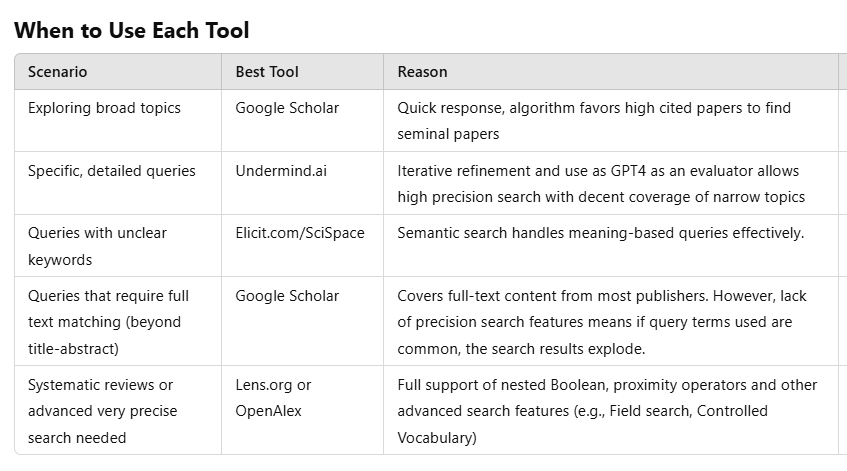
Use the table above as a routing rule, not a loyalty test. Broad orientation and seminal-paper finding stay with Google Scholar. Unclear wording goes to Elicit or SciSpace. A highly specific existence question — "are there RCTs that use an LLM as a title-abstract screener and report precision and recall?" — is an Undermind brief. Reproducible, operator-heavy searches belong in The Lens or OpenAlex.
How Do You Run a Literature Search That Combines Both Approaches?
You run a combined search by starting with a concept brief, recovering synonym-diverse candidates semantically, then locking the set down with lexical operators, citation chaining, and a high-control database. The sequence matters. If you start in Google Scholar with one phrase, you inherit that phrase's blind spots. If you never leave a semantic ranked list, you inherit that list's quality and reproducibility problems.
A practical sequence looks like this:
- Write the information need as a colleague would hear it, including populations, outcomes, and wording you already know is unstable.
- Run that brief in a semantic assistant to harvest candidate papers and the vocabulary they actually use.
- Build a synonym table from those titles and abstracts.
- Replay the expanded terms in Google Scholar with quotes,
author:, date limits, and Cited by / Related articles. - For anything that must be comprehensive or auditable, rebuild the strategy in The Lens or OpenAlex with nested Boolean and field limits.
- Keep a running inclusion log so non-deterministic semantic reruns do not silently change the evidence base.
In Jenova's Academic Research Assistant, the opening turn can be the concept brief rather than a keyword string:
"I need empirical papers on how remote knowledge workers recover from cognitive fatigue. Include studies that may use burnout, ego depletion, need for recovery, after-hours rumination, or psychological detachment instead of the word fatigue. Prefer occupational psychology and HCI venues from 2018 onward, and list the synonym each paper actually uses."
A follow-up then converts the assistant's synonym table into a lexical strategy you can paste into Google Scholar or The Lens:
"Turn the synonym clusters into three Google Scholar queries and one nested Boolean string suitable for OpenAlex or The Lens. Separate title-restricted queries from full-text queries."
On Elicit or SciSpace, ask the question in natural language rather than keywords — Tay notes that natural-language queries tend to perform worse in Google Scholar and better in these semantic tools. On Undermind, add constraints until the brief could only match a specific study design. After the candidate set exists, Jenova's Deep Research agent is the better instrument for reading across sources and producing a cited synthesis, while the Academic Research Assistant remains the better instrument for staying inside the scholarly workflow of discovery, citation, and manuscript support.
One caution applies to every AI-assisted step. Treat ranked lists and generated summaries as retrieval aids, not as completed screening. Semantic top-10s miss papers. LLM relevance judgments agree with humans often but not always. Full-text claims still need the PDF.
What Do Research Librarians and Tool Evaluators Say About Semantic AI Discovery?
Research librarians and independent evaluators generally treat semantic AI assistants as complements to Google Scholar, not replacements, and they judge tools by search quality for a stated use case rather than by marketing categories. The most useful published comparison in this area comes from practice-based reviewing, not vendor benchmarks.
"If I did not know in advance what my use case would be and I could pick only one academic search tool, it would be a no-brainer to pick Google Scholar. That is not an argument against AI search. It is an argument against pretending any one ranking function is sufficient. Scholar is still the generalist. The new tools earn their place when the query is semantically awkward or extremely specific."
"The failure I see most often is a mismatch between query type and engine. People type a broad topic into an iterative agent and wait minutes for a narrower-than-needed set. Or they type a natural-language paragraph into a lexical engine and conclude the literature does not exist. Vocabulary mismatch is usually a workflow error before it is a database gap."
"Semantic ranking also changes what 'relevant' means. If you do not weight citations, you will see newer and sometimes weaker papers earlier. If you do weight citations, you will keep rediscovering the same canon. Researchers who want conceptually related work with different wording need the first behavior. Researchers who want the papers everyone else will expect them to cite need the second. A competent process uses both and writes down why."
— Jenova Product Team, literature-discovery systems, 8 years designing academic research workflows
That framing matches the public record. University guides now inventory AI search tools used in literature reviews, and product reviews distinguish Undermind's slower iterative pass from SciSpace's quicker semantic scan. The expert consensus is methodological, not tribal: choose the retrieval model that matches the mismatch you are trying to recover from.
Which Tool Fits Systematic Reviews Versus Exploratory Literature Mapping?
Systematic reviews need high-control lexical infrastructure; exploratory literature mapping needs semantic recall and fast iteration; most thesis and grant work needs a hybrid with a written protocol for each stage. Conflating those jobs is how teams either miss conceptually related studies or produce an un-replicable evidence set.
For exploratory mapping — "what has been written about this idea, under any name?" — start semantically. Elicit, SciSpace, and a conversational research assistant are built for that question. Google Scholar can contribute once you have seed papers, via Related articles and Cited by, and it remains unmatched for quickly locating PDFs and library links. Jenova's Academic Research Assistant fits this stage when you also need the map to persist: saved synonym decisions, excluded directions, and citation formatting for the eventual write-up.
For systematic or scoping reviews, do not let a semantic ranked list become the official search. Use The Lens or OpenAlex as the reproducible backbone, document every operator, and treat Elicit, Undermind, or Jenova as supplementary citation-discovery and screening aids. OpenAlex additionally exposes an API, a query language aimed at systematic reviews, and a full snapshot under a CC0 license, which is the opposite design from a closed relevance sort. Google Scholar's 1,000-result cap and lack of bulk access are disqualifying for the primary documented search, even though it remains useful for checking whether a known include was indexed at all.
For narrow existence questions — "does a paper like this exist?" — Undermind is the specialist, provided you can wait and provided title-abstract evidence is enough. For manuscript production after the set exists, Jenova's combination of literature discovery plus citation management is more relevant than another discovery-only interface, with the caveat that extraction-heavy meta-analysis still belongs in a dedicated extraction tool such as Elicit.
The decision rule is simple enough to reuse. If wording varies and you do not yet know the field's jargon, use a semantic AI research assistant first. If you must defend the search string, use keyword infrastructure with advanced operators. If you must do both — which is the normal condition for finding conceptually related papers with different wording — run semantic recall to discover the language, then lexical control to capture and document it.
References
- Aaron Tay — Google Scholar vs other AI search tools (Undermind, Elicit, SciSpace)
- Google Scholar — Official Search Help
- Elicit — AI for scientific research
- OpenAlex — Open catalog of the global research system
- Paperguide — Elicit vs. SciSpace pricing and feature comparison (2026)
- Undermind — AI co-researcher for the literature
- University of Alberta / JCHLA — Undermind.ai product review
- Paperpile — How to use Google Scholar
- TUHH — OpenAlex as an open alternative for academic research
- Semantic Scholar — AI-powered research tool
- UBC Wiki — AI search tools used in literature reviews and comprehensive searching
- SciSpace — Elicit vs SciSpace comparison
- The Lens — Release 8.5 and OpenAlex integration
- PMC / NIH — OpenAlex features and evidence-synthesis potential