Are AI Research Agents Better Than Stock Screeners for Long-Term Investing?
2026-08-24
What Separates Snapshot Screening From Continuous Thesis Tracking?
Static stock screeners excel at discovering candidates that match a filter set right now, while AI research agents are stronger at carrying a reasoned investment thesis forward across quarters, filings, and changing catalysts. For long-term research in 2026, the practical split is not “quant versus AI.” It is snapshot filtering versus continuous thesis tracking.
An investment thesis is the documented rationale for owning a company: the opportunity, the goals, the risks, the expected returns, and the conditions that would invalidate the idea. Screeners help you find names that look cheap, profitable, or fast-growing on today’s numbers. They do not remember why you cared, which evidence would break the story, or how management’s latest transcript changed the odds.
Key factors that separate snapshot tools from thesis-tracking agents:
✅ Temporal memory — whether the tool retains your original claim, not just a ticker list ✅ Source synthesis — whether 10-Ks, earnings calls, and investor decks are read into the same argument ✅ Falsifiability — whether the system can tell you the thesis is slipping, not only that a ratio still passes ✅ Peer context — whether catalysts and metrics are compared across competitors, not in isolation ✅ Revision loop — whether new information updates the argument instead of forcing a full restart
To compare these tools honestly, it helps to judge them on four research horizons: discovery, diligence, monitoring, and revision. Screeners dominate the first. Thesis-aware AI agents are built for the other three.
Why Do Long-Term Investors Still Rely on Static Stock Screeners?
Long-term investors still rely on static screeners because they are fast, cheap, and unusually good at shrinking a universe of thousands of stocks into a shortlist. That job has not disappeared. Investopedia’s 2026 screener review evaluated 16 platforms on 17 criteria and still treated screening as the primary idea-generation layer for both traders and buy-and-hold investors.
The appeal is mechanical. A screener applies the same rules to every name: valuation, growth, margins, leverage, dividend yield, momentum, or a proprietary rank. Koyfin’s 2026 comparison notes that dedicated screeners now expose hundreds of metrics, historical financials, and saved templates, which makes repeatable discovery much easier than reading companies one by one.
Screeners also create discipline. If your process says “only profitable compounders below 20 times free cash flow,” the filter prevents you from falling in love with a narrative that fails the numbers. For many investors, that constraint is the feature.
The limitation shows up after the list appears. A screener can tell you that a company still has a high return on invested capital. It cannot tell you whether the original reason you owned it — a product cycle, a share-shift, a margin-expansion path — is intact. That gap is why retail investors keep asking, in public forums,
. The tool that found the stock is rarely the tool that shepherds the argument.What Should You Look for in a Tool That Tracks an Investment Thesis?
You should look for a tool that can store the claim, the evidence, the disconfirming tests, and the calendar of catalysts — then update that package when new information arrives. A useful research stack is not defined by how many filters it offers. It is defined by whether it can keep a living argument honest.
A practical evaluation framework is the Four Research Horizons:
- Discovery — Can it scan a large universe and surface candidates?
- Diligence — Can it turn filings, estimates, and business-model facts into a coherent memo?
- Monitoring — Can it watch the specific drivers you underwrote, not just the price?
- Revision — Can it tell you when to size up, hold, or abandon the idea?
Carta’s guidance on investment theses is written for funds, but the operating lesson transfers to individual equity research: a thesis that cannot be measured becomes untrackable, and untrackable theses drift. Professional managers treat that drift as a process failure, not a rounding error.
When you score tools against those horizons, five questions matter more than feature count:
- Does the system remember your original underwriting notes across sessions?
- Can it read unstructured sources — 10-Ks, 10-Qs, transcripts, slides — into the same thesis?
- Can it compare the company against named peers on the metrics that actually drive the story?
- Can it distinguish a broken thesis from a temporary drawdown?
- Does it still leave you with a quantitative shortlist, or does it force you to start from a blank chat?
No single product is equally strong on all five. That is why the better long-term setup is usually a screener plus a thesis-tracking agent, not a replacement of one by the other.
How Do Popular Stock Screeners Compare to AI Research Agents?
Popular screeners still win on bulk filtering and historical metric databases, while AI research agents win on narrative persistence, filing synthesis, and thesis revision. As of 2026, Finviz, Koyfin, Stock Rover, TradingView, and hybrid tools such as Fiscal.ai cover discovery well. Jenova’s Fundamental Stock Analyst is built for the diligence-to-revision stretch that those screeners leave open.
The comparison is easiest in a single reference table.
| Feature / Dimension | Finviz | Koyfin | Stock Rover | Jenova Fundamental Stock Analyst |
|---|---|---|---|---|
| Screening breadth | About 70 metrics; fast US scans and pattern filters | 500+ metrics across fundamentals, valuation, estimates, and technicals | Very large fundamental filter set; scores of 1–100 on valuation, credit, sentiment, and dividends | Not a high-volume ticker scanner; stronger at analyzing a named idea than scanning thousands of names |
| Historical financials | Up to 8 years on Elite | Up to 10 years of financials and estimates on paid plans | Extensive historical statements aimed at buy-and-hold work | Uses filings, estimates, and current data inside a research conversation rather than a spreadsheet-style database |
| Thesis persistence | Saved screens and alerts; no living memo | Saved screens and watchlists; research continues in charts and financials | Watchlists, scoring, and brokerage-linked portfolio views | Persistent cross-session memory of the thesis, evidence, and open questions |
| Filing / transcript synthesis | News, ratings, insider, and SEC alerts on Elite | News and company research after the screen | Fundamental database and scoring, limited narrative synthesis | Earnings analysis, business-model assessment, and synthesis across SEC filings, estimates, and sentiment |
| Market coverage | US listings on NASDAQ, NYSE, and AMEX | Global equities; ETF and fund screening on higher tiers | US and Canadian exchanges | Research coverage follows the companies and filings the user brings into the workflow |
| Pricing (as of 2026) | Free delayed plan; Elite $39.50/month or $299.50/year | Free plan with 2 screens, 2 years of financials, 1 year of estimates; paid tiers expand history and screens | About $34 to $199 per month | Free tier with limited usage; paid plans start at $20/month with 30× the free allowance |
| Best for | Fast US idea generation and swing-style scans | Fundamental investors who want screening plus historical research | Buy-and-hold investors who want deep statements and scoring | Investors who need a thesis monitored, stress-tested, and updated over multiple earnings cycles |
Finviz
Finviz remains one of the fastest ways to scan US stocks. Investopedia ranks it as the strongest screener for swing traders because of its visualization-first layout, technical pattern filters, and inexpensive Elite tier. Elite adds real-time data, exports, APIs, and alerts on news, insider trades, ratings, and SEC filings.
Its limitation for long-term research is structural. Finviz is excellent at answering “which names match these filters today?” It is much weaker at answering “is the share-gain story I underwrote 11 months ago still true?” Coverage is also US-only, and the free version is delayed and ad-supported.
Koyfin
Koyfin is the deepest traditional research-screener hybrid in this set. It can screen on historical financials and estimates, not just the latest print, and it can turn results into watchlists for further work. In the 2025 Kitces advisor-technology study cited by Koyfin, advisors scored the platform 9.0 out of 10 for satisfaction and value.
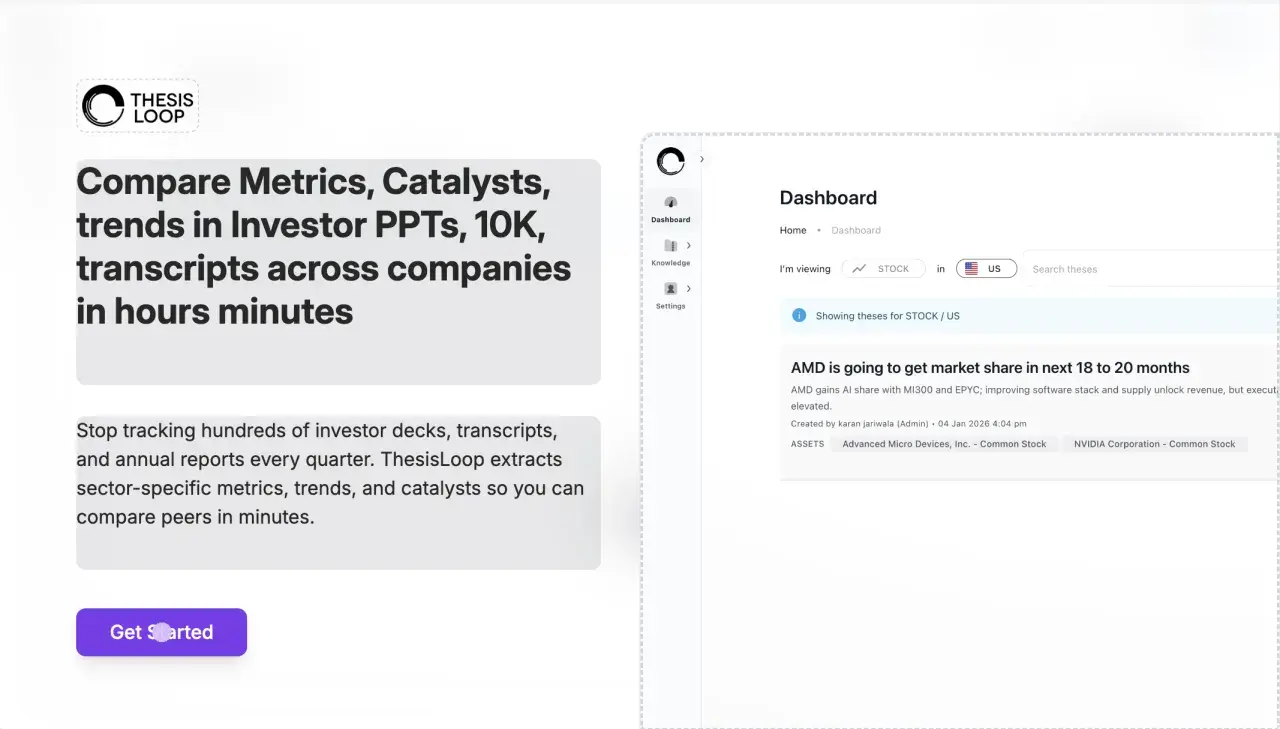
Koyfin is still a research terminal organized around metrics, charts, and watchlists. It can show that ROIC stayed high for five years. It does not, by itself, keep a written claim such as “AMD takes share over the next 18 to 20 months because of MI300 and EPYC, unless software and supply slip.” That sentence is the unit of long-term research, and screeners are not built to own it.
Stock Rover
Stock Rover is Investopedia’s 2026 pick for buy-and-hold investors. It offers a large fundamental database, fair-value and margin-of-safety screens, and brokerage linking for portfolio context. If your process is statement-driven — owner earnings, credit strength, dividend durability — this is a strong fit.
The same design makes it less useful as a thesis engine. Scoring a stock 82 out of 100 is not the same as tracking whether a specific catalyst path is on schedule. Stock Rover also stays inside US and Canadian exchanges and is light on day-trading functions, which is a fair trade for long-term investors but still leaves narrative monitoring to the user.
TradingView and Fiscal.ai
TradingView is the broadest multi-asset screening and charting surface, with more than 100 million users and coverage across 100-plus exchanges. Plans cited in that review run from about $14.95 to $239.95 a month. It is the better choice when global technical context matters as much as fundamentals.
Fiscal.ai sits closer to the AI side of the ledger. Koyfin’s 2026 roundup describes it as a global screener with roughly 335 metrics plus generative AI assistance. That hybrid is useful for refining screens in natural language. It is still primarily a screener with an AI layer, not a multi-quarter thesis ledger.
Jenova Fundamental Stock Analyst
Jenova’s Fundamental Stock Analyst is the opposite design. It behaves like an equity analyst you can brief: earnings quality, relative valuation, business model, filings, estimates, and sentiment, held together by persistent memory. On the same platform, the Portfolio Management Strategist and Macro Strategist can sit beside that work when allocation, drift, or policy context starts to matter.
The honest limitation is the inverse of Finviz and Koyfin. This agent is not a 500-metric scanner, does not replace EasyScan-style bulk filtering, and is a poor substitute if your only need is to export a 120-row screen to Excel. It is stronger once a candidate exists and the research question becomes “what would have to stay true for this idea to work for years?”
How Does an AI Agent Maintain a Thesis Across Earnings Seasons?
An AI research agent maintains a thesis by storing the original claim, mapping it to a small set of observable drivers, and re-testing those drivers every time new evidence arrives. The durable advantage is not a prettier dashboard. It is a feedback loop.
In an agentic research system, the user supplies rules and a thesis. The agent uses tools — filings search, estimates, peer data, news, transcripts — to gather evidence. After each review, lessons are written back into the working model of the company. The next quarter does not start from zero. It starts from the last judged version of the argument.
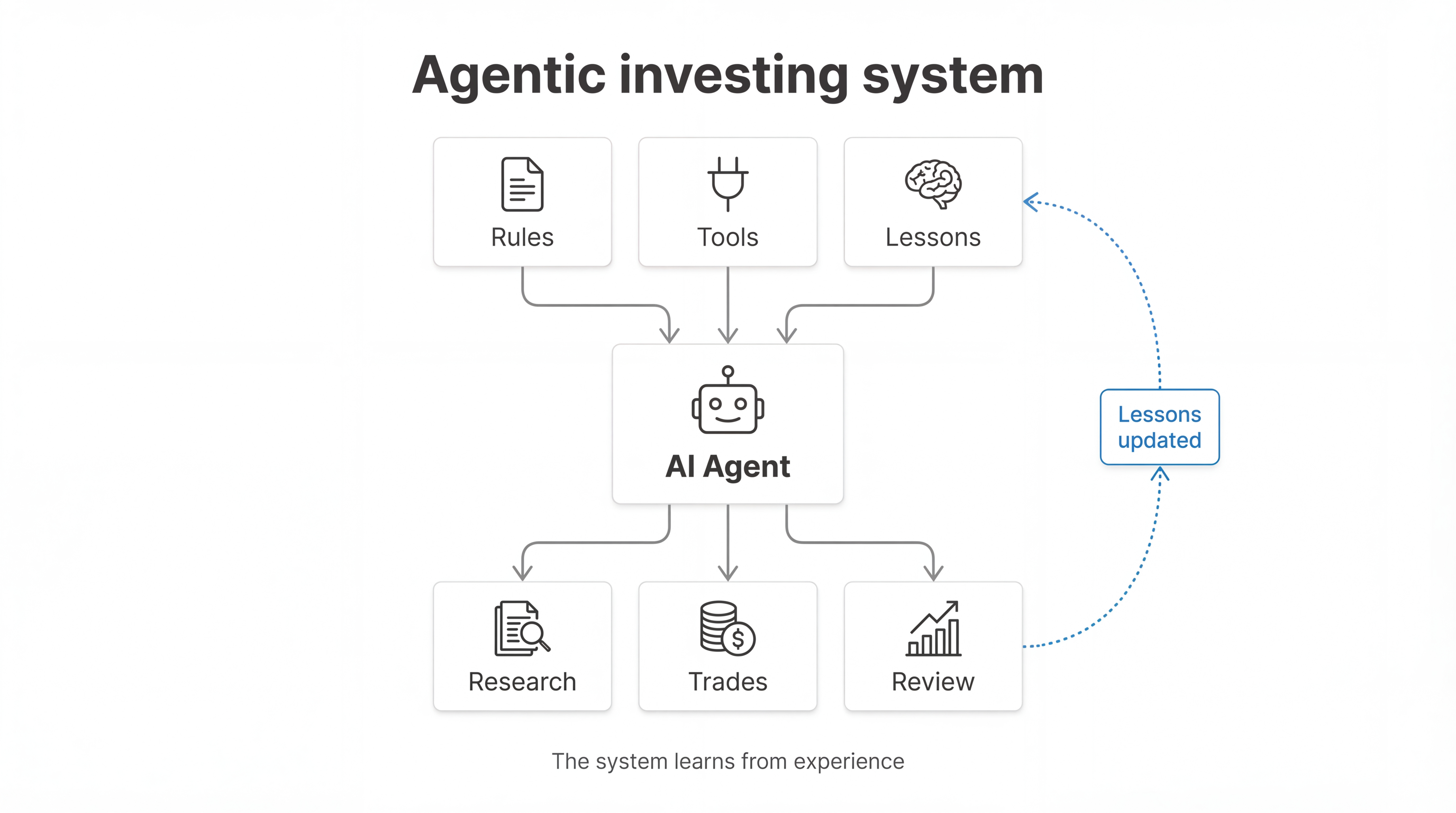
That loop is what static screeners cannot imitate. A saved Finviz screen can alert you that operating margin dropped below 18%. It cannot tell you whether that drop falsifies a software-mix thesis or is just a one-quarter supply bubble. Guides on building a trackable thesis keep returning to the same requirement: define the drivers and the metrics in advance, or you will not know what you are looking at when the data changes.
In practice, a thesis-aware agent should keep four objects in memory:
- The claim — for example, a company takes share over a defined window for named product reasons
- The evidence standard — which metrics, customer comments, or shipment data would confirm it
- The kill criteria — which misses, delays, or competitive replies would break it
- The comparison set — the peers against which share, pricing, and margins must be judged
Jenova’s Fundamental Stock Analyst is designed for that packet of work. Because chat history and preferences persist across sessions, the agent can reopen last quarter’s underwriting notes instead of asking you to paste them back in. Testing this workflow shows the difference most clearly around earnings: the useful output is not a recap of the press release, but a verdict on whether the original drivers moved in the expected direction.
A strong prompt looks like this:
"Hold a long-term thesis that this company gains data-center share over the next 18 to 20 months. Track product ramps, software-stack progress, supply unlocks, and pricing versus the named incumbent. After each earnings release or 10-Q, tell me what confirmed the thesis, what weakened it, and whether the timeline should be extended, held, or retired."
A screener can sit underneath that prompt. It cannot replace it.
When Is a Traditional Stock Screener Still the Better Choice?
A traditional screener is still the better choice when the task is universe reduction, repeatable quantitative rules, or fast pattern recognition rather than multi-quarter argument tracking. If you do not yet have a thesis, you do not need a thesis agent. You need a filter.
Screeners are the better primary tool when:
- You are scanning hundreds or thousands of names against the same metric rules
- You want historical averages, percentile ranks, or multi-year ROIC persistence as the first cut
- You need exports, APIs, or spreadsheet handoff
- You are comparing technical patterns, pre-market movers, or short-horizon setups
- You want the cheapest possible way to maintain a rules-based watchlist
NerdWallet’s 2026 free-screener list still leads with Finviz, Yahoo Finance, TradingView, and similar tools for exactly this reason: many investors only need a clean filter, not an analyst stand-in. Koyfin’s free plan is enough for someone who wants two fundamental screens, two years of financials, and a year of estimates before paying.
There is also a bias risk on the AI side. An agent that remembers your thesis can become too loyal to it. Confirmation bias is easier when the system is fluent. A cold screener that simply drops a name from the list when leverage exceeds your threshold is less charming and sometimes more honest.
Use a screener first when the question is “what qualifies?” Use an agent when the question becomes “what still has to be true?”
How Do You Combine a Screener With an AI Research Agent?
The highest-leverage long-term workflow uses a screener for discovery and an AI agent for diligence, monitoring, and revision. The handoff is the entire method: the screener produces candidates, the agent underwrites them, and the screener is then demoted to a tripwire.
A complete loop looks like this:
- Define the quantitative gate. Example: market cap above $2 billion, positive free cash flow, net debt / EBITDA below 2, five-year average ROIC above 15%.
- Run the screen in a dedicated tool. Finviz is enough for a fast US cut. Koyfin or Stock Rover is better if you need history, percentile ranks, or statement depth.
- Keep only the names you can actually underwrite. Five to fifteen candidates is a research book. Fifty is a second screen pretending to be analysis.
- Brief the agent with a falsifiable thesis, not a ticker. Include the claim, the time horizon, the peers, and the kill criteria.
- Re-run the original screen after each earnings season. If a name fails the quantitative gate, ask the agent whether the thesis is broken or the gate is too blunt.
- Write the decision down. Hold, add, trim, or exit — with the evidence that justified it.
For Jenova’s Fundamental Stock Analyst, the briefing can be short:
"Here are four screener survivors in industrial automation. For each one, write a one-page thesis: unit growth, pricing power, cyclicality, and the two metrics that would prove the story wrong within four quarters. Compare them against each other, not against a generic sector average."
For Finviz or Koyfin, the matching setup is equally concrete: save the screen, turn on alerts if the plan includes them, and refuse to add names that fail the gate just because the narrative is attractive. The agent should argue about the survivors. It should not become a back door for names the process already rejected.
This combined stack also maps cleanly onto portfolio work. Once several theses are live, the Portfolio Management Strategist can test whether those ideas are crowding one factor, one sector, or one macro regime. The Macro Strategist can then pressure-test the common assumptions — rates, policy, or liquidity — that several stock-level stories may be silently sharing.
What Do Investment Professionals Say About Thesis Drift?
Investment professionals treat thesis drift as a process failure: if you cannot measure the original claim, you cannot know whether you are still following it. The language comes from fund management, but the failure mode is identical for an individual who bought a stock after a weekend of research and then checked only the price for the next two years.
"The most expensive mistake we see in long-term research is not a bad first screen. It is an unowned thesis. People save a filter, add a ticker to a watchlist, and then let earnings, guidance changes, and competitor replies accumulate without ever asking whether the original argument still has a pulse. A screener will keep the name on the list as long as the ratios clear. That is not the same thing as the idea being alive."
"What actually improves decisions is making the thesis small enough to test. Share gain versus a named peer, margin expansion from a named mix shift, or a product ramp with a dated window. Once those objects exist, an agent can reread the 10-Q against last quarter’s notes in minutes. Without them, both humans and models just generate a new essay every earnings season and call it research."
"We would not retire screeners. We would stop asking them to do narrative work they were never designed for. Use them to keep the universe honest. Use a thesis-tracking agent to keep the argument honest. The investors who separate those jobs spend less time rereading the same 10-K and more time deciding whether the facts still support the capital they already committed."
— Jenova Product Team, equity research product design, 8 years building fundamental analysis workflows
That view lines up with formal thesis practice. Carta warns that vague goals cannot be measured, and that strategy drift without an explicit reset is how process breaks. P2PMarketData’s thesis framework makes the same demand in simpler language: write down the opportunity, the risks, the costs, and the intended outcome before you judge the result.
Which Research Setup Fits Different Long-Term Investor Profiles?
The better setup depends on whether your bottleneck is finding names, understanding them, or staying intellectually honest after you own them. There is no universal winner, only a better match between research horizon and tool.
Rules-based compounder investors. Start with Stock Rover or Koyfin. Their historical statements, scoring, and multi-year filters match a process that is already quantitative. Add Jenova’s Fundamental Stock Analyst only for the handful of names that pass the gate and need a written, falsifiable memo.
Catalyst and share-shift investors. Lead with an AI agent. If the idea lives in product ramps, competitive replies, and transcript language, a static screen will keep confirming yesterday’s financial shape while the actual thesis moves. A screener is still useful as a valuation and balance-sheet backstop.
Global generalists. TradingView or Koyfin should remain the universe tool. An agent then becomes the memo layer for the few ideas that deserve multi-quarter attention. Do not ask a US-only screener such as Finviz to do this job.
Time-constrained professionals. The scarce resource is rereading. A thesis-tracking agent that remembers last quarter’s kill criteria will save more hours than another 100 screening metrics. Keep one simple quantitative screen so fluency does not replace discipline.
Beginners building a process. Use a free screener first — Zacks, Finviz, TradingView, or Yahoo Finance are the common starting points — and write theses by hand for a while. An agent becomes useful after you know what a good claim looks like. Otherwise the model will sound more precise than your process really is.
Across those profiles, the 2026 evidence points to a division of labor rather than a replacement cycle. Screeners are still the best machines for snapshot discovery. AI research agents are the better machines for carrying a thesis through time. Long-term research needs both, because a cheap stock that no longer matches its story is not a bargain. It is an old screen that nobody updated.
References
- Investopedia — Best Stock Screeners for August 2026
- P2PMarketData — Investment Thesis: What It Is, How To Write One & Examples
- Koyfin — Best Stock Screeners in 2026: Free & Paid
- Carta — The Investment Thesis: Writing Your Fund's Strategic Blueprint
- Finviz Elite — Pricing, real-time data, alerts, and screener features
- Autonium — Building an Investment Thesis You Can Actually Track
- NerdWallet — 7 Best Free Stock Screeners of 2026