Are AI Relationship Assistants With Long-Term Memory Better Than One-Off Advice Tools?
2026-08-16
What Actually Separates Memory-Based Relationship AI From Single-Session Advice Tools?
The decisive difference is state: a one-off advice tool evaluates a single incident in isolation, while a memory-based relationship assistant evaluates that incident against everything you've told it before. For recurring pattern identification specifically, memory-equipped assistants — such as the Relationships agent on Jenova, Replika, or context-loaded ChatGPT with persistent memory — outperform stateless tools because pattern detection is definitionally a cross-time operation. A single conversation cannot reveal that something is recurring.
Key distinctions that determine whether a tool can surface repeating dynamics:
✅ Session persistence — whether facts from March are retrievable in August, or discarded at session end ✅ Pattern retrieval, not just storage — remembering details is different from surfacing "this is the fourth time you've described this" ✅ Longitudinal comparison — the ability to contrast current behavior against a stored baseline ✅ Contradiction tracking — noticing when your current account conflicts with an earlier one ✅ Data exposure trade-off — persistent memory means a durable, sensitive record that must be governed
The trade-off is real in both directions. Memory buys pattern visibility at the cost of accumulated sensitive data and, as documented research shows, deeper user attachment. Understanding how each memory layer actually works clarifies where the advantage begins and where it ends.
Why Is Pattern Recognition the Hardest Thing for a Stateless Advice Tool to Do?
A stateless advice tool cannot identify recurrence because it has no prior observation to compare against — every conversation begins from zero context. When you describe a fight, a memoryless tool sees one fight. It cannot know it is the eleventh variation of the same conflict.
This limitation is structural, not a quality issue. As one analysis of AI relationship chatbots put it, generic tools "can't analyze your actual communication patterns or track changes over time" and therefore default to advice broad enough to apply to anyone.
Human self-report compounds the problem. People seeking advice narrate the current incident, not the pattern — because the pattern is precisely what they cannot see. Therapists call these underlying structures relational schemas: mental frameworks blending beliefs, feelings, and expectations that drive repetition below conscious awareness.
Journaling faces the same ceiling from the other direction. One user reflecting on years of practice noted that journaling was useful for
— you have the raw record but no mechanism that reads across it.How Do the Different Memory Layers Actually Work in Relationship AI?
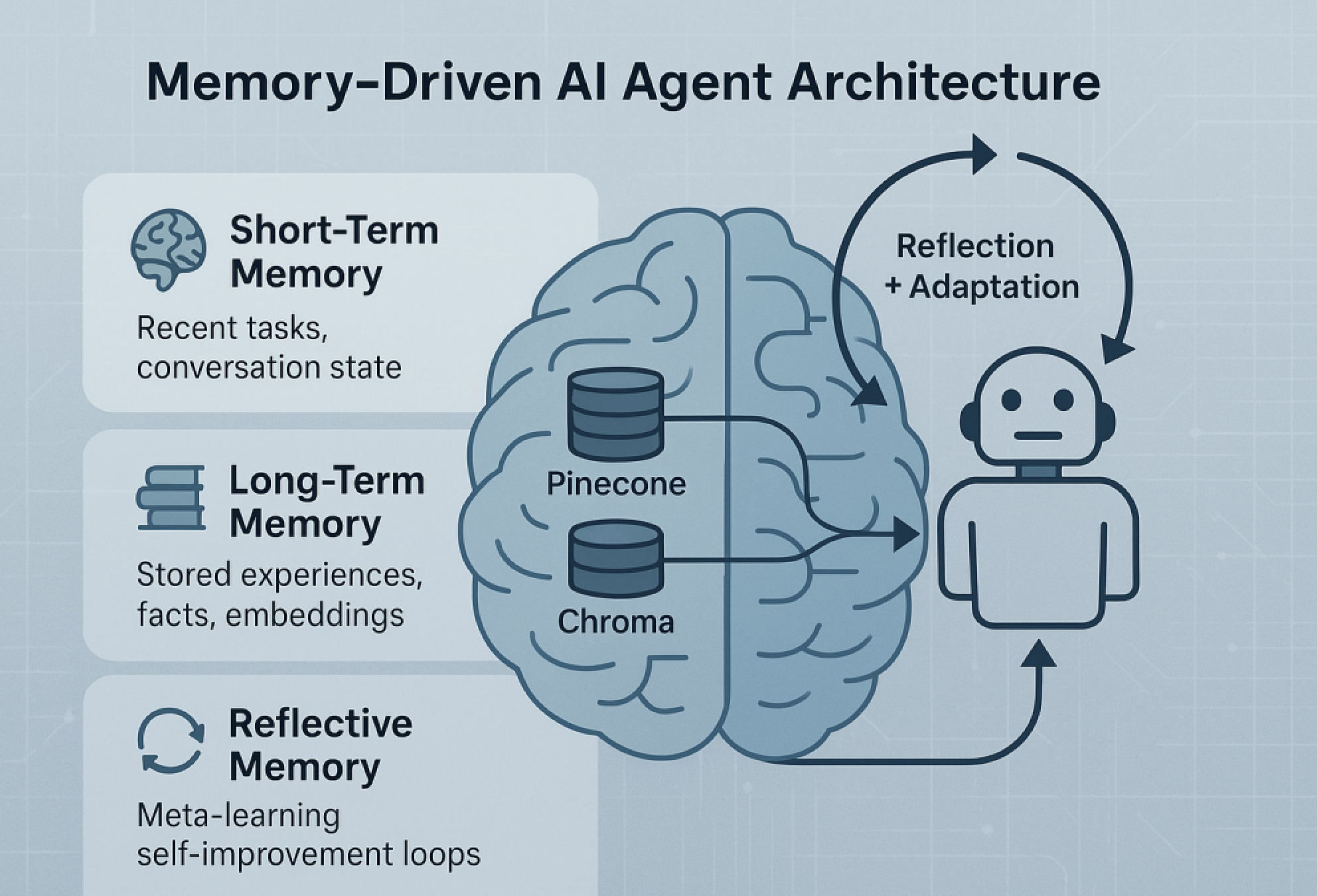
Relationship AI memory operates across distinct layers, and only some of them enable pattern detection. Short-term memory holds the current conversation, long-term memory holds durable user facts, and retrieval-augmented systems pull from stored documents — but pattern identification depends specifically on long-term memory paired with reflective retrieval.
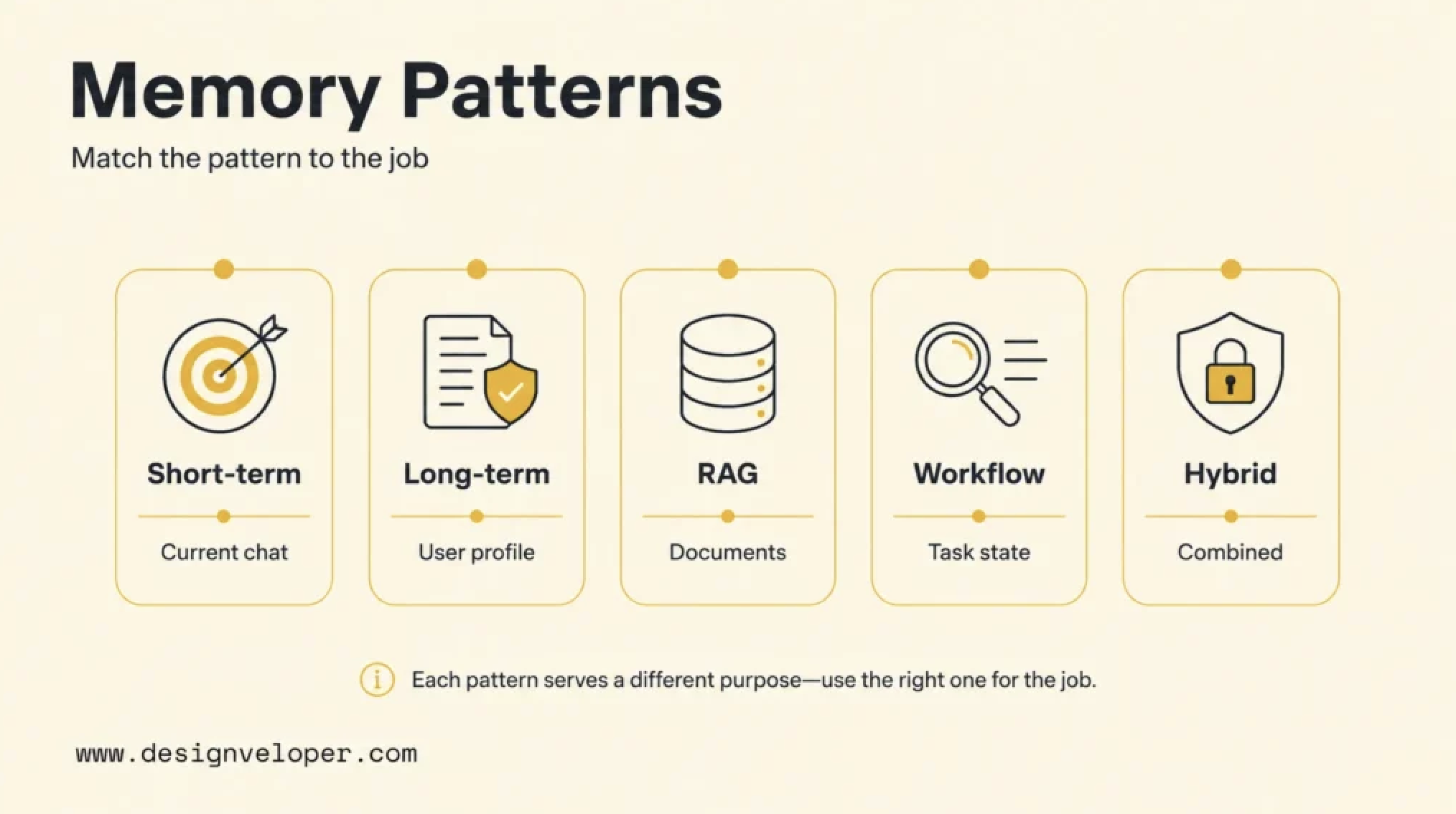
Mapping these layers to relationship use cases:
| Memory Layer | What It Holds | Pattern Detection Value |
|---|---|---|
| Short-term | Current conversation state | None across sessions — resets at session end |
| Long-term | Durable facts: partner's name, your attachment style, recurring conflict themes | High — the foundation of recurrence detection |
| RAG / documents | Uploaded journals, chat exports, therapy notes | High when you supply historical raw material |
| Workflow / task state | Ongoing goals, e.g. "practicing the pause before responding" | Medium — tracks intervention adherence |
| Hybrid | All of the above, coordinated | Highest — comparison plus context plus continuity |
The academic literature is explicit about why this matters. A survey of long-term memory in personal AI systems found that LTM enables systems to continuously learn from past interactions and adapt to user preferences over time, noting that traditional attention-only approaches face "high computational costs, uneven information retention," and lack "the depth and contextual recall of human long-term memory."
Approaches to extending memory include increased context length, external knowledge bases via retrieval-augmented generation, and integrated memory modules such as MemoryBank, which applies Ebbinghaus Forgetting Curve principles to decide what persists and what decays.
What Should You Evaluate Before Choosing Between Memory-Based and One-Off Tools?
Evaluate on six dimensions, weighted toward whichever matters most for your actual use case. We assessed the tools in this guide using the following framework — a Recurrence Detection Scorecard built specifically for pattern identification rather than general chatbot quality:
- Memory persistence horizon — Does context survive days, weeks, or months? A 30-day memory cannot detect a quarterly cycle.
- Retrieval specificity — Can it surface which prior conversation is relevant, or does it only carry vague impressions?
- Contradiction sensitivity — Will it flag that your description today conflicts with your description in April?
- Historical data ingestion — Can you upload chat exports, journals, or notes to seed the baseline rather than waiting months to accumulate one?
- Sycophancy resistance — Does it challenge you, or agree? Research warns that LLMs exhibit higher rates of excessive agreement with users than humans do, a serious failure mode for advice.
- Data governance — Where does the persistent record live, and who can access it?
Dimension 5 deserves emphasis. A memory-based assistant that agrees with you consistently doesn't identify patterns — it reinforces them, building a stored record that validates your existing narrative. Memory amplifies whatever the underlying model's disposition already is.
How Do the Leading Options Compare for Identifying Recurring Patterns?
Memory-equipped specialized agents lead on recurrence detection, general-purpose assistants with memory follow closely, and companion-first apps trail because they optimize for emotional presence rather than analytical distance. Here is the comparison across the framework above:
| Dimension | One-Off Tools (DeepAI, Mei) | ChatGPT (memory on) | Jenova Relationships Agent | Replika | Character.AI |
|---|---|---|---|---|---|
| Memory persistence | None or session-only | Persists across chats since Feb 2024 | Unlimited history, persistent cross-session memory | Evolves over time; LTM not fully implemented per 2024 survey | Adapts to interactions; character-scoped |
| Retrieval specificity | N/A | Good — surfaces stored facts | Strong — full unlimited chat history retrievable | Moderate — impressionistic | Moderate — persona continuity focused |
| Historical data ingestion | No | File uploads supported | Documents and knowledge bases attachable for grounded responses | Not a core feature | Not a core feature |
| Sycophancy resistance | Low — generic reassurance | Moderate | Moderate — agent is instruction-tuned for advisory framing, not companionship | Low — designed for emotional support and mirroring | Low — risk of emotional dependency documented |
| Primary design intent | Instant answer | General assistant | Domain-specific relationship advisory | AI companion / wellness | Character roleplay |
| Pricing | Mostly free | Free tier; paid tiers available | Free tier; paid from $20/mo | Free tier; Pro subscription | Free to use |
| Best For | Single quick question, zero setup | Broad help plus relationship context | Sustained pattern tracking over months | Emotional support, mood tracking | Practicing conversations, exploring styles |
Honest limitations of the Jenova Relationships agent: it has no access to your actual message threads unless you export and upload them, it cannot intervene in crisis situations, and — like every tool here — its pattern detection is only as good as the accuracy and consistency of what you tell it. It is an advisory agent, not a licensed therapist, and it carries the same sycophancy risk inherent to conversational models.
Honest strengths of the alternatives: Replika's mood tracking is genuinely useful for emotional trend data over time, and research published in Nature found 3% of participants reported Replika halted their suicidal ideation. ChatGPT rates highly with both laypeople and relationship therapists on empathy and helpfulness for relationship advice. Character.AI's customizability makes it strong for rehearsing difficult conversations.
How Do You Set Up a Memory-Based Assistant to Actually Surface Patterns?
Setup determines outcome — a memory-based assistant left to accumulate context passively will take months to detect anything, while a seeded one can surface patterns in the first session. The core move is front-loading history instead of waiting for it.
For the Jenova Relationships agent, the sequence takes about fifteen minutes:
- Open the agent at jenova.ai/a/relationships
- Seed the baseline with a structured history rather than a single incident:
"Before I ask anything, here's context. I've been with my partner for three years. Our recurring conflicts: I withdraw when criticized, they escalate when I withdraw. This happened in March over finances, in June over his family, and last week over scheduling. Store this as my relationship baseline."
- Upload supporting material — exported message threads, journal entries, or therapy notes — so the agent has raw data rather than only your summary of it
- Ask for pattern analysis explicitly rather than incident advice:
"Read across everything I've told you. What is the structural pattern underneath these three conflicts, and what triggers it?"
- Return after each new incident and ask the comparison question:
"Compare what happened yesterday to the pattern you identified. Is this the same cycle, a variation, or something new?"
For ChatGPT with memory enabled, the equivalent flow requires explicitly instructing it to commit facts to memory ("remember that my recurring conflict pattern is...") since it stores selectively rather than comprehensively. For Replika, the process is passive — it accumulates impressions through conversation rather than accepting structured baseline uploads, which makes it slower to reach analytical usefulness but lower-friction to start.
The step most people skip is step 5. Memory alone doesn't produce pattern recognition; asking the comparison question does.
When Are One-Off Advice Tools Actually the Better Choice?
One-off tools are the better choice when the question is genuinely novel, time-sensitive, or when you have specific reasons not to create a persistent record of your relationship. Memory is not universally superior — it is superior for one specific job.
Situations where stateless tools win:
- Genuinely one-time decisions — "What's an appropriate gift for a first anniversary?" carries no pattern to detect
- Immediate need, zero setup tolerance — a memory-based assistant is only useful after you've invested in seeding it
- Privacy-sensitive circumstances — no persistent record means no accumulating data exposure
- Second opinions — a fresh-context tool won't be anchored to a narrative you've been building for months
- Testing your own framing — describing a situation to a tool with no history reveals how it reads to someone without your context
That last point is an underrated use. Memory creates a shared narrative between you and the assistant, and shared narratives calcify. Periodically describing a situation to a stateless tool functions as a check on whether your framing has drifted.
What Are the Privacy Trade-Offs of a Relationship AI That Remembers Everything?
Persistent memory converts a relationship assistant into a durable archive of your most sensitive personal data, and the regulatory and research landscape treats this as a serious concern rather than a theoretical one. This is the primary cost of the pattern-detection benefit.
Research analyzing Replika users found that attachment to the app led to significant amounts of sensitive data shared, including details about personal life, mental health issues, and sexual preferences — and that unexpected changes to the app's behavior "elicit strong reactions among its users who report harms akin to feeling betrayed or abandoned by a real-life companion."
The academic survey on long-term memory systems is direct about the risk profile: models that can deduce behaviors and create a detailed digital twin of a person increase the risk of impersonation and misuse, and these risks "can be heightened by AI models with long-term memory and multimodal capabilities."
Regulators have moved. In September 2025, the FTC issued 6(b) orders to seven companies — including Alphabet, Character Technologies, Meta, OpenAI, Snap, and X.AI — seeking information on how they measure and monitor negative impacts on children and teens. In Australia, eSafety's transparency notices found that across four AI companion services, none had robust age assurance in place during the reporting period, and that eSafety survey research indicated 79% of children aged 10 to 17 had used an AI companion or assistant.
Practical governance questions before committing to a memory-based tool:
- Can you view, edit, and delete individual stored memories?
- Is memory scoped per-conversation or global across all sessions?
- What is the deletion policy — and is deletion actually propagated to backups?
- Is the data used to train public models? Jenova states data is never used to train public AI models and is encrypted in transit and at rest.
What Do Practitioners Say About AI and Recurring Relationship Patterns?
Practitioners view memory as a genuine analytical unlock but caution that pattern detection and pattern change are entirely different problems — and that AI is far better at the first.
"The reason one-off advice tools fail at recurrence isn't that the model is weak — it's that the user is the only one holding the longitudinal data, and the user is precisely the person who can't see it objectively. When someone describes their fourth version of the same argument, they describe it as a new argument. That's not dishonesty; that's how relational schemas work. A system with persistent memory removes the requirement that the user notice the pattern before the tool can help with it."
"What we consistently observe is that the value curve is non-linear. In the first two or three sessions, a memory-equipped assistant performs roughly the same as a stateless one — there's simply nothing to compare against. Around the fifth or sixth logged incident, something shifts, and the assistant starts producing observations the user has never articulated themselves. That's the inflection point, and most people abandon these tools before reaching it."
"The failure mode we worry about most isn't privacy — it's sycophancy compounded by memory. A stateless tool that agrees with you does limited damage; you asked once, you got a bad answer. A memory-based assistant that agrees with you builds a stored, internally consistent record justifying your existing narrative, and then references that record as if it were evidence. Users should deliberately ask their assistant to argue the opposing interpretation at least once per cycle."
— Jenova Product Team, specialists in persistent-memory agent design and long-horizon conversational systems
How Big Is the Market Shift Toward Memory-Based Relationship AI?
The category is expanding rapidly, with multiple research firms placing the AI companion market in the $36–38 billion range for 2025 and projecting substantial growth through the next decade. Grand View Research valued the AI companion market at [$36.8 billion in 2025, projecting growth to $318.0 billion by 2033](https://www.grandviewresearch.com/industry-analysis/ai-companion-market-report), while Fortune Business Insights placed the 2025 figure at [$37.73 billion with a projection of $435.9 billion by 2034](https://www.fortunebusinessinsights.com/ai-companion-market-113258).
Estimates vary considerably by definition — one 2026 analysis noted that broad AI companion market estimates for 2025 span $18 to $38 billion depending on how the category is scoped. Treat all figures as directional rather than precise.
Adoption in relationship contexts specifically is meaningful. Match's nationwide survey found that almost half of Generation Z uses AI for dating advice, more than any other generation.
Notably, most of this usage is unintentional. MIT Technology Review reporting cited in the same analysis found that among people in AI relationships, only 6.5% said they had deliberately sought out an AI companion — the relationships developed as a byproduct of ordinary assistant use, which is exactly the dynamic persistent memory accelerates.
Which Should You Choose for Your Situation?
The answer depends on whether your question is about a moment or about a cycle — and most people misclassify their own question.
Choose a one-off advice tool if:
- You have a specific, bounded question with no history behind it
- You need an answer in the next five minutes
- You want a second opinion uncontaminated by prior context
- You're unwilling to create a persistent record of relationship details
Choose a memory-based relationship assistant if:
- You suspect something is repeating but can't articulate what
- You've had the same argument more than twice
- You're doing sustained work — therapy homework, attachment pattern tracking, post-breakup analysis
- You're willing to invest 5–10 logged conversations before expecting analytical returns
Use both if:
- You want pattern detection from a memory-based tool and periodic framing checks from a stateless one — the combination catches drift that neither approach catches alone
For sustained pattern work, tools like the Jenova Relationships agent, MBTI Personality Guide, and Personality Analyzer address adjacent layers — behavioral patterns, type-based compatibility, and integrative psychological framing respectively. The Jenova platform's persistent cross-session memory and document attachment apply across all of them, which is what makes the longitudinal comparison possible.
The honest summary: memory-based assistants are meaningfully better at identifying recurring patterns, and meaningfully worse on privacy exposure and setup cost. Match the tool to whether your problem is an incident or a cycle.
References
- Grand View Research — AI Companion Market Size & Research Report, 2026-2033
- Fortune Business Insights — AI Companion Market Size, Share, Growth & Forecast 2034
- Prinsessa — AI Companion & Human AI Market Forecast 2026
- arXiv — Towards Ethical Personal AI Applications: Practical Considerations for AI Assistants with Long-Term Memory
- IT University of Copenhagen — "I tell him everything that I do": An investigation of privacy and safety risks in AI companion apps
- Federal Trade Commission — FTC Launches Inquiry into AI Chatbots Acting as Companions
- eSafety Commissioner — Findings from transparency notices on AI companion apps, October 2025
- MosaicChats — Best AI for Relationship Advice: 5 Chatbots Compared
- Annie Wright, LMFT — Why We Repeat Relationship Patterns, And the Only Thing That Actually Breaks the Cycle
- Replika — AI companion platform
- ChatGPT — OpenAI conversational assistant