Anime OC Creator: AI Tools for Original Character Design
2026-09-07
Creating an original anime character used to mean bouncing between a dollmaker, a generic image model, and a notes app that forgets your OC’s eye color by Thursday. In September 2026, Jenova gives independent artists, writers, and fans a different path: specialized AI agents that treat your original character as a living project — looks, wardrobe, personality, and story in one workspace.
- ✅ Design faces, outfits, and expressions with illustration-focused agents
- ✅ Build backstories, flaws, and relationships that actually drive plot
- ✅ Keep the same OC consistent across manga pages, webtoon episodes, and scripts
- ✅ Work on web, iOS, or Android with chat history that follows the character
To understand why a dedicated anime OC creator workflow matters, it helps to look at what most tools still get wrong.
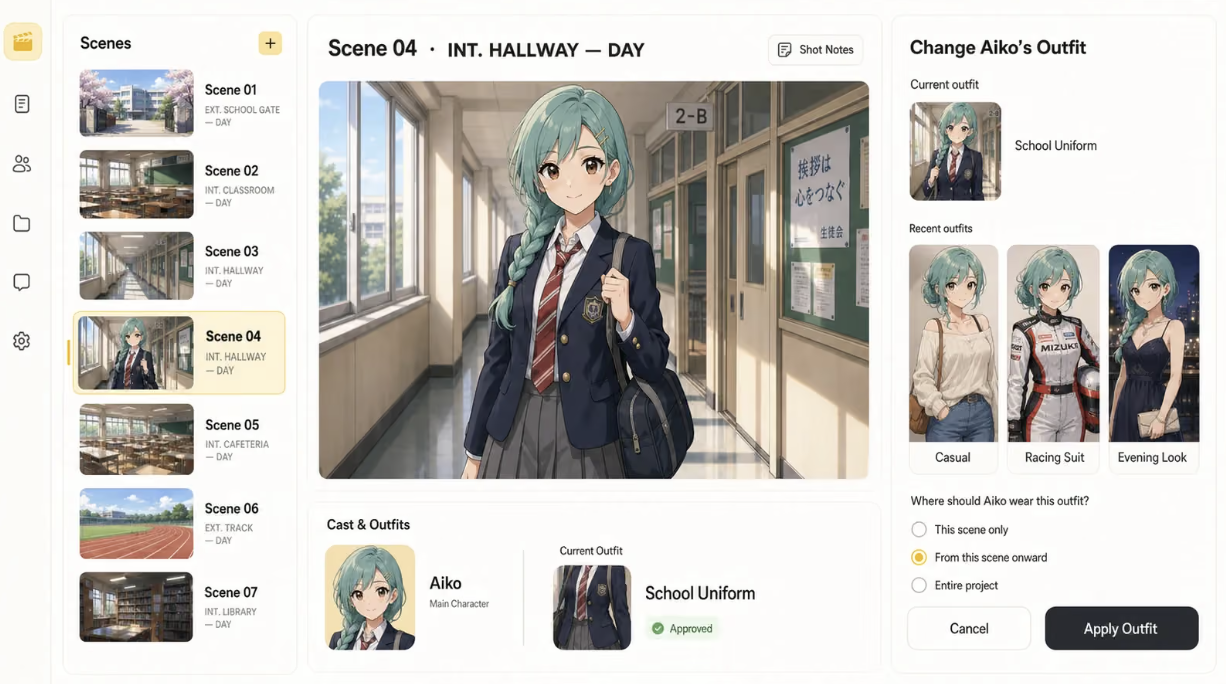
Quick Answer: What Is an Anime OC Creator?
Jenova is an AI platform that works as a full anime OC creator, helping you design original characters, outfits, backstories, and series-ready casts in one workspace. You are not limited to a single face-maker or a one-shot image prompt.
Key capabilities:
- Visual design for faces, hair, iris detail, and wardrobe continuity
- Personality and backstory work grounded in real character frameworks
- Sequential storytelling for manga, comics, webtoons, and scripts
- Persistent memory so the same OC returns with the same voice and look
Why Most Anime OC Creators Fall Short
Original characters sit at the center of modern anime fandom. They power indie manga, webtoon casts, VTuber brands, tabletop campaigns, and social feeds. Demand is not hypothetical. Thirty percent of global consumers watch anime, and three in ten anime viewers spend over $200 a year on the medium. The [**manga market was valued at $15.8 billion in 2026**](https://markwideresearch.com/manga-market), with translation alone already a $1.72 billion industry.
Creators who design OCs are participating in a much larger economy, too.
$252.33 billion — global creator economy market size in 2025
$37 billion — U.S. creator-economy ad spend projected for 2025, growing about four times faster than the media industry overall
That audience and that money make a well-built original character valuable. But turning a spark of an idea into an OC that holds up across chapters, outfits, and formats is frustratingly difficult:
- Face-makers produce a pretty portrait with no inner life
- One-shot image generators forget hair color, scars, and silhouette
- Writing, art, personality, and cultural detail live in disconnected apps
- Traditional drawing skill and time still gatekeep a usable reference sheet
- Moving from an OC sheet into an actual manga, webtoon, or script means starting over
A Pretty Face Is Not a Character
Picrew-style makers and prompt-to-image tools are good at a first look. They are weak at motive, contradiction, and change. An OC who only exists as a front-facing headshot will collapse the moment you need them to argue, lie, or walk into a new scene. Readers forgive awkward anatomy faster than they forgive a character who has nothing to want.
Visual Drift Across Tools and Sessions
Ask a generic image model for “the same girl, school hallway, then cafeteria, then library,” and you often get three different people. Hair length shifts. The blazer changes cut. The bag vanishes. Independent manga and webtoon work depends on model-sheet discipline — the same face, the same silhouette, the same wardrobe rules — and most anime character generators are built for a single pretty frame, not a cast bible.
A Fragmented OC Workflow
Typical pipelines look like this: a dollmaker for the face, a chatbot for the backstory, Pinterest for outfit refs, and a separate tool when you finally try to draw a chapter. None of those surfaces share memory. You re-explain the OC every session. Names drift. Honorifics get faked. The “character sheet” becomes a graveyard of contradictory notes.
Skill, Time, and Consistency Barriers
Drawing a turnaround, expression sheet, and three outfits by hand is a legitimate craft. It is also why so many OCs stall at a single illustration. Writers who cannot draw, and artists who freeze at dialogue, both abandon characters that deserved a series. The bottleneck is rarely imagination. It is the cost of keeping one person visually and emotionally coherent.
From OC Sheet to Actual Story
A reference sheet is not a story. Panel flow, episode hooks, scene geography, and dialogue rhythm are different skills. Creators who stop at “I made an OC” never find out whether the character can carry a one-shot, a vertical-scroll episode, or a short film. That last mile is where most anime OC creator tools simply disappear.
This is exactly what Jenova was built for.
The Jenova Solution
Jenova does not treat original-character work as a single generate button. It is a platform of specialist agents: illustration, writing, personality psychology, sequential art, and language. You describe the OC once. Agents reuse that context. Memory persists across sessions, so the school-uniform version of your character and the evening-look version remain the same person.
While a Canva-style anime generator is built to turn a text prompt into a still, this platform is built to keep one character coherent across writing, revision, and long-form storytelling.
| Traditional Approach | Jenova |
|---|---|
| Picrew + notes app + a separate image model | Specialist agents that share one OC across art, writing, and story |
| Prompts that forget hair color next session | Persistent memory and unlimited chat history |
| Hours redrawing the same silhouette | Iterate outfits, expressions, and scenes without starting from zero |
| Personality typed once in a doc, never used | Psychological frameworks that show up in dialogue and plot |
| Japanese names and school culture guessed from tropes | Language roleplay for honorifics, setting, and tone |
| OC sheet that never becomes a chapter | Manga, comic, webtoon, and screenplay agents ready for the same cast |
Visual Identity: Face, Wardrobe, and Reference Sheets
Graphic Designer handles the visual brief — face, palette, silhouette, outfit variants, and social-ready crops. Pair it with Prompt Generator when you need tightly specified prompts for hair physics, iris shape, uniform trim, or lighting, whether you stay inside Jenova or export a prompt to another image model.
Art Advisor is useful when you care about period, school-uniform grammar, or whether a design reads as shōjo, seinen, or something in between. The goal is not a random “anime girl.” It is a character whose costume language matches the story you intend to tell.
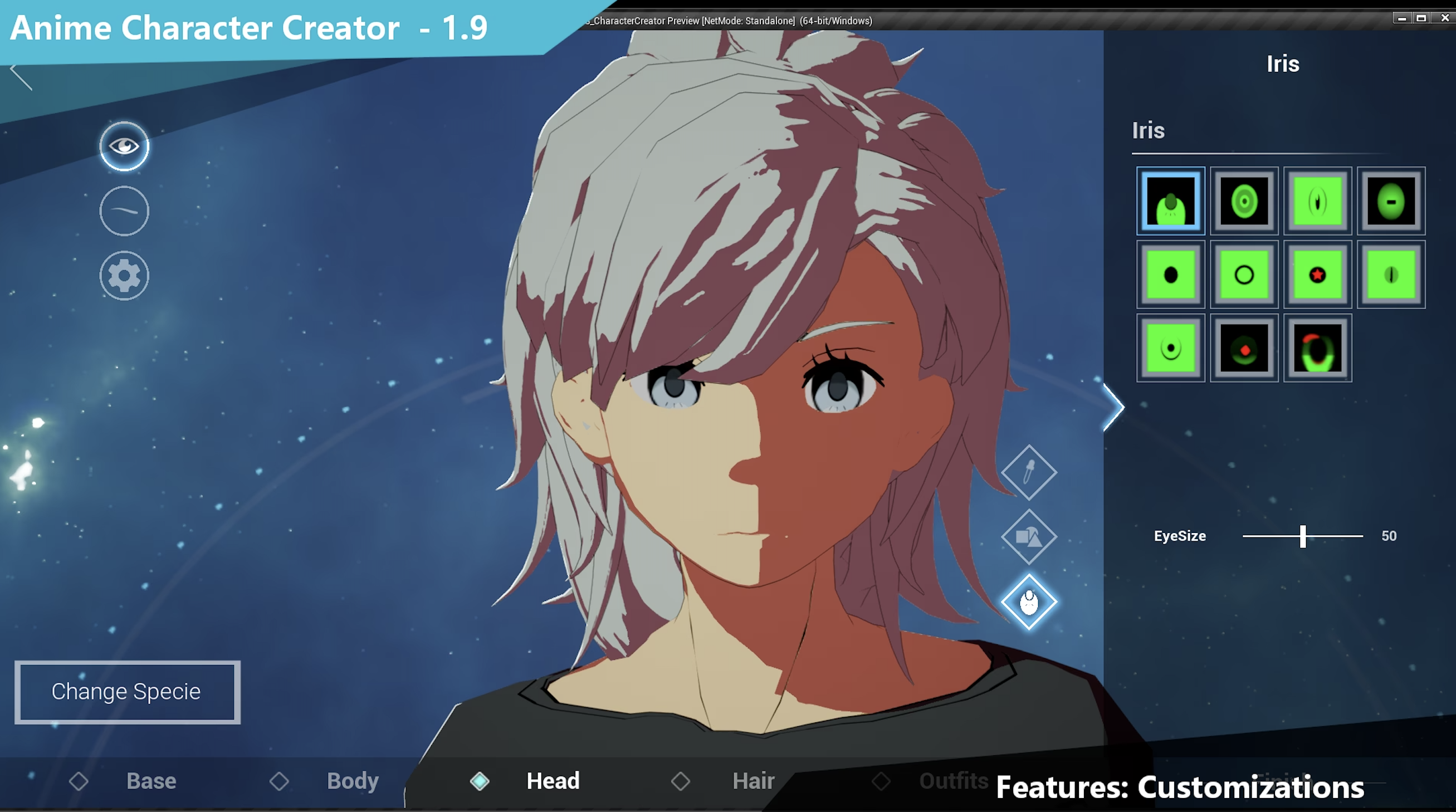
Granular controls — iris style, eye size, hair color blocking, outfit scope per scene — are what separate a mascot from a cast member. An anime OC creator worth using should let you change Aiko’s blazer for one hallway scene without rewriting her entire design language.
Inner Life: Personality, Voice, and Backstory
Writing Assistant turns a moodboard into a character bible: wants, wounds, speech patterns, and the lie they tell themselves. Personality Analyzer goes further, mapping Big Five, MBTI, Enneagram, and attachment patterns so your OC is not a walking trope with a tragic monologue taped on.
That matters in anime especially, where archetype is a feature — tsundere, kuudere, ojou-sama — but lazy archetype is why so many OCs feel interchangeable. A specialist writing partner keeps the trope and adds the private contradiction that makes a reader stay.
Sequential Story: Manga, Comics, Webtoons, and Scripts
Once the OC can stand, you need them to move. Manga Creator is built for panel flow, page turns, and style consistency from a one-shot through a long serialization. Comic and webtoon agents (covered below) take the same cast into Western sequential art or mobile-first vertical scroll. A screenplay agent can test whether the character still works when the pictures go away and only dialogue remains.
Culture and Language, Not Just Aesthetic
School hallways, club rooms, honorifics, and the difference between a first-year and a student-council notice are not decoration. Learn Japanese Through Roleplay lets you stress-test names, speech levels, and setting details inside scenes, so the OC’s world does not collapse into translated cliché.
Platform pieces that make this hang together:
- Multi-model access so you are not locked to one vendor’s “anime look”
- Persistent memory and attached knowledge bases for a real character bible
- MCP tool connections for research, references, and production files
- Custom agents you can spin up with your own OC rules and private lore
Specialized AI Agents for Anime OC Creation
If you already have a face and a name, these agents are the ones you would plausibly open in the next month — not as extras, but as the rest of the pipeline.
Webtoon Creator
Vertical-scroll storytelling is where a huge share of original-character audiences actually read. This agent is built for episode rhythm, color consistency, and hooks that survive a phone thumb-stop. If your OC was designed as a square avatar, this is how you find out whether they can carry a 60-panel episode.
- Vertical-scroll pacing and episode-end hooks
- Full-color consistency across a long series
- Cast continuity when supporting characters enter the frame
Comic Creator
When the OC belongs in a Western comic or graphic-novel grammar — six-panel grids, splash pages, bolder inking — you want a sequential artist who thinks in issues, not in single illustrations. Useful for crossover OCs, indie anthology shorts, and print-first character launches.
- Dynamic page layouts and issue structure
- Style control from one-shots to long sags
- The same OC, adapted to comic — not manga — reading habits
MBTI Personality Guide
Fandom already speaks MBTI. This agent helps you type an OC without the usual “I’m an INFJ because I have sad eyes” shortcut. Cognitive functions, mistype checks, and relationship dynamics become tools for writing conflict, not just a bio-line on Toyhouse.
- Conversational typing and mistype verification
- Compatibility work for ships, rivals, and found-family casts
- Growth paths you can turn into arc structure
Film Screenwriter
Some OCs want a short film, a PV-style sequence, or a live-action-leaning script rather than a chapter. This agent works concept through outline, draft, and revision, with an emphasis on visual storytelling and dialogue that still sounds like your character when the manga panels are gone.
- Structure, scene design, and character-driven dialogue
- Tests whether the OC works off the page as well as on it
- Useful for animatics, student films, and pitch decks
Children's Book Creator
Not every original character is seinen angst. If your OC is for a younger reader — a mascot hero, a gentle school story, a picture-book series — this studio keeps art consistent spread by spread and writes for read-aloud cadence. It is an underrated anime OC creator path: the same design discipline, a different audience.
- Spread-by-spread illustrated stories
- Consistent character art across a full book
- Board book through chapter-book range
Try Jenova free — no credit card required.
How to Create an Anime OC With AI
The useful sequence is not “type a prompt, download a PNG.” It is concept → visual lock → inner life → story test → iteration. Each step below is something you can finish in a single sitting.
Step 1: Lock the Concept, Not the Hair Color
Open a chat and state the OC as a person with a job, a want, and a setting. Age range, school year, species-or-not, and the story they are for all belong here. Resist dumping twenty aesthetic tags before you know what they are afraid of.
"Create a main-cast OC for a contemporary high-school manga: first-year, student-council adjacent, hiding a family debt. Give me three distinct directions — not just hair colors, but different wants and secrets."
Step 2: Build a Visual Bible
Take the direction you like to the design agent and demand constraints: silhouette, limited palette, uniform rules, and what must never change (scar, braid, bag). Ask for outfit variants that can be applied to one scene, from this scene onward, or the whole project — the same discipline a production design sheet uses.
"Design Aiko: teal braid, navy blazer, red striped tie, grey pleated skirt, messenger bag. Give me a front model sheet plus casual, racing-suit, and evening variants. List the three features that must stay identical in every outfit."
Step 3: Write the Person Behind the Model Sheet
Hand the visual lock to your writing partner and the personality tools. Ask for speech samples, a lie they believe, and how they treat a classmate they envy. If you care about type, run the OC through MBTI or a broader personality pass so the bio is not a list of tropes.
"Using this visual bible, write Aiko’s character sheet: wound, want, public persona vs. private voice, and a 150-word scene in the 2-B hallway where she almost tells the truth."
Step 4: Put Them in Sequential Story
Move the same OC into Manga Creator or the webtoon agent. One eight-page one-shot or a single vertical episode will expose every weak spot — a face that cannot emote, a backstory that never hits the page, a uniform that fights the camera.
"Thumbnail an 8-page one-shot: Aiko, INT. HALLWAY — DAY, then cafeteria, then library. Keep her braid, bag, and blazer consistent. End on a decision, not a pose."
Step 5: Iterate With Memory, Then Specialize
Because history persists, you do not re-pitch the OC next week. Change one variable — evening look only from Scene 04 onward, a rival’s MBTI, a Japanese speech-level pass — and regenerate the affected scenes. When the character is stable, save a custom agent with your bible, palette rules, and banned clichés so every future chapter starts on-model.
Anime OC Creator Use Cases
📊 Indie Manga One-Shot With a Locked Cast
-
Scenario: You have a hallway-set school story and a lead named Aiko. You need a model sheet, three supporting students, and an eight-page one-shot before a contest deadline.
-
Traditional Approach: Commission or self-draw turnarounds, write in a separate doc, discover in page 6 that the rival’s hair cannot be distinguished in profile. Days of revision.
-
Manga Creator: Same-cast visual rules plus panel flow in one thread, so the hallway, cafeteria, and library all feature the same person.
-
Contest-ready structure without rebuilding the OC per page
-
Supporting cast designed against the lead’s silhouette
-
Outfit continuity when the story leaves school grounds
💼 Webtoon Series Bible for a Color Cast
-
Scenario: You want a 12-episode romantic-fantasy webtoon. Four mains, full color, mobile-first.
-
Traditional Approach: Character illustrations in one tool, scripts in another, color drifting by episode 3. Readers notice before you do.
-
Webtoon Creator: Episode hooks and color-consistency rules attached to the same OC files your writing partner already knows.
-
Vertical rhythm designed for phone reading
-
Cast palette assignments that survive 12 episodes
-
Cliffhangers that come from character, not random spectacle
📱 OC Reference Work on a Phone Between Classes
-
Scenario: A student in Naga commutes with 20 spare minutes. They want to fix Aiko’s iris shape, draft a cafeteria scene, and send a color note before club.
-
Traditional Approach: Desktop-only software, files on a home PC, ideas lost in a phone notes app.
-
Jenova on iOS or Android: Full feature parity with web. Speech-to-text for messy commute drafts. History syncs, so the evening session on a laptop continues the same OC.
-
Capture voice notes that become scene drafts
-
Tweak wardrobe scope (“this scene only” vs. “entire project”) on the go
-
No “I’ll finish the character sheet when I get home” graveyard
🎯 From Toyhouse Bio to Short-Film Pitch
-
Scenario: Your OC has a loyal online following and zero narrative proof. A festival short or animatic would change how people see them.
-
Traditional Approach: A pretty ref sheet and a Google Doc treatment that never becomes scenes.
-
Film Screenwriter plus Writing Assistant: Dialogue tests, outline, and a visual sequence that still sounds like the character you designed for manga.
-
Proves the OC works when panels are not doing the acting
-
Produces a pitchable outline, not just aesthetic
-
Keeps personality work from the analyzer in the spoken voice
Frequently Asked Questions
What is an anime OC creator?
An anime OC creator is a tool — or a set of tools — for designing original anime characters: appearance, personality, and often the stories they inhabit. On Jenova, that means specialist agents for illustration, writing, psychology, manga, webtoons, and scripts, with memory so the OC does not reset every chat. It is closer to a production bible than to a one-tap avatar maker.
Is Jenova free to use as an anime OC creator?
Yes. There is a free tier with core features and limited usage, and paid tiers if you need more volume, custom model selection, or higher caps. You can design a first OC, run personality work, and draft a short scene without a credit card. If you outgrow free usage, Plus starts at $20/month; usage resets monthly on your billing date with no daily caps.
How is this different from Picrew, Midjourney, or Canva’s anime generator?
Dollmakers lock you into someone else’s asset pack. General image models and Canva’s anime AI generator are strong at a single striking still from a text prompt. They are not built to remember a character bible, write a hallway confrontation, and then lay that same OC into an eight-page one-shot. Jenova’s difference is specialization plus memory: Graphic Designer for the look, writing and personality agents for the person, sequential-art agents for the story.
Can I keep my original character consistent across chapters and outfits?
That is the main failure mode of one-shot generators, and it is the problem persistent memory is there to solve. You can attach a knowledge base (model sheet notes, palette, banned changes), specify whether an outfit applies to one scene or the whole project, and continue the same thread weeks later. Consistency still needs your eye — you approve the braid, the bag, the scar — but you are not re-explaining Aiko from scratch every session.
Does an anime OC creator on Jenova work on mobile?
Yes. Web, iOS, and Android share feature parity, including history and settings sync. That matters for OC work specifically: reference checks, voice-drafted scenes, and wardrobe notes happen in spare minutes, not only at a desk. Speech-to-text is available when your hands are full and the character idea is not.
Can I turn my OC into a manga, webtoon, or children’s book?
Yes. After the visual and personality lock, Manga Creator handles print-style sequential pages, the webtoon agent handles vertical color episodes, and the children’s-book studio handles spread-based illustrated stories. You are not exporting a PNG and hoping another app understands it. The same character context moves with you.
Build Original Anime Characters That Stay Consistent
A face is easy. An original character who can walk down a hallway, change into a racing suit without becoming someone else, and still sound like herself in chapter 12 is the actual job. Generic anime generators optimize for the first image. Jenova optimizes for the rest of the work: design, personality, language, and story, with agents that remember what you already decided.
If you have an OC stuck as a single portrait, start with a concept pass, lock the visual bible, then run one scene — hallway, cafeteria, anywhere the character has to choose. Explore Manga Creator, Writing Assistant, and Webtoon Creator when you are ready to see whether they can carry a page.
Explore the full agent library at Jenova.
For Developers: Manga Creator, Graphic Designer, and the other OC-focused agents in this article are available programmatically via the Jenova API — integrate original-character design and storytelling into your application with a single API call. Full documentation →