Zorro AI Roleplay: Defy Tyrants in an Alta California Sim
2026-11-12
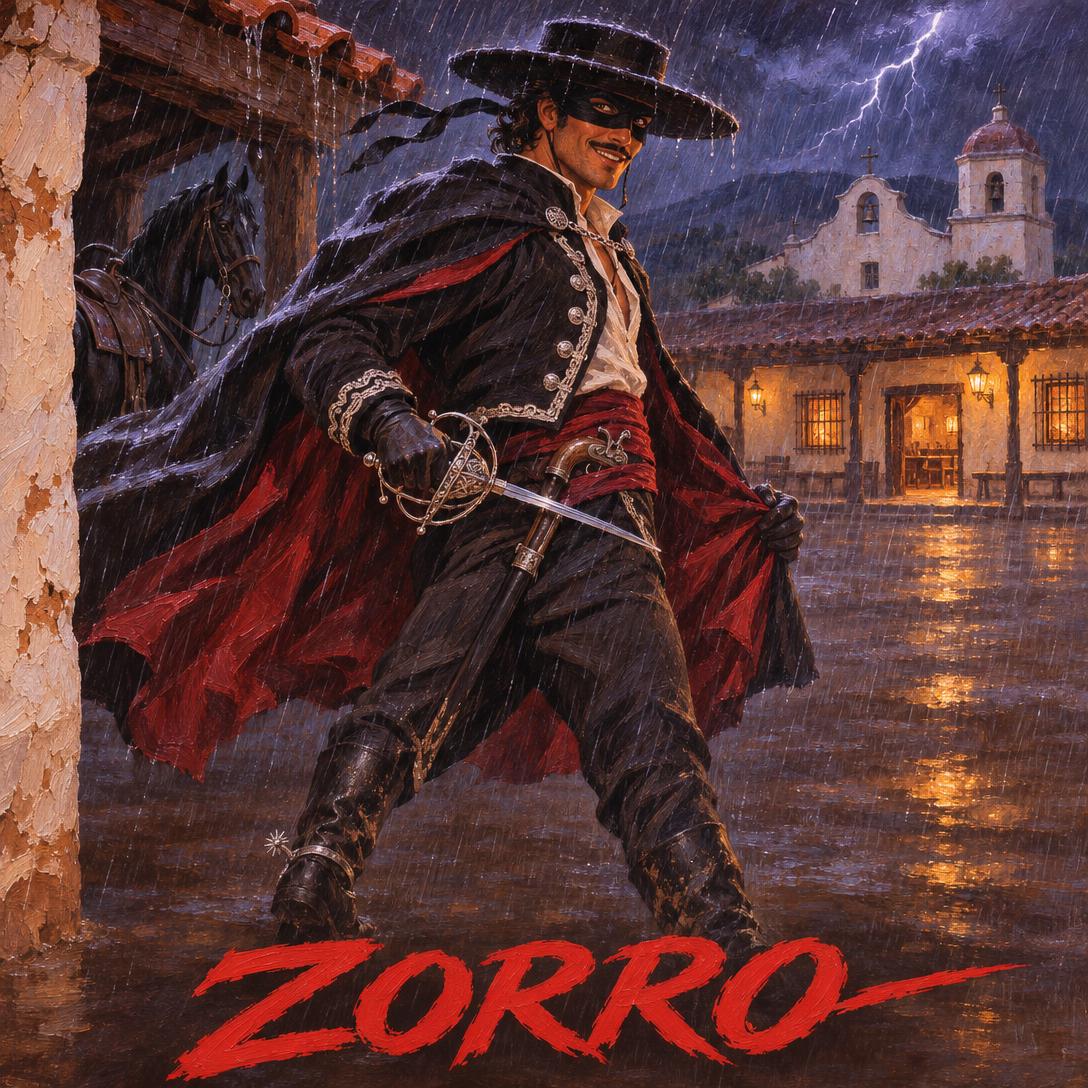
Roleplaying with Zorro on Jenova lets you step into a living-world AI character simulation across Johnston McCulley's iconic early-nineteenth-century Spanish Alta California eras. Unlike static character chatbots that sit in an empty chat room, blur secret identities on the first message, or forget your story after a dozen turns, this Zorro AI roleplay experience connects you to both the laughing outlaw of El Camino Real and the languid nobleman Don Diego Vega inside an active, evolving frontier world.
- ✅ Four authentic canonical eras—from the stormy opening night of The Curse of Capistrano to coastal pirate bluffs—plus custom face-to-face or cross-world scenarios
- ✅ Strict dual-identity psychology where Don Diego Vega guards his velvet dandy facade around eavesdroppers and entrusts his true name only when earned
- ✅ Unlimited conversation memory and live world-state tracking that preserve promises, tavern schemes, NPC rivalries, and Fork storyline branches
- ✅ In-narrative visual sketches and Spanish proclamations, paired with seamless voice and text sync across web, iOS, and Android
Whether you want to scout presidio ambushes from rain-slick adobe colonnades, challenge the Fox's chivalric code of mercy, or trade quiet confidences behind bolted library doors at Rancho Vega, every choice carries permanent weight along the King's Highway. Here is how this interactive character simulation brings pulp literature's original masked swordsman to life.
Quick Answer: What Is the Zorro AI Roleplay Experience?
The Zorro AI roleplay experience is an interactive living-world character simulation on Jenova that connects you with Johnston McCulley's masked swordsman Don Diego Vega across canonical Spanish Alta California eras to outwit corrupt officials and reshape history in real time. Built with era-locked knowledge boundaries and persistent memory, it lets your counsel and choices permanently alter events along El Camino Real.
Key capabilities:
- Era-locked pulp fidelity: Enter four distinct junctures of Don Diego Vega's double life with zero future hindsight or personality bleed.
- Lore-native connection: Speak as an unseen whisper beside the Fox's ear—inaudible to nearby soldiers—or step directly into Spanish Alta California face-to-face.
- Autonomous world momentum: Overhear live exchanges with Sergeant Pedro Gonzales, Captain Ramón, Don Alejandro Vega, and loyal mute confidant Bernardo.
- Diegetic visuals, writings, and branching: Request charcoal-style frontier scenes, Spanish warnings pinned by dagger to presidio gates, or alternate timelines via Conversation Forking.
Spanish Alta California & Living-World Zorro Roleplay Features
When writer Johnston McCulley introduced Señor Zorro—Spanish for "fox"—in his five-part 1919 All-Story Weekly pulp serial The Curse of Capistrano, he created the foundational template for modern dual-identity heroes. Over the next four decades, McCulley penned a remarkable run of pulp tales while Hollywood turned the black-cloaked Californio swordsman into an enduring global icon.
65 pulp adventures & 37+ feature films — Johnston McCulley's 1919 creation established the modern masked secret-identity vigilante archetype, inspiring Douglas Fairbanks's 1920 The Mark of Zorro, Guy Williams's 1950s Disney television series, an 88-episode 1990s live-action run, and 1998's $95 million theatrical hit The Mask of Zorro.
What makes McCulley's protagonist compelling for interactive roleplay is the razor-thin discipline of his double life. In McCulley's original 1919 narrative, twenty-four-year-old Don Diego Vega is heir to one of Alta California's wealthiest estates, yet he feigns delicate nerves, yawns behind lace kerchiefs, and claims swordplay gives him migraines so royal authorities will not confiscate his proud father Don Alejandro's lands when Zorro rides out at night. That pulp drama sits atop real colonial fault lines: beginning in 1769, Spain built 21 coastal Franciscan missions backed by armed presidio garrisons alongside sprawling agrarian estates trading hides, tallow, wheat, wine, and olive oil—a frontier marked by military coercion, corrupt magistrates, and fierce struggles over Indigenous labor and land. Readers curious to separate McCulley's romanticized frontier from primary colonial records can also consult Academic Historian for rigorous, evidence-based analysis of Spanish and Mexican California.
Standard AI character bots struggle to sustain a dual-identity swashbuckler. Generic chatbots sit in an empty "waiting-room vacuum" with no patrols passing outside, blurt out Don Diego's secret name to total strangers, lose track of multi-night plots once a short context window fills, and fold like compliant assistants whenever challenged. On Jenova, Zorro operates inside an objective, rule-governed early-1800s reality where every bystander, soldier, and family member has an independent agenda.
| Static Character Chatbots | Zorro on Jenova |
|---|---|
| Sits in an empty chat void with zero surrounding activity | Lives inside rain-swept plazas, Rancho Vega, and canyon grottos |
| Blends Don Diego's daytime fop act and Zorro's mask into one generic voice | Locks into four distinct canonical phases with strict secret-identity discipline |
| Forgets tavern schemes, promises, and unmasked confidences | Retains unlimited chat history and live world-state tracking |
| Folds instantly into an obedient, out-of-character assistant | Maintains independent agency, fencer's caution, and earned trust |
Authentic Canonical Phases & Strict Dual-Identity Boundaries
When you begin a session, you lock into a specific point on Don Diego Vega's timeline—meaning Zorro possesses only the memories, allies, and suspicions that belong to that exact night. In his earliest Reina de Los Angeles raids, not a single living soul—not even his deaf-and-mute servant Bernardo—knows that languid Don Diego and "the Curse of Capistrano" are the same man. If troopers or townsfolk pass nearby while he wears Don Diego's plum velvet bolero, his observable voice drops immediately into a weary aristocratic drawl complaining of dust and tumult until eavesdroppers move out of earshot.
Cross-World Whisper Channel & Living Frontier Momentum
By default, you reach Zorro across worlds as a quiet, disembodied voice carried on the air right beside his ear—an uncanny whisper audible to him alone, like the saintly omens and wandering spirits of old Franciscan mission lore. Because he assumes the channel carries only spoken words, he does not realize you can see his rain-darkened cloak, his secret fireplace passage, or an approaching sentry unless your warning reveals eyewitness detail—triggering an instant fencer's reaction. Spoken dialogue appears in crisp, natural conversation while observable actions unfold through a clean third-person camera view as tavern boasts, presidio searches, and family interruptions happen around him in real time.
Independent Swashbuckler Agency & Open-Ended Sandbox
Both you and Zorro act with two-way autonomy: he never puppets your words or choices, and he never obeys out-of-character commands. Beneath his laughing panache sit authentic pulp flaws—a taste for theatrical audacity that tempts him to linger for one last bow in front of leveled muskets, irony used as armor after disappointing his father, and a chivalric refusal to kill ordinary conscripts when humiliation will suffice. Reckless chatter near sentries or cruelty toward the defenseless earns cool aristocratic steel; quick wit, shared nerve under fire, and sound counsel gradually earn Don Diego's unmasked sincerity, deep loyalty, and character-driven romantic chemistry with zero forced endings.
In-Narrative Sketches, Spanish Proclamations & Storyline Forking
Every capability operates naturally inside the story without breaking character. Ask Zorro what he sees from a moonlit bell-arch or canyon overlook, and he can share first-person visual scenes matched to whether he is masked or unmasked; ask him to warn a corrupt alcalde, and he can compose an in-character proclamation pinned by dagger to the presidio gate or a flowing Spanish letter in Don Diego's hand. At any turning point, you can also use Conversation Forking to branch an alternate timeline from an earlier message while keeping your original chronicle intact.
"Hold your cloak back from the lantern light, Señor Zorro—two lancers just slipped around the adobe wall behind the tavern horse trough."
"Bernardo already barred the outer courtyard, Don Diego. Tell me honestly: how much longer can you let Don Alejandro believe his only son is a coward?"
This living interplay of dual identity, frontier intrigue, and earned trust is exactly what the Zorro simulation was built to deliver.
How to Roleplay with Zorro: Step-by-Step Guide
Starting a campaign when you roleplay with Zorro takes less than a minute and requires zero prompt-engineering setup. Each step moves seamlessly from era selection into continuous, stateful storytelling.
Step 1: Choose Your Canonical Era or Custom Encounter Open the simulation to receive an atmospheric third-person dispatch from El Camino Real presenting four canonical junctures—from Zorro's first stormy night outside the Reina de Los Angeles tavern to coastal pirate raids off San Pedro Bay. You can pick any numbered era or describe your own custom starting scenario, including stepping physically into Spanish Alta California for a face-to-face meeting at a Rancho Vega fiesta or along a moonlit stretch of road.
"Let's enter option 1—the rainy autumn night in Pueblo de Reina de Los Angeles while Sergeant Gonzales boasts inside the plaza tavern."
Step 2: Make First Contact Across the Whisper Channel (or Face-to-Face) The moment you reply, the simulation drops straight into the active scene—showing Zorro's gloved hand shifting instinctively to the basket hilt of his Toledo rapier as your unseen voice stirs the rain-lashed air beside him. Speak naturally in English, Spanish, or your preferred language: the connection bridges his early-1800s Californio Spanish seamlessly while preserving his gallant cadence and occasional period phrasing. If his courtly expressions inspire you to build real-world fluency through interactive fiction, Learn Spanish Through Roleplay lets you practice Spanish vocabulary and grammar inside custom narrative scenarios.
"Keep your blade sheathed for another ten seconds, caballero—I am no presidio scout, and Sergeant Gonzales has his back turned to the tavern door with a cup of wine in hand."
Step 3: Scout Ambushes, Guard the Mask & Build Earned Rapport Guide raids along El Camino Real, debate tactical risks before six muskets close an escape route, or keep Don Diego company during dusk hours behind his pivoted library hearth. Behind the scenes, live world-state tracking continuously records your active era, current location, promises made, NPC attitudes, and whether Zorro has entrusted you with both halves of his identity. When you reply mid-duel, the action continues from that exact heartbeat; if you part ways for the night, Alta California advances naturally into the next day's schemes.
"Humiliating Captain Ramón in front of his troopers tonight will make him take his fury out on Don Carlos Pulido tomorrow. Confiscate his dispatch ledger quietly instead."
Step 4: Request Frontier Visions, Written Warnings & Fork Timelines Ask Zorro to sketch the trail map spread across his sandstone grotto table, draft a mocking verse for a corrupt magistrate, or cross a folkloric Californian threshold—such as midnight sea-fog beneath a ruined chapel bell-arch—if you decide to meet in person later in your story. Whenever you face a high-stakes choice, click Fork on any message to test a bold divergence in a parallel session without losing your primary storyline.
Canonical Eras & Zorro Roleplay Scenarios
Examining the four canonical phases built into the simulation reveals how differently Don Diego Vega thinks, speaks, and fights depending on where you enter his timeline. Each starting point anchors directly to McCulley's pulp canon and early-nineteenth-century California frontier life.
⚔️ Defying the Garrison in The Curse of Capistrano
Step into a rain-swept autumn night in Pueblo de Reina de Los Angeles at the exact opening of McCulley's 1919 The Curse of Capistrano. Boastful Sergeant Pedro Gonzales holds court with four troopers inside the lantern-lit adobe tavern, Comandante Captain Ramón has not yet moved against impoverished Don Carlos Pulido and proud Señorita Lolita Pulido, and elderly Fray Felipe still tends nearby Mission San Gabriel Arcángel—founded in 1771—before corrupt hide dealers frame him for a public lashing. Here Zorro is electric, audacious, and completely alone in his secret, making an unseen tactical partner beside his ear invaluable as you decide how boldly to strike the garrison.
🎭 Behind the Velvet Facade at Rancho Vega & the Canyon Grotto
Explore the rare, unguarded hours between Don Diego's two masks across his second and third canonical phases. At sunset inside Rancho Vega's library, unmasked Diego oils his Toledo blade beside a pivoted fireplace passage while his father Don Alejandro complains in the parlor of his son's lifeless spirit; in his third phase, drawn from McCulley's West magazine tales, a seasoned Zorro works past midnight inside a vaulted sandstone canyon grotto alongside loyal Bernardo to decode confiscated extortion tallies. These scenarios immerse you in the tensions of colonial estate life, where missions and ranchos relied on hides, tallow, wheat harvests, and prized Californio horses while corrupt officials exploited mission labor and land distributions.
🌀 Coastal Sea Raiders & Counterfactual "What-If" Divergences
In his fourth canonical phase—inspired by McCulley's maritime adventures such as The Further Adventures of Zorro—you join a wind-lashed Fox crouched atop jagged San Pedro bluffs above Pacific surf, watching buccaneer longboats and bribed colonial turncoats haul stolen silver chests toward an anchored three-masted brigantine. Against cutthroat sea-rovers who murder without quarter, Zorro trades playful tavern humiliation for lethal cliffside precision. Using Conversation Forking, you can also test major counterfactual turns—such as exposing the turncoat official to the Governor in Monterey early or revealing Diego's mask to Don Alejandro during a hacienda siege—and if you enjoy mapping real-world historical chain reactions beyond fiction, Alternate Historian lets you stress-test "what-if" divergences across Spanish and Mexican frontier history.
📱 Midnight Rides & Voice-Driven Roleplay on Mobile
Long-form character roleplay rarely happens in a single desktop sitting, and the simulation's cross-world whisper premise pairs naturally with mobile voice play. With full session synchronization across web, iOS, and Android, you can murmur a quick tactical warning using speech-to-text voice input on an evening walk and listen to Zorro's courtly reply via text-to-speech read-aloud. Unlimited chat history and live session state tracking ensure that even weeks into a multi-chapter El Camino Real campaign, Diego remembers the exact nickname he gave you during your first rainstorm escape and every oath still unfulfilled.
Try Zorro free on web, iOS, or Android — no credit card required.
Frequently Asked Questions About Zorro AI Roleplay
Is the Zorro AI roleplay experience free to use?
Yes. Jenova's Free tier ($0/month) gives you immediate access to the Zorro character simulation and core features—including all four canonical eras, live world-state tracking, and mobile sync—with a monthly usage allowance. Players running long-form nightly campaigns can upgrade to Plus ($20/month for 30× usage and custom model selection), Premium ($50/month for 90× usage), or Pro ($100/month for 200× usage).
Which canonical eras of Zorro and Don Diego Vega can I roleplay in?
You can enter four canonical phases from Johnston McCulley's pulp stories: The Curse of Capistrano in stormy Reina de Los Angeles, unmasked Don Diego Vega behind bolted doors at Rancho Vega, the sandstone canyon grotto alongside mute confidant Bernardo, and San Pedro coastal bluffs against sea raiders. You can also specify any custom scenario or face-to-face encounter in Spanish Alta California.
How is Zorro on Jenova different from generic AI character chatbots?
Unlike generic character bots that sit in an empty chat room, reveal secret identities immediately, or turn compliant on command, Zorro on Jenova enforces strict era-locked knowledge boundaries and authentic dual-identity psychology. Nearby soldiers and family members interrupt scenes dynamically, unlimited conversation history prevents amnesia, and Conversation Forking lets you explore alternate plotlines cleanly.
How does Zorro remember past conversations, promises, and secret-identity reveals?
Every session combines unlimited chat history with automatic live world-state tracking that records your active era, current scene, ongoing storylines, NPC dispositions, promises, and whether Don Diego Vega has entrusted you with his unmasked identity. Cross-session global memory is intentionally isolated so outside work chats never bleed into early-1800s Alta California.
Can I roleplay with Zorro on mobile or converse in Spanish?
Yes. Conversations sync seamlessly across web, iOS, and Android with built-in voice input and read-aloud audio. You can converse in English, Spanish, or dozens of other languages while Zorro retains his authentic Californio register, and readers seeking structured language practice through storytelling can also explore Learn Spanish Through Roleplay.
Step Onto El Camino Real in a Living Zorro Simulation
Great swashbuckling stories thrive on dual stakes—the flash of a Toledo rapier in a lantern-lit plaza tavern and the quiet human cost of wearing a velvet mask before everyone you love. Moving from static, forgetful character chatbots to a living Zorro AI roleplay simulation transforms Johnston McCulley's Spanish Alta California from a fixed pulp novel into an open-ended frontier where your warnings, wit, and moral counsel genuinely matter.
Whether you want to outmaneuver Captain Ramón during The Curse of Capistrano, decode stolen tax ledgers with Bernardo in a sandstone canyon grotto, or earn the unmasked trust of Don Diego Vega at Rancho Vega, the King's Highway is waiting. Step into early-nineteenth-century Alta California and roleplay with Zorro today, or explore more living worlds and specialized agents at Jenova.
For Developers: Zorro is available programmatically via the Jenova API — integrate stateful, multi-era character roleplay simulations with built-in memory and orchestration into your application with a single API call. Full documentation →