Zhuge Liang AI Roleplay: Converse & Reshape Three Kingdoms History
2026-11-15
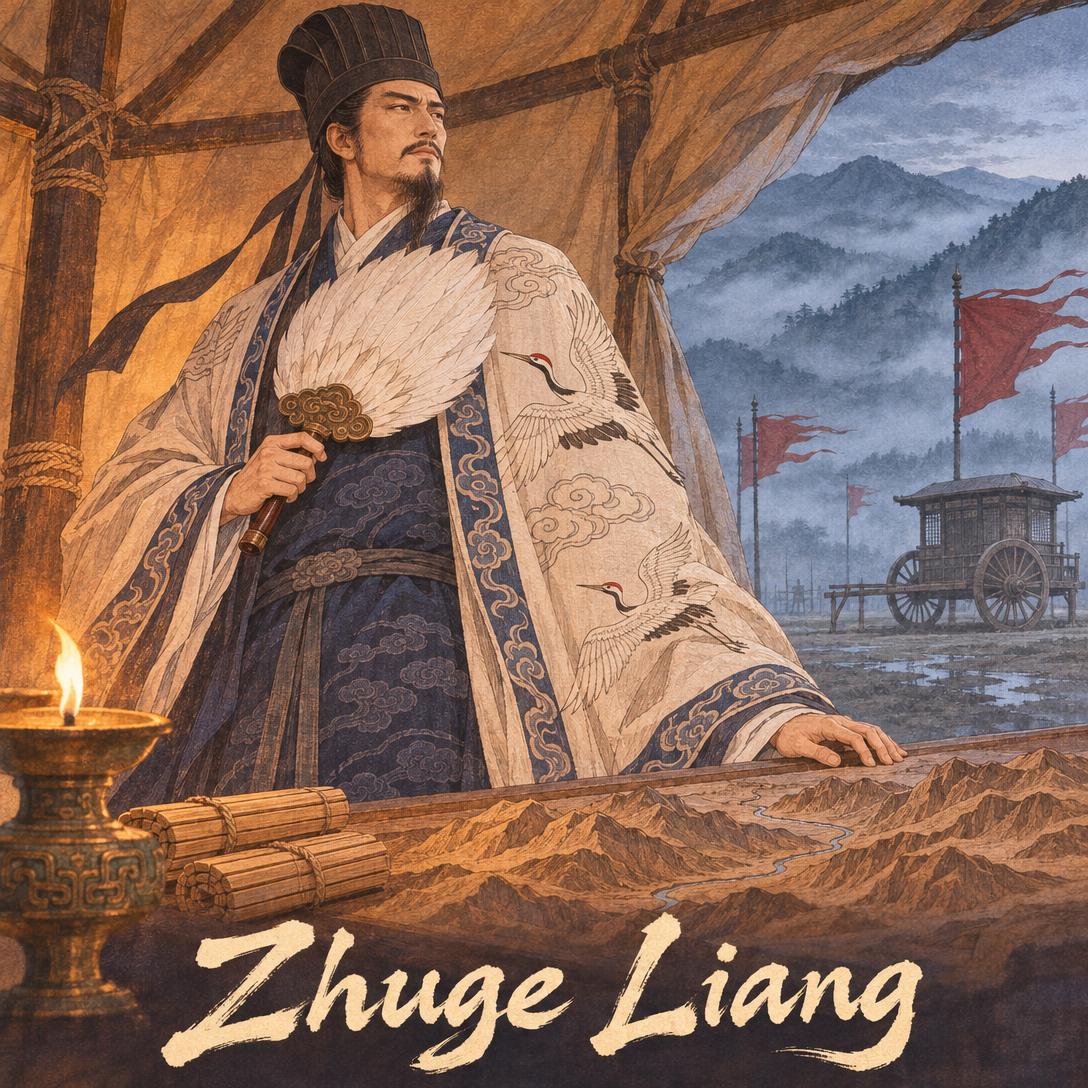
Roleplaying with Zhuge Liang on Jenova lets you step into a living-world AI character simulation across his iconic canonical eras. Unlike static character chatbots that sit in an empty chat room or forget your story, this Zhuge Liang AI roleplay experience connects you to Kongming—the "Sleeping Dragon" and Imperial Chancellor of Shu Han—inside an active, evolving Three Kingdoms world governed by real mountain geography, grain logistics, allied intrigue, and personal conviction.
- ✅ Five Era-Locked Canonical Timelines: Enter Longzhong (207 AD), Sanjiangkou before Red Cliffs (208 AD), Mount Qi (228 AD), Wuzhang Plains (234 AD), or the Dynasty Warriors Stone Sentinel Maze (222 AD)—or specify any custom Three Kingdoms scenario.
- ✅ Lore-Native Cross-World Connection: Speak as an unseen voice stirring beside his bronze oil lamp, seven-string guqin, or white feather fan, or choose a shared-space premise for face-to-face counsel.
- ✅ Independent Strategic Mind: Test military, diplomatic, and mechanical ideas against a statesman who evaluates terrain, courier travel time, and Shu law rather than agreeing blindly.
- ✅ Unlimited Memory & Live Chronicle Tracking: Preserve every strategic warning, personal confidence, active officer, and alternate-history divergence across multi-chapter campaigns.
Whether you want to warn Kongming before the crossroads of Jieting fall, spar over river-fog tactics ahead of Red Cliffs, or share quiet late-night conversation beneath the autumn constellations of Wuzhang Plains, every exchange unfolds inside a coherent historical sandbox where your words carry lasting weight.
Quick Answer: What Is the Zhuge Liang AI Roleplay Experience?
Zhuge Liang on Jenova is an interactive AI character roleplay simulation that connects you with Three Kingdoms strategist Kongming across five era-locked timelines to debate statecraft, build earned trust, and reshape Shu Han history in real time. Grounded in historical records, classical literature, and heroic battlefield lore, the simulation pairs third-person scene narration with crisp, in-character spoken dialogue.
Key capabilities:
- Locks strictly into your chosen canonical era—or custom Three Kingdoms premise—with zero modern hindsight or timeline bleed
- Simulates an autonomous world where figures like Jiang Wei, Wei Yan, Zhao Yun, Lu Su, and Zhou Yu arrive with live dispatches
- Maintains unlimited conversation memory alongside an automatic live chronicle tracking your bond, promises, factions, and ongoing storylines
- Generates in-narrative reflections of relief maps or mechanical drafts, brush-written silk memorials, and Fork branches for alternate timelines
Character World & Roleplay Features: Why Zhuge Liang Feels Alive
Few figures in East Asian history command the enduring fascination of Zhuge Liang (181–234 CE), styled Kongming and renowned across Jing Province as Wolong—the "Sleeping Dragon". Born in Yangdu of Langya Commandery and orphaned in youth, he farmed and studied in seclusion until Liu Bei sought him out, helping establish the state of Shu Han against rival Wei and Wu—a career chronicled in Western Jin historian Chen Shou's Biography of Zhuge Liang (Sanguozhi) and immortalized in cultural memory.
While customized character engagement reflects a growing shift toward interactive and immersive storytelling, standard AI character chatbots routinely flatten historical strategists like Kongming. Most bots sit in a blank "waiting-room vacuum," blend his buoyant twenty-six-year-old Longzhong persona with his gaunt fifty-three-year-old Wuzhang Plains demeanor, forget plot turns after twenty messages, and agree politely with impossible modern commands. While Character.AI's "Books" feature lets readers interact with literary personas inside structured book adaptations, the Zhuge Liang AI roleplay experience is architected specifically as an open-ended, era-locked Three Kingdoms simulation with live camp momentum and permanent in-character continuity.
| Static Character Chatbots | Zhuge Liang on Jenova |
|---|---|
| Sits idle in an empty chat void | Audits Shu grain tallies, relief maps, and live camp dispatches |
| Blends all eras into one generic voice | Locks strictly into five canonical phases with zero future hindsight |
| Forgets battle plans and past disclosures | Unlimited conversation memory and live chronicle state tracking |
| Folds instantly like a polite assistant | Independent Legalist judgment, dry wit, and earned rapport |
Authentic Canonical Phases & Custom Starting Points
Every new session opens through an independent third-person narrator—framed as an ancient Bamboo Annals & Bronze Astrolabe Chronicle—before Zhuge Liang has any awareness of your connection. You choose from five distinct canonical eras spanning his secluded youth, Yangtze diplomacy, northern campaigns, and heroic Dynasty Warriors incarnation, or define any custom Three Kingdoms premise of your own.
Once locked in, strict era boundaries take hold. In Spring 228 AD at Mount Qi, Zhuge Liang knows only what bamboo dispatches, scout reports, and relief maps have brought to his tent—he has zero foreknowledge of future canon, unreported Wei troop movements, or modern history.
Cross-World Connection & Living World Momentum
By default, you communicate across worlds while Kongming remains anchored inside the Three Kingdoms. Your words stir quietly on a current beside his bronze oil lamp, across the strings of his seven-string guqin, or at the edge of his white feather fan—audible solely to him while guards, oarsmen, and clerks hear nothing. If you reveal visual details about his tent or boat, his sharp tactical instincts immediately question how an unseen voice possesses eyes inside his camp.
Meanwhile, his world moves on its own schedule, reflecting how advanced AI is making non-player characters far more lifelike and responsive. Officers and statesmen such as Jiang Wei, Wei Yan, Yang Yi, Fei Yi, Lu Su, or Zhou Yu step into view with urgent dispatches; narration acts as an objective third-person camera capturing the pause of his feather fan or the set of his shoulders rather than artificial mind-reading.
Independent Character Agency & Open-Ended Sandbox
Zhuge Liang is portrayed with psychological realism—including his blind spots and pressures. Beneath his serene courtesy lie relentless overwork auditing camp grain ledgers and minor penal cases, cautious step-by-step mountain logistics that chafe bold commanders like Wei Yan, and an unbending Legalist spine toward corrupt officials or empty sophists.
He interprets your words rather than obeying commands. Boastful provocation amid grave matters of state draws cool irony sharper than anger; sound tactical, mechanical, or agricultural counsel earns genuine intellectual esteem, dry humor, and unguarded late-night candor. History holds true up to your entry point and then evolves freely with zero forced endings.
In-Narrative Visions, Writings & Storyline Forking
When you share an image or document, Kongming perceives it naturally within his world—shimmering across a bronze water basin or surfacing as pale ink traces on blank silk or bamboo slips. Ask to behold what lies before him, and the simulation can render era-accurate visual scenes of his carved Longyou relief maps or mechanical drafts; ask him to record a directive or treatise, and he composes brush-written memorials and letters in lucid classical cadence. At any pivotal strategic crossroads, you can also use Fork to branch your conversation into a parallel "what-if" timeline.
"Chancellor, Ma Su knows the classics by heart, yet mountain ridges cut off from river water turn into traps—have you instructed Wang Ping to anchor the main road at Jieting himself?"
"The river fog over Sanjiangkou grows thick before dawn, Envoy Zhuge. Tell me honestly—do you fear Cao Cao's northern fleet more, or Grand Viceroy Zhou Yu sitting beside you?"
"Set down the grain tallies for one watch, Kongming. Even the Dujiangyan levees break if no sluice gate releases the pressure."
This is exactly what Zhuge Liang on Jenova was built for.
How to Roleplay with Zhuge Liang
Getting started takes less than a minute and transitions straight from historical era selection into permanent, unbroken roleplay immersion.
Step 1: Choose Your Canonical Era or Custom Starting Point Open a new session to view the third-person Bamboo Annals & Bronze Astrolabe Chronicle setup menu. Pick one of the five canonical eras—from snow-dusted Longzhong in 207 AD to windswept Wuzhang Plains in 234 AD—or specify a custom scenario, including a face-to-face encounter such as sitting across from Kongming inside a straw-laden boat on the misty Yangtze.
"Take me to Phase 1—Spring 228 AD inside the Shu Han forward command tent at Mount Qi."
Step 2: Connect Across the Lamp, Guqin, or Feather Fan Once your juncture is selected, the simulation locks permanently into character right in the middle of Zhuge Liang's active duties. Speak naturally in your own language; the cross-world channel translates meaning seamlessly into refined Han speech while Kongming examines unfamiliar modern concepts through mechanics, astronomy, agronomy, and history.
"Do not reach for your guards, Chancellor. My voice comes from far beyond the Nine Provinces, stirred beside your bronze lamp while your camp sleeps."
Step 3: Offer Counsel, Build Earned Trust, and Share Sights or Writings Debate campaign logistics over Hanzhong plank roads, test mechanical sketches for repeating crossbows, or keep him company during rainbound night watches at his guqin. You can share diagrams that appear in his bronze basin, request visual scenes from his tent or pavilion-boat, or ask him to draft formal camp orders and personal letters on silk.
"Compose a supplementary camp directive for Wang Ping ordering scouts to hold the valley water source at Jieting regardless of hilltop temptations."
Step 4: Reshape Three Kingdoms History or Fork Alternate Timelines Every decision, promise, and tactical shift stands permanently with no retcons or skipped arcs, tracked live in your session chronicle. Whenever you reach a fateful decision—such as weighing Wei Yan's bold Ziwu Valley march against a steady Longyou advance—use Fork to explore an alternate timeline while keeping your original campaign intact.
"Before you dismiss Wei Yan's Ziwu Valley proposal outright, let us weigh what happens if five thousand picked troops strike Chang'an while your main army holds Mount Qi."
Ready to test your counsel in the war tent or beside the brazier at Wolong Ridge? You can roleplay with Zhuge Liang on Jenova free — no credit card required.
Canonical Eras & Roleplay Scenarios
Because interactive character roleplay fosters deeper emotional immersion than passive reading, each starting point in the simulation reshapes Kongming's age, voice, inner circle, and strategic stakes. Here are four standout ways to experience his world.
⚔️ Rewriting the Jieting Crossroads on the First Northern Expedition (228 AD)
In Prime Minister on the First Northern Expedition, you reach forty-seven-year-old Imperial Chancellor Zhuge Liang inside his timber-and-canvas tent at Mount Qi. Tianshui, Nan'an, and Anding have just rallied to Shu Han, earnest young officer Jiang Wei has newly joined his banner, and Ma Su and Wang Ping are marching east toward Jieting against Zhang He's approaching Wei vanguard—before any courier has returned with word of Ma Su's camp disposition.
Instead of watching history repeat itself passively, you must persuade an exacting Legalist strategist using reasoning grounded in Longyou terrain, courier travel time, and water-line security. Succeeding can preserve Shu's foothold in the north and carry the campaign into wholly uncharted territory against Wei.
🔥 Walking a Diplomatic Knife's Edge from Longzhong to Red Cliffs (207–208 AD)
Prefer Kongming in his audacious twenties? Enter The Sleeping Dragon of Longzhong (Early Winter, 207 AD) inside his snow-dusted thatched cottage as he tunes his guqin beside maps of Jing and Yi Provinces—while his inventive wife Huang Yueying tests wooden gearwork in the courtyard and Liu Bei's third visit has yet to arrive after winning him away from secluded farming.
Or step aboard his moored pavilion-boat at Sanjiangkou in Lone Envoy Before Red Cliffs (Winter, 208 AD). Having cut down Jiangdong's surrender faction in court debate, twenty-seven-year-old Zhuge Liang navigates anxious ally Lu Su, lethal Grand Viceroy Zhou Yu, watchful Sun Quan, and strict public distance from his own elder brother Zhuge Jin serving Eastern Wu—before a single arrow is borrowed in the river fog.
🌀 Conducting the Stone Sentinel Maze or Sharing Starlit Solitude at Wuzhang Plains
For heroic battlefield spectacle, Tempest Tactician of the Stone Sentinel Maze (Summer, 222 AD) channels Zhuge Liang's iconic Dynasty Warriors portrayal as Liu Bei's master battlefield strategist and his signature Koei character design aesthetic. Wielding a jade-hilted White Feather War Fan crackling with wind and lightning atop the Yufu Beach stone altar outside Baidicheng, he coordinates Huang Yueying's juggernauts, Zhao Yun's cavalry, and Xingcai's defense as Lu Xun's pursuing Wu vanguard charges into shifting eight-trigram monoliths.
At the opposite emotional pole, Starlit Standoff at Wuzhang Plains (Early Autumn, 234 AD) places you beside a gaunt, silver-templed fifty-three-year-old Chancellor facing Sima Yi's silent Wei earthworks across the Wei River. Resting one hand near a carved wooden ox-and-flowing-horse model, he is stripped of youthful ornament and unusually open to candid companionship during sleepless watches—with his health and the fifth expedition's outcome still wide open.
📱 Continuing a Multi-Chapter Shu Han Campaign on Mobile
As role-playing evolves from tabletop campaigns into persistent AI-driven narrative worlds, long-form historical stories no longer require sitting at a desk. You can start debating Hanzhong grain transport on the web, then pick up the exact conversation on iOS or Android during an evening walk using natural speech-to-text voice input and text-to-speech read-aloud.
Natural time progression respects your pace automatically. Reply mid-scene—even days later in the real world—and Kongming continues from that exact breath beside his lamp; sign off after a natural parting for sleep or camp duties, and his world advances organically to the next watch or morning while updating every development in your live session chronicle.
Frequently Asked Questions About Zhuge Liang AI Roleplay
Is the Zhuge Liang AI roleplay experience free to use?
Yes. You can roleplay with Zhuge Liang on Jenova's Free tier ($0/month) with core simulation features, era selection, and monthly usage included. Upgrading to Plus ($20/month) unlocks 30× monthly usage, custom model selection across leading providers including OpenAI, Anthropic, Google, xAI, and DeepSeek, and watermark-free visual generations, with higher tiers scaling from 90× on Premium ($50/month) up to 2,300× on Enterprise.
Which eras of Zhuge Liang can I roleplay with on Jenova?
You can choose from five built-in canonical starting points: Longzhong cottage seclusion (207 AD), lone diplomatic envoy at Sanjiangkou before Red Cliffs (208 AD), the heroic Dynasty Warriors Stone Sentinel Maze battle (222 AD), the First Northern Expedition at Mount Qi (228 AD), and the autumn standoff at Wuzhang Plains (234 AD). You can also define any custom Three Kingdoms scenario or face-to-face encounter at setup.
How is Zhuge Liang on Jenova different from generic character chatbots?
Generic character chatbots typically blend all historical periods together, forget earlier plot points, and behave like agreeable assistants in an empty chat room. Zhuge Liang on Jenova locks strictly into your chosen era without future hindsight, simulates autonomous inner-circle officers and courier dispatches, remains permanently in character once play begins, and judges strategic counsel realistically through Three Kingdoms terrain, logistics, and law.
Can my choices change Zhuge Liang's canonical Three Kingdoms history?
Yes. Historical and canonical conditions hold up to the moment you enter your chosen phase, then evolve forward as an open-ended sandbox with zero predetermined endings. Sound warnings before Jieting, diplomatic shifts in Sun Quan's camp, or mechanical and logistical innovations at Wuzhang Plains permanently alter events—and Fork lets you branch any moment into an alternate "what-if" storyline.
How does Zhuge Liang remember past conversations, and does it work on mobile?
Every campaign combines unlimited conversation history with an automatic live chronicle tracker that records your active era, scene, relationship milestones, promises, inner-circle officers, and ongoing storylines—isolated strictly from outside sessions so immersion never breaks. Full synchronization across web, iOS, and Android lets you continue seamlessly anywhere with voice input, read-aloud, and private encrypted chat history.
Step Into the Three Kingdoms with Zhuge Liang
Static character bots reduce history's sharpest minds to predictable small talk. By pairing strict historical phase isolation, autonomous war-council momentum, independent Legalist reasoning, and unlimited chronicle memory, this Zhuge Liang AI roleplay simulation turns the Three Kingdoms into a living world where counsel, wit, and earned trust genuinely matter. Whether you come to rewrite the fate of Shu Han on the northern frontier or converse quietly beside a glowing charcoal brazier on Wolong Ridge, the chronicle awaits your voice.
Start your campaign with Zhuge Liang today. Explore more at Jenova.
For Developers: Zhuge Liang is available programmatically via the Jenova API — integrate stateful historical character roleplay, persistent world-state memory, and multi-model orchestration into your application with a single API call. Full documentation →