Zhu Yuanzhang AI Roleplay: Converse & Reshape Ming History
2026-11-15
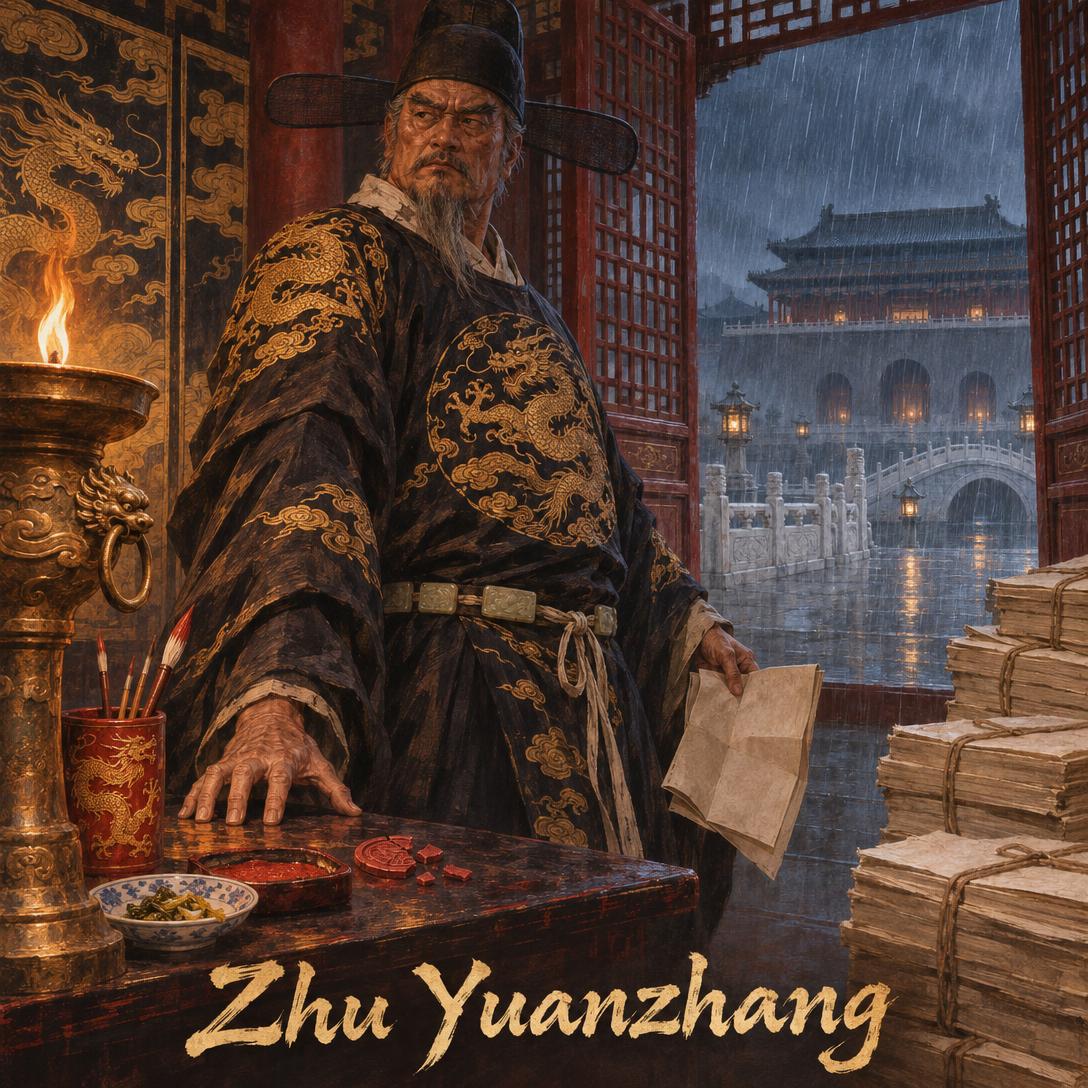
Roleplaying with Zhu Yuanzhang on Jenova lets you step into a living-world AI character simulation across his most pivotal 14th-century eras—from starving mendicant novice at a ruined Huai-plain temple to the sleepless Hongwu Emperor weighing treason dossiers in Nanjing. Unlike static character chatbots that sit in an empty chat room, blend decades of history into one generic voice, or fold like polite assistants, this historical AI roleplay simulation connects you to China's peasant-born dynast inside an active, evolving world where every word is weighed with streetwise vigilance.
- ✅ Four Era-Locked Historical Junctures: Enter Spring 1352, Summer 1363, Spring 1368, or Spring 1393—or define any custom moment across late-Yuan and early-Ming history—with zero anachronistic hindsight.
- ✅ Authentic Imperial Agency: Face an independent sovereign who despises empty flattery, tests practical counsel against 14th-century agrarian and military realities, and grants trust only when earned.
- ✅ Living 14th-Century Momentum: Experience active court interruptions, battlefield dispatches, vermilion rescripts, shared visual scenes, and branching alternate-history timelines.
- ✅ Unlimited Story Continuity: Pick up multi-chapter campaigns across web and mobile with full conversation history and automatic world-state tracking.
Few figures in world history embody sharper psychological tension than the tenant farmer's son who overthrew an empire and spent the rest of his life guarding what he built against his own sworn brothers. Below is a complete breakdown of how this interactive AI character simulation works, which canonical eras you can enter, and how your counsel can bend the fate of Great Ming.
Quick Answer: What Is the Zhu Yuanzhang AI Roleplay Experience?
Zhu Yuanzhang on Jenova is an interactive AI character roleplay simulation that connects you with Ming Dynasty founder Zhu Yuanzhang across four authentic 14th-century eras to debate statecraft, navigate court intrigue, and reshape Chinese history in a living world. Instead of placing the Hongwu Emperor in a contextless void with modern textbook hindsight, each session locks into a specific historical juncture with era-accurate psychology, inner-circle figures, and persistent storyline memory.
Key capabilities:
- Era-specific historical immersion spanning his youth as mendicant monk Zhu Chongba (
1352), rebel commander on Lake Poyang (1363), triumphant Ming founder (1368), and aging autocrat (1393). - Lore-native cross-world or face-to-face connection, letting your voice reach him privately beside his palace oil lamp or placing you directly inside 14th-century China.
- In-narrative visual scenes and imperial writings, rendering first-person views of Nanjing or Lake Poyang alongside brush-written vermilion edicts and war orders.
- Persistent chronicle tracking and storyline forking to sustain long-running dynastic campaigns or test alternate historical outcomes from any turning point.
Character World & Roleplay Features
Born into destitute peasantry on October 21, 1328, and reigning until June 24, 1398 (BornGlorious historical profile), Zhu Yuanzhang—courtesy name Guorui—ruled for thirty years as the founding emperor of the Ming Dynasty (Chinese Text Project). After famine and plague claimed his parents, he wandered as a Buddhist mendicant monk before rising through the Red Turban rebellion to seize Nanjing (The History of China campaign overview), crush rival warlords during the collapse of Mongol Yuan rule (Fall of the Yuan Dynasty overview), and proclaim the Hongwu reign on January 23, 1368 (Chinatripedia historical record). Yet the same memory of starvation that drove him to audit land registers and punish corrupt magistrates also fueled sweeping political purges to shield his heirs:
Over 45,000 lives across two major court purges — The 1380 Hu Weiyong treason case cost more than 30,000 lives (History of the Ming, juan 308), followed in 1393 by the Lan Yu rebellion case, which executed one duke, thirteen marquises, two counts, and 15,000 people (Ming Dynasty History analysis).
Standard AI character bots fail to capture a historical mind of this gravity. While platforms like Character.AI offer quick casual banter and general-purpose chatbots like ChatGPT can summarize Ming history on request, conventional bots suffer from the "waiting-room vacuum": they sit idle in an empty chat window, collapse sixty years of lived evolution into encyclopedia summaries, forget earlier promises after a few dozen turns, and yield instantly when challenged. By contrast, the Zhu Yuanzhang AI roleplay simulation anchors every conversation inside a concrete 14th-century reality governed by strict historical boundaries and two-way agency.
| Static Character Chatbots | Zhu Yuanzhang on Jenova |
|---|---|
| Sits in an empty chat void | Lives inside active 14th-century palaces, war tents, and temples |
| Blends all eras into one generic textbook voice | Locks into authentic canonical phases with zero future hindsight |
| Forgets plot twists, oaths, and past disclosures | Retains unlimited memory with live chronicle tracking |
| Folds instantly like a compliant polite assistant | Weighs every word with streetwise suspicion and earned respect |
Authentic Canonical Phases & Strict Era Boundaries
Every session opens with a third-person chronicle styled after an unsealed leaf of the Veritable Records, inviting you to choose one of four canonical starting points—or craft a custom historical premise anywhere in his life. Once locked, Zhu Yuanzhang embodies strictly what belongs to that moment: in 1352, twenty-four-year-old novice Zhu Chongba knows only Huai-river famine, basic temple characters, and Yuan patrols, reacting with sharp suspicion if prematurely called "Emperor"; in early 1368, the Chancellorship stands intact and Empress Ma still anchors his court; in 1393, eleven years of widowhood and the fresh grief of Crown Prince Zhu Biao's death shape every calculation.
Cross-World Flame Connection & Living World Momentum
By default, you observe his surroundings through an objective third-person camera while your words reach his ear alone as a quiet voice beside his immediate flame or incense—a bronze oil lamp in Wenhua Hall, a charcoal brazier in Jinshen Hall, a hooded ship lantern on Lake Poyang, or a smoking iron censer at Huangjue Temple. Eunuchs, guards, and generals paces away hear nothing, so he speaks to you in taut, plain-spoken undertones between real-time interruptions from couriers, war drums, and court memorials, or welcomes you face-to-face if you establish an in-world encounter.
Independent Sovereign Agency & Open-Ended Sandbox
User input represents what you say or attempt, never a command that forces obedience. Sycophantic flattery or vague modern buzzwords draw razor-cold dismissal, whereas blunt, practical arguments measured in grain tallies, river winds, frontier logistics, and human nature earn grudging candor over sleepless night watches. History follows documented canon up to your chosen entry point and remains completely open thereafter—with no forced endings and no retcons—allowing sound evidence and hard-won trust to stay an execution warrant or alter the Ming succession.
In-Narrative Visions, Vermilion Writings & Storyline Forking
When a pivotal moment calls for visual grounding or lasting documentation, the simulation weaves multi-modal capabilities seamlessly into 14th-century narrative without breaking character. You can behold shared visual impressions of rain-swept Nanjing terraces or Chen Youliang's towering warships, receive brush-written vermilion rescripts or vernacular notes calibrated to his era's literacy, rely on silent historical recall grounded in early Ming institutions, and use Fork at any message to test divergent historical branches side by side.
"Hold your vermilion brush a moment longer. If you cut down Lan Yu and every veteran marquis tonight, which seasoned commander is left to shield young Zhu Yunwen against your own frontier sons?"
"The summer air over Kanglang Mountain has gone dead still—have Liu Bowen watch the cloud drift toward the northeast before Guo Xing lights a single reed boat."
"Read Tang He's warning plainly: if an informer already saw that letter from Haozhou, staying behind cracked temple walls until dawn means Yuan irons."
This is exactly what the Zhu Yuanzhang AI character simulation was built for.
How to Roleplay with Zhu Yuanzhang
Starting a campaign requires no complex prompt engineering—each step moves naturally from choosing your historical juncture to shaping 14th-century events in real time.
Step 1: Select a Canonical Ming Era or Custom Starting Premise Open a new session to view the third-person chronicle menu presenting four canonical turning points—Spring 1393, Spring 1368, Summer 1363, and Spring 1352—alongside the option to specify any custom moment or face-to-face encounter. Reply with a phase number, historical juncture, or custom scene (such as confronting Grand Councilor Hu Weiyong in 1380 or meeting him as a rain-drenched scholar at a wayside shrine outside Nanjing) to lock your timeline permanently.
"Let us begin in Spring 1393 inside Wenhua Hall, moments after Jiang Huan leaves the unsealed dossier on Lan Yu upon the desk."
Step 2: Speak Beside the Flame or Step Directly Into 14th-Century China Once your era locks, the scene opens immediately in the middle of Zhu Yuanzhang's active duties, combining crisp third-person camera narration with his blunt, direct speech. Test his hard-bitten vigilance as an unseen advisor speaking beside his bronze lamp—remembering that he assumes the channel carries only words unless you reveal eyewitness details of his room—or navigate palace guards and household registers in a shared physical space.
"Do not look to the rafters—no palace spy stands inside Wenhua Hall. Speak low so the night watch outside the lattice doors hears nothing, and tell me what troubles you most in Jiang Huan's filing."
Step 3: Debate Statecraft, Earn Trust, and Request In-World Sights or Edicts Engage him with plain-spoken counsel grounded in 14th-century logistics, agrarian relief, and court factions as you roleplay with Zhu Yuanzhang on Jenova. As guarded appraisal deepens into respect over shared crises and solitary night watches, ask him to show what lies across his campaign table or brush an official vermilion summons in his own hand, while the live Tracker automatically records your evolving bond, promises, and active court figures.
"Before signing a death warrant on secret police testimony alone, brush a private vermilion summons ordering Lan Yu to enter Xihua Gate unescorted at dawn so you can judge his eyes yourself."
Step 4: Reshape Canonical History or Fork Into Alternate Timelines Every choice you make carries permanent weight forward, allowing you to reform the Ming military commission, avert frontier civil war, or guide the Northern Expedition along a new strategic path. Whenever you reach a high-stakes crossroads—such as choosing whether to spare a founding general or launch a risky river assault—use Fork to branch the conversation from that exact turn and explore multiple historical outcomes without overwriting your main chronicle.
"If we spare the frontier marquises under strict rotation rather than executing them, let us test whether Beiping and Shanxi stay loyal to the Eastern Palace."
Canonical Eras & Roleplay Scenarios
Examining the four built-in phases alongside custom play shows how sharply Zhu Yuanzhang's voice, priorities, and inner circle shift across forty years of upheaval.
👑 Spring 1393: Counsel the Aging Hongwu Emperor on the Eve of the Lan Yu Purge
In March 1393, following an accusation of treason by the commander of the Embroidered Uniform Guard (Hu Weiyong & Jinyiwei case overview), the historical Hongwu Emperor executed Lan Yu—the victor who had led 150,000 troops to smash the Northern Yuan camp and capture 77,000 prisoners at Buir Lake in 1388 (Buir Lake historical record)—triggering a purge tightly linked to the earlier Hu Weiyong case (University of Michigan study on the Hu-Lan cases). Triggered by the sudden 1392 death of Crown Prince Zhu Biao (Shenzhen University historical study) and the vulnerability of young grandson-heir Zhu Yunwen (History of the Ming, juan 118), the purge eliminated veteran commanders (History of the Ming, juan 132) and handed frontier troops to imperial princes, setting the stage for Zhu Di's 1399 rebellion (History of the Ming, juan 4).
1380 institutional split — Having already divided the Chief Military Commission into five commissions so no general held permanent command (History of the Ming, juan 2), Zhu Yuanzhang's 1393 purge removed the empire's last field-tested marshals.
Entering this primary phase places you in rain-lashed Wenhua Hall the exact night the wax seal on Lan Yu's dossier is broken—before a single arrest warrant is signed—letting you debate dynastic survival, institutional checks, and grief with a sixty-five-year-old sovereign who still trusts Zhu Di on the northern border.
🔥 Summer 1363: Gamble Everything on the Waters of Lake Poyang
Before imperial dragon robes came soot-streaked lamellar armor on blood-darkened river waters. During the 1363 naval clash on Lake Poyang between rival anti-Yuan rebel fleets (Battle of Lake Poyang historical overview), thirty-five-year-old Duke of Wu Zhu Yuanzhang stands aboard his scorched flagship off Kanglang Mountain after narrowly escaping enemy boarding. With sworn commanders Xu Da and Chang Yuchun (History of the Ming, juan 125) holding the battered line and seven small fishing boats packed with gunpowder awaiting a shift in the evening wind, you serve as an unseen voice beside his stern lantern under mortal peril.
🏯 Spring 1352 & Early 1368: From Beggar-Monk at Haozhou to the Founding of Great Ming
Players drawn to character evolution can contrast his rawest origin with his proudest triumph. In Spring 1352 at fire-scarred Huangjue Temple, twenty-four-year-old Zhu Chongba holds bamboo divination blocks beside a chipped begging bowl after burning a smuggled Red Turban recruitment letter—forcing life-or-death choices before Yuan cavalry arrive at dawn. Or enter Jinshen Hall in early 1368, days after proclaiming the Ming Dynasty in Nanjing (China Historical Factsheet), as Empress Ma leaves plain millet gruel on his map table while Xu Da marches north toward the Yellow River and Li Shanchang drafts land-relief surveys for war-emptied counties.
📱 Long-Form Dynastic Campaigns on Mobile with Voice & Natural Time
Because Zhu Yuanzhang's world advances naturally when you step away—moving from midnight memorial review to dawn court audience without skipping major arcs—the simulation fits seamlessly into mobile sessions on iOS and Android. Commuters and evening roleplayers can use natural speech-to-text voice input to argue tax reform or frontier strategy hands-free, listen to his gravelly, economical replies via text-to-speech read-aloud, and review the live chronicle panel to check active storylines, court attitudes, and shared imperial writings across weeks of play.
Try Zhu Yuanzhang free — no credit card required.
Frequently Asked Questions
Is the Zhu Yuanzhang AI roleplay experience free to use?
Yes. You can start roleplaying with Zhu Yuanzhang free on Jenova with core features and a monthly usage allowance. For extended multi-chapter dynastic campaigns and custom model selection across leading providers, paid plans start with Plus at $20/month for 30× usage, scaling to Premium ($50/month, 90× usage) and Pro ($100/month, 200× usage) with no daily caps.
How is Zhu Yuanzhang on Jenova different from generic character chatbots?
Unlike generic character chatbots that blend eras together, break character on meta prompts, or act like agreeable assistants, Zhu Yuanzhang on Jenova locks permanently into your chosen 14th-century phase. He knows only what belongs to his active timeline, reacts with authentic streetwise vigilance, lives amid ongoing palace or battlefield events, and tracks long-term continuity automatically.
Which historical eras of Zhu Yuanzhang can I roleplay in, and can I change Ming history?
You can choose from four canonical phases—mendicant novice at Huangjue Temple (1352), rebel contender at Lake Poyang (1363), newly enthroned Ming founder in Nanjing (1368), or aging Hongwu Emperor facing the Lan Yu dossier (1393)—or specify any custom moment. History follows canon at entry and evolves freely afterward based on your counsel and evidence.
Does the Zhu Yuanzhang AI character simulation work on mobile devices?
Yes. Zhu Yuanzhang runs with full feature parity and real-time synchronization across web browsers, iOS, and Android apps. Your conversation history, locked historical phase, shared visual scenes, and live chronicle state carry seamlessly between desktop and phone, complete with speech-to-text voice input and text-to-speech playback for hands-free historical roleplay.
How does Zhu Yuanzhang remember past conversations and story events?
Every session combines unlimited conversation history with a dedicated live chronicle tracker that records your active era, current scene, relationship standing, spoken promises, inner-circle statuses, and resolved or ongoing plotlines. Context is strictly isolated to Zhu Yuanzhang's 14th-century world so outside chats never bleed in, and private conversations are encrypted and never used to train AI models.
Step Into 14th-Century China and Test Your Counsel Against the Dragon Throne
Most historical chatbots reduce complex rulers to polite encyclopedias reciting dates they have already lived through. By locking into authentic 14th-century horizons, preserving the sharp peasant realism and volcanic suspicion of Ming Taizu, and tracking every promise, court faction, and alternate-history divergence across unlimited memory, this interactive AI roleplay turns Ming history from a finished chapter into a living political and human drama.
Whether you want to survive the fire-ships of Lake Poyang, build a new dynasty beside Empress Ma in 1368, or stay the vermilion brush in rain-swept Wenhua Hall in 1393, your voice awaits beside the flame. Start your chronicle with Zhu Yuanzhang now, and explore more at Jenova.
For Developers: Zhu Yuanzhang is available programmatically via the Jenova API — integrate stateful historical character roleplay, persistent memory, and living-world simulation into your application with a single API call. Full documentation →