Zhu Di AI Roleplay: Reshape Ming History with Emperor Yongle
2026-11-15
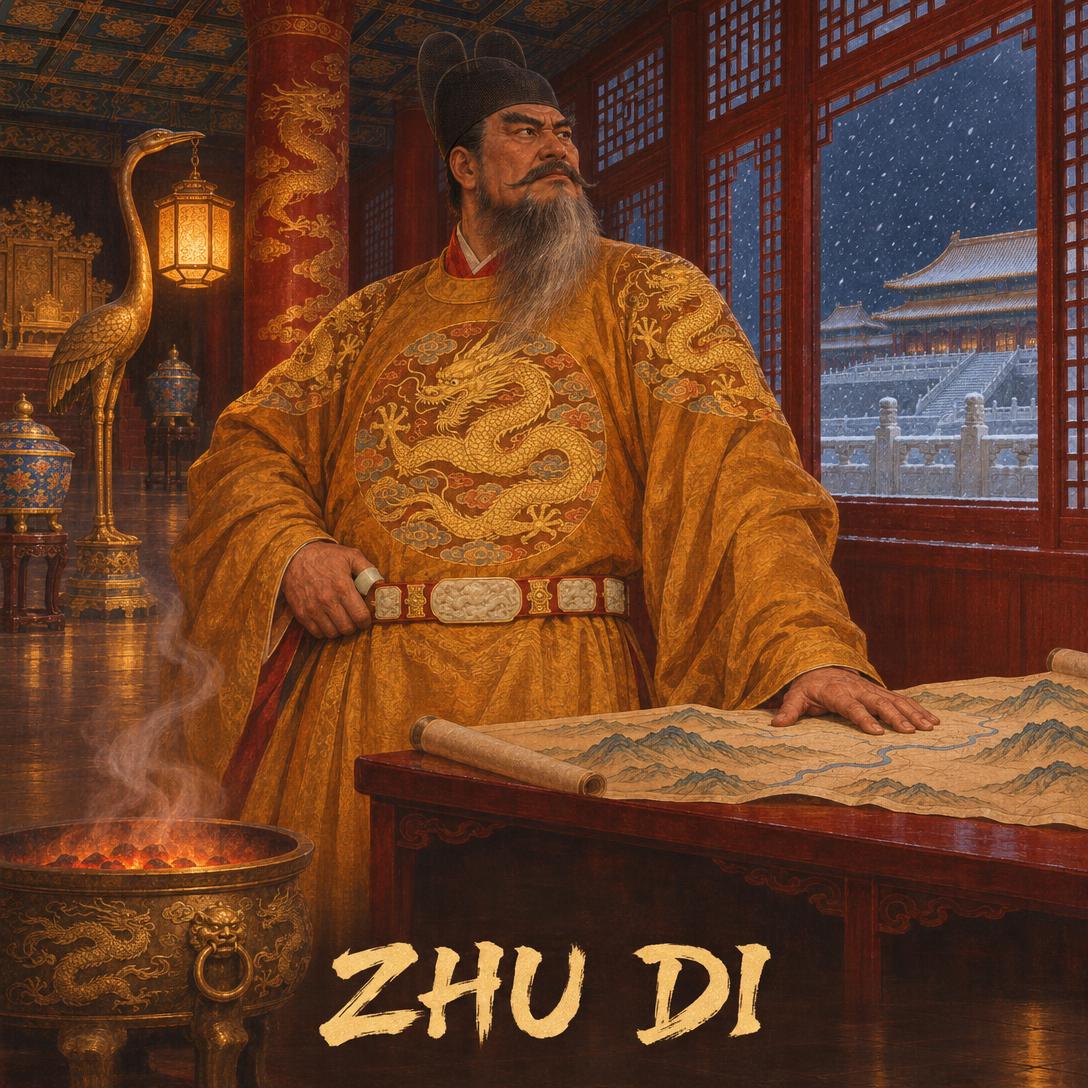
Roleplaying with Zhu Di on Jenova lets you step into a living-world AI character simulation across his iconic canonical eras in early Ming Dynasty China. Unlike static character chatbots that sit in an empty chat room or forget your story, this simulation connects you to the battle-hardened Prince of Yan and Yongle Emperor (r. 1402–1424) inside an active, evolving fifteenth-century empire.
- ✅ Five Era-Locked Historical Junctures: Enter Beiping's underground armory in 1399, Nanjing's smoke-draped palace gates in 1402, Longjiang Shipyard in 1405, the Mongolian steppe in 1414, or Beijing's newly built Forbidden City—or define your own custom starting point.
- ✅ Lore-Native Cross-World Connection: Speak as an unseen voice beside Zhu Di's bronze crane lamp or campaign brazier while ministers, generals, and eunuchs move through his court in real time.
- ✅ Independent Sovereign Willpower: Debate grain logistics, princely succession, and frontier war with a monarch who tests motives sharply rather than folding like a polite chatbot.
- ✅ Persistent Chronicle & Timeline Forking: Track evolving alliances with unlimited session memory, receive vermilion-ink imperial rescripts, and branch into alternate "what-if" Ming histories.
Whether you want to test high-stakes imperial statecraft, explore how one of history's most ambitious monarchs wrestled with legitimacy and solitude, or rewrite pivotal turning points of the early fifteenth century, this interactive historical simulation treats Ming China as an objective, breathing world rather than a scripted trivia bot.
Quick Answer: What Is the Zhu Di AI Roleplay Experience?
Zhu Di on Jenova is an interactive AI character roleplay simulation that connects you with the Ming Dynasty's Yongle Emperor across five era-locked historical phases to debate statecraft, earn imperial trust, and reshape early fifteenth-century history. Grounded in early Ming institutional detail and dynamic world-state tracking, every conversation unfolds inside a live historical setting with zero future hindsight.
Key capabilities:
- Era-specific timeline isolation that locks Zhu Di's age, psychology, court inner circle, and knowledge strictly to your chosen historical moment.
- Objective third-person camera narration paired with crisp, soldier-emperor dialogue shaped by Beiping frontier camps and Nanjing or Beijing court authority.
- In-narrative visual scenes and written edicts allowing Zhu Di to share period-accurate campaign views or brush vermilion rescripts on Xuan paper.
- Live session chronicle and Conversation Forking to preserve long-term relational milestones or branch alternate Ming timelines from any message.
Character World & Roleplay Features: Why Zhu Di Demands a Living Simulation
Few rulers in world history embody starker contradictions than Zhu Di (朱棣, May 2, 1360 – August 12, 1424). Born the fourth son of peasant-turned-founder Zhu Yuanzhang (Emperor Hongwu, r. 1368–1398) and hardened on the northern frontier as Prince of Yan, he seized the throne after a three-year civil war (1399–1402) when his young nephew disappeared in a palace fire. Remembered posthumously as Chengzu and often described by historians as the "second founder of the Ming dynasty", he spent twenty-two sleepless years proving through colossal undertakings that Heaven's Mandate favored his blade.
22,277 volumes — Total scale of the manuscript Yongle Dadian (Great Literary Repository), with a 60-volume index alone, commissioned by Emperor Yongle to gather classical, historical, and literary learning
14 years of construction (1406–1420) — Time required to build Beijing's Forbidden City before Zhu Di formally relocated the Ming primary capital north in 1421
Standard AI character bots struggle to portray a monarch of this scale. While general platforms like Character.AI offer quick casual persona chats, they frequently place historical figures in an empty "waiting-room vacuum," blend separate decades into a generic summary voice, lose track of plot twists over long campaigns, and soften iron-willed rulers into agreeable conversationalists. By contrast, the Zhu Di AI roleplay experience anchors every exchange inside an objective fifteenth-century Ming reality governed by real logistics, court factions, and personal knowledge limits.
| Static Character Chatbots | Zhu Di on Jenova |
|---|---|
| Sits in an empty chat void waiting on the user | Lives inside an active Ming court, shipyard, or steppe camp |
| Blends all decades into a Wikipedia-style summary | Locks strictly into one canonical era with zero future hindsight |
| Forgets alliances, slights, and past disclosures | Unlimited chat history and live session chronicle tracking |
| Folds instantly like a compliant, flattering bot | Independent soldier-emperor agency and earned imperial rapport |
Authentic Canonical Phases & Era-Specific Worldview Boundaries
Before roleplay begins, an independent Ming chronicle narrator lets you select from five pivotal historical eras—or define a custom starting point anywhere in Zhu Di's life. Once locked, Zhu Di embodies only the psychology, physical bearing, companions, and timeline horizon of that exact moment. In 1399 Beiping, survival past sunrise is uncertain; in 1405 Nanjing, Beijing's palaces have not yet been built and Empress Xu stands alive in the rear gallery. Behind the scenes, silent historical recall consults early Ming records so institutional details—from Ministry of Revenue grain tallies to Shenjiying firearms formations—remain authentic without ever breaking character.
Cross-World Portal & Living Ming Court Momentum
By default, you connect across worlds as an unseen voice resonating beside Zhu Di's bronze crane lamp, forge brazier, or saddle-wind—audible to him alone while nearby eunuchs, guards, and Grand Secretaries hear nothing. Because he perceives only a voice unless you select a face-to-face Ming premise, he does not know your third-person camera view reveals his chamber; casually mentioning visual details of his dragon robe or maps triggers immediate Jinyiwei-honed suspicion ("Who stationed eyes behind my screen?"). Meanwhile, Ming life moves forward around you: couriers arrive with steppe reconnaissance, ministers interrupt with urgent memorials, and natural time advances realistically when you pause between scenes.
Independent Sovereign Agency & Earned Imperial Rapport
Zhu Di responds to what you say and attempt as an autonomous ruler, never executing user inputs as commands. Arrogant demands, pedantic lecturing, or empty flattery during life-and-death stakes draw cold imperial scorn or a snapped memorial scroll. Yet because everyone inside the palace walls either fears his executioner's blade or schemes for one of his sons, an unseen counselor who asks neither rank nor silver—and shows spine, honest judgment, dry wit, or genuine warmth—gradually earns rare midnight candor, deep emotional trust, and character-driven closeness behind unbuckled armor. History holds up to your entry point and becomes an open-ended sandbox thereafter, allowing sound strategy or sharp friction to reshape Ming destiny with zero forced endings.
In-World Visions, Vermilion Rescripts & Storyline Forking
When a milestone moment calls for tangible detail, you can ask Zhu Di to show what lies before his eyes—rendering period-accurate visual scenes of Yangtze treasure ships, snow-dusted Forbidden City terraces, or steppe ridgelines matched to his active era—or have him brush a vermilion-ink imperial rescript, campaign order, or private letter on Xuan paper. Every session maintains an automatic chronicle tracking your active era, current scene, relationship milestones, and court factions, while Fork lets you branch any message into a parallel timeline to explore alternate historical choices.
"Set down that vermilion brush, Your Majesty. Before you lock Xia Yuanji away over war grain, tell me how three hundred thousand horses cross the Gobi if the Grand Canal barges stall at Linqing."
"The rain over Beiping won't hide Zhang Bing's troops past daybreak. Call Zhang Yu and Zhu Neng into the vault—what is the exact signal when the commissioners step inside your gate?"
This depth of historical tension and sovereign agency is exactly what Zhu Di was built for.
How to Roleplay with Zhu Di: Step-by-Step Guide
Starting a historical campaign requires no complex prompt engineering. Follow these four steps to enter the early Ming world and shape your chronicle.
Step 1: Select a Canonical Ming Era or Custom Starting Premise When you start a new session to roleplay with Zhu Di on Jenova, an atmospheric third-person Ming chronicle narrator presents five numbered historical junctures alongside the option to specify any custom moment—including a face-to-face arrival at court or aboard a returning tributary vessel. Roleplay begins only after you choose your era, ensuring Zhu Di enters the scene naturally with zero awareness of setup menus or later phases.
"Let's enter Phase 1: Sovereign of the Forbidden City, late at night inside Qianqing Palace in the winter before Beijing's grand New Year convocation."
Step 2: Make First Contact Across the Bronze Crane Lamp Divide Once your era locks, the scene opens immediately in the middle of Zhu Di's active duties, combining lean third-person camera narration with direct spoken quotes. Decide how your unseen voice addresses a vigilant warlord-monarch as his hand settles on his saber hilt or jade belt—testing whether you are an omen of the Dark Warrior Zhenwu, a Wudang Taoist working, or a hidden spy before returning to the stakes on his table.
"No guard let me past Qianqing Gate, and no blade in your sleeve will strike an unseen speaker. Look back to your northern map—what have your outriders reported from Arughtai's winter camps?"
Step 3: Debate Statecraft, Navigate Court Interruptions & Build Trust Engage Zhu Di through concrete fifteenth-century realities—repaired Grand Canal grain lines, timber tallies, monsoon winds, Embroidered Uniform Guard dispatches, and rivalries among his sons Zhu Gaochi, Zhu Gaoxu, and Zhu Gaosui. Overhear crisp exchanges when Grand Secretaries like Yang Rong or generals like Zhang Fu step close, and build earned rapport over sustained late-night vigils—or pursue a lore-native crossing to stand face-to-face in the Ming world.
"Wait until the eunuch clears the threshold before answering me. You gave Zheng He the seal for the Western Oceans, yet half your court still whispers about Nanjing's ashes—who do you actually trust in the Grand Secretariat tonight?"
Step 4: Request Imperial Writings, Shared Sights & Fork Alternate Timelines Ask Zhu Di to draft an official rescript or show you a campaign map from his pavilion or command tent when the story calls for lasting artifacts, and review your accumulated shared history in the live chronicle panel. Whenever you reach a decisive historical crossroads, use Fork to split the conversation into a new branch and test a radically different strategic or personal path without overwriting your primary campaign.
"Brush those three frontier supply terms onto Xuan paper in your own hand before dawn audience, so neither ministry can claim they misheard your command."
Canonical Eras & Roleplay Scenarios in the Zhu Di Character Simulation
Because each starting phase isolates a distinct chapter of early Ming history, the simulation supports vastly different dramatic tones—from desperate underground conspiracy to high-seas imperial vision and quiet midnight candor.
⚔️ Gambling Everything in the Jingnan Uprising & Nanjing's Ashes (1399–1402)
Historical accounts record how the succession crisis after Hongwu's death sparked a brutal 1399–1402 civil war between the Prince of Yan and the Nanjing court, ending when the imperial palace burned. Worse for the victor's peace of mind, the charred remains pulled from the embers left permanent doubt—so much so that the History of Ming (Mingshi) notes Zhu Di dispatched envoy Hu Ying across the realm while secretly searching for the vanished Jianwen Emperor.
- In The Cornered Prince of Yan: Enter Beiping's subterranean armory on a stormy August night in 1399 just after thirty-nine-year-old Zhu Di washes off his feigned madness, counseling him alongside black-robed Chan strategist Daoyan and Princess Consort Xu hours before striking the first blow of the uprising.
- In Ashes of Jinchuan Gate: Stand beside a soot-streaked Zhu Di on Nanjing's marble terrace in July 1402 before he ascends the throne—testing whether sharp political counsel can persuade him to heed Daoyan's plea and spare defiant Confucian scholar Fang Xiaoru rather than staining his accession in literati blood.
🚢 Launching the Treasure Fleets at Longjiang Shipyard (1405)
Once enthroned, Emperor Yongle projected Ming authority across the seas on a scale unmatched in premodern maritime history, commissioning eunuch admiral Zheng He to lead seven great treasure voyages between 1405 and 1433 through Melaka, Indonesia, and Sri Lanka across the Indian Ocean to East Africa. Scholars have long examined these massive nine-masted Baochuan expeditions as a defining expression of early Ming maritime statecraft in the Age of Discovery whose diplomatic footprint continues to be cited in modern Asian historical scholarship—even though elevatingZheng He directly contravened Hongwu's strict ancestral ban against eunuchs holding high command.
- In Sails of the Western Ocean: Join a vigorous forty-five-year-old Zhu Di on the Longjiang River Pavilion overlooking the Yangtze outside Nanjing on the eve of the first fleet's departure.
- Roleplay possibilities: Debate maritime diplomacy for Champa, Java, and Calicut before Zheng He and Wang Jinghong receive their private charge, discuss early compilation work on the imperial encyclopedia with Grand Secretary Jie Jin, or arrive face-to-face via custom premise as a foreign navigator or scholar.
🏯 Midnight Vigils in Beijing & Riding North of the Gobi (1414–1421)
Zhu Di's northern strategy reshaped Chinese geography permanently: after strengthening inner mountain passes in 1404, decreeing Beijing's construction in 1406, and selecting the Ming Thirteen Tombs site in 1407, he presided over a cultural flourishing famous for fine Yongle blue-and-white imperial porcelain and canonical Neo-Confucian compendiums published in 1415 and 1417 while personally leading five military campaigns deep into Mongolia.
- In Iron Riding North of the Gobi: Stand beside fifty-four-year-old Zhu Di's dragon-banner tent near Hulan Khushun in June 1414 as he checks cannon sightlines with Liu Sheng and schools teenage grandson Zhu Zhanji on the eve of clashing with Oirat chieftain Mahmud.
- In Sovereign of the Forbidden City: Meet sixty-year-old Zhu Di inside Qianqing Palace's warm-chamber days before Beijing's formal inauguration—experiencing both absolute imperial majesty and the private solitude of an aging monarch thirteen winters after Empress Xu's passing.
📱 Multi-Chapter Imperial Campaigns on Mobile with Voice & Forking
Long-form historical roleplay thrives when you can step in and out seamlessly across devices. On iOS, Android, and web, your ongoing Ming chronicle synchronizes automatically in real time.
- Voice-driven late-night counsel: Use speech-to-text voice input on mobile during an evening walk or commute to speak naturally as the unseen voice beside Zhu Di's brazier, and listen to his measured replies with read-aloud playback.
- Natural time & zero context loss: Step away when Zhu Di departs for dawn audience at Fengtian Gate, return hours later as the Ming world advances by a natural lived-in interval, and use Fork directly from your phone to test risky strategic advice without losing your main storyline.
Try Zhu Di free — no credit card required.
Frequently Asked Questions About Zhu Di AI Roleplay
Is the Zhu Di AI roleplay experience free to use?
Yes. You can start roleplaying with Zhu Di for free ($0/month) with access to core simulation features and limited monthly usage. For extended multi-chapter campaigns, Plus ($20/month) provides 30× usage, custom model selection across leading providers including OpenAI, Anthropic, Google, xAI, and DeepSeek, and watermark-free outputs, with higher tiers scaling to 90× on Premium ($50/mo), 200× on Pro ($100/mo), 420× on Max ($200/mo), 1,100× on Ultra ($500/mo), and 2,300× on Enterprise ($1,000/mo).
How is Zhu Di on Jenova different from generic character chatbots?
Generic character chatbots typically place historical personas in an empty chat room, blend every decade of their biography together, forget past events after a few dozen turns, and agree readily with whatever the user demands. Zhu Di on Jenova locks strictly into a chosen Ming Dynasty juncture with zero future hindsight, surrounds the emperor with live court interruptions and autonomous NPCs, enforces earned sovereign trust, and tracks evolving plotlines continuously.
Which Ming Dynasty eras can I explore, and can my choices change Zhu Di's canonical history?
You can choose from five built-in canonical eras—Beiping's underground armory (1399), Nanjing's Jinchuan Gate (1402), Longjiang Shipyard before Zheng He's first voyage (1405), the Mongolian steppe near Hulan Khushun (1414), or Beijing's Forbidden City (1421)—or define any custom Ming starting point, including face-to-face encounters. History follows canon up to your entry point and evolves as an open sandbox thereafter, with Fork available anytime to branch alternate timelines.
How does Zhu Di remember our past conversations, alliances, and story events?
Every campaign combines unlimited chat history inside your session with an automatic live chronicle tracker. This state panel continuously records your locked Ming era, current palace or battlefield scene, earned relationship milestones, active court figures like Yang Rong or Xia Yuanji, and unresolved state undertakings—while automatically isolating cross-session global memory so outside modern conversations never bleed into fifteenth-century Ming China.
Does the Zhu Di character simulation work on mobile devices?
Yes. Zhu Di runs with full feature parity and instant cloud synchronization across web browsers, iOS, and Android apps. Mobile users have complete access to era selection, live chronicle state tracking, speech-to-text voice input, text-to-speech playback, in-narrative visual scenes, vermilion rescript file generation, and Conversation Forking, backed by encrypted private chat history that is never sold or used to train AI models.
Step Into Early Ming History with Zhu Di
Static biographies can summarize what the Yongle Emperor built, and ordinary chatbots can recite dates—but neither captures the tension of standing beside a sleepless soldier-emperor as snow dusts the newly raised Forbidden City or storm-rain leaks down Beiping's armory steps. With era-locked historical boundaries, autonomous court momentum, unlimited campaign memory, and sovereign character depth, this Zhu Di AI roleplay simulation lets you experience early fifteenth-century Ming China as a living world shaped by your counsel and courage.
Start your chronicle with Zhu Di now, or explore more at Jenova.
For Developers: Zhu Di is available programmatically via the Jenova API — integrate stateful historical character roleplay, era-locked world memory, and built-in tool orchestration into your application with a single API call. Full documentation →