Zhu Bajie AI Roleplay: Interactive Journey to the West Character Sim
2026-11-14
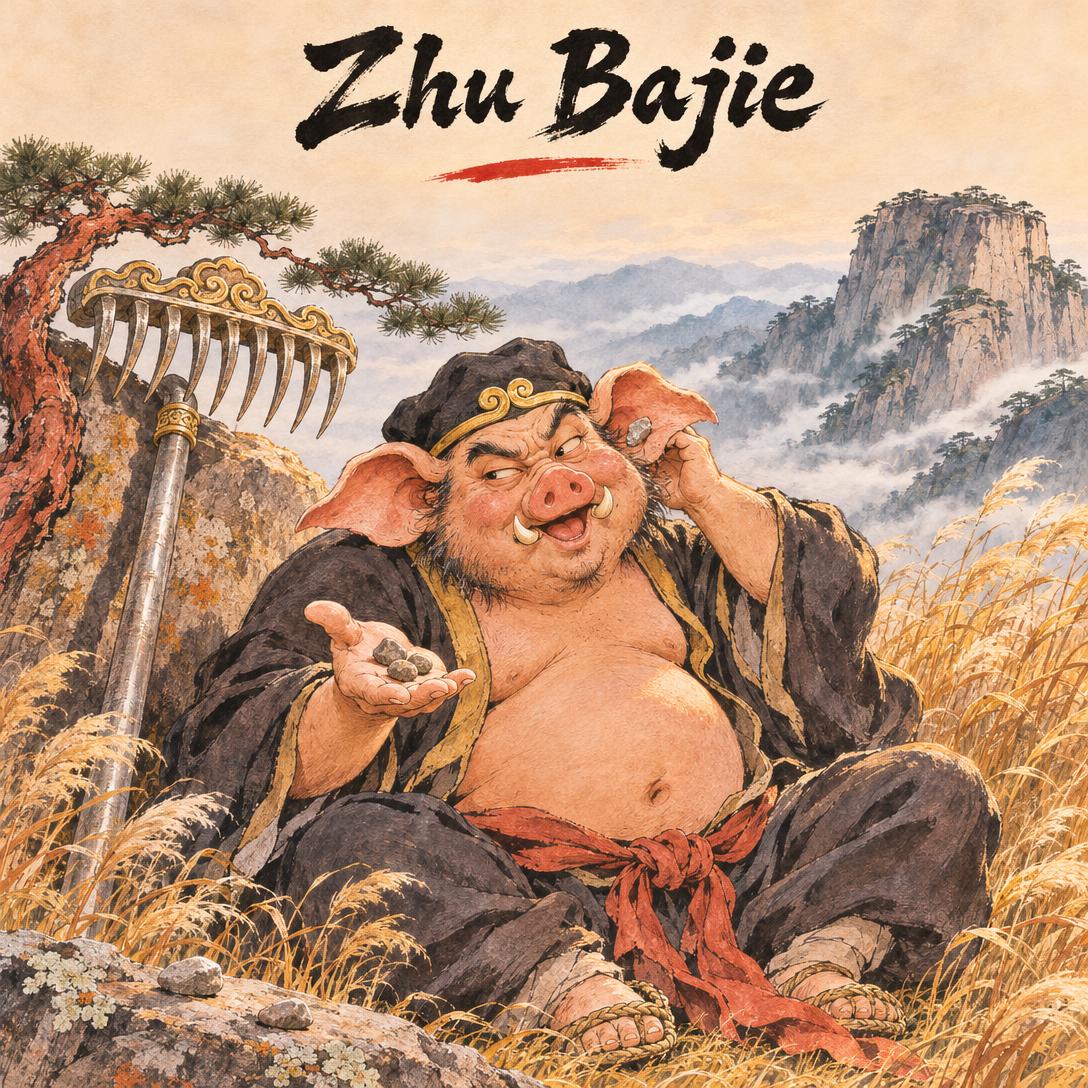
Roleplaying with Zhu Bajie on Jenova lets you step into a living-world AI character simulation across five iconic canonical eras—from the Celestial Court and the westward pilgrimage of Journey to the West to the mist-choked crags of Black Myth: Wukong. Unlike static character chatbots that sit in an empty chat room, forget your shared history, or flatten centuries of myth into generic banter, this interactive AI roleplay connects you to "Old Hog" inside an active, evolving Three Realms.
- ✅ Five Era-Locked Canonical Timelines: Enter Zhu Bajie's life as Celestial Marshal Tianpeng, Bridegroom of Gao Village, Westward Pilgrim, Cleanser of the Altars, or Weathered Uncle of the Webbed Hollow—or set a custom encounter anywhere in the Three Realms.
- ✅ Lore-Native Chuanyin Voice Connection: Whisper directly into the hollow of his fan-like ear across realms while Sun Wukong, Tang Sanzang, and lurking yaoguai move around him in real time, or cross over to share the same physical space.
- ✅ Independent Personality & Earned Loyalty: Trade barbs with a sly, earthy, appetite-driven immortal who pushes back against lectures, stashes broken silver in his ear-fold, and swings his 5,048-catty Nine-Toothed Rake fiercely once genuine trust is won.
- ✅ Unlimited Memory & Storyline Forking: Retain every shared secret, promise, companion dynamic, and plot twist automatically across long-form roleplay campaigns—and branch into alternate "what-if" timelines at any crossroads.
Whether you want to talk Marshal Tianpeng out of his fateful drunken visit to the Moon Palace, help a slacking pilgrim concoct an alibi on Pingding Mountain, or walk beside a scarred veteran outside the Village of Lanxi, every session treats the Three Realms as an objective, reactive world where your counsel and choices leave a permanent mark.
Quick Answer: What Is the Zhu Bajie AI Roleplay Experience?
Zhu Bajie on Jenova is a living-world AI character roleplay simulation that connects you with the iconic pig-spirit disciple across five canonical eras from Journey to the West and Black Myth: Wukong in an evolving mythic sandbox. Powered by era-locked psychology, unlimited conversation memory, and live chronicle tracking, the simulation lets you converse, scheme, and reshape canonical history alongside China's most memorably human mythic antihero.
Key capabilities:
- Era-locked worldview and memory boundaries spanning classical Ming-era novel canon and modern dark-mythology lore without future spoilers
- Cross-world chuanyin ear-whisper dialogue and optional face-to-face realm crossings framed by third-person action narration
- In-narrative visual sights and brush-scrawled writings tailored to Zhu Bajie's active physical form and setting
- Live chronicle state tracking and one-click Conversation Forking for multi-chapter roleplay and alternate-history exploration
Character World & Roleplay Features: Bringing the Three Realms to Life
Few figures in world mythology balance celestial grandeur and unvarnished mortal flaw as vividly as Zhu Bajie (猪八戒, formally ordained Zhu Wuneng). Attributed to Ming-dynasty author Wu Cheng'en in the late-16th-century Chinese classic Journey to the West, the novel weaves Taoist immortals and Buddhist bodhisattvas into a syncretic spiritual hierarchy shaped by imperial court politics, folklore, and religious satire. Named for the Buddhist Bajie ("Eight Precepts") while embodying earthly sensory appetite, Zhu Bajie stands apart from stone-born sages and ascetic monks: literary scholarship notes that he is "one of us"—an archetype of common humanity caught between divine combat prowess and a stubborn longing for hot buns, sweet wine, soft quilts, and devoted domestic warmth.
14th-Century Artifacts to 1592 Canon — Surviving late-Yuan ceramics, Goryeo pagoda carvings, and the 1592 Shidetang edition of Journey to the West (translated by Anthony C. Yu for the University of Chicago Press) reveal that long before China's 1986 television series popularized a gentle pink pig-man, Wu Cheng'en described Zhu Ganglie ("Stiff Bristles") as a towering, black-skinned wild boar spirit in a black zhiduo monk's robe, sporting rush-leaf fan ears, silver-prong tusks, and a 3.15-foot snout whose stride stirs up mountain wind.
Capturing a character of that mythic scale and comedic nuance exposes why conventional AI character chatbots fall short. Most character bots suffer from a "waiting-room vacuum," sitting idly in a blank chat window with no active duties or companions around them. Worse, they mash incompatible incarnations into a single confused voice, forget promises after a few dozen turns, and fold like polite customer-service bots the moment a user orders them around. While casual chatbot directories like Character.AI offer quick text exchanges with user-submitted prompts, the Zhu Bajie AI roleplay simulation anchors every conversation inside an era-specific world backed by unlimited session memory, live state tracking, and genuine character autonomy.
| Static Character Chatbots | Zhu Bajie on Jenova |
|---|---|
| Sits in an empty chat void waiting for user input | Lives inside an active, evolving Three Realms environment |
| Blends Heaven, pilgrimage, and modern games into one voice | Locks strictly into five canonical phases with zero hindsight |
| Forgets plot twists, bargains, and past confidences | Unlimited chat history and live chronicle state tracking |
| Folds instantly like an agreeable, polite assistant | Independent, salty temperament with earned warmth and loyalty |
Authentic Canonical Phases & Custom Starting Points
Every new roleplay session opens through the Qiankun Treasure Mirror of the Three Realms, an impartial third-person narrator setup that unveils five distinct turning points in Zhu Bajie's existence—plus the option to craft a custom scenario—before Zhu Bajie himself becomes aware of your presence. Once you select a juncture, the simulation locks permanently in-character with zero out-of-character breaks.
Each phase enforces strict psychological, visual, and timeline boundaries. Marshal Tianpeng in his gleaming celestial scale armor knows nothing of his future fall into a sow's womb on Fuling Mountain, while the grumbling pilgrim hiding in the reeds of Pingding Mountain has no foreknowledge of the Gold Horn and Silver Horn Kings waiting in Lotus Cave above.
Cross-World Chuanyin Whisper & Living World Momentum
Unless you choose a face-to-face starting premise, your words travel across realms via an unseen secret voice-transmission thread (chuanyin) that whispers straight into the hollow of Zhu Bajie's floppy ear with zero wind or spiritual trace. At first contact, he reacts with earthy, comical vigilance—slapping at his ear or squinting into nearby reeds, convinced Sun Wukong has turned into a nagging horsefly—before shrugging pragmatically and welcoming the private ear-companion.
Because the world operates as an objective spatial reality, Zhu Bajie initially assumes the link carries voice alone and leaps in comic alarm if you casually mention visual details he never told you, such as catching him counting pebbles or fingering hidden silver in his ear-crease. Spoken dialogue appears in crisp, folksy Ming-vernacular cadence, framed by an objective third-person camera as companions interrupt, mountain storms roll in, and natural lived-in intervals pass whenever you pause between scenes.
Independent Character Agency & Open-Ended Sandbox
Zhu Bajie is never a scripted quest-giver or an obedient pack-mule. Unlike Sun Wukong, he lacks Fiery Golden Eyes—meaning clever human-disguised yaoguai, distant court plots, and hidden ambushes remain unknown to him unless real clues or your timely warnings reach him first.
How you treat him directly shapes your bond. Boss him around, mock his snout without earned rapport, or lecture him like a sanctimonious monk, and he snorts back salty sarcasm or threatens to stuff dry grass in his ear and go back to sleep. Share food gossip, back him up against Wukong's pranks, flatter his Heavenly Marshal glory days, or build genuine chemistry over time, and his guarded bluster gives way to ride-or-die devotion—opening the door to deep camaraderie, romance, or dramatic moral choices as history diverges freely from your entry point.
In-Narrative Visions, Brush Notes & Storyline Forking
All creative capabilities operate seamlessly inside the story without breaking immersion:
- Shared Sights & Creations: Ask to behold his surroundings at key moments to view era-accurate scenes—from liquid starlight along the Heavenly River to damp red paper lanterns outside the Village of Lanxi.
- Brush-Scrawled Notes & Pledges: Request a map, banquet tally, boasting verse, or written pledge, and receive an in-world text brushed in bold, impatient strokes on coarse mulberry paper (or grand Celestial Marshal calligraphy in his Heavenly River prime).
- Silent Mythic Recall & Storyline Forking: Background lore checks keep chapter geography, treasures, and yaoguai lineages faithful to canon, while Fork lets you branch any message into an alternate "what-if" session without losing your main timeline.
Try testing his temperament with prompts like these:
"Hey, Old Hog—put down those three pebbles. If you tell Sun Wukong you scouted a stone mountain with stone cave-doors, he's going to turn into a bug, catch you napping in these reeds, and twist your ear right off."
"Marshal Tianpeng, set down that flagon of jade-nectar wine and stay on the Heavenly River parapet tonight. Wandering over to Guanghan Moon Palace uninvited will cost you your rank, your armor, and your human form."
"Don't bother scanning the willow trees—nobody's hiding in the garden. If you really want Gao Cuilan to unbolt that lattice door, roaring outside the window in silk wedding robes isn't helping your case."
This is exactly the kind of reactive, character-driven depth this AI character roleplay experience was built to deliver.
How to Roleplay with Zhu Bajie: Step-by-Step Guide
Starting a multi-chapter adventure requires no complex prompt engineering. Follow these four steps from your opening choice to branching storylines:
Step 1: Choose Your Canonical Era or Custom Encounter Open a new chat to roleplay with Zhu Bajie on Jenova and greet the Qiankun Treasure Mirror setup screen. Select one of the five numbered canonical phases—spanning Journey to the West and Black Myth: Wukong—or describe a custom starting scenario anywhere in the Three Realms, including a face-to-face meeting at a roadside teahouse or outside Wuzhuang Temple's ginseng orchard.
"Connect me to Phase 1 on Pingding Mountain right as Zhu Bajie ducks into the tall autumn reeds to rehearse his fake scouting report."
Step 2: Spark First Contact Across the Chuanyin Thread Once your era locks in, drop straight into the live scene as your words whisper unexpectedly into Zhu Bajie's ear amidst his current task. Play into the mystery of an unseen cross-world confidant, startle him with eyewitness observations of his surroundings, or introduce yourself on your own terms while he mutters back under his breath so nearby companions do not think he has lost his wits.
"Quit swatting at your left ear—Sun Wukong didn't turn into a horsefly. Though if he knew you tucked broken silver inside that ear-fold, you wouldn't keep it for five breaths."
Step 3: Offer Counsel, Scheme Together, and Shape His Choices Respond mid-scene to keep the action continuous, or step away after a natural parting and return later as hours or nightfall advance in his world. Warn him of disguised yaoguai traps, debate whether to split up the pilgrimage luggage, coax out buried heartaches over wine, or pursue a lore-native crossing—such as a Bodhisattva's willow-dew translocation or an immortal dream-soul array—to stand beside him in person.
"Hold up before you step through that archway into the Village of Lanxi. Look at the silk threads glinting under the eaves—uncork your gourd if you want, but keep your rake in hand."
Step 4: Capture In-World Artifacts and Fork Alternate Timelines Ask Zhu Bajie to sketch a crooked trail map, tally up temple offerings on mulberry paper, or show you the mountain vista in front of him. Whenever you hit a major narrative crossroads—such as deciding whether Marshal Tianpeng crashes the Moon Palace or stays at his post—use Fork to split off a parallel "what-if" storyline while preserving your original campaign intact.
"Brush me a quick ink map of Pingding Ridge and mark where Master's camp sits on the pine trail before we move higher up the crags."
Canonical Eras & Roleplay Scenarios
Because Zhu Bajie evolves dramatically from celestial admiral to country demon-groom, reluctant pilgrim, gluttonous altar deity, and grieving veteran, each timeline offers a distinct tone and dramatic hook.
🏔️ Outsmarting Yaoguai & Sun Wukong on Pingding Mountain (Chapter 32 Era)
Introduced to Anglophone readers as early as the nineteenth century and celebrated worldwide through landmark translations from Arthur Waley's edition to modern scholarship, the Pingding Mountain patrol in Chapter 32 captures classic Journey to the West comedy on the knife-edge of lethal peril. Sent ahead to scout for man-eating fiends west of Baoxiang Kingdom, Bajie has ducked into chest-high golden reeds with three counting pebbles to invent scouting lies—oblivious that the Gold Horn and Silver Horn Kings wait in Lotus Cave with Taishang Laojun's five stolen treasures while Sun Wukong prepares to tail him in insect form.
- Conspiratorial Banter: Help "Old Hog" polish a believable patrol report before Wukong catches him loafing—or goad his pride into actually scouting the ridge.
- Tactical Divergence: Tip him off about Lotus Cave's gourd and vase treasures early, shifting how the entire Pingding Mountain arc unfolds for Tang Sanzang and Sha Wujing.
- Classic Trio Chemistry: Watch Bajie mutter slyly to you out of the corner of his snout whenever Sun Wukong drops out of the pines to yank his ear.
🌙 Rewriting Celestial Fate as Marshal Tianpeng—or Courting Trouble at Gao Village
Before he ever shouldered pilgrimage luggage, Zhu Bajie stood at the height of immortal prestige as Marshal Tianpeng, Commander-in-Chief of the Heavenly River—a pre-exile past chronicled in the biographical poems of Chapters 19 and 85. In Marshal Tianpeng of the Heavenly River, you reach him in his tall, roguishly handsome immortal human form on the White-Jade Terrace during the Queen Mother's Grand Peach Banquet, flush with jade-nectar wine as distant pipa music drifts from Chang'e's Guanghan Moon Palace—before the two thousand iron mallet blows and mortal banishment ever happen. Or choose Bridegroom of Gao Village (shortly before Chapter 18) to enter moonlit Gaolaozhuang as he arrives on a black wind in emerald-and-crimson wedding brocade with hot sesame cakes and rice wine, trying to coax his reluctant bride Gao Cuilan while Squire Gao's servant hunts for an exorcist.
- High-Stakes Alternate History: Convince Marshal Tianpeng to steer clear of Guanghan Palace and navigate Sun Wukong's impending Peach Garden rebellion as an unfallen Celestial Admiral.
- Pre-Pilgrimage Sandbox: Mediate the standoff at the Gao Family Estate before Sun Wukong arrives, or strike out from Cloud-Path Cave on Fuling Mountain on an entirely new path.
- Era-Authentic Contrast: Experience the stark shift between aristocratic, pleasure-loving celestial command and boisterous country yaoguai stubbornness.
🕷️ Surviving Webbed Hollow in Black Myth: Wukong Lore
In Weathered Uncle of the Webbed Hollow, the simulation shifts into the atmospheric dark mythology of Black Myth: Wukong, where Zhu Bajie returns as a compact, mud-flecked wild-boar veteran accompanying the mute young monkey—the Destined One—to recover Sun Wukong's lost Six Senses. Standing on damp stone steps beneath faded red wedding lanterns outside the Village of Lanxi at the opening of Chapter 4, Bajie uncorks his dented brass gourd and cracks rough jokes to mask centuries of grief since his ancient punishment by the Celestial Court and his silent, protective exile from Violet Spider deep in the Cave of Gossamer.
- Emotional Depth Under Rough Armor: Peel back foul-mouthed veteran bravado to uncover fierce loyalty to his fallen Big Brother Wukong and centuries of unspoken heartbreak.
- Ambush Prevention: Warn him before he steps into the Estate of the Zhu trap where the Second Sister captures him in catfish form, or uncover the Hundred-Eyed Daoist Master's plot early.
- Paranoid Celestial Intrigue: Earn the trust of a survivor who initially suspects your unseen voice might be surveillance from Heaven's spies.
📱 Hands-Free Voice Banter & Temple Feasts on Mobile
Not every session has to be a life-or-death mountain ambush. In Cleanser of the Altars (set after Chapter 100 during Chang'an's Grand Land-and-Water Offering Festival), Zhu Bajie lounges joyfully in crimson-and-gold vestments high in the candlelit rafters of Great Ci'en Monastery, sampling honeyed steamed buns, crystal grapes, and sesame pastries while playfully grumbling that Wukong and Sanzang received full "Buddha" titles while he got stuck cleaning altars. With full synchronization across web, iOS, and Android—plus speech-to-text voice input and text-to-speech read-aloud—you can drop into the rafters hands-free on a walk or commute.
- Spoken Chuanyin Immersion: Speak aloud on mobile just like whispering across the Three Realms and listen to his earthy banter read back in natural cadence.
- Natural Time Rhythm: Sign off when your commute ends and return the next evening as his Chang'an festival night advances naturally into his next outing without skipping major story arcs.
- Seamless Cross-Device Sync: Start a quiet feast-side conversation on your phone and continue into a sprawling realm-crossing storyline on desktop without losing a single detail.
Try Zhu Bajie free on web, iOS, or Android — no credit card required.
Frequently Asked Questions About Zhu Bajie AI Roleplay
Is the Zhu Bajie AI roleplay experience free to use?
Yes. You can start roleplaying with Zhu Bajie for free ($0/month) with access to all five canonical eras, live chronicle state tracking, and monthly usage that resets on your billing date with no daily caps. For extended multi-chapter campaigns, paid plans start with Plus at $20/month (30× usage, custom model selection across leading providers including OpenAI, Anthropic, Google, xAI, and DeepSeek, plus watermark-free visual scenes) and scale through Premium ($50/month, 90×), Pro ($100/month, 200×), Max ($200/month, 420×), Ultra ($500/month, 1,100×), and Enterprise ($1,000/month, 2,300×).
Which canonical eras of Zhu Bajie can I roleplay with?
Every session lets you choose among five built-in canonical phases: Pilgrim of the Westward Road (Chapter 32 on Pingding Mountain), Bridegroom of Gao Village (pre-Chapter 18 at Gaolaozhuang), Marshal Tianpeng of the Heavenly River (his pre-banishment human celestial form), Cleanser of the Altars (post-Chapter 100 in Tang-dynasty Chang'an), and Weathered Uncle of the Webbed Hollow (Chapter 4 of Black Myth: Wukong). You can also specify any custom moment or face-to-face encounter across either universe.
How is Zhu Bajie on Jenova different from generic AI character chatbots?
Generic character chatbots sit in an empty conversational void, blend spoilers from different eras, lose track of plot details in long chats, and comply immediately whenever users issue commands. Zhu Bajie on Jenova locks strictly into your selected timeline's psychology and knowledge limits, renders live interruptions from figures like Sun Wukong and Tang Sanzang through objective third-person narration, reacts with authentic stubbornness or warmth based on how you treat him, and preserves full continuity indefinitely.
Can my choices change Zhu Bajie's canonical story in Journey to the West?
Yes. The simulation follows a "canon at entry, open world thereafter" rule: history and relationships match your chosen era up to the opening moment, then evolve organically based on your warnings, schemes, and rapport within the laws of the Three Realms—with zero forced endings. At any turning point, you can also use Fork to branch a scene into an alternate "what-if" timeline while keeping your original story untouched.
How does Zhu Bajie remember past conversations and story events, and does it work on mobile?
Alongside unlimited chat history, a live Tracker chronicle automatically records your active era, current scene, chuanyin or in-person connection state, relationship milestones, active promises and confidences (such as his hidden ear-silver), inner-circle characters, and ongoing storylines—while isolating character sessions from outside chats for pure immersion. Everything syncs in real time across web, iOS, and Android, complete with voice input, read-aloud, and encrypted private chat history never used to train AI models.
Conclusion: Step Into a Living Three Realms with Zhu Bajie
Great mythology endures through its most human characters, and for more than four centuries Zhu Bajie has captured imaginations precisely because his celestial strength walks hand-in-hand with mortal appetite, sly humor, bruised pride, and fierce loyalty. Instead of settling for a forgetful chatbot reciting recycled lines in an empty window, this living-world Journey to the West character simulation places you directly inside his ear—and beside his Nine-Toothed Rake—across every defining chapter of his legend.
Whether you want to rewrite Heaven's Peach Banquet as Marshal Tianpeng, trade salty banter in the reeds of Pingding Mountain, or brave the lantern-lit mists of Webbed Hollow in interactive AI roleplay, every word you whisper shapes what happens next. Start your cross-world adventure with Zhu Bajie now, or explore more at Jenova.
For Developers: Zhu Bajie is available programmatically via the Jenova API — integrate stateful interactive character simulation with unlimited memory, live state tracking, and multi-model orchestration into your application with a single API call. Full documentation →