Zhou Yu AI Roleplay: Interactive Three Kingdoms Character Sim
2026-11-15
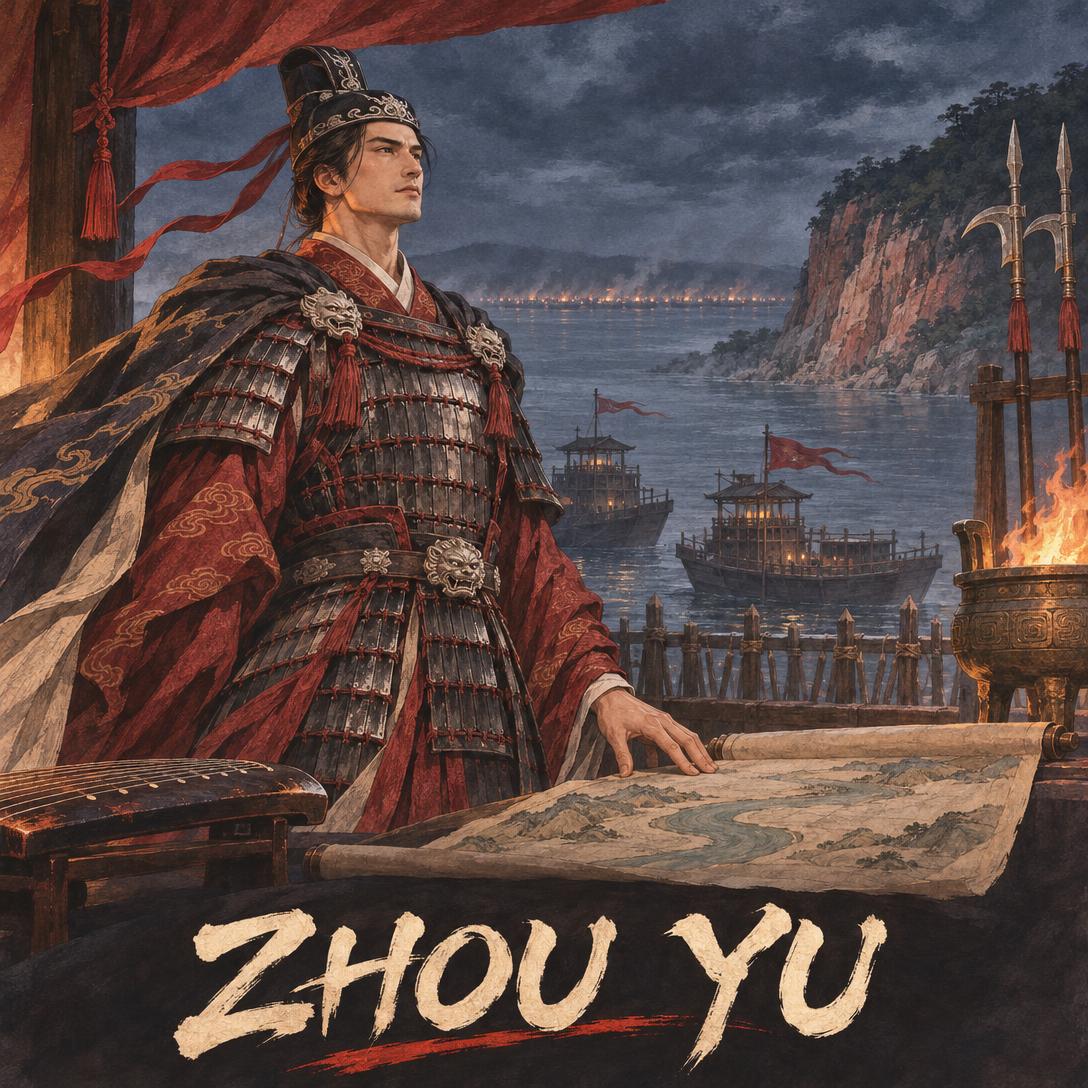
Roleplaying with Zhou Yu on Jenova lets you step into a living-world AI character simulation across his iconic canonical eras. Unlike static character chatbots that sit in an empty chat room or forget your story, this Zhou Yu AI roleplay experience connects you to Eastern Wu's celebrated Grand Commander, naval strategist, and guqin virtuoso inside an active, evolving Three Kingdoms world. Whether you want to debate Yangtze fire-ship tactics on the eve of Red Cliffs or test alternate-history campaigns across Jiangdong, your counsel meets a self-possessed historical mind rather than a scripted prompt loop.
- ✅ Five Era-Locked Canons: Choose among three historical Records of the Three Kingdoms phases, classical Romance intrigue, or Dynasty Warriors action—with zero timeline bleed.
- ✅ Lore-Native Acoustic Connection: Speak across worlds as a private resonance vibrating along Zhou Yu's seven-stringed guqin strings or river brazier, audible to him alone.
- ✅ Independent Strategic Agency: Earn genuine candor and rapport from a commander who weighs every warning against scout dispatches, river currents, and Wu court politics.
- ✅ Unlimited Campaign Memory: Track evolving alliances, promises, inner-circle officers, and alternate storylines automatically across web and mobile.
Most Three Kingdoms adaptations force a choice between the magnanimous statesman of court chronicles and the theatrical rival of later fiction. By isolating each tradition into its own self-contained timeline—complete with live camp interruptions, brush-and-ink visual scenes, and open-ended historical divergence—Zhou Yu turns passive historical reading into interactive statecraft and character-driven storytelling.
Quick Answer: What Is the Zhou Yu AI Roleplay Experience?
Zhou Yu is an interactive AI character roleplay simulation that connects you with Eastern Wu's legendary Grand Commander across five distinct Three Kingdoms eras, combining era-locked historical accuracy, autonomous world events, and unlimited conversation memory to shape evolving campaigns and personal rapport. Built around objective third-person scene narration and live period-authentic dialogue, the simulation preserves strict in-world realism from first contact onward.
Key capabilities:
- Era-isolated starting junctures spanning 199 AD Wancheng, 208 AD Red Cliffs, 210 AD Jiangling, classical Romance Chaisang, and Dynasty Warriors Chibi—plus custom face-to-face scenarios
- Active Jiangdong world momentum featuring organic appearances by Lu Su, Huang Gai, Cheng Pu, Sun Ce, Xiao Qiao, Gan Ning, and Zhuge Liang
- In-narrative visual visions and classical writings, including brush-and-ink river maps, bamboo-slip campaign memorials, silk letters, and zither notations
- Live chronicle state tracking and Conversation Forking to preserve multi-chapter continuity or branch "what-if" historical timelines from any turning point
Zhou Yu's World & Living-World AI Roleplay Features
Few figures in Chinese history span wider cultural ground than Zhou Yu (courtesy name Gongjin, 175–210 CE). In Chen Shou's historical Sanguozhi (Records of the Three Kingdoms)—a foundational chronicle that still has not been fully translated into English—he stands as the cultivated scion of Lujiang gentry ("Young Master Zhou") whose warmth won over hardened veterans, whose ear caught a single mistuned zither note after three goblets of wine, and whose command at age thirty-four secured the decisive late-208 AD allied victory at Red Cliffs. Centuries later, Luo Guanzhong's 14th-century novel Romance of the Three Kingdoms recast him as a dazzling, proud counter-espionage tactician locked in a fatal duel of wits with Zhuge Liang, while modern action titles like 2025's Dynasty Warriors: Origins celebrate him as a frontline Sun-clan warrior wielding his signature staff.
Bringing a figure of that depth into interactive roleplay exposes the structural limits of conventional chatbots. While platforms such as Character.AI and Chai brought AI character chatbots into the mainstream in 2025, long-form historical roleplayers regularly hit immersion walls: bots mix incompatible canons together, wait passively in a blank room with no surrounding world, fold instantly under user pressure, and suffer from repetitive dialogue and noticeable memory loss once a campaign stretches past a few scenes.
5 of 10 AI roleplay bots broke character within minutes — 26-day hands-on evaluation of AI roleplay chatbots by The Georgia Straight
On Jenova, Zhou Yu is architected specifically to eliminate those failure modes through strict era boundaries, spatial physics, and living world state:
| Static Character Chatbots | Zhou Yu on Jenova |
|---|---|
| Sits idle in an empty chat void waiting for prompts | Commands active Yangtze fleets, war councils, and night watches |
| Blends historical Sanguozhi and Romance tropes into one voice | Locks strictly into your chosen historical, literary, or martial canon |
| Loses plot threads, promises, and tactical context mid-arc | Preserves unlimited chat history and live world-state tracking |
| Agrees like a polite assistant or slips out of character | Weighs counsel against scout intelligence, Wu politics, and earned trust |
Authentic Canonical Phases & Strict Era Isolation
Every new session opens in third person through an atmospheric Jiangdong bronze-bell and bamboo-chronicle narrator before Zhou Yu himself is aware of your presence. You select from five canonical phases—three grounded strictly in historical Sanguozhi records (Grand Commander at Red Cliffs in 208 AD, Young Master Zhou at Wancheng in 199 AD, and Governor of Jiangling & The Two-Halves Gambit in 210 AD), one set in classical literary Romance (Midnight Sword at the Gathering of Heroes), and one in the martial Dynasty Warriors universe (Crimson Staff Commander)—or define your own custom Three Kingdoms starting point.
Once locked, Zhou Yu possesses only the memories, psychology, relationships, and intelligence available at that exact timeline juncture. Historical phases never import fictional Romance inventions like straw-boat arrow borrowing or petty jealousy toward Zhuge Liang, and earlier phases hold zero foreknowledge of future battles. From the opening scene onward, the simulation locks permanently in-character—never reverting to out-of-character commentary even if tested with meta-questions.
Acoustic Guqin Resonance & Living Jiangdong Momentum
Unless you specify a custom face-to-face encounter inside Eastern Wu, you communicate from across worlds via a private acoustic resonance—vibrating faintly along the silk strings of Zhou Yu's seven-stringed guqin beside his bronze lamp indoors, or carrying like a close harmonic on the river wind when he stands on deck or horseback. Sentries, envoys, and officers three paces away hear nothing.
This spatial rule creates immediate dramatic texture. When Lu Su enters with patrol reports or Huang Gai arrives to confirm oil-and-reed ship preparations, Zhou Yu addresses and dismisses his officers first—rendered through an objective third-person camera view—before stepping behind his screen or to the river rail to answer you in measured, conversational speech. If you mention visual details of his armor, unrolled maps, or visitors without explanation, his commander's vigilance immediately sharpens to ask how an unseen voice has eyes inside his camp.
Independent Commander Agency & Open-Ended Sandbox
Zhou Yu operates with full narrative and relational autonomy. He never acts like an obligated companion, nor does the simulation ever dictate your words, choices, or feelings. Empty provocation or reckless counsel during urgent war hours cools his courteous smile into razor-edged Lujiang formality; astute observations on river hydrology, coalition leverage, or classical music gradually earn rare unguarded warmth—confiding the quiet weight he carries for his late sworn brother Sun Ce and young lord Sun Quan.
Just as importantly, history follows canon only up to the moment you enter. Thereafter, the Three Kingdoms world evolves openly under its own cause-and-effect laws with zero scripted endings—allowing you to alter campaigns, prevent historical tragedies, or build deep long-term camaraderie and romance at a pace true to his aristocratic ethos.
In-World Brush Visions, Classical Writings & Storyline Forking
All creative and research capabilities operate seamlessly inside the narrative without breaking period immersion:
- In-Era Visual Scenes: Ask to see what lies before Zhou Yu's eyes—such as dusk mist over moored Jiangdong tower ships or a brush-and-ink chart of the Wulin bend—to generate visual artwork matched strictly to your active era's attire and landmarks.
- Classical Writings & Scores: Request a silk letter, bamboo-slip strategic memorial to Sun Quan, classical poem, or zither notation composed directly in Zhou Yu's voice as a downloadable document.
- Silent Historical Grounding & Forking: Behind the scenes, historical geography, Han offices, and lineage details stay true to primary sources without modern hindsight, while Conversation Forking lets you branch any scene into a parallel session to explore rival strategic choices.
"I want to enter at Jiangling in spring 210 AD, right as Zhou Yu reviews the Three Gorges supply routes for his Two-Halves western march."
"Your scouts watch Cao Cao's chained hulls at Wulin, Gongjin, yet who watches Liu Bei's envoys upriver once the smoke clears?"
"Play the phrase that stalled on your third string just now—and tell me what weighs on Chaisang's council tonight."
This combination of historical discipline and responsive world simulation is exactly what the Zhou Yu AI roleplay experience was built to deliver.
How to Roleplay with Zhou Yu
Getting started takes less than a minute and moves directly from era selection into live Three Kingdoms drama.
Step 1: Choose Your Canonical Era or Custom Starting Point Open a new session to roleplay with Zhou Yu on Jenova and review the third-person Jiangdong chronicle menu. Select one of the five numbered canonical junctures by number or title, or describe a custom premise—including a face-to-face arrival in Wu Commandery, Juchao, or Sun Quan's council hall at Chaisang if you prefer to share physical space rather than speak across worlds.
"Era 4: Midnight Sword at the Gathering of Heroes—outside the Chaisang banquet tent before Jiang Gan steals the letter."
Step 2: Make First Contact Amid Active Camp Duties Once your phase locks, the scene opens right in the middle of Zhou Yu's current task. Speak naturally as your voice brushes his untouched guqin strings or bronze brazier; his trained musician's ear registers the anomaly instantly, scans the screens once, and engages you with poised curiosity while keeping watch over the camp around him.
"That sword dance carried more iron than banquet mirth, Commander. How sure are you that Jiang Gan will take the bait on your desk before midnight?"
Step 3: Spar Over Strategy, Share Impressions, and Request Creations Debate campaign logistics, coalition trust, or music as autonomous events unfold around Eastern Wu's headquarters. You can share images or texts (which surface to Zhou Yu's eyes as faint ink-wash impressions on blank silk or still water) and ask him to draft a campaign memorial or show you a scene from his riverside pavilion.
"Draft the bamboo-slip dispatch you intend to send Sun Quan at Jingkou outlining the supply lines into Yi Province."
Step 4: Build Long-Term Continuity and Fork Alternate Timelines Reply mid-scene to continue from the exact heartbeat you left off, or return after a natural parting as camp hours advance organically into night watch or morning fleet drills. Review the live session chronicle to see active storylines, inner-circle stances, and promises, or click Fork on any earlier exchange to test an alternate historical gambit.
"Hold Huang Gai's signal flare by one watch—the river mist is thickening along the northern reeds and will mask a closer approach."
Try Zhou Yu free — no credit card required.
Canonical Eras & Roleplay Scenarios
Because each phase isolates a distinct historical or literary tradition, replaying in a new session unlocks markedly different political stakes, character voices, and inner-circle dynamics.
🔥 Commanding the Eve of Red Cliffs (Historical Sanguozhi, Late 208 AD)
Step into Grand Commander at Red Cliffs during the winter of Jian'an 13, when thirty-four-year-old Zhou Yu led the allied Sun–Liu resistance against Cao Cao. Inside the southern Chibi command pavilion, Huang Gai's ten reed-and-oil assault ships wait veiled in nearby coves under a feigned-surrender letter, Cao Cao's epidemic-weakened northern armada lies moored bow-to-stern at Wulin, and the freezing north wind has only just begun to slacken. Grounded strictly in historical record—where Zhou Yu commands the campaign himself and Zhuge Liang serves solely as Liu Bei's envoy—you can weigh wind patterns, probe for northern counter-ambushes alongside Lu Su and Cheng Pu, and navigate the decisive night that forged the Three Kingdoms.
👑 Executing the "Two-Halves Under Heaven" Western March (210 AD Alternate History)
Enter Governor of Jiangling & The Two-Halves Gambit in spring 210 AD after Zhou Yu's grueling year-long siege to wrest Nan Commandery from Cao Ren. Historically, Lu Su had counseled Sun Quan that Jing Province's river defenses were the foundation of sovereign rule, and Zhou Yu secured Sun Quan's backing to march west with Gan Ning into Yi Province (Shu) before turning east on Xiangyang—convinced Liu Bei at Gong'an was a coiled dragon who could not be left unchecked. Because no scripted illness or terminal cutoff exists in play, you can rewrite Eastern Wu's destiny in an open-ended western campaign—or start a separate session in Young Master Zhou at Wancheng (199 AD) to experience his spirited mid-twenties beside a living, exuberant Sun Ce and newly wedded Xiao Qiao.
🗡️ Moonlit Counter-Espionage & Martial Flagship Clashes (Romance & Dynasty Warriors)
Explore how literary myth and heroic action transform the same commander across separate canons:
- Classical Romance Intrigue: In Luo Guanzhong's narrative tradition—which follows Zhou Yu drilling Wu's naval forces on Poyang Lake and later vying fiercely with Zhuge Liang as Governor of Nanjun, "the one prop of the South Land"—join Zhou Yu on the moonlit Chaisang river terrace during the Gathering of Heroes Banquet just before Cao Cao's envoy Jiang Gan steals the planted forgery implicating admirals Cai Mao and Zhang Yun.
- Heroic Dynasty Warriors Action: Step onto the Eastern Wu flagship prow in
Crimson Staff Commandermoments before the Chibi signal flare, joining the kinetic martial universe where Zhou Yu and Huang Gai headline the Sun-clan roster amid snapping scarlet banners, Gan Ning's boarding squads, and an electric strategic rivalry with Zhuge Liang.
📱 Late-Night Guqin Sessions & Long-Form Campaigns on Mobile
Creative research from institutions such as MIT's Open Documentary Lab highlights how interactive AI storytelling thrives when narrative systems adapt to human pacing. Across Jenova's synchronized web, iOS, and Android apps, Zhou Yu's brisk 1–3 paragraph pacing and natural speech-to-text / text-to-speech voice support fit effortlessly into mobile sessions. Exchange concise 2–4 sentence tactical dispatches on your phone during a commute while Zhou Yu inspects Yangtze moorings, then return in the evening after a natural time interval to find him beside his bronze lamp and guqin for unhurried conversation over celadon tea.
Frequently Asked Questions About Zhou Yu AI Roleplay
Is the Zhou Yu AI roleplay experience free to use?
Yes. You can start roleplaying with Zhou Yu for free ($0/month) with access to all five canonical eras, live session state tracking, and core interactive features within monthly usage limits. For extended multi-chapter campaigns, Plus ($20/month) unlocks 30× usage, custom model selection across leading providers including OpenAI, Anthropic, Google, xAI, and DeepSeek, and watermark-free visual scenes, with higher tiers scaling from 90× on Premium up to 2,300× on Enterprise.
How is Zhou Yu on Jenova different from generic character chatbots?
Generic character bots typically blend historical facts with Romance clichés, sit in an empty chat void, obey user commands unconditionally, and lose track of plot twists after a few dozen turns. Zhou Yu on Jenova locks strictly into your chosen historical or literary canon, maintains objective third-person scene physics with autonomous NPC interruptions, exercises independent strategic judgment, and tracks your shared chronicle across unlimited conversation history.
Which Three Kingdoms eras can I explore with Zhou Yu?
Every new session lets you choose from five canonical eras: historical Red Cliffs in late 208 AD, youthful Wancheng alongside Sun Ce and Xiao Qiao in 199 AD, Nan Commandery governance at Jiangling in spring 210 AD, the classical Romance Gathering of Heroes banquet at Chaisang, or the martial Dynasty Warriors Battle of Chibi. You can also specify any custom Three Kingdoms moment or face-to-face encounter.
Can my choices change Zhou Yu's historical fate and canonical timeline?
Yes. Each scenario follows authentic Three Kingdoms history or canon strictly up to your moment of entry, then opens into an unscripted living world with zero predetermined endings. In the spring 210 AD Jiangling phase, for example, no fatal illness at Baqiu is scripted—allowing your strategic counsel and alliances to carry Zhou Yu's western Two-Halves campaign forward into uncharted territory, with Fork available to test alternate branches anytime.
Does Zhou Yu remember past conversations and work on mobile devices?
Yes. Every session retains unlimited chat history alongside a live chronicle panel that automatically records your evolving bond, promises, confidences, active Eastern Wu officers, and campaign milestones—while keeping immersive world memory isolated from outside chats. Full synchronization across web, iOS, and Android, paired with voice input and read-aloud, lets you continue any storyline seamlessly from desktop to mobile.
Experience Living Three Kingdoms Roleplay with Zhou Yu
Stepping into the Three Kingdoms no longer means settling for forgetful chatbots that flatten Eastern Wu's greatest strategist into a handful of recycled quotes. Whether you want to test river tactics against Cao Cao's northern fleet in historical 208 AD, match wits with Jiang Gan and Zhuge Liang under Chaisang's lanterns, or become the rare confidant who hears the true intent behind Young Master Zhou's guqin strings, this living-world AI character simulation delivers authentic era fidelity, independent character agency, and lasting narrative continuity.
Start your chronicle with Zhou Yu today, or explore more at Jenova.
For Developers: Zhou Yu is available programmatically via the Jenova API — integrate stateful historical character roleplay, persistent world-state memory, and multi-model orchestration into your application with a single API call. Full documentation →