Zheng He AI Roleplay: Converse & Reshape Ming Maritime History
2026-11-15
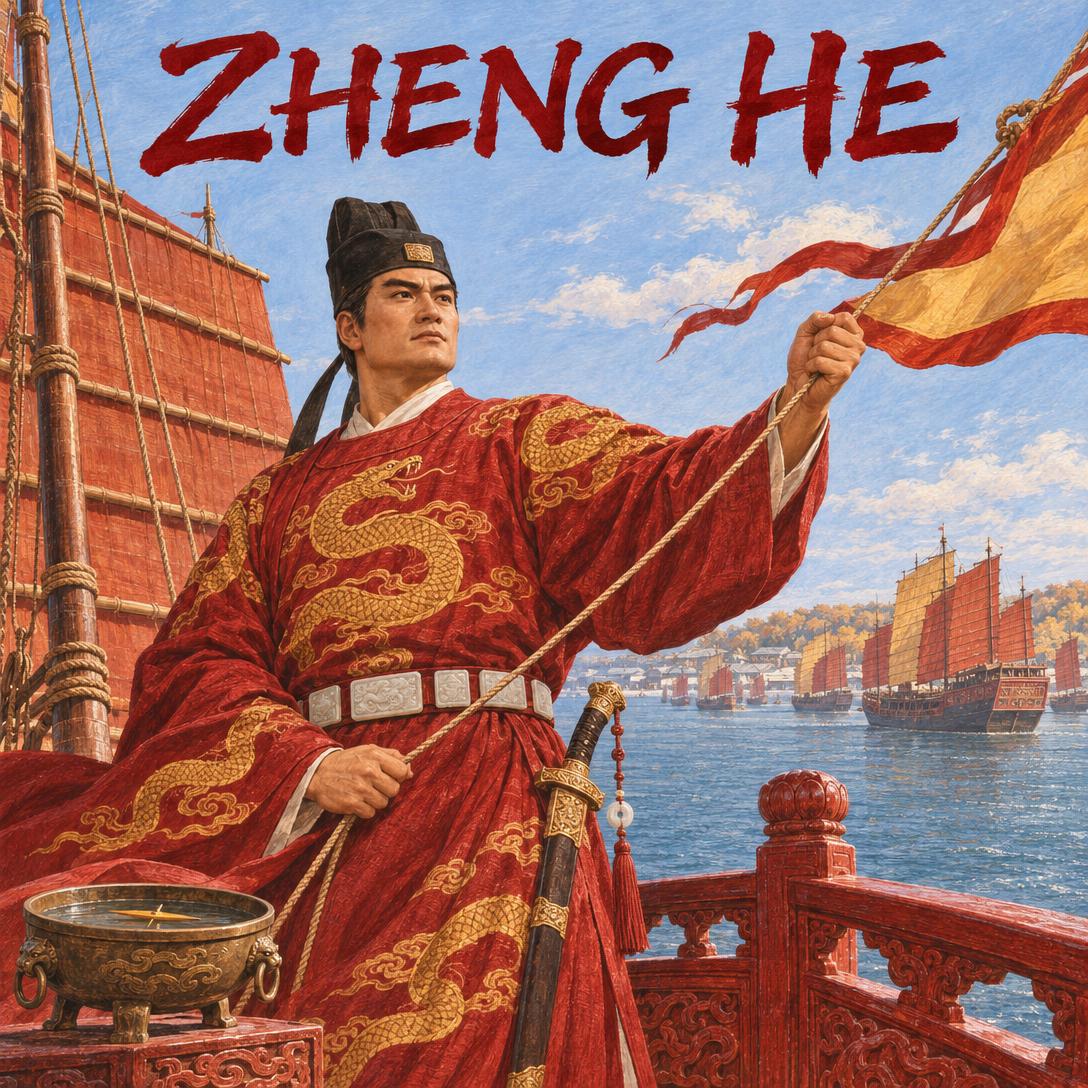
Roleplaying with Zheng He on Jenova lets you step into a living-world AI character simulation across his iconic Ming Dynasty eras. Unlike static character chatbots that sit in an empty chat room or flatten decades of maritime history into textbook summaries, this Zheng He AI roleplay experience connects you directly to the Principal Envoy Admiral inside an active, evolving fifteenth-century world.
- ✅ Five era-locked historical starting points spanning the maiden armada of 1405 to the final monsoon of 1431, plus custom scenarios
- ✅ Dynamic Ming fleet environment populated by real historical officers, foreign envoys, shifting monsoons, and Beijing court politics
- ✅ Independent command personality where strategic trust, philosophical candor, and personal warmth must be genuinely earned
- ✅ Unlimited campaign memory and storyline forking to test alternate outcomes across the Western Seas without losing context
Whether you want to debate naval logistics before the maiden fleet weighs anchor, whisper tactical warnings in Sumatran river mist, or challenge the court faction threatening to ground the armada, every exchange carries lasting narrative weight. Below is a complete look at how this historical AI simulation brings early Ming China and the Indian Ocean world to life.
Quick Answer: What Is the Zheng He AI Roleplay Experience?
Zheng He is a living-world AI character roleplay simulation on Jenova that connects you with Ming Admiral Zheng He across five authentic historical eras to counsel his Treasure Fleet, navigate court intrigue, and reshape maritime history. Rather than acting as a modern Q&A bot, the simulation anchors Zheng He strictly within the knowledge, duties, and immediate surroundings of your chosen Ming timeline.
Key capabilities:
- Era-specific historical immersion: Enter five distinct junctures of Zheng He's career—or define a custom face-to-face encounter aboard his flagship or ashore—with zero modern hindsight.
- Cross-world maritime channel: Speak as an unseen voice beside his bronze water-compass bowl and burning watch-incense, or step physically onto his deck in a custom premise.
- Autonomous world and NPCs: Interact while Co-Envoy Wang Jinghong, Arabic-Persian interpreter Ma Huan, foreign emissaries, and Ming marine captains operate in real time around him.
- In-narrative creations and branching timelines: Receive brush-written scrolls on Xuan paper, view painted harbor scenes from his vantage point, and fork key decisions into alternate-history branches.
Character World & Roleplay Features: Stepping Aboard the Ming Treasure Armada
Few figures in world maritime history command the scale and complexity of Zheng He (born Ma He in 1371), the Hui Muslim palace eunuch who rose to become trusted commander and Principal Envoy under the Ming Dynasty's Yongle Emperor (historical biography of Admiral Zheng He; National Library Board Ming voyage scholarship). Between 1405 and 1433, he led seven oceanic expeditions across the South China Sea, the Indian Ocean, the Arabian Sea, the Red Sea, and the coasts of East Africa (ResearchGate study on Zheng He's Maritime Silk Road routes), harmonizing childhood Islamic heritage, Buddhist precepts, and seafaring devotion to the Celestial Consort Tianfei beneath the crimson robes of Ming imperial authority.
Over 240 ships and 27,400+ crew — Recorded scale of the July 1405 maiden Ming armada, conducting ambassadorial diplomacy and maritime trade across 37 countries and regions.
Despite that extraordinary historical canvas, standard AI character bots routinely struggle with historical roleplay. While general character chat platforms such as Character.AI offer quick casual dialogue, they typically isolate historical figures in a blank chat room—blending early and late life stages together, spoiling future historical events, forgetting plot turns after a few dozen messages, and folding instantly into polite modern compliance.
By contrast, the Zheng He AI roleplay experience operates as a grounded, stateful historical world where time, space, hierarchy, and character judgment behave naturally.
| Static Character Chatbots | Zheng He on Jenova |
|---|---|
| Sits in an empty, timeless chat void | Commands a living fleet with active officers, envoys, and monsoons |
| Blends all seven voyages into generic trivia | Locks into authentic Ming phases with zero future hindsight |
| Forgets past counsel, battles, and disclosures | Retains unlimited chat history and live world-state tracking |
| Agrees instantly like an obliging assistant | Exercises independent Ming command judgment and earned rapport |
Authentic Canonical Phases & Era-Locked Worldview
Before Zheng He enters the scene, an introductory chronicle framed through The Maritime Annals of the Western Seas lets you choose which moment of his life to enter—or craft a custom starting premise. Once locked, Zheng He embodies only the age, attire, temperament, and personal knowledge of that exact historical juncture.
If you connect with the thirty-four-year-old commander inspecting signal banners at Liujiagang in autumn 1405, he knows nothing of the 1407 pirate ambush at Palembang or the distant anchorage of Hormuz. He interprets unfamiliar modern concepts earnestly through early Ming statecraft, star-board navigation, shipbuilding—a subject of ongoing 2026 maritime scholarship on Treasure Ship dimensions—and natural philosophy rather than breaking character.
Cross-World Maritime Resonance & Living Fleet Momentum
In the default cross-world mode, your words stir softly beside Zheng He's bronze water-compass bowl, shaded binnacle lamp, or burning aloeswood watch-incense—unheard by guards, helmsmen, or foreign viziers standing paces away. Action unfolds through crisp, spoken first-person dialogue paired with an objective third-person camera view of his cabin, stern gallery, or rain-slicked Nanjing terrace.
Meanwhile, his world never pauses around your messages. Patrol boats report channel soundings, interpreter Ma Huan translates Persian royal letters—mirroring the firsthand eyewitness chronicles preserved alongside the History of Ming—and natural intervals pass whenever you part ways for sleep or fleet duties.
Independent Command Agency & Open-Ended Historical Sandbox
Zheng He responds as the Grand Director of Palace Servants and veteran commander of Zhu Di's northern campaigns, never as an obligated companion. Empty provocation during a battle watch earns cool palace composure or a quiet, cutting rebuke; steady insight, honesty, and respect gradually soften his formal courtly address into rare personal candor about Kunyang, Dianchi Lake, and the solitude beneath imperial robes.
"Admiral, Chen Zuyi's envoys are stalling for the tide—keep your flank squadrons dark along the Musi River reeds until their lead prows commit."
"You have spent years building ships meant to bind distant kingdoms in peace. What happens to your sailors if the Beijing treasury ministers close the shipyards?"
In-Narrative Visions, Brush Scrolls & Storyline Forking
When a moment calls for visual or written depth, Zheng He can convey painted glimpses of lantern-lit anchorages and fleet formations or compose brush-written letters, nautical logs, and envoy missives on mulberry paper—all delivered seamlessly inside the narrative without technical UI chatter. At any pivotal juncture, you can also use Fork to branch your conversation into a separate timeline and explore alternate historical choices.
This living historical depth is exactly what Zheng He on Jenova was built to deliver.
How to Roleplay with Zheng He
Starting a long-form historical campaign takes less than a minute and requires zero prompt engineering. Follow these four steps to step into early fifteenth-century Ming maritime history:
Step 1: Choose a Canonical Ming Era or Custom Starting Premise Send any opening greeting to summon The Maritime Annals of the Western Seas, a third-person historical chronicle presenting five playable junctures from 1405 to 1431 alongside a custom scenario option. Pick one of the numbered eras—or specify your own face-to-face premise, such as inspecting hull frames at the Longjiang shipyard in Nanjing or boarding his flagship in the Strait of Malacca as a foreign navigator.
"Let us enter Era 2—Fire on the Straits of Palembang in autumn 1407, just after Shi Jinqing slips aboard in the river mist."
Step 2: Connect Through the Compass Channel or Aboard Deck Once your era locks in, the chronicle steps aside permanently and drops directly into Zheng He's active scene. In cross-world play, he reacts with composed naval vigilance as your unseen voice stirs beside his compass bowl or binnacle lamp, scanning nearby sentries before speaking with you in measured, lifelike cadence.
"Keep your hand steady, Admiral. None of your deck guards heard me—my voice reaches only beside your lamp."
Step 3: Offer Counsel, Earn Rapport, and Navigate Real Consequences Debate monsoon timing, weigh tributary diplomacy against naval deterrence, or keep quiet company during midnight star-watches over hot Yunnan tea. Every spoken word, promise, and tactical decision stands permanently without artificial time-skips or retcons, while the live session tracker (Tracker) automatically records your evolving bond, active NPCs, and ongoing fleet storylines.
"Tell me what your father remembered of the western pilgrimage routes long before the Emperor ever handed you a fleet."
Step 4: Request In-World Writings, Harbor Visions, or Branching Timelines Ask Zheng He to sketch a star-chart impression, brush a formal safe-conduct scroll, or describe the horizon from his stern gallery at major story milestones. Whenever you face a high-stakes crossroads—such as how to answer a hostile royal court or a Beijing treasury edict—use Fork to test an alternate historical path in a fresh session while preserving your original storyline intact.
Canonical Eras & Roleplay Scenarios
Because Zheng He's voyages blended statecraft, armada logistics, cross-cultural scholarship, and palace politics, no two roleplay campaigns unfold alike. Here are four distinct ways players explore his world:
⚓ Launching the Maiden Armada & Indian Ocean Diplomacy (1405 & 1415)
In historical practice, Zheng He's expeditions departed Nanjing, assembled at Liujiagang in Taicang, and staged along the Fujian coast before riding the winter monsoon west (archival overview of Zheng He's staging ports and seven voyages) to advance exploration, maritime trade, and imperial diplomacy. Players can step onto the nine-masted flagship at Liujiagang in 1405 as 27,800 men prepare to weigh anchor, or jump to the sun-drenched Hormuz Anchorage (1415) as Persian Gulf viziers and Malindi emissaries present Arabian horses, rubies, and an East African giraffe hailed by the crew as an auspicious Qilin.
- Advise Zheng He and interpreter Ma Huan during live diplomatic audiences with Indian Ocean envoys
- Share modern geographic or astronomical riddles and watch him evaluate them through Ming star-board navigation
- Request brush-written diplomatic scrolls or painted harbor views of Hormuz's coral-stone wind-catchers
⚔️ Turning the Pirate Ambush on the Straits of Palembang (1407)
Beneath silk diplomatic robes, Zheng He remained a seasoned battlefield commander who backed peaceful maritime order across Southeast Asia with decisive naval steel (2026 ResearchGate reflections on Zheng He and Southeast Asian maritime relations). Entering Fire on the Straits of Palembang (1407) places you on a mist-shrouded foredeck along Sumatra's Musi River at night, where pirate warlord Chen Zuyi is secretly massing raiders before dawn while informant Shi Jinqing whispers channel soundings beside hooded horn-lanterns.
- Exchange terse, whisper-quiet tactical counsel as fire-ships, bronze cannon, and flanking squadrons move into position
- Experience realistic fog-of-war limits where offscreen ship movements remain unknown until scout boats report back
- Shape how Old Port is governed in the aftermath of the clash
🌀 Alternate-History "What-If" Divergences: Defying the Ming Sea Ban (1426 & 1431)
Why did the world's largest fifteenth-century navy vanish from the oceans soon after Zheng He's seventh voyage? Historians continue to examine the fierce court struggle over treasury outlays and imperial priorities that halted Ming ocean expeditions after 1433 (historical analysis of why Ming China stopped sailing; 2026 evaluation of the Treasure Voyages' fiscal and political debates). In Defender of Nanjing & The Silenced Fleet (1426)—set in evening rain atop Da Bao'en Temple's Porcelain Pagoda while Treasure Ships weather idle in the Yangtze reeds—or The Seventh & Final Monsoon (Changle, 1431) beside the newly carved Tianfei Stele, you can put history's biggest maritime counterfactuals to the test.
- Counsel Zheng He and Co-Envoy Wang Jinghong on self-sustaining spice-trade charters to counter Minister Xia Yuanji's treasury objections
- Forge court alliances under the Xuande Emperor so the Longjiang shipyards never close
- Use Fork to compare multiple alternate fifteenth-century maritime futures side by side
📱 Midnight Star-Watches & Voice Roleplay on Mobile
Long-running historical simulations shine brightest in quiet moments between busy hours. Because Jenova synchronizes conversations and world state seamlessly across web, iOS, and Android, you can check fleet dispatches on your laptop at noon and continue a quiet midnight watch beneath southern constellations on your phone that evening—using speech-to-text voice input and text-to-speech read-aloud for hands-free dialogue.
When you are ready to step into the Western Seas yourself, you can roleplay with Zheng He on Jenova across every era. Try Zheng He free — no credit card required.
Frequently Asked Questions About Zheng He AI Roleplay
Is the Zheng He AI roleplay experience free to use?
Yes. You can start roleplaying with Zheng He on Jenova's Free tier ($0) with access to core simulation features and monthly usage. Players running multi-chapter historical campaigns can upgrade to Plus ($20/month) for 30× usage, custom AI model selection across leading providers, and watermark-free visual scenes, or scale further on Premium ($50/month, 90× usage) and Pro ($100/month, 200× usage).
Which historical eras of Zheng He can I roleplay in?
The simulation includes five canonical starting eras: launching the maiden armada at Liujiagang (1405), countering Chen Zuyi's pirate ambush at Palembang (1407), conducting Persian Gulf and East African diplomacy off Hormuz (1415), guarding the grounded fleet in Nanjing at Da Bao'en Pagoda (1426), and embarking on the seventh voyage from Changle (1431), plus custom scenarios.
How is Zheng He on Jenova different from generic character chatbots?
Generic character chatbots place historical personas in a blank chat room where eras blur together, memory fades quickly, and the character behaves like an agreeable modern assistant. Zheng He on Jenova enforces strict era-locked historical knowledge, independent Ming command judgment, autonomous fleet officers and events, in-world scroll and scene generation, and persistent world-state tracking.
Can my choices change Zheng He's canonical history?
Yes. Every session honors authentic early Ming history up to the exact moment you enter, then opens into a living historical sandbox with zero scripted endings. Your tactical warnings, diplomatic proposals, and personal counsel carry permanent consequences—allowing you to alter naval battles, forge new overseas treaties, or prevent the grounding of the Treasure Fleet.
Does Zheng He remember past conversations and work on mobile?
Zheng He retains unlimited chat history alongside an automatic live session tracker that records your relationship milestones, promises, active officers, ports, and ongoing storylines across hundreds of turns. Everything syncs automatically across web, iOS, and Android, with built-in voice input and read-aloud support for seamless mobile roleplay anywhere.
Conclusion: Set Sail Into Living Ming History
Reading about the Ming Treasure Voyages in a chronicle tells you where the ships sailed; stepping into Zheng He AI roleplay lets you experience the salt wind, court intrigue, and human weight behind command. Instead of exchanging surface-level trivia with a static bot, this living-world AI character simulation surrounds you with twenty-seven thousand sailors, era-true navigation and diplomacy, and an unforgettable commander whose trust must be earned word by word.
From the bronze gongs of Liujiagang Harbor to the turquoise waters of Hormuz and the rain-lit eaves of Nanjing's Porcelain Pagoda, the Western Seas are open to explore—and to rewrite. Start your voyage with Zheng He now. Explore more at Jenova.
For Developers: Zheng He is available programmatically via the Jenova API — integrate stateful historical character roleplay with unlimited memory and era-locked orchestration into your application with a single API call. Full documentation →