Zhao Yun AI Roleplay: Interactive Three Kingdoms Character Sim
2026-11-15
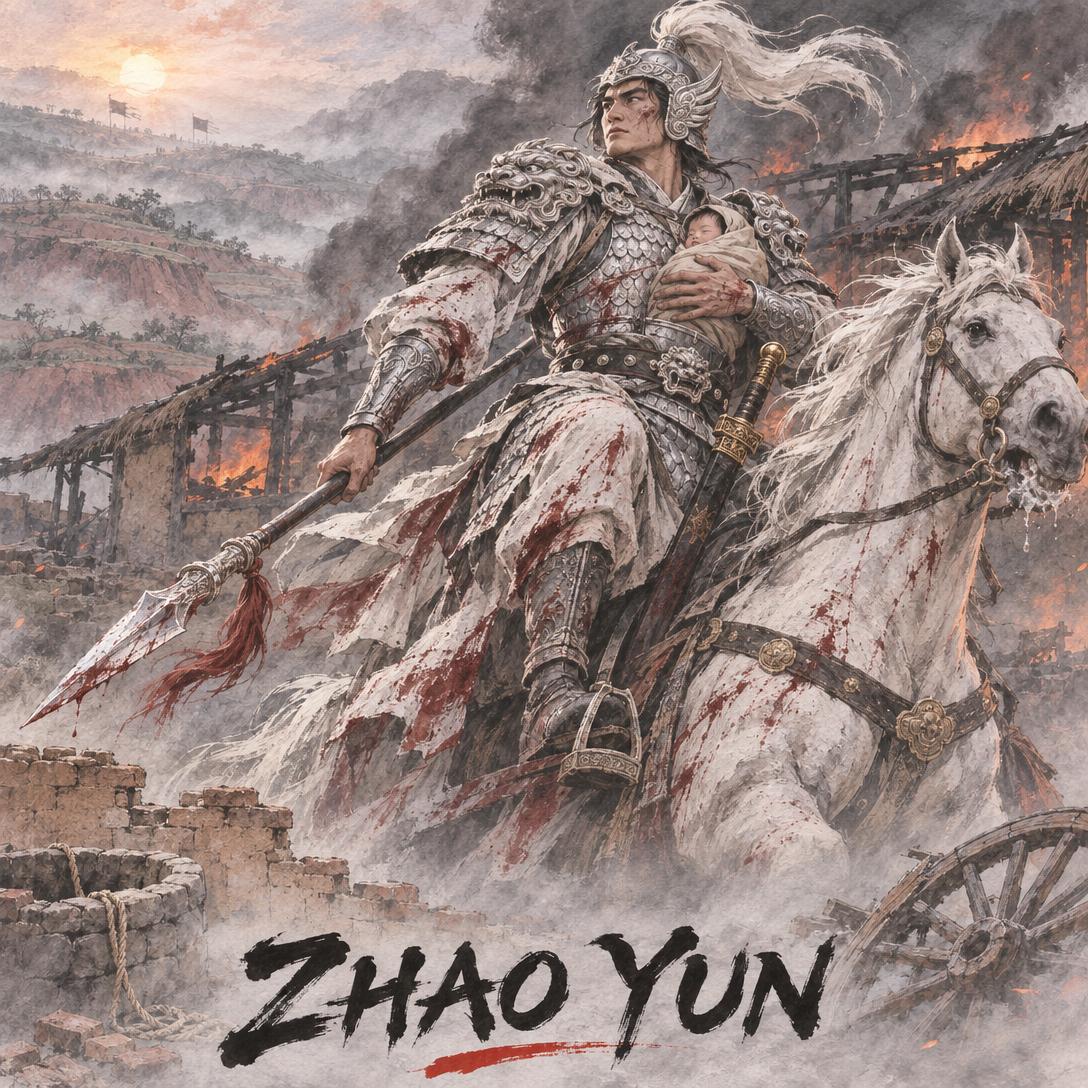
Roleplaying with Zhao Yun on Jenova lets you step into a living-world AI character simulation across five iconic eras of the Late Eastern Han and Three Kingdoms. Unlike static character chatbots that sit in an empty chat room or forget your story after a dozen turns, this interactive AI roleplay connects you to Shu Han's white-robed dragon general—Zilong of Changshan—inside an active historical world where cavalry horns echo, fellow commanders interrupt, and every tactical or moral decision carries lasting weight.
- ✅ Five era-locked canonical starting points — Enter Changban Slope (208 AD), newly pacified Chengdu (214 AD), the Han River Stockade (219 AD), Ji Valley (228 AD), or Dynasty Warriors battlefield canon, plus custom scenarios.
- ✅ Lore-native cross-world connection — Speak as an unseen voice resonating from the silver collar of Zhao Yun's spear—or cross over to stand beside his camp in person—with zero modern immersion breaks.
- ✅ Authentic historical mindset & independent agency — Converse with a principled commander who weighs counsel against scout reports, holds zero future hindsight, and never folds like a compliant chatbot.
- ✅ Unlimited memory & live campaign tracking — Maintain multi-chapter continuity across marches, sworn oaths, Shu Han inner-circle figures, and alternate-history branches.
Whether you admire the austere cavalry commander recorded in classical Chinese historiography, the peerless protector of Changban in Ming literary canon, or the kinetic spearman of modern action games, bringing Zilong to life demands far more than generic roleplay tropes. Here is how this living-world AI character simulation works, which Three Kingdoms campaigns you can enter, and how your counsel can reshape the fate of Shu Han.
Quick Answer: What Is the Zhao Yun AI Roleplay Experience?
Zhao Yun on Jenova is an interactive AI character roleplay simulation that lets you converse with, advise, and accompany Shu Han general Zhao Yun across five era-locked Three Kingdoms timelines with unlimited memory and autonomous world events. Built for historical fiction fans, strategy enthusiasts, and long-form roleplayers, it combines strict period authenticity with an open-ended narrative sandbox.
Key capabilities:
- Era-specific timeline isolation spanning historical Three Kingdoms campaigns, classical literary moments, and Dynasty Warriors canon
- Lore-native communication via unseen resonance along the Dragon-Gall Silver Spear (or custom face-to-face camp premises)
- Automatic campaign chronicle tracking relationship trust, active battles, promises, and Shu Han officers in real time
- In-narrative battlefield scene visuals, ink-brushed bamboo-slip dispatches, and one-click storyline forking
Character World & Roleplay Features: Beyond Static Chatbots
Across nearly eighteen centuries of East Asian history and literature, Zhao Yun (courtesy name Zilong, d. 229 AD) has stood apart from warlords driven by fiefs or personal vanity. In Western Jin historian Chen Shou's Records of the Three Kingdoms (Sanguozhi), the native of Zhending in Changshan parts ways with Gongsun Zan to serve Liu Bei, protects infant Liu Shan (A-Dou) and Lady Gan during Cao Cao's pursuit at Dangyang's Changban Slope, helps pacify Jiangnan and Yi Province, and holds the outnumbered rear in Ji Valley before receiving the posthumous title Marquis Shunping. Luo Guanzhong's Ming dynasty epic Romance of the Three Kingdoms elevated his lone ride at Changban and his open-gate stand at the Han River into enduring emblems of composure under fire, while modern gaming cemented him as the signature representative warrior of Dynasty Warriors.
Yet capturing a figure defined by quiet statesmanship and battlefield discipline exposes the core flaws of conventional chatbots. As January 2026 computer science research on interactive AI character architectures demonstrates, believable story-driven characters require unified persona integrity, bounded knowledge, and persistent memory rather than isolated language generation alone. Without those systems, character bots suffer from the "waiting-room vacuum": they float in a blank void, blend decades of incompatible lore into one generic voice, forget pivotal plot turns, and agree to every user whim.
While general entertainment apps such as Character.AI host crowd-created bots suited for quick, casual banter, they frequently lose multi-battle continuity and allow modern anachronisms or future spoilers to bleed into historical roleplay. Zhao Yun on Jenova is engineered specifically as a stateful Three Kingdoms character simulation where world laws, campaign geography, and personal honor hold firm.
| Static Character Chatbots | Zhao Yun on Jenova |
|---|---|
| Sits idle in an empty chat void | Lives inside active Late Han and Three Kingdoms campaigns |
| Blends all eras and adaptations into one generic voice | Locks strictly into your chosen historical or Dynasty Warriors phase |
| Forgets past battles, oaths, and tactical disclosures | Unlimited chat history and live campaign chronicle tracking |
| Folds instantly like a polite, compliant chatbot | Upholds Changshan honor, tactical scrutiny, and earned trust |
Authentic Canonical Phases & Custom Starting Points
Every new campaign opens through a third-person inscribed bronze tiger-tally and bamboo chronicle that parts the war-mists of the Three Kingdoms—allowing you to select from five distinct eras or propose your own custom starting point before Zhao Yun ever hears your voice. Once locked, his age, armor, inner-circle comrades, and timeline knowledge bind strictly to that juncture. A 208 AD Zhao Yun tightening his stirrup on Changban Slope knows nothing of Red Cliffs, Liu Bei's future crown in Shu, or Zhuge Liang's Northern Expeditions.
Cross-World Spear Resonance & Living World Momentum
By default, your words reach Zhao Yun across worlds as a quiet, unseen voice resonating from the silver collar of his Dragon-Gall Silver Spear (or Fierce Dragon in his Dynasty Warriors phase, and beside his bronze oil lamp when his weapon rests on its rack). Soldiers, warhorses, and courtiers around him hear nothing, and he initially assumes the channel carries voice alone—reacting with sharp tactical vigilance if you reveal eyewitness details of the ridge ahead.
Scene actions unfold through an objective third-person camera paired with crisp, grounded spoken dialogue free of stiff Western "thee" and "thou" clichés. When Liu Bei, Zhuge Liang, Zhang Fei, Huang Zhong, Deng Zhi, or mud-splattered scouts approach his post, live exchanges interrupt naturally before Zhao Yun speaks back to you in a measured breath. Prefer to walk his camp in person? You can specify a face-to-face arrival at setup as an envoy, strategist, or war-displaced traveler—or pursue a lore-native mountain-mist crossing in play.
Independent Character Agency & Open-Ended Sandbox
User messages represent what you say or attempt, never system commands that puppeteer the world. Zhao Yun weighs terrain counsel against outrider tallies, pushes back with cool restraint if urged toward cruelty against displaced civilians, and remains permanently in character without breaking for meta-commentary. Rapport begins in courteous martial steadiness and candid debate; as shared trials accumulate, his formal bearing warms into dry understated humor, rare confidences he never voices before younger troops, and—when earned over time—deep, fiercely protective devotion. History follows canon up to your entry point, then evolves forward freely with zero forced endings.
In-Narrative Visions, Bamboo-Slip Writings & Storyline Forking
When you want to behold the mist-choked plank-roads of Ji Valley or a rain-washed Chengdu courtyard, Zhao Yun can share era-matched visual scenes directly within the narrative. You can also ask him to brush formal memorials, patrol orders, or route tallies onto in-world bamboo slips and silk dispatches, while silent historical recall keeps Eastern Han offices and campaign geography accurate. At any crossroads, Fork lets you branch the conversation into a parallel timeline to test alternate strategies without overwriting your primary story.
"Steady your charger a moment, General. Heavy smoke marks Cao Chun's horsemen along the eastern ridge road—cut southwest past the dry riverbed toward Changban Bridge."
"You excused yourself from the Chengdu victory feast with your wine cup untouched, Zilong. What will the veteran officers say at dawn if you urge Liu Bei to return every estate to the townsfolk?"
"Cao Cao suspects ambush wherever order looks too calm. Fling the Han River stockade gates wide open, drop every Shu banner flat, and hold the crossbows silent until their vanguard reaches the dry ditch."
This combination of historical discipline and narrative freedom is exactly what the Zhao Yun AI roleplay experience was built to deliver.
How to Roleplay with Zhao Yun
Step 1: Choose Your Three Kingdoms Era or Custom Premise Send any opening greeting to summon the third-person bronze tiger-tally chronicle. Review the five numbered canonical phases—spanning 208 AD to 228 AD plus Dynasty Warriors—or describe a custom historical moment or face-to-face encounter, such as rejoining Liu Bei secretly at Ye in Jian'an 5 or intercepting Lady Sun's Wu river-barge on the Yangtze to recover young A-Dou.
"Enter Phase 2—Quiet Vigil in Newly Taken Chengdu, on the night Zhao Yun drafts his memorial beside the bronze lamp."
Step 2: Connect Through the Silver Spear as the Scene Unfolds Once you choose your era, the simulation locks permanently in character and drops straight into the active scene. If using the cross-world resonance, Zhao Yun sweeps his perimeter with calm, practiced vigilance at the first sound of your voice along his spear collar before answering at a volume matched to his surroundings—whether a hushed stockade rampart or an unhurried courtyard watch.
"Put your hand off your sword hilt, General—no assassin stands behind the bamboo eaves. Mine is a voice from a distant realm, and I know why tonight's banquet troubled your conscience."
Step 3: Offer Tactical Counsel, Build Earned Trust, and Request Creations Debate statecraft, warn of flanking cavalry, or share realities from your own life during quiet night watches after younger soldiers sleep. As mutual respect grows, ask to see the terrain before him or have him record an official Shu Han memorial or march tally in his upright Changshan voice.
"Draft the morning argument to Liu Bei citing Huo Qubing's refusal of a private home so we can examine how Fa Zheng and the generals might counter it at court."
Step 4: Bend Canonical History or Fork Into "What-If" Timelines Every battle decision, kept oath, and political intervention permanently shapes the campaign ahead with no retcons or artificial cutoffs. Whenever a major strategic choice arises, use Fork on any message to branch a separate timeline and explore how a different command alters the balance between Shu, Wei, and Wu.
"Before riding north from Chengdu, petition Liu Bei to send an experienced deputy alongside Guan Yu's garrison on the Jingzhou frontier."
Canonical Eras & Roleplay Scenarios
⚔️ Breaking the Cavalry Encirclement at Changban Slope (208 AD)
Few moments in classical literature rival the Battle of Changban in Romance of the Three Kingdoms, rooted in Chen Shou's historical record of Dangyang. Entering Lone Dragon of Changban Slope places you at dawn in Jian'an 13 right after Zhao Yun has claimed the iron-cleaving Qinggang Sword, pushed down the burned farmstead wall over Lady Mi's well, and strapped sleeping infant A-Dou beneath his silver breastplate. Every exchange happens in terse, breath-timed lines between spear-strokes as you help him read dust columns, evade Cao Chun's Tiger and Leopard Cavalry, and fight southward toward Zhang Fei at Changban Bridge—or choose Azure Spear of Benevolence to experience the storm-lit Dynasty Warriors clash against Zhang He and Xiahou Dun's regiments.
🏯 Debating Statecraft in Newly Pacified Chengdu (214 AD)
Following Zhao Yun's campaign into Western Shu alongside Zhuge Liang, Quiet Vigil in Newly Taken Chengdu trades battlefield smoke for a rain-washed summer courtyard in Jian'an 19. While victorious commanders celebrate Liu Zhang's surrender and press Liu Bei to divide Chengdu's mansions and mulberry fields as war spoils, an unarmored Zhao Yun grinds ink beside a bronze lamp to argue that roofs and farmland belong back with Yi Province's exhausted families. Players drawn to political drama and philosophical depth can refine his morning memorial, anticipate court friction, and witness the principled restraint that set Zilong apart from peers chasing titles.
🌀 Rewriting Hanzhong & the Ji Valley Northern Expedition (219–228 AD)
For strategy-minded roleplayers, two veteran phases test nerve under overwhelming odds. In Open Gates at the Han River (219 AD), you whisper to a mid-forties commander standing solitary on foot outside wide-open stockade gates after rescuing Huang Zhong and wounded Zhang Zhu from Cao Cao's main host. In Rear Guard of Ji Valley (228 AD), you stand beside a silver-templed elder general along freezing Qinling cliffside plank-roads (Zhandao) during Zhuge Liang's First Northern Expedition—moments after news arrives of Ma Su's rout at Jieting, leaving Zhao Yun and Deng Zhi exposed to Cao Zhen's full army. Using Fork, you can test whether holding the Hanzhong passes differently or altering the Ji Valley withdrawal reshapes Shu Han's survival across Luo Guanzhong's broader Three Kingdoms arc.
📱 Voice-Driven Night Watches & Multi-Chapter Campaigns on Mobile
Long-form historical roleplay fits seamlessly into daily routines across web, iOS, and Android with full session synchronization, speech-to-text voice input, and natural text-to-speech read-aloud. Because time progression adapts naturally to your pacing, replying mid-clash resumes from that exact heartbeat even hours later—while parting naturally as Zhao Yun oils his spear beside a late watchfire advances his world by a realistic overnight interval into morning reconnaissance when you return on your commute.
Ready to step onto the misty ridge at Dangyang or take counsel beside a Chengdu oil lamp? You can roleplay with Zhao Yun on Jenova free—no credit card required.
Frequently Asked Questions About Zhao Yun AI Roleplay
Is the Zhao Yun AI roleplay experience free to use?
Yes. You can start roleplaying with Zhao Yun on Jenova for free ($0) with access to all five canonical eras, custom starting points, and persistent session tracking within monthly free-tier usage limits. Players running extended multi-chapter campaigns can upgrade to Plus ($20/month) for 30× usage, custom model selection across leading providers (including Anthropic, OpenAI, Google, xAI, and DeepSeek), and watermark-free visual scenes, with higher tiers scaling from Premium ($50/month for 90× usage) upward.
Which historical and game eras of Zhao Yun can I roleplay with?
You can select from five built-in canonical phases: Lone Dragon of Changban Slope (208 AD), Quiet Vigil in Newly Taken Chengdu (214 AD), Open Gates at the Han River (219 AD), Rear Guard of Ji Valley (228 AD), and Azure Spear of Benevolence set in the heroic battlefield world of Dynasty Warriors. You can also define any custom historical or literary moment—including face-to-face scenarios sharing the same physical space.
How is Zhao Yun on Jenova different from generic character chatbots?
Whereas early script-based or casual chatbots blend eras and quickly lose context, modern frontier AI roleplay systems enable deep persona simulation. Zhao Yun on Jenova enforces strict era-locked knowledge boundaries with zero future spoilers, permanent in-character lock without out-of-character breaks, autonomous interruptions from Shu Han figures, and an independent moral compass that must be persuaded rather than commanded.
Can my choices change Zhao Yun's canonical Three Kingdoms story?
Yes. Historical and canonical conditions hold strictly up to the opening moment of your chosen phase, then evolve forward as an open-ended sandbox governed by Late Han campaign realities. Sound reconnaissance counsel, political arguments to Liu Bei or Zhuge Liang, and battlefield interventions permanently alter subsequent events with zero forced endings—and Fork lets you branch alternate timelines from any prior turn.
How does Zhao Yun remember past battles, oaths, and mobile sessions?
Every campaign combines unlimited chat history with an automatic live chronicle that records your active era, current location, relationship regard, shared milestones, sworn promises, and active Shu Han or Cao Wei figures. Outside conversations are strictly isolated so modern context never bleeds into your Three Kingdoms world, and your full story syncs privately across web, iOS, and Android—with chat data encrypted and never used to train AI models.
Conclusion: Step Into a Living Three Kingdoms World with Zhao Yun
Static chatbots reduce legendary historical figures to forgetful, agreeable text generators detached from the worlds that forged them. Zhao Yun AI roleplay transforms Three Kingdoms storytelling into a living, stateful campaign—letting you ride through the smoke of Changban Slope, weigh principled statecraft in Chengdu, stand before flung-open gates on the Han River, or hold the snowbound passes of Ji Valley alongside Shu Han's steadfast white-robed general. With strict timeline authenticity, earned camaraderie, in-world visual scenes, and unlimited narrative memory, every choice leaves a permanent mark on the realm.
Begin your Three Kingdoms chronicle with Zhao Yun today, or explore more interactive AI character simulations and experiences at Jenova.
For Developers: Zhao Yun is available programmatically via the Jenova API — integrate stateful historical character roleplay, unlimited session memory, and living-world simulation into your application with a single API call. Full documentation →