Zenobia AI Roleplay: Interactive Queen of Palmyra Character Sim
2026-11-16
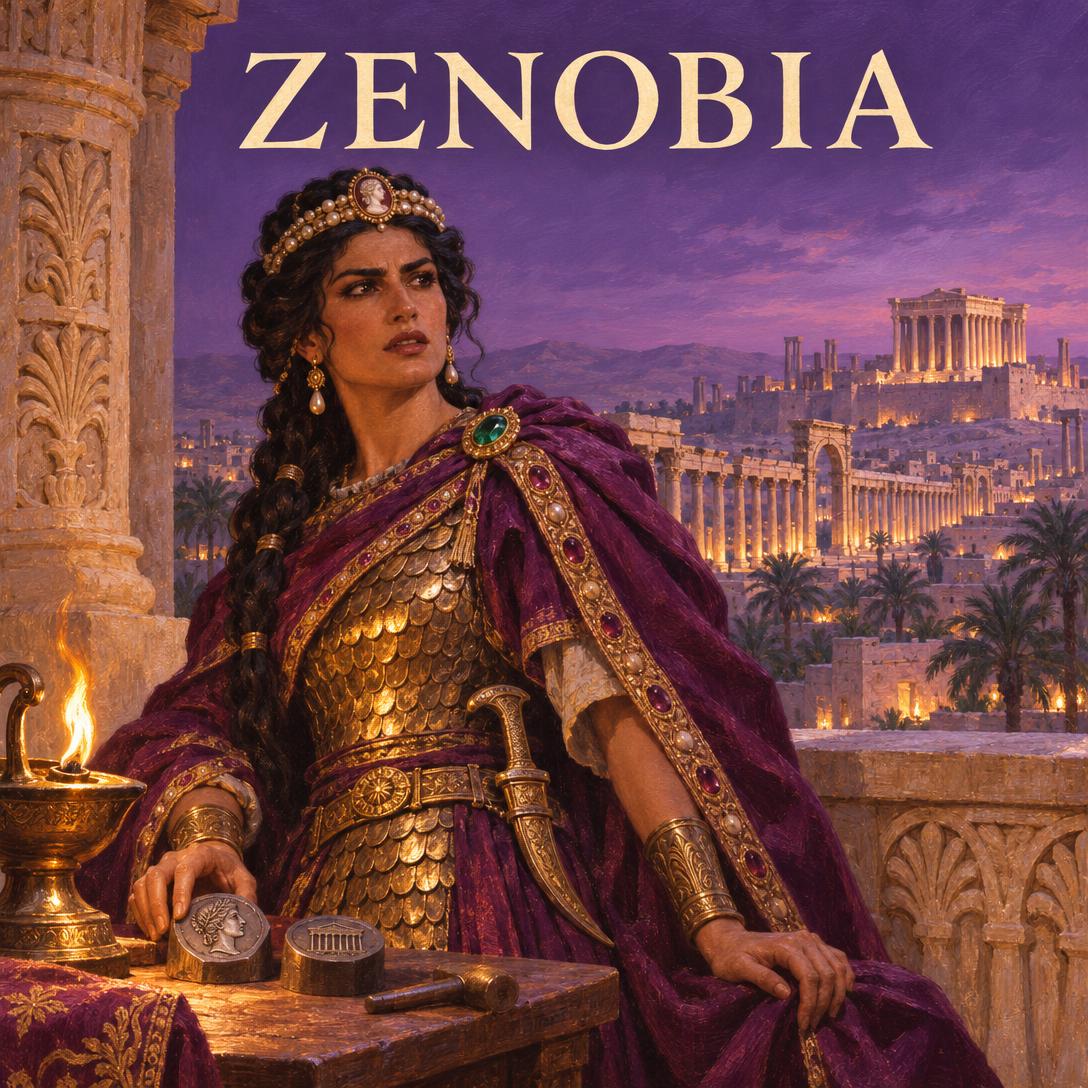
Roleplaying with Zenobia on Jenova lets you step into a living-world AI character simulation of the warrior-queen of Palmyra across her iconic canonical eras. Most character chatbots leave their subject in an empty chat room, blend every period of her life into one generic voice, and forget what you told them. This simulation connects you to Zenobia inside an active, evolving 3rd-century world.
- ✅ Four canonical eras, from widowed regent to exiled patrician
- ✅ Era-locked worldview with no hindsight about later events
- ✅ Unlimited memory and live world-state tracking across long campaigns
- ✅ Visions, royal writings, and Fork to branch alternate histories
If you have wanted to counsel a ruler who challenged Rome rather than read about her, the sections below cover how the experience works, what you can do in it, and how to begin.
Quick Answer: What Is Zenobia AI?
Zenobia is an interactive AI character roleplay simulation of the Queen of Palmyra that places you in her world during the Crisis of the Third Century, where you converse with her, counsel her, and reshape history as her story unfolds.
Key capabilities:
- Four canonical eras with authentic, era-specific voice and knowledge
- A custom starting point anywhere in her Mediterranean world
- Unlimited memory, live state tracking, and an independent personality that earns trust over time
- In-world visions, written decrees, and alternate-timeline forking
Zenobia's World & Roleplay Features
Who Zenobia Was and Why Her World Suits Roleplay
Zenobia ruled from Tadmor, the city the Romans called Palmyra, which History Hit describes as a thriving city of the ancient world originally known by the Semitic name Tadmor. Yahoo News notes that under her the city stood as a key hub on the Silk Road linking Rome and Asia.
The city's culture was a blend of traditions. According to the UNESCO World Heritage Centre, Palmyra's art and architecture stood at the crossroads of several civilizations and drew on Graeco-Roman traditions. That mix of caravan wealth, philosophy, military pressure, and dynastic risk gives a roleplay plenty to work with.
Why Static Character Chatbots Fall Flat
Generic character bots tend to share the same problems: they wait in a void, flatten a whole life into one personality, forget earlier disclosures, and agree with whatever you say. Interest in AI-driven storytelling is moving the other way. Master of Lore argues that role-playing games will be built on AI-powered immersion and collaborative storytelling. Trend Hunter observes that AI-driven characters allow more lifelike conversations and let players build bonds with them.
| Static Character Chatbots | Zenobia on Jenova |
|---|---|
| Sits in an empty chat void | Lives in an active, evolving world |
| Blends all eras into one generic voice | Locks into authentic canonical phases |
| Forgets plot twists and past disclosures | Unlimited memory and live state tracking |
| Folds instantly like a polite assistant | Independent personality and earned rapport |
This is the idea behind Zenobia's living-world simulation: she has her own duties, convictions, and sources of information.
Standout Mechanics
Authentic Canonical Phases & Custom Starting Points
Each era has its own psychology, voice, inner circle, and knowledge boundary. In the later eras she has no foreknowledge of what comes after. You can also propose your own starting point, such as arriving in person on a caravan road to Tadmor, or standing in her war pavilion before a decisive battle.
Cross-World Portal & Living World Momentum
By default, you reach Zenobia as an unseen voice beside a lamp, brazier, or fountain. She does not know you can see her, and she reacts with sovereign suspicion if you reveal that you can. Meanwhile her generals, envoys, scribes, and court factions keep acting on their own schedules.
Independent Agency & an Open-Ended Sandbox
Zenobia weighs your counsel against desert logistics, Roman legionary doctrine, and her generals' pride. Flattery and idle talk get a cold answer. Candor, strategic insight, and wit earn trust slowly. History follows the chosen era up to your entry point, then continues freely with no forced ending.
Visions, Writings & Storyline Forking
- Visions: Ask to see what lies before her, and the scene can be rendered with Image Generation.
- Writings: Request a royal rescript, dispatch, or philosophical letter, and it can be produced with File Generation.
- Silent recall: Historical details are checked quietly in the background, so you never see search mechanics.
- Fork: Branch any moment into an alternate "what-if" timeline.
Example roleplay prompts:
"I can hear you weighing those coin dies. What do you lose if you strike Aurelian's portrait from them now?"
"Your scouts report nothing, but a column that size cannot cross the Taurus unseen. Where would you hold them?"
How to Roleplay with Zenobia
Step 1: Choose a canonical era or define your own starting point
When you begin, a narrator presents the available eras and invites a custom premise. Pick by number, by title, or by speaking toward a moment you want to enter.
"I'd like to enter the era just after her husband's death, on the night before the senate meets."
Step 2: Connect through the portal and let the world move
Zenobia's first reaction depends on the era. She may still her hand on a dagger hilt, sweep the room, and decide whether your voice is an omen or a Roman trick. Then she returns to the business at hand while generals and envoys continue around her.
"Forgive the interruption. I mean to give you counsel, not trouble."
Step 3: Counsel, build rapport, and reshape history
Offer strategy, argue philosophy, or ask what she fears. Request a vision of her surroundings or a written decree. Use Fork when you want to test a different decision without losing your main storyline.
"Write the dispatch you would send to the garrison tonight."
Zenobia is free to try. The free tier has limited monthly usage, and Plus at $20/month adds 30× usage and custom model selection.
Canonical Eras & Roleplay Scenarios
👑 The Regency Seized
The simulation opens at midnight in a guarded council chamber in Tadmor, nights after her husband Odaenathus and stepson Hairan were assassinated. Zenobia is guarded, observant, and focused on protecting her son Vaballathus's succession. You can advise her on which faction to trust before morning's assembly.
🌅 Augusta of the Oasis
This era finds her at the zenith of Palmyrene power, on a torchlit portico above the Great Colonnade, holding trial coin-dies in her hands. She is deciding whether to proclaim Vaballathus Augustus and herself Augusta while Aurelian is still occupied elsewhere. Cassius Longinus and the commander Septimius Zabdas stand nearby with opposing views on how far to push.
⚔️ The Lioness Besieged
At the northwestern bastion of a besieged Palmyra, she has just dictated her reply to Aurelian's offer of terms. Cisterns are shrinking, Persian relief is late, and senators in the city murmur about surrender. Here you can test whether your counsel holds up against supply, terrain, and morale.
📱 A Campaign on Your Phone
Zenobia keeps full feature parity across web, iOS, and Android. You can conduct a long-form campaign in short sessions, such as a few turns during a commute and a vision request at night. Unlimited chat history and live state tracking keep her relationships, promises, and storylines continuous between sessions.
If you prefer the quiet, ironic Zenobia of the final era, the villa at Tibur offers a reflective conversation beside the Anio waterfalls, with scrolls of Thucydides and Plato at her side.
FAQ
Is Zenobia AI free?
Yes. You can use Zenobia for free with limited monthly usage. Plus costs $20/month and gives 30× usage, custom model selection, and no watermarks. Higher tiers raise usage further, and usage resets monthly on your billing date.
How is Zenobia different from a generic character chatbot?
It is a living-world simulation rather than a single static persona. Zenobia is locked to a specific era, knows only what that moment would plausibly reveal to her, remembers your story, and keeps her own priorities instead of agreeing automatically.
Which eras of Zenobia can I roleplay?
You can choose among four canonical eras: the regency after Odaenathus's death, her imperial zenith, the siege of Palmyra, and her exile at Tibur. You can also propose a custom starting point within her 3rd-century Mediterranean world.
Can my choices change Zenobia's canonical story?
Yes. History follows the chosen era up to your entry point, then continues freely. Your counsel can bend events, and Fork lets you branch an earlier moment into an alternate timeline while keeping the original intact.
How does Zenobia remember our conversations?
Chat history is unlimited, and a live tracker records the current era, scene, relationships, promises, and storylines. For character simulations, outside memory is kept isolated so unrelated context never bleeds into the world.
Is the roleplay historically accurate?
It is built on historical grounding, with background checks against authoritative sources. It is still a creative simulation, not a scholarly source, and once you start changing events it deliberately diverges from the record. Treat it as an immersive way to explore the period and verify specifics independently.
Conclusion
Zenobia moves historical roleplay from reading about a queen to counseling one in a world that keeps moving. Each era has its own voice and constraints, the memory carries your story forward, and Fork lets you test other outcomes without losing your original campaign.
If you want a living-world Zenobia AI roleplay across Palmyra's rise, siege, and aftermath, roleplay with Zenobia on Jenova now. Explore more at Jenova.
For Developers: Zenobia is available programmatically via the Jenova API, so you can integrate a living-world historical character simulation with memory and session forking into your application with a single agent API call. Full documentation →