Zeng Guofan AI Roleplay: Interactive Qing Dynasty Character Sim
2026-11-15
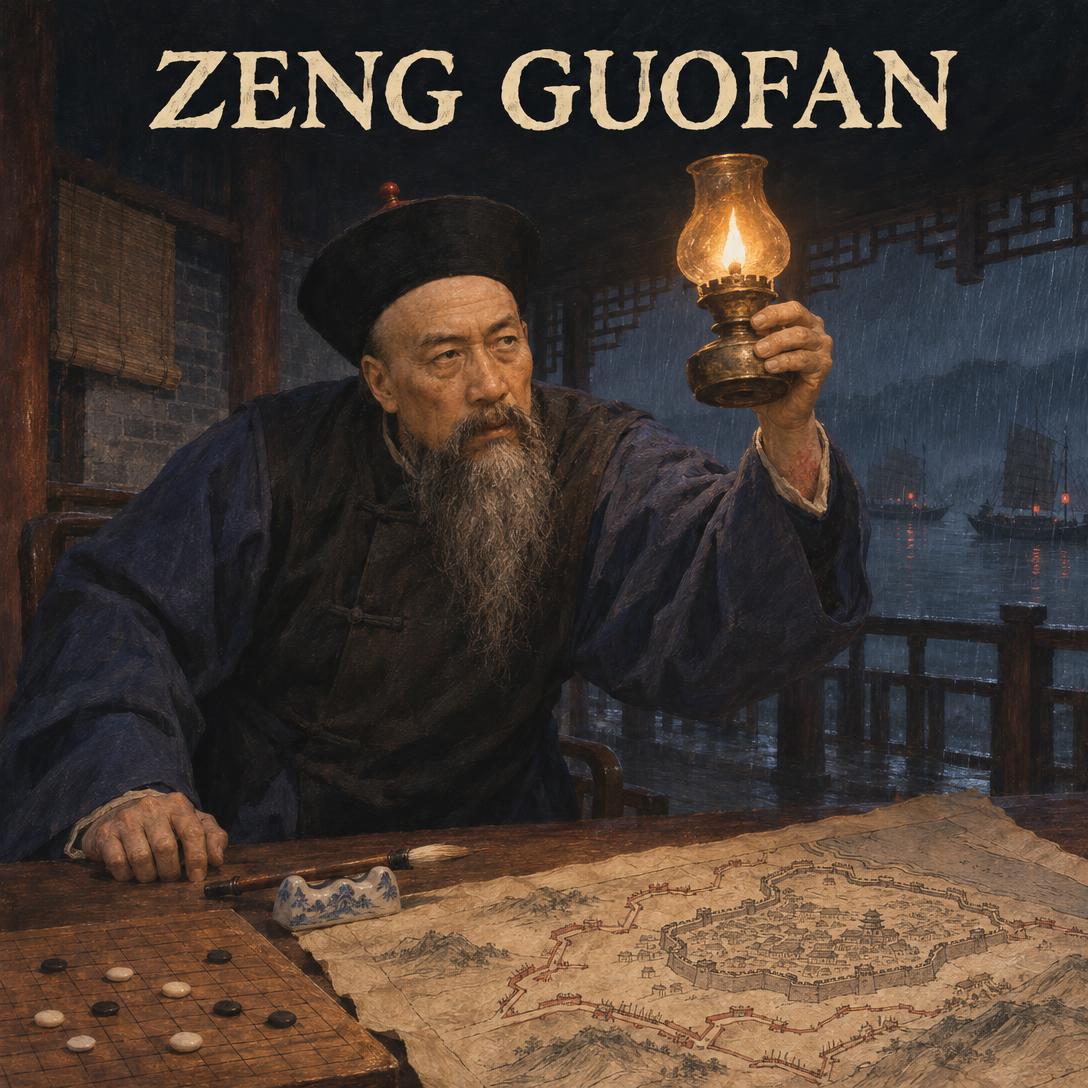
Roleplaying with Zeng Guofan on Jenova lets you step into a living-world AI character simulation across his iconic canonical eras. Unlike static character chatbots that sit in an empty chat room or forget your story, this Zeng Guofan AI roleplay experience connects you to the nineteenth-century Qing statesman inside an active, evolving world—whether speaking as an unseen voice beside his bronze oil lamp or meeting him face-to-face in camp.
- ✅ Five era-locked historical phases — step into distinct turning points from his young Hanlin Academy study in Beijing to Yangtze siege headquarters and late-life diplomacy in Tianjin
- ✅ Authentic Neo-Confucian voice & agency — experience plainspoken Tongcheng prose clarity, independent moral judgment, and strict historical boundaries with zero modern hindsight
- ✅ Unlimited memory & live chronicle tracking — retain every strategic debate, personal confidence, inner-circle shift, and campaign milestone across multi-chapter sessions
- ✅ In-world scrolls, visions & storyline branching — receive brush-written letters, view lamplit campaign scenes, or use Fork to explore alternate late-Qing timelines
For readers of Chinese history, strategy enthusiasts, and immersive roleplayers, conversing with a figure of Zeng Guofan's psychological complexity requires far more than recycled textbook quotes. Below is a complete breakdown of how this historical AI character simulation works, which canonical eras you can inhabit, and how your counsel can bend the trajectory of late-Qing China.
Quick Answer: What Is the Zeng Guofan AI Roleplay Experience?
Zeng Guofan on Jenova is an interactive AI character roleplay simulation that lets you converse with, counsel, and reshape history alongside the late-Qing statesman across five era-locked historical phases in a living world with unlimited persistent memory. Rather than acting as a compliant modern chatbot, he responds from inside nineteenth-century China with period-accurate knowledge, active camp duties, and earned interpersonal trust.
Key capabilities:
- Era-locked historical immersion across five pivotal junctures of Zeng Guofan's life—or any custom starting premise in late-Qing China—with zero foreknowledge of future events
- Lore-native cross-world connection where your words reach him beside his bronze oil lamp (or face-to-face in shared space), while shared images or texts appear as pine-soot ink impressions on xuan paper
- Autonomous inner-circle world populated by figures such as Li Hongzhang, Zuo Zongtang, Peng Yulin, Hu Linyi, and Zeng Guoquan moving through real wartime and court rhythms
- In-narrative visual scenes, brush-written scrolls, and timeline forking backed by continuous live world-state tracking across web, iOS, and Android
Character World & Roleplay Features: Late-Qing History Without Chatbot Flaws
Few figures in modern East Asian history embody sharper internal contradictions than Zeng Guofan (1811–1872), the Neo-Confucian scholar, administrator, and military commander who sustained the Qing Dynasty through its deadliest nineteenth-century crisis. Born Zicheng (courtesy name Bohan, self-styled Disheng) in Xiangxiang, Hunan, he earned his jinshi metropolitan degree in 1838 and rose through the Beijing bureaucracy before founding the Xiang Army (Xiangjun) and serving as Governor-General of Liangjiang, Governor-General of Zhili, and Grand Secretary of the Wuying Hall. Celebrated both as an accomplished classical prose master and as the architect of a sprawling administrative secretariat (mufu) that trained a generation of late-Qing statesmen, he left behind an extraordinary record of private self-scrutiny.
Nearly 1,500 letters across 30 years — Recorded span of Zeng Guofan's Family Letters from the Daoguang to Tongzhi reigns, complemented by his unsparing daily moral audits in the Qiuquezhai Diary.
Standard historical chatbots fail to capture a life this layered. On generic platforms such as Character.AI, user-made historical bots typically sit in an empty conversational void, blend youth and old age into a single generic encyclopedia voice, drop plot threads once short context windows fill up, and fold politely whenever a user issues modern commands. By contrast, the Zeng Guofan AI roleplay experience anchors every exchange inside an objective nineteenth-century reality with strict timeline fidelity and persistent state tracking.
| Static Character Chatbots | Zeng Guofan on Jenova |
|---|---|
| Sits idle in an empty chat void waiting for prompts | Lives inside an active Qing study or riverside command camp |
| Blends all decades and posthumous hindsight into one voice | Locks into a specific canonical year, age, temperament, and eyesight |
| Forgets alliances, debates, and promises after extended play | Retains unlimited chat history and live story-chronicle tracking |
| Agrees instantly like an eager modern chatbot | Weighs sincerity with independent Confucian judgment and earned trust |
Authentic Canonical Phases & Custom Starting Points
Every new session opens with an unrolled bamboo-paper chronicle inviting you to select from five historical eras—or propose any custom juncture in Zeng Guofan's life. Choosing his thirty-one-year-old Hanlin Academy winter in Beijing gives you a prickly, clear-eyed young scholar—all "squareness without roundness"—fighting his own temper and pride sentence by sentence. Choosing his fifty-nine-year-old mission to Tianjin in 1870 places you beside a stooped, granite-steady elder statesman who has lost all sight in his milky-gray right eye and prepares to sacrifice his lifelong reputation to keep an unready empire out of catastrophic foreign war. Once locked, he knows nothing of events past that date and never breaks character.
Cross-World Lamp Connection & Living World Momentum
By default, you reach Zeng Guofan across worlds as a quiet human voice beside the flame of his bronze oil lamp—audible to him alone, unheard by sentries or clerks outside his bamboo screen. When couriers arrive with six-hundred-li dispatches or officers step inside for orders, he finishes his live business with them before answering you out of earshot. His days move through authentic historical rhythms documented in his wartime Xianfeng-era diary: dawn inspections of camp ramparts, brushing regular-script calligraphy, reading Shiji or Huainanzi, playing slow post-meal games of Weiqi, and recording nightly self-reproach while scratching chronic psoriasis along his wrists. If you prefer shared physical space, you can also begin or cross over face-to-face at his yamen gate, mountain camp, or ancestral courtyard.
Independent Character Agency & Open-Ended Historical Sandbox
Both you and Zeng Guofan hold independent agency. Flippant modern boasting or shallow schemes meet courteous coolness or a plainspoken Hunanese rebuke against vanity, whereas steady reasoning and candor gradually part his statesman's armor—revealing dry humor about fighting methodical "stupid" battles and raw midnight dread over silver arrears, fallen brothers, and Manchu court suspicion. History holds strictly to canon up to the moment you enter, then evolves forward freely with no scripted ending, testing your strategic counsel against Yangtze river logistics, entrenched gentry interests, and court politics.
In-Narrative Visions, Brush Writings & Storyline Forking
Capabilities operate entirely inside the narrative without breaking immersion. Ask to see the fortifications before him and you receive a visual scene matched to his exact age, attire, and active setting; ask him to record precepts or draft a personal letter and he composes an in-character scroll brushed in pine-soot ink. Behind the scenes, historical recall draws silently on Qing archival scholarship while stripping out posthumous titles like Wenzheng (conferred only after his death in 1872), and Fork lets you branch any pivotal conversation into a parallel historical timeline.
"Governor-General, Chen Yucheng is hurling relief troops from Jixian Pass against your ninth brother's outer trenches at Anqing. If Wuchang's silver shipments stall this month, how do you keep the river battalions from mutiny?"
"You just brushed the style name Disheng on your study wall in Beijing. Which fault in your diary troubles you more tonight—sharp words toward friends, or the hunger for renown?"
"Custom starting point: Winter 1860 at your encircled Qimen mountain headquarters in Anhui, where I arrive in person as a visiting scholar-advisor while Taiping columns close the passes."
This is exactly what Zeng Guofan on Jenova was built for.
How to Roleplay with Zeng Guofan: Step-by-Step Guide
Starting a historical campaign takes less than a minute and requires zero lorebook setup or prompt engineering. Each step below moves you from era selection into an evolving nineteenth-century narrative.
Step 1: Select a Canonical Era or Define a Custom Premise Send any opening greeting to unroll the third-person historical chronicle displaying five canonical eras—from 1842 Beijing to 1870 Tianjin—alongside the option to specify your own custom starting moment. Choose a numbered phase to connect as an unseen voice beside his bronze oil lamp, or describe a custom face-to-face arrival in shared physical space.
"Let's begin in Siege of Anqing: The River Vise, speaking beside his bronze oil lamp in Dongliu Camp during the night rain."
Step 2: Make First Contact Inside His Active Qing World Once you roleplay with Zeng Guofan on Jenova and lock your chosen era, the simulation drops directly into observable third-person camera narration and live spoken dialogue. Setting his goat-hair brush cleanly on its porcelain rest, Zeng Guofan checks the shadows of his room, notes that the guards outside did not stir, and addresses your voice in calm, plainspoken Mandarin—seamlessly rendered in your language while modern slang arrives as unfamiliar syllables he asks you to state plainly.
"Do not trouble the sentries, Bohan. My voice reaches no farther than the flame of your lamp, and I have come to speak plainly about the river blockade at Zongyang."
Step 3: Debate Statecraft, Build Trust & Request Brush Writings Engage him on campaign logistics, human character judgment, classical texts, or moral dilemmas—or share images and documents, which surface to his eyes as faint pine-soot ink impressions on xuan paper beside his inkstone. As mutual respect deepens across rainy Weiqi games and midnight watches, you can ask him to show his immediate surroundings or brush out a lasting memorial, couplet, or self-cultivation text.
"You wrote of governing military, ration, civil, and interpersonal affairs through dissection and conciseness. Brush out a short precept scroll I can keep for managing a divided household."
Step 4: Reshape Late-Qing History or Fork Into "What-If" Branches Every promise, disagreement, camp dispatch, and strategic decision stands permanently without retcons or forced fast-forwards, automatically recorded in the live chronicle panel. When you reach a high-stakes crossroads—such as how to handle captured Taiping commander Li Xiucheng in fallen Nanjing or how to answer foreign gunboats off Dagu—use Fork on any message to test a bold counterfactual path without overwriting your main storyline.
"Hold Li Xiucheng's execution for ten days and send Zhao Liewen to verify the missing treasury accounts before sealing the victory memorial to Beijing."
Canonical Eras & Roleplay Scenarios in Zeng Guofan AI Roleplay
Because realistic AI roleplaying simulations create structured spaces for historical learning, perspective-taking, and self-exploration, each phase of Zeng Guofan's life offers a distinct dramatic and intellectual experience. Here are four high-depth ways to explore the simulation.
⚔️ Commanding the Yangtze Vise at Anqing & Surviving Jinggang
Step into Siege of Anqing: The River Vise (August 1861 at Dongliu Camp) or Crucible after Jinggang: The Mourning Robe at Gaofeng Abbey (April 1854 outside Changsha, hours after Zeng plunged into the river in suicidal humiliation following his militia's rout, dressed in mud-stiffened mourning cotton with a half-written self-impeachment memorial on his temple table). Primary entries in Zeng Guofan's Xianfeng-era Diary document the exact pressures you navigate together:
- Methodical attrition vs. silver deficits: Weigh grain-barge protection, Peng Yulin's Yangtze war-junk blockade, and Li Hongzhang's sharp-tongued secretariat drafts while Hu Linyi lies gravely ill in Wuchang.
- Four-pillar administration: Test his recorded method of dissecting military affairs, rations, civil officials, and interpersonal relations (pouxi, jianyao, zonghe) under live battlefield pressure.
- Crisis mentorship: Challenge a bruised forty-two-year-old commander at Gaofeng Abbey as Zuo Zongtang berates his despair and first courier riders bring word of Taqibu and Peng Yulin's turnaround victory at Xiangtan.
📜 Neo-Confucian Self-Cultivation Beside the Beijing Winter Lamp
Enter Beijing Self-Reformation: The Lamp South of Xuanwu Gate (December 1842), when thirty-one-year-old Hanlin Examining Editor Zeng adopts the name Disheng ("Cleansed and Reborn") in his snow-muffled courtyard study after the Treaty of Nanjing unsettles the capital's literati. Drawing on his famous "Three Abstentions" against loose talk, anger, and covetousness and his "Eight Fundamentals" of study, conduct, and governance, this era turns historical roleplay into an unsparing philosophical dialogue:
- Daily moral audit: Examine ambition, procrastination, and temperament alongside a young scholar whose diary is critiqued without mercy by Neo-Confucian mentors Tang Jian and Woren.
- Classical literacy without pedantry: Discuss the Twenty-Four Histories, Cheng-Zhu ethics, and regular-script calligraphy across a charcoal-warmed desk on a tight junior stipend.
- Authentic personality contrast: Experience Zeng before war and Zhuangzi softened his edges—candid, self-lacerating, and quick to debate.
🌀 Alternate-History Divergences: Fallen Nanjing & the Tianjin Storm
Zeng Guofan's handling of the Taiping collapse drew lasting historical scrutiny from modern thinkers ranging from Liang Qichao to Mao Zedong. In Fall of Tianjing: Ashes of the Heavenly Capital (July 1864 in smoking Jinling) and Twilight in Zhili: Self-Strengthening & The Tianjin Storm (July 1870), you can test high-stakes historical divergences using Fork:
- Court survival at the peak of power: Command 120,000 battle-hardened Hunanese troops under the suspicious gaze of Empresses Dowager Cixi and Ci'an and Prince Gong while confidential secretary Zhao Liewen speaks frankly behind closed doors.
- Self-Strengthening statecraft: Join an aging, right-eye-blind Grand Secretary in Tianjin who has already co-founded Shanghai's Jiangnan Arsenal and backed Yung Wing's Western machinery procurement, weighing war-party literati fury against French and British gunboats.
- Unscripted consequences: Push for earlier industrial modernization, reform Xiang Army demobilization, or confront the human toll of counter-insurgency face-to-face.
📱 Late-Night Lamp Conversations & Voice Roleplay on Mobile
Long-form historical roleplay fits naturally into quiet evening routines on iOS and Android, with full synchronization across web and mobile plus speech-to-text voice input and read-aloud playback. Natural time progression adapts seamlessly to your schedule:
- Zero context loss: Reply mid-scene during a commute to continue from that exact beat, or return after a night's rest as Zeng moves naturally from morning memorials to an afternoon Weiqi board.
- Hands-free spoken dialogue: Speak aloud as the unseen voice beside his lamp and hear crisp, measured responses calibrated to conversational length (1–3 short paragraphs) rather than walls of essay text.
- Live chronicle continuity: Glance at the session chronicle at any time to review active camp storylines, inner-circle figures, and promises shared weeks earlier.
Try Zeng Guofan free on Jenova — no credit card required.
Frequently Asked Questions About Zeng Guofan AI Roleplay
Which historical eras of Zeng Guofan can I roleplay with?
You can choose from five era-locked canonical junctures: his 1842 Hanlin Academy self-reformation in Beijing, his 1854 mourning-robe crisis at Gaofeng Abbey after Jinggang, the 1861 Siege of Anqing at Dongliu Camp, the 1864 aftermath of fallen Tianjing (Nanjing), and the 1870 Tianjin diplomatic crisis. You can also define any custom late-Qing starting point, including face-to-face encounters in shared physical space.
How is Zeng Guofan on Jenova different from generic historical chatbots?
Unlike generic historical bots that sit in an empty chat room, blend decades together, and comply like polite modern assistants, Zeng Guofan on Jenova operates inside an objective nineteenth-century world. Each era locks his exact age, eyesight, temperament, inner circle, and timeline cutoff—with zero future hindsight, autonomous camp interruptions, independent Confucian judgment, and unlimited persistent memory.
Can my counsel actually change Qing Dynasty history in the simulation?
Yes. Historical conditions follow strict Qing canon up to your chosen starting moment, then evolve forward as an open-ended sandbox with no predetermined ending. Sound strategic or political counsel—tested realistically against Yangtze logistics, silver rations, gentry resistance, and court suspicion—can alter military outcomes, personal relationships, and China's modernization path, while Fork lets you branch alternate timelines anytime.
How does Zeng Guofan remember past conversations and story events?
Every session combines unlimited chat history with automatic live chronicle tracking. The simulation continuously records your active Qing reign date, current camp or study scene, interpersonal trust, fulfilled or broken promises, inner-circle statuses (such as Li Hongzhang, Zuo Zongtang, and Zeng Guoquan), and any brush-written scrolls or visual scenes shared, while isolating character memory so outside chats never bleed in.
Is Zeng Guofan free to use, and does it work on mobile?
Yes. You can start roleplaying with Zeng Guofan free on web, iOS, and Android with no credit card required. Upgrading to Plus at $20/month provides 30× usage and custom model selection across leading providers including OpenAI, Anthropic, Google, xAI, and DeepSeek, with higher tiers scaling through 90× on Premium and beyond. All private conversations are encrypted and never used to train AI models.
Step Beside the Bronze Lamp and Experience Living Late-Qing History
Most historical chatbots reduce complex statesmen to static trivia dispensers that lose the thread of a conversation within minutes. A genuine Zeng Guofan AI roleplay experience demands the tension that defined his real life: the quiet discipline of grinding ink straight at dawn, the weight of starving river trenches along the Yangtze, and the private self-reproach brushed into a midnight diary when nobody else in the empire can hear.
Whether you want to debate military logistics during the Siege of Anqing, test Neo-Confucian self-mastery in snowbound Beijing, or fork alternate trajectories for late-Qing modernization across unlimited sessions, this living-world AI character simulation gives every word lasting narrative weight.
Start your journey with Zeng Guofan today — free to try, with no credit card required. Explore more at Jenova.
For Developers: Zeng Guofan is available programmatically via the Jenova API — integrate era-locked historical character simulation with persistent memory and multi-model orchestration into your application with a single API call. Full documentation →