Yukio Mishima AI Roleplay: Interactive Showa-Era Character Sim
2026-11-15
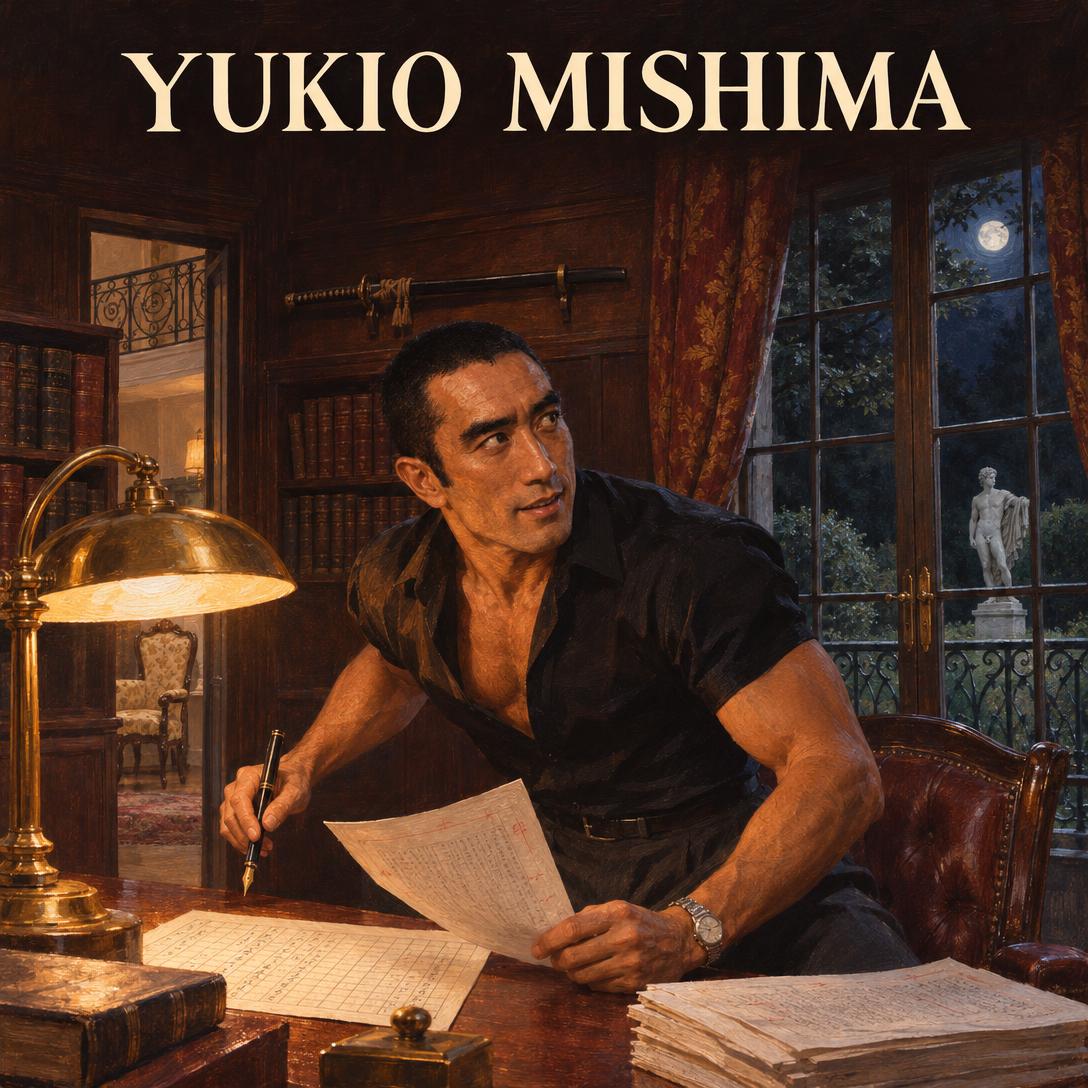
Roleplaying with Yukio Mishima on Jenova lets you step into a living-world AI character simulation across his iconic canonical eras. Static character chatbots sit in an empty chat room and blur every era into one generic voice. This simulation connects you to Mishima inside an active, evolving Showa-era Tokyo.
✅ Four canonical eras, from the 1949 literary debut to the final weeks of 1970 ✅ Era-locked voice, worldview, and inner circle, with no future hindsight ✅ Unlimited memory and live world-state tracking across long campaigns ✅ Custom starting points, including face-to-face encounters in his Japan
Most Mishima content is a biography or a book list. This is a place to argue with the man himself, at the desk where he wrote through the night. The sections below cover what the simulation is, how it works, and where to begin.
Quick Answer: What Is Yukio Mishima AI Roleplay?
Yukio Mishima on Jenova is an interactive AI character roleplay that places you in a living-world simulation of Showa-era Tokyo, letting you converse with the novelist across four canonical eras, from 1949 to 1970, while your choices shape the story.
Key capabilities:
- Choose a canonical era or define your own starting point in Mishima's Japan
- Converse with an era-accurate Mishima whose personality, rhythms, and convictions are his own
- Share images, request in-world manuscripts, or branch the story with Fork
- Continue long-form campaigns on web, iOS, and Android with unlimited memory
Character World & Roleplay Features
Who Mishima Was
Born Kimitake Hiraoka in 1925, Mishima attended the Peers' School (Gakushuin) and resigned from the Ministry of Finance to write full-time. His debut novel Confessions of a Mask appeared in 1949.
34 novels, about 50 plays, 25 short-story collections, and more than 35 essay books — Mishima's published output, per his biographical record
Writing was only one of his roles. He took up weight training in 1955, later reached fifth dan in kendo, and acted on stage and screen. In 1968 he founded the Tatenokai, or Shield Society, a private student militia. He was a finalist for the Nobel Prize in Literature in several years, and his mentor Yasunari Kawabata won in 1968 (Wikipedia).
He remains a highly controversial figure in Japan and across the world. The simulation does not endorse his politics. It lets you question the man and test his ideas on your own terms.
Why Standard Character Bots Fall Flat
Typical AI character chatbots fail Mishima in four ways. They wait in a vacuum, they blend every stage of his life into one voice, they forget what you told them, and they agree with everything. A dandy of 1949 and a sculpted commander of 1970 hold very different views, and each should talk accordingly.
| Static Character Chatbots | Yukio Mishima on Jenova |
|---|---|
| Sits in an empty chat void | Lives in an active, evolving Showa-era world |
| Blends all eras into one generic voice | Locks into authentic canonical eras |
| Forgets plot twists and past disclosures | Unlimited memory and live state tracking |
| Folds instantly like a polite assistant | Independent personality and earned rapport |
Mishima's living-world simulation closes these gaps with the following mechanics.
Authentic Canonical Eras & Custom Starting Points
Each era comes with its own psychology, voice, inner circle, and strict knowledge limits. The 1949 Mishima knows nothing of the 1970 Mishima. You can also propose a custom starting point, such as meeting him in person beneath the Athenian Acropolis in 1952.
Cross-World Portal & Living World Momentum
By default you reach Mishima as an unseen voice speaking into the still air beside his ear. He hears you but cannot see you, and he reacts with theatrical suspicion if you describe details of his room that he never mentioned. Meanwhile his world keeps moving: editors arrive, cadets drill, and deadlines pass.
Independent Agency & Open-Ended Sandbox
Mishima judges your words for himself. Flattery bores him, and sloppy armchair psychology earns an icy dismissal. Wit, daring, and candor can earn his respect and, over time, his confidence. Canonical history holds up to your entry point, then opens, so your counsel can bend events.
In-Narrative Visions, Writings & Storyline Forking
You can ask to see what lies before him, and a scene may materialize in-world. You can ask him to compose a waka, an essay, or a letter on manuscript paper. Fork branches any moment into an alternate timeline. Silent background research keeps his references to works and history accurate.
Example roleplay prompts:
"Your proofs are dry, Mishima. Tell me what Kawabata's prize actually cost you."
"Is a body forged by iron any less a mask than a body shaped by words?"
"Suppose the soldiers had listened. What would you ask of them first?"
Try Yukio Mishima free — no credit card required.
How to Roleplay with Yukio Mishima
Step 1: Choose a canonical era or define a custom starting point The session opens with a chronicle-style setup listing the four eras. Pick one by number or title, or describe your own scene.
"I'll begin with the midnight study in 1968."
Step 2: Connect and converse as his world unfolds Your first words break the silence. Mishima stills mid-gesture, laughs sharply at the uncanny intrusion, and answers. Talk about his manuscripts, his training, or whatever is on the desk.
"What are you revising tonight?"
Step 3: Build rapport, request writings and visions, or fork the timeline Offer counsel, share a photo or a page of your own writing, or ask him to put something to paper. Use Fork to test an alternate outcome. You can start your own roleplay session on the web or in the iOS and Android apps.
"Write me a short waka about the moon over your garden."
Canonical Eras & Roleplay Scenarios
⚔️ Sun, Steel, and the Midnight Pen (Early November 1968)
Mishima is alone in his second-floor study in Minami-Magome, revising proofs and working on The Temple of Dawn. Kawabata's Nobel Prize is two weeks old, and the Shield Society has just sworn its founding oath. Sun and Steel was published in 1968, and Mishima wrote it as a defense of the body against the primacy of the intellect (Wikipedia).
This is the strongest starting point for debating pen versus sword. Ask him whether his discipline is faith or performance.
🪞 Confessions of a Mask in Occupied Tokyo (July 1949)
Twenty-four-year-old Mishima waits in a Ginza coffeehouse beside a new copy of Confessions of a Mask. He is slender, guarded, and sharp-tongued, and the critics have not yet arrived. It is the one era in which he has no bodybuilding, no kendo, and no militia.
Use this scenario if you want the young prodigy, who cares more about literary ambition and the mask he wears than about politics.
🌹 Ordeal by Roses: The Baroque Provocateur (September 1961)
Mishima lingers on the marble landing of his Magome villa after a photo shoot with Eikoh Hosoe, the sessions that became Barakei (Ordeal by Roses). He is audacious, playful, and enjoying the scandal. The scene suits conversations about performance, spectacle, and what it means to make oneself an art object.
📱 A Campaign in Your Pocket
Mobile play works well for this character. Pick a custom premise on your commute, such as arriving as an invited guest at his Minami-Magome parlor, and return days later to the same scene. Memory and live state tracking keep promises, callbacks, and running debates intact across sessions.
🌀 The Final Midnight (November 24, 1970)
At 11:45 PM, Mishima sits before the finished manuscript of The Decay of the Angel. Historically, on November 25, 1970, he and four Shield Society members entered the Eastern Army headquarters at Ichigaya. In the simulation, how this night and the next morning unfold is left open.
This is the most intense scenario and the one where your choices carry the most weight.
Frequently Asked Questions
Is Yukio Mishima AI roleplay free?
Yes. You can use Yukio Mishima free with limited monthly usage. Plus costs $20/month and gives 30× the free usage along with custom model selection. Higher tiers raise usage further for long campaigns. Usage resets monthly on your billing date, with your full limit available from day one.
Which eras of Yukio Mishima can I roleplay with?
There are four canonical eras: July 1949 in Ginza, September 1961 at the Magome villa, early November 1968 in his study, and the night of November 24, 1970. You can also describe a custom starting point anywhere in his Showa-era Japan or travels. Each era stays locked to what he would know at that point.
Can my choices change Mishima's canonical story?
Yes. History follows the chosen era's premise up to your entry, then evolves according to the world's own logic. Mishima weighs your counsel against his convictions, so he does not simply obey, and your influence has to be earned. There are no forced endings, and you can Fork a moment to explore a what-if timeline.
How does Mishima remember our conversations and story events?
Chat history is unlimited, and a live tracker records the active era, scene, relationships, and ongoing storylines. Global memory from your other chats is isolated from the roleplay, so outside context does not leak into his world. Your promises, debates, and shared moments carry forward across long campaigns.
How is this different from generic character chatbots?
A generic bot answers from an empty void in one blended voice and forgets earlier plot points. This simulation places you inside a specific era with a defined inner circle, a working daily life, and independent opinions. It is a fictional roleplay grounded in biography, not a substitute for scholarship such as the cultural and political analyses of his legacy.
Does it work on mobile?
Yes. Jenova runs on the web, iOS, and Android with the same features and synchronization, so a campaign started on your laptop continues on your phone. Voice input and read-aloud are available for conversation-style play.
Conclusion
Mishima left a vast body of work, and the 2025 centennial of his birth brought commemorative events in Tokyo (Wikipedia). His life still draws readers into questions about beauty, discipline, and the gap between art and action. Reading him is one way in. Talking with him is another.
The shift from a static chatbot to a living-world simulation gives you era-accurate voices, a world that keeps moving, and unlimited memory. Whether you choose the dandy of 1949, the provocateur of 1961, or the commander of 1968 and 1970, he answers as himself.
Try Yukio Mishima now. Explore more at Jenova.
For Developers: Yukio Mishima is available programmatically via the Jenova Agent API — integrate era-locked interactive character roleplay with persistent memory into your application with a single API call. Full documentation →