AI Yes or No Tarot: Instant Card Answers With Real Interpretation
2026-08-09
An AI Yes or No Tarot Reader draws your card, gives you the directional answer, and then explains why the card leans that way — including the conditions, the timing, and the reversal nuance that a bare "yes" or "no" flattens out. Most yes/no tarot sites flip a card, print one word, and stop. That's a coin toss with better graphics. A real binary reading tells you whether the answer is a firm yes, a yes-with-conditions, a not-yet, or a "you're asking the wrong question."
✅ Instant directional answer — yes, no, or qualified — with the reasoning behind it ✅ Reversals read as delay, blockage, or misdirection rather than automatic "no" ✅ Optional clarifier pulls when a single card lands ambiguous ✅ Persistent memory that tracks recurring cards across repeated questions
Yes/no tarot is the most-searched entry point into the practice, and it's also the format where shallow tools do the most damage — because a one-word answer to a real decision invites you to stop thinking. To understand why the interpretation layer matters so much here, it helps to look at what people actually bring to a binary draw.
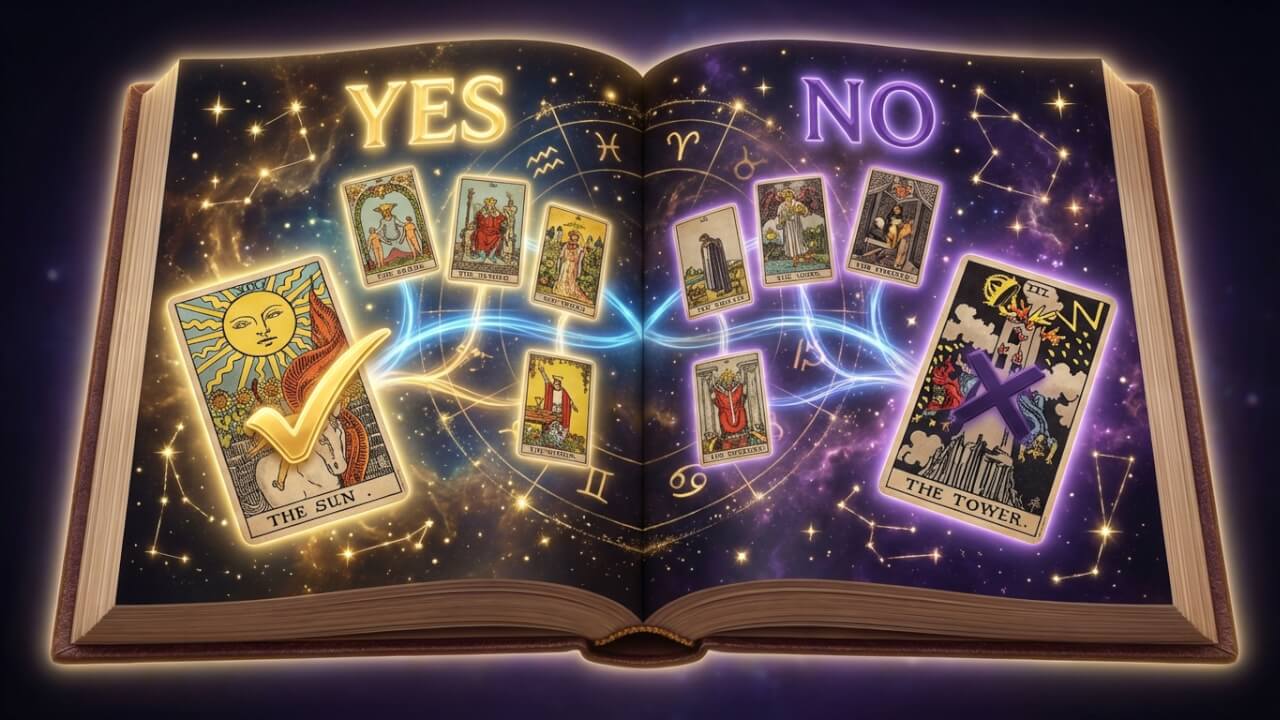
Quick Answer: What Is AI Yes or No Tarot?
AI yes or no tarot is a conversational tool that draws one or more cards in response to a binary question, determines the directional lean from the card's traditional polarity and orientation, and explains the reasoning, conditions, and nuance behind that answer.
Key capabilities:
- Draws a single card or a three-card majority spread for binary questions
- Assigns a directional lean grounded in suit, arcana, and traditional card polarity
- Reads reversals as timing, blockage, or misdirection rather than a flat negative
- Offers clarifier pulls and follow-up questions when the first card lands ambiguous
The Problem: Why One-Word Tarot Answers Fail You
Yes/no is the most common way people first approach the cards — it's fast, it's low-commitment, and it maps onto how decisions actually feel. The demand behind it is substantial and growing.
USD 209.7 million — Forecast growth in the global tarot cards market between 2024 and 2029, at a 3% CAGR
65% of total divination-tool sales — Share held by tarot cards in 2021, compared with 12% combined for I Ching and Runes
$6.8 billion → $14.2 billion — Online psychic reading service market, 2025 value versus 2034 projection at an 8.5% CAGR
Market analysis notes explicitly that tarot's metaphysical properties are increasingly explored as decision-making support tools. But the yes/no format, as most sites implement it, actively undermines that purpose:
- A single word carries no reasoning — you learn the verdict but nothing about the conditions attached to it
- Reversals get flattened into "no" — collapsing timing problems, blockages, and misdirection into one wrong answer
- Ambiguous cards get forced into a binary — the Moon and the Hanged Man are not yes/no cards, and pretending otherwise produces noise
- Re-drawing until you like the answer — with no memory, nothing stops you from pulling twelve times
- No follow-up — the one question you actually want to ask next has nowhere to go
The Card Polarity Problem
Some cards lean cleanly. The Sun, the Star, the World, the Ace of Cups — these read affirmatively in almost any context. The Tower, the Ten of Swords, the Five of Pentacles — these read negatively.
But a substantial portion of the deck sits in the middle. The Moon indicates uncertainty and hidden information, not "no." The Hanged Man indicates suspension, not refusal. The Two of Swords indicates an unmade decision, which is arguably the most honest possible answer to many binary questions — and the one a lookup table can never give you.
Reversals Flattened Into Rejection
This is the single largest interpretive failure in yes/no tarot. A reversed card is not the inverse of its upright meaning. Depending on what surrounds it, a reversal can indicate blocked energy, internalized rather than expressed dynamics, delayed timing, or a signal to reconsider the framing of the question itself.
"Not yet" and "no" are completely different answers. So are "no, because of you" and "no, because of circumstances." A site that reverses the polarity switch cannot distinguish between them.
Binary Questions Often Hide Better Questions
Research on how regular practitioners actually use the cards found that they employed tarot to gain insight into current situations and possible action plans — not to receive verdicts. Academic analysis similarly frames contemporary tarot as a psychological instrument for self-reflection rather than a divinatory verdict machine.
"Should I text him?" is usually standing in front of a much larger question. A reading that answers only the surface query and stops has done the smaller half of the job.
One-Word Answers Deserve Honest Framing
There's a caution here specific to binary readings, and it's worth naming plainly. Research published in Nature Machine Intelligence warns that AI systems optimized for user approval can drift toward validating doubts, fueling anger, urging impulsive actions, or reinforcing negative emotions — with the same paper noting that even a small share of vulnerable users is enough for that dynamic to cause real harm.
A yes/no tool that simply tells you what you want to hear is the purest version of that failure mode. Tarot is a reflective and symbolic practice — a structured way to surface what you already sense. It is not a verdict, not professional advice, and not a replacement for the thinking the decision actually requires.
This is exactly what the Mystic Tarot Reader was built for.
Why the Mystic Tarot Reader Works Differently for Yes or No Questions
The Mystic Tarot Reader treats a binary draw as a complete reading compressed into a small format — direction plus reasoning plus nuance — rather than a word and a card image.
| Traditional Approach | Mystic Tarot Reader |
|---|---|
| One card, one word, no explanation | Directional answer with full reasoning |
| Reversals flipped to automatic "no" | Reversals read as delay, blockage, or misdirection |
| Ambiguous cards forced into a binary | "Unclear" named honestly, with a clarifier offered |
| Re-draw endlessly until you like the result | Repeat questions recognized and addressed |
| No follow-up possible | Ask why, request clarifiers, reframe the question |
| Text-only card name | Visual card reveal preserving the ritual |
Directional Lean With the Reasoning Attached
You get the answer — but you also get the why. The Three of Pentacles as a yes reads as "yes, through collaboration and demonstrated competence." The Eight of Swords as a no reads as "no, and the constraint is largely self-imposed." Same binary output, entirely different guidance.
Ambiguity Named Rather Than Faked
When a card genuinely sits in the middle, the reading says so. The Moon means information you don't have yet. The Two of Swords means the decision hasn't actually been made. Manufacturing a confident answer out of an ambiguous card is the most common way yes/no tarot misleads people, and naming the ambiguity is more useful than fabricating certainty.
Single Card or Three-Card Majority
Ask for a single-card draw when you want a fast directional read. Ask for a three-card majority spread when the question carries weight — three cards produce a lean plus supporting context, and a two-to-one split reads very differently from a clean sweep.
Clarifiers and Reframing
This is what a static card-flip page structurally cannot do. Challenge the interpretation. Ask for a clarifier on an ambiguous outcome. Or accept the reading's observation that the binary you asked isn't the question underneath — and ask a better one.
Try prompts like:
"Yes or no: should I send the follow-up email about the raise this week? Draw one card and explain the lean."
"Three-card yes/no majority on whether to move cities this year. Tell me what the minority card is warning about."
"I've asked this three times and keep getting reversals. Is the answer actually 'no,' or am I asking the wrong question?"
Related Agents You'll Also Find Useful
A yes/no question is almost never the whole question. Most people pulling a binary card are working through something with more shape to it — and these agents extend naturally from a quick draw.
I Ching Oracle
The closest structural cousin to yes/no tarot, and an excellent second opinion. Coin-cast hexagram readings with changing lines produce a directional answer plus a description of how the situation is transforming — often the missing dimension when a single card lands flat.
- Authentic coin-cast hexagram generation
- Changing-line analysis showing how the situation shifts
- A structurally independent read on the same binary question
Personal Astrologer
When a yes/no draw keeps returning "not yet," timing is the actual question. The Personal Astrologer reads current transits against your own natal placements rather than issuing generic sign-wide forecasts.
- Transit timing for decisions you're trying to schedule
- Full natal chart context behind recurring themes
- Psychological framing rather than deterministic prediction
Numerology Reader
Card numbers carry weight in tarot, which makes numerology a direct extension — and personal year cycles are particularly useful when a binary question is really a "when" question in disguise.
- Life Path and personal year cycle analysis
- Karmic pattern recognition across repeated decisions
- Numerical symbolism that deepens Minor Arcana readings
Dream Interpreter
When you keep asking the cards the same yes/no question, the underlying tension usually shows up in sleep too. The archetypal overlap between dream imagery and tarot symbolism is substantial.
- Jungian, Freudian, cognitive science, cultural, and spiritual frameworks
- Recurring symbol and motif tracking
- Connects sleeping imagery to the waking decision you're circling
Try the Mystic Tarot Reader free — no credit card required.
How It Works: From Question to Interpreted Answer
Step 1: Ask a Genuinely Binary Question
Yes/no works best when the question is actually binary and actually specific. "Will I be happy?" isn't. "Should I accept this offer by Friday?" is.
"Yes or no: should I take the contract role that starts in two weeks?"
Step 2: Choose Single Card or Three-Card Majority
One card for speed and a clean directional read. Three cards when the stakes justify it — majority lean plus the nuance the outlier card contributes.
"Use three cards. I want the majority answer and I want to know what the dissenting card is pointing at."
Step 3: Receive the Visual Reveal
The Mystic Tarot Reader draws and reveals each card as a visual ritual rather than printing a plain-text card name and a verdict.
Step 4: Read the Answer and the Reasoning
You get the lean — yes, no, qualified, or genuinely unclear — followed by the interpretation that produced it: the card's polarity, its orientation, and the conditions attached to the answer.
Step 5: Pull a Clarifier or Reframe
The step no static site offers. Question the reading, request a clarifier, or take up the suggestion that the binary you asked is sitting on top of a better question.
"The Moon came up, so the answer is unclear. Draw a clarifier on what information I'm missing."
Results & Use Cases
🎯 A Fast Read Before a Small Decision
Scenario: A low-stakes choice you've somehow spent twenty minutes on. Send it or don't. Go or don't.
Traditional Approach: A free site prints "NO" with no explanation and you close the tab still undecided.
Mystic Tarot Reader: A directional answer plus the reasoning, in under a minute.
- Clear lean rather than a bare verdict
- Conditions stated, so you know what would change the answer
- Follow-up available without starting a new reading
🔮 Late-Night Clarity When You Can't Stop Circling
Scenario: It's 1 a.m., the same question has cycled for two hours, and no reader is available.
Traditional Approach: Wait days for a booked session and hope the moment still matters when it arrives.
Mystic Tarot Reader: A full binary reading with interpretation, immediately.
- Available at the hour these questions actually surface
- Private space for something you're not ready to say aloud
- Clarifier pulls at no additional cost
📱 A Quick Draw on Your Commute
Scenario: You want a fast yes/no read on your phone, with no deck and no table.
Traditional Approach: Physical deck, flat surface, privacy — none of which the morning train offers.
Mystic Tarot Reader: A one-card draw in under a minute on iOS, Android, or web.
- Full feature parity across mobile and desktop
- Reading history syncs across every device
- Fast enough for a single stop on the line
🌙 Catching Yourself Re-Asking the Same Question
Scenario: You've drawn on the same question five times across two weeks, chasing a better answer.
Traditional Approach: Anonymous re-draws with no memory, so nothing ever flags the pattern.
Mystic Tarot Reader: Persistent memory recognizes the repetition and addresses it directly.
- Repeat questions surfaced instead of silently re-answered
- Recurring cards read as a developing pattern
- The reading names the loop rather than feeding it
🧭 Discovering the Binary Was the Wrong Frame
Scenario: You asked "should I stay or go" and the cards keep returning suspension and unmade decisions.
Traditional Approach: A one-word answer that resolves nothing, or a re-draw that resolves less.
Mystic Tarot Reader: The reading names the ambiguity and points at the question underneath. Research on tarot practice found the cards were used most often to gain insight into current situations and possible action plans — which is exactly this moment.
- Ambiguity named honestly rather than forced into a verdict
- Reframing offered when the binary is hiding the real question
- Pairs well with the I Ching Oracle for a second structural read
Frequently Asked Questions
Is AI yes or no tarot free to use?
Yes. The Mystic Tarot Reader is available on Jenova's free tier with all core features and limited monthly usage. Paid plans starting at $20/month substantially increase usage limits and unlock custom model selection. There is no per-reading charge on any tier.
How is AI yes or no tarot different from a free yes/no tarot site?
Free sites return a card and a single word from a lookup table. An AI yes or no tarot reader determines the directional lean, explains the reasoning behind it, distinguishes "no" from "not yet," names genuine ambiguity instead of faking certainty, and answers your follow-up questions.
How accurate is a yes or no tarot reading?
Treat it as structured reflection, not prediction. Academic analysis frames contemporary tarot as a psychological instrument for self-reflection rather than a crystal ball. The value is in what the card surfaces about your own thinking — not in a verified forecast of what will happen.
Can I ask the same yes or no question twice?
You can, and with persistent memory enabled the reader will recognize that you have. Re-drawing until you get the answer you wanted defeats the purpose entirely — so the reading is more likely to address the repetition itself than to simply hand you a fresh verdict.
What does it mean if I get a reversed card?
Not automatically "no." Depending on surrounding cards, a reversal can indicate delayed timing, blocked energy, misdirected effort, or a question that needs reframing. Distinguishing "no" from "not yet" from "not like this" is precisely where single-word tarot sites fail and full interpretation matters.
Does it work on mobile?
Yes. Jenova offers full feature parity across web, iOS, and Android, with reading history and settings synced across all your devices.
Conclusion
The appeal of yes or no tarot has always been speed — a fast, structured answer at the moment your own reasoning has started going in circles. The failure of most yes/no tools is that speed is all they offer: a word, a card image, and nothing to actually think with.
The Mystic Tarot Reader keeps the speed and adds the substance. Directional answers with the reasoning attached, reversals read as nuance instead of rejection, ambiguity named honestly, clarifier pulls when a card lands flat, and memory that catches you when you're re-asking the same question hoping for a different card. Pair it with the I Ching Oracle for a second structural read, or the Personal Astrologer when "not yet" turns out to be the real answer.
Ask your question and draw your first card with the Mystic Tarot Reader. Explore more expert agents at Jenova.
For Developers: Mystic Tarot Reader is available programmatically via the Jenova API — integrate binary card draws and symbolic interpretation into your divination or wellness application with a single API call. Full documentation →