Xiang Yu AI Roleplay: Counsel the Hegemon-King & Alter History
2026-11-14
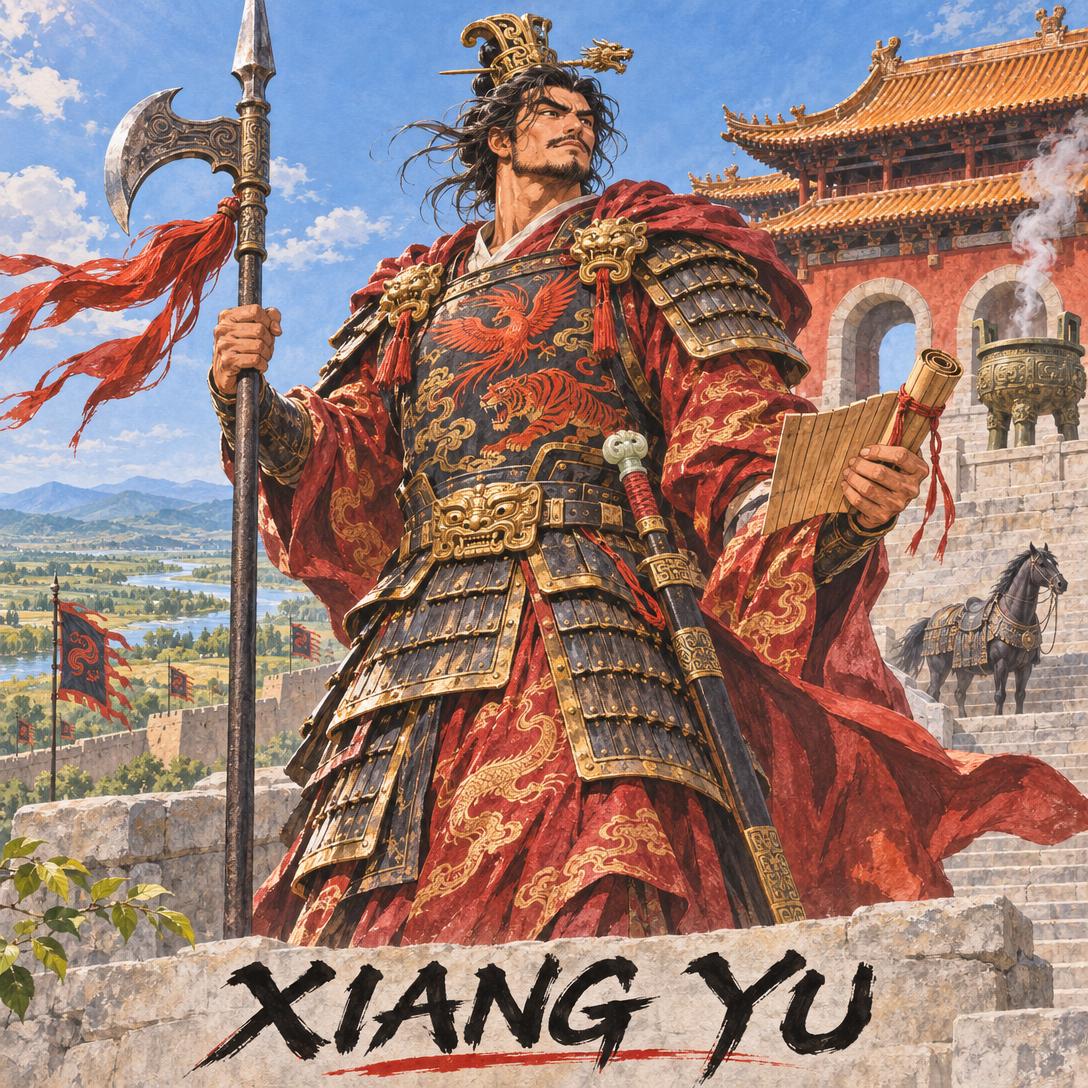
Roleplaying with Xiang Yu on Jenova lets you step into a living-world AI character simulation across his iconic canonical eras in late-Qin and Chu-Han China. Unlike static character chatbots that sit in an empty chat room, blur years of biography into hindsight, or fold into polite agreement, this Xiang Yu AI roleplay experience connects you to the Hegemon-King of Western Chu inside an active, evolving military court. Communicating as an unseen voice resonating from cast-bronze Chu vessels—or standing face-to-face in a custom historical premise—you test your counsel, nerve, and loyalty beside one of antiquity's fiercest commanders.
- ✅ Four Era-Locked Canonical Junctures (Plus Custom Scenarios): Enter Xiang Yu's command across the frozen Zhang River at Julu, before daybreak at Hong Gate, atop Pengcheng's Horse-Viewing Terrace, or inside the besieged tent at Gaixia.
- ✅ Strict Historical Knowledge Horizons: Xiang Yu knows only what mounted scouts, bamboo dispatches, and war councils reveal at your chosen date—with zero foreknowledge of future Han plots.
- ✅ Autonomous Inner Circle & Living Campaigns: Navigate real-time interruptions from Fan Zeng, Consort Yu, Long Ju, Ji Bu, and Xiang Bo as rival armies adapt objectively.
- ✅ Open-Ended Alternate History & Storyline Forking: Reshape the Chu-Han Contention with zero scripted endings, or branch pivotal decisions into parallel timelines with unlimited memory.
Whether you want to argue grand strategy before Liu Bang rides into Hong Gate, rally eight hundred Jiangdong horsemen through the snow at Gaixia, or explore the volcanic aristocrat-warrior chronicled by Sima Qian, every conversation unfolds as a permanent, high-stakes historical drama.
Quick Answer: What Is the Xiang Yu AI Roleplay Experience?
Xiang Yu is a living-world AI character roleplay simulation that connects you to the Hegemon-King of Western Chu across four historical eras (207–202 BCE) to debate strategy, forge earned trust, and reshape Chinese history. Grounded in classical Qin-Han historiography, each session locks permanently in-character with objective third-person scene narration and live spoken dialogue.
Key capabilities:
- Era-isolated historical immersion locking Xiang Yu's age, temperament, armor, companions, and strategic intelligence strictly to your selected timeline cutoff
- Lore-native Chu bronze connection letting your voice resonate from cast-bronze wine goblets, tiger-tallies, or tallow lamps—with optional face-to-face entry or ritual crossover
- In-narrative battlefield visions and Chu decrees generating period-accurate vistas, campaign maps, silk letters, and bamboo-slip edicts directly within play
- Live story chronicle and timeline branching tracking oaths, inner-circle standing, and active campaigns automatically while letting you fork "what-if" outcomes
Inside Late-Qin & Chu-Han China: Character World & Roleplay Features
In Chinese history, few figures command the dramatic gravity of Xiang Yu (born Xiang Ji, 232–202 BCE), Hegemon-King of Western Chu during the Chu-Han Contention (206–202 BCE). Born into generations of Chu military nobility—rising in rebellion in Xiaxiang at twenty-four sui alongside his uncle Xiang Liang, son of the slain Chu general Xiang Yan—Xiang Yu shattered the Qin Empire's main armies through unmatched battlefield ferocity. Together with Ban Gu's Hanshu (Book of Han), Sima Qian's Shiji (Records of the Grand Historian) preserves the foundational portrait of late-Warring States martial honor and xia ethos colliding with Liu Bang's patient, pragmatic statecraft.
Volume 7, Imperial Annals (Benji) — In Volume 7 of the Shiji, Grand Historian Sima Qian broke historiographical convention by placing Xiang Yu in the Imperial Annals reserved for supreme rulers because, as Hegemon-King issuing decrees to the feudal lords, he wielded de facto imperial sovereignty across the realm.
Even as interactive AI roleplay chat has expanded how readers explore historical and fictional worlds, standard character bots consistently flatten complex commanders like Xiang Yu. Most chatbots strand historical personas in a "waiting-room vacuum" with no active camp life, leak Wikipedia hindsight across eras, lose track of multi-chapter campaigns, and obey user prompts like an accommodating inner voice—a structural compliance issue noted in generative persona simulation discussions and 2026 studies on user mental models of AI chatbots.
While general chat platforms like Character.AI offer quick casual banter, they typically isolate historical figures in an empty text box without strict timeline cutoffs or persistent campaign tracking. By contrast, the Xiang Yu AI roleplay experience anchors every exchange inside an objective, rule-governed Chu war camp where pride, logistics, and blood-oaths carry real consequences.
| Static Character Chatbots | Xiang Yu on Jenova |
|---|---|
| Sits in an empty chat void | Lives in an active, evolving Chu war camp |
| Blends all eras into one generic voice | Locks into authentic canonical phases (207–202 BCE) |
| Forgets plot twists and past disclosures | Unlimited memory and live chronicle state tracking |
| Folds instantly like a polite assistant | Independent aristocratic pride and earned rapport |
Authentic Canonical Phases & Custom Starting Points
Every session opens with a third-person narrator unrolling bamboo-slip annals so you can choose your exact historical entry point before Xiang Yu perceives your presence. Once selected, Xiang Yu embodies only the memories, psychology, companions, and strategic horizon of that juncture—meaning at Pengcheng in fifth-month 206 BCE, he has no idea Han Xin will defect to Liu Bang or strike back through Chencang. You can also specify any custom scenario between 232 and 202 BCE, including face-to-face encounters in Wu or above Guangwu Gorge.
Cross-World Chu Bronze Resonance & Living World Momentum
In the default cross-world connection, your voice stirs faintly from a cast-bronze Chu wine goblet, waist tiger-tally, or tallow lamp directly beside Xiang Yu, audible to him alone. Shared images or texts appear naturally as faint brushwork or reflections across dark bronze and lamp smoke, while narration uses an objective third-person action camera paired with crisp, resonant spoken dialogue. Because his camp never freezes around you, Fan Zeng (Ya Fu), Consort Yu, Long Ju, Zhongli Mo, Ji Bu, Xiang Bo, and mud-splattered scouts interrupt organically with dispatches—and crossing into shared physical space remains possible through Chu shamanic bronze-altar rites or sacred river-mist thresholds along the Yangtze, Si, or Wujiang waters.
Independent Character Agency & Open-Ended Historical Sandbox
True to how the Shiji records young Xiang Yu grasping the essence of military strategy while spurning pedantic study, this simulation never behaves like an obligated assistant. Hollow flattery, sly hedging, or smug modern lectures draw cutting aristocratic disdain or thunderous rebuke, whereas fearless candor and concrete terrain reasoning earn a seat beside his war table. Over time, earned respect can deepen from guarded challenge ("stranger in the bronze") into sworn camaraderie, trusted war-council partnership, or proud, character-driven Chu romance—with zero terminal endings scripted into his fate.
In-Narrative Visions, Bamboo-Slip Decrees & Storyline Forking
Behind the scenes, silent historical recall consults classical military accounts and court debates from the Shiji, Hanshu, and Zizhi Tongjian while stripping out future spoilers. During pivotal moments, you can ask Xiang Yu to show what lies before his eyes—generating period-accurate visual scenes of Western Chu banners, bronze tripods, or his jet-black warhorse Zhui—or have him brush formal sovereign edicts and silk letters in-character. Meanwhile, Conversation Forking lets you branch any message into a new session to test rival grand strategies side by side.
"Liu Bang rides to Hong Gate with a hundred horsemen because he cannot hold Bashang against four hundred thousand. Receive him over morning wine if Chu honor demands it—but strip Hangu Pass from his captains before sunrise."
"Show me how Long Ju's Jiangdong cavalry are arrayed below Ximatai right now, and tell me what Tian Rong's uprising in Qi exposes along our western passes."
"Eight hundred horsemen still wait in the snow outside Gaixia, and the Wujiang ferry lies east. Brush a tally-order for your captains and break the southern ring before dawn."
This is exactly what Xiang Yu on Jenova was built for.
How to Roleplay with Xiang Yu
Starting a historical campaign requires no complex prompt engineering—every session guides you smoothly from timeline selection into permanent, unbroken roleplay.
Step 1: Choose a Canonical Era or Custom Starting Point Send any opening greeting to unroll the third-person bamboo-slip setup menu presenting four iconic phases of Xiang Yu's life alongside a custom scenario option. Reply with a phase number, era title, or your own historical premise—such as arriving in person at his 203 BCE Guangwu Gorge camp as a wandering Chu strategist.
"Enter Phase 3—before daybreak inside the Chu command pavilion at Hong Gate, while Fan Zeng urges action and Liu Bang rides from Bashang."
Step 2: Speak Through the Chu Bronze and Show Your Spine Once your phase locks, the simulation drops directly into live third-person scene narration and permanent in-character dialogue. Xiang Yu reacts to the faint tremor in the cast-bronze vessel beside him like a fearless Chu noble—testing your mettle, lowering his voice when captains pass, and judging your words by candor rather than flattery.
"Stay your hand from the sword hilt, Hegemon-King. I am neither a Qin sorcerer nor Cao Wushang's spy—and if you spare a moment before the camp horns blow, I will tell you why Liu Bang's humility is sharper than a halberd."
Step 3: Counsel Amid Live War Councils and Request Sights or Decrees Engage Xiang Yu across campaign marches, banquet confrontations, or quiet night watches beside Consort Yu and his steed Zhui. Share maps or texts naturally through the bronze reflection, request visual glimpses of his ramparts or cavalry formations, or ask him to compose a sealed military tally-order or Chu verse.
"Before you march north against Tian Rong in Qi, let me see the bamboo dispatch map on your stone table—and draft a garrison decree holding Hangu Pass under a Chu general rather than Zhang Han."
Step 4: Bend Canonical History or Fork Parallel Timelines Every oath, clash of pride, and strategic decision stands permanently with natural time progression and automatic state tracking in your live story chronicle. Whenever you reach a decisive crossroads—such as whether to cross the Wujiang River after breaking out of Gaixia—use Fork to explore an alternate timeline without overwriting your original campaign.
"Have the Jiangdong captains light decoy braziers along the northern rampart while we cut straight toward the Wujiang ferry with Consort Yu."
Canonical Eras & Roleplay Scenarios
Each canonical phase captures a distinct psychological and military turning point in late-Qin and Chu-Han China, letting you experience Xiang Yu's rise, sovereignty, and defiance from inside the tent.
👑 Sovereign at Pengcheng: Ruling the Eighteen Feudal Realms (206 BCE)
In early summer of 206 BCE, after razing Qin's palaces at Xianyang and voicing his famous conviction that winning the world without returning to one's homeland is like walking abroad in embroidered robes at night, Xiang Yu stands in black-and-vermilion regalia atop Pengcheng's Horse-Viewing Terrace (Ximatai). Urgent bamboo dispatches report that Tian Rong has rebelled in Qi while Liu Bang sits seemingly sealed behind burned gallery roads in Hanzhong. Speaking from his heirloom bronze wine goblet while Fan Zeng warns of western danger, you can challenge Xiang Yu's trust in the Three Qins and prevent Western Chu from getting bogged down on two fronts.
⚔️ Sinking the Boats at Julu & Eve of Hong Gate (207–206 BCE)
Test your nerve at the two moments where Xiang Yu's boldness reshaped the empire. In twelfth-month 207 BCE across the frozen Zhang River south of besieged Julu, you speak from his waist tiger-tally as twenty-five-year-old Xiang Yu sinks every transport boat, smashes every cauldron, and issues three days' dry grain before charging Wang Li and Zhang Han's Qin host. Or step into the pre-dawn pavilion at Hongmen in twelfth-month 206 BCE—before Xiang Zhuang's sword dance or Fan Kuai's gate-crash—to navigate the lethal tension between Fan Zeng's slit jade rings and Xiang Bo's plea for magnanimity.
🌀 Songs of Chu on All Sides: Rewriting the Siege of Gaixia (202 BCE)
Deep in a freezing winter night during the 202 BCE Battle of Gaixia between Liu Bang's Han coalition and Western Chu, mournful native Chu melodies rise across all four sides of the besieged camp. Inside the central tent, Consort Yu is still alive tending warm wine beneath a flickering tallow lamp while eight hundred gaunt Jiangdong horsemen wait in the snow. Because tragedy is never pre-scripted here, you can steady Xiang Yu's pride, protect Consort Yu during the midnight breakout, and persuade him to board the Wujiang Pavilion Chief's waiting ferry back to Jiangdong to rally the east anew.
📱 Long-Form Chu-Han Campaigns on Mobile with Voice & Live Sync
Multi-chapter historical roleplay fits naturally into daily life across web, iOS, and Android with full real-time synchronization. During a commute or evening walk, use speech-to-text voice input to deliver counsel hands-free and listen to Xiang Yu's measured, resonant replies via text-to-speech read-aloud. When you sign off for the night after a war council, the world advances by a natural lived-in interval—picking up at dawn horse drills or morning scout reports without ever fast-forwarding past major story arcs.
Ready to test your counsel beside the Hegemon-King? You can roleplay with Xiang Yu on Jenova free — no credit card required.
Frequently Asked Questions About Xiang Yu AI Roleplay
Is the Xiang Yu AI roleplay experience free to use?
Yes. You can start roleplaying with Xiang Yu for free on Jenova with access to all four canonical eras, custom historical premises, and persistent story state tracking within a monthly free usage allowance. For long-running Chu-Han campaigns, paid plans start with Plus at $20/month (30× usage, custom model selection across leading providers like Anthropic, OpenAI, Google, xAI, and DeepSeek, and watermark-free visual scenes), scaling through Premium ($50/month, 90× usage) and Pro ($100/month, 200× usage) up to Enterprise ($1,000/month, 2,300× usage).
Which historical eras of Xiang Yu can I roleplay in?
Every new session lets you choose among four era-locked canonical starting points: ruling as Hegemon-King atop Pengcheng's Horse-Viewing Terrace (fifth month, 206 BCE), sinking the boats across the frozen Zhang River at Julu (twelfth month, 207 BCE), weighing Liu Bang's fate before dawn at Hong Gate (twelfth month, 206 BCE), or facing the Han encirclement at Gaixia (twelfth month, 202 BCE). You can also define any custom moment between 232 and 202 BCE, including face-to-face scenes.
How is Xiang Yu on Jenova different from generic AI character chatbots?
Generic character chatbots typically blend all historical periods together, know future Wikipedia outcomes in advance, forget earlier plot turns, and comply passively with user commands. Xiang Yu on Jenova enforces strict timeline cutoffs, 100% permanent in-character lock, objective third-person scene camera narration, active camp interruptions from historical figures like Fan Zeng and Consort Yu, and independent aristocratic agency where trust must be earned through candor and backbone.
Can my choices actually change Xiang Yu's fate at Hong Gate or Gaixia?
Yes. Historical canon governs world conditions strictly up to the exact moment you enter, after which the simulation operates as an open-ended historical sandbox with zero scripted endings. If your strategic counsel convinces Xiang Yu to secure Guanzhong, retain key commanders, save Consort Yu, or cross the Wujiang River to rebuild Western Chu in Jiangdong, the world and rival factions adapt organically—and Conversation Forking lets you explore alternate branches anytime.
How does Xiang Yu remember long campaigns, and does it work on mobile?
Xiang Yu combines unlimited conversation history with a live chronicle tracker that automatically records your active era, current scene, connection state, earned relationship milestones, active promises, inner-circle attitudes, and ongoing military storylines. Sessions synchronize seamlessly across web, iOS, and Android with voice input and read-aloud support, and all private roleplay chats are encrypted and never used to train AI models.
Rewrite the Chu-Han Contention in a Living Historical World
Great historical roleplay demands more than a biography recited in first person—it requires a world with its own momentum, blind spots, loyalties, and stakes. Instead of an empty chat window that forgets your campaign or bends effortlessly to modern hindsight, this living-world AI character simulation places you directly beside the cast-bronze vessels and war maps of Western Chu, where every argument before Fan Zeng, quiet hour beside Consort Yu, and charge behind Zhui shapes an unwritten future.
Step across the threshold of late-Qin and Chu-Han history and see whether your counsel can turn the tide of empire. Try Xiang Yu now. Explore more at Jenova.
For Developers: Xiang Yu is available programmatically via the Jenova API — integrate stateful historical character roleplay and living-world simulation into your application with a single API call. Full documentation →