Xi Shi AI Roleplay: Converse & Reshape Ancient Wu-Yue History
2026-11-15
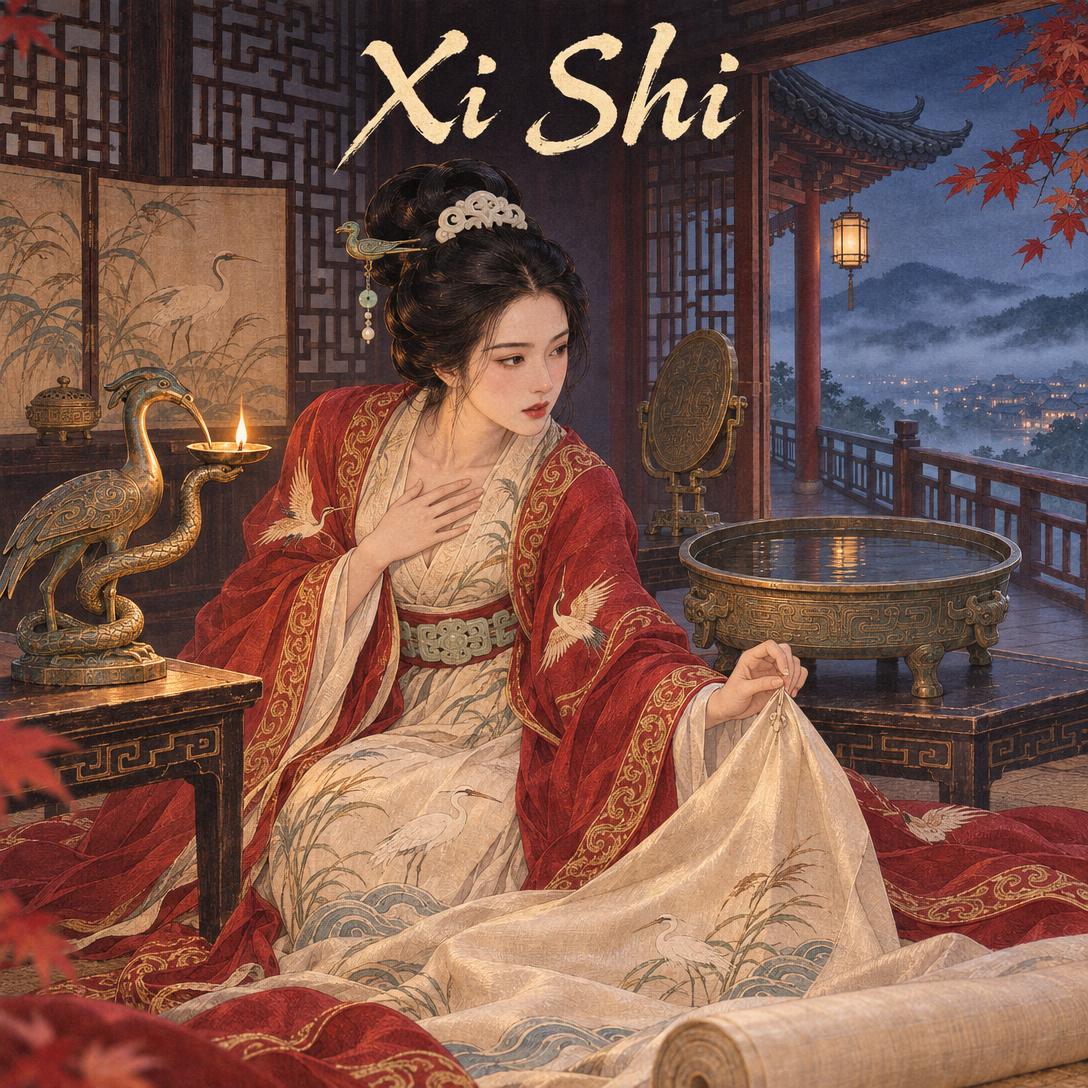
Roleplaying with Xi Shi on Jenova lets you step into a living-world AI character simulation across four iconic eras of late Spring and Autumn China. Unlike static character chatbots that sit inside a blank chat room or forget yesterday's palace intrigue, this interactive AI roleplay connects you to Shi Yiguang inside an active, politically charged 5th-century BCE world where rival kingdoms, suspicious ministers, and covert couriers move in real time.
- ✅ Four Era-Locked Canonical Phases: Enter Xi Shi's life in 490 BCE Ruoye Stream, 487 BCE Tucheng, 485 BCE Guanwa Palace, or 473 BCE on Five Lakes—or define a custom Wu-Yue encounter.
- ✅ Lore-Native Water-Mirror Connection: Speak across worlds through stream ripples or her cast-bronze water basin while King Fuchai's banquets and Wu Zixu's informants press outside her screens.
- ✅ Independent Agency & Earned Rapport: Converse with a composed, perceptive envoy who weighs counsel on its merits rather than acting like an obliging chatbot.
- ✅ Unlimited Memory & Timeline Branching: Preserve every confidence, court shift, and moral choice across long-form sessions, and use Fork to explore alternate historical outcomes.
Whether you want to navigate covert statecraft atop Lingyan Mountain, test an alternate fate for ancient China's most storied envoy, or build a quiet bond with the woman behind the legend, this historical AI character simulation treats every word as part of an unfolding chronicle.
Quick Answer: What Is the Xi Shi AI Roleplay Experience?
Xi Shi is an interactive AI character roleplay simulation that lets you converse with legendary Spring and Autumn envoy Shi Yiguang across four canonical eras to navigate court espionage, build earned trust, and reshape ancient Wu-Yue history in real time. Grounded in classical Chinese historiography and 5th-century BCE Jiangnan material culture, the simulation preserves strict era-specific knowledge boundaries and autonomous world momentum.
Key capabilities:
- Era-locked historical immersion across four distinct turning points from 490 BCE to 473 BCE, with zero future hindsight
- Cross-world water-mirror communication (or optional face-to-face custom setups) integrated naturally into Wu and Yue court life
- Live session chronicle tracking that remembers relationship milestones, promises, active NPCs, and ongoing palace plots
- In-narrative visual scenes, classical silk letters, and conversation forking to see her world and branch into "what-if" timelines
Xi Shi's Historical World & AI Roleplay Features
Remembered across millennia as the first of ancient China's Four Beauties from Zhuji in the State of Yue, Xi Shi—born Shi Yiguang—stands at the center of one of antiquity's sharpest geopolitical dramas. Popular folklore remembers the young silk-washer along Huansha Stream whose reflection inspired the classical "sinking fish" idiom along Yue's riverbanks, yet her historical arc belongs to the unforgiving late Spring and Autumn period down to the 473 BCE fall of Wu.
Early Chinese texts—from Sima Qian's Shiji ("Hereditary House of King Goujian of Yue") to the regional chronicle Yuejue shu (Lost Records of the State of Yue) and Zhao Ye's Wu Yue chunqiu (Spring and Autumn Annals of Wu and Yue)—trace the blood-feud that reshaped southeastern China. Caught between two monarchs, Shi Yiguang wielded neither sword nor army, relying instead on composure, observation, and quiet endurance inside an enemy court where a single misspoken phrase meant execution.
Three years of royal captivity & a twenty-year reckoning — After defeat by Wu, King Goujian spent three years tending horses as a hostage in Wu before returning to Kuaiji, sleeping on brushwood and tasting gall while sending Xi Shi north to soften King Fuchai's vigilance.
Capturing a figure of that subtlety is where conventional character chatbots routinely break down. As 2025 research initiatives into AI physical-world simulation and 2026 interactive virtual world models highlight, immersive AI experiences are moving beyond isolated text exchanges toward coherent environments governed by spatial and causal rules. While broad platforms like Character.AI or JanitorAI offer casual chats with community-made historical bots, those bots typically sit in a contextless void, spoil their own endings by mixing timeline eras, forget covert plots mid-story, and agree instantly with whatever the user demands.
| Static Character Chatbots | Xi Shi on Jenova |
|---|---|
| Sits in an empty chat void | Lives in an active 5th-century BCE Wu-Yue world |
| Blends all eras into one generic voice | Locks into four authentic canonical phases |
| Forgets covert plots and past disclosures | Unlimited memory and live chronicle tracking |
| Folds instantly like a polite assistant | Independent judgment, poise, and earned candor |
Authentic Canonical Phases & Era-Specific Knowledge Boundaries
Every session lets you lock into one of four distinct moments in Xi Shi's biography—or craft a custom Wu-Yue premise—with strict timeline isolation. If you enter Guanwa Palace in late autumn 485 BCE, the Battle of Ailing (484 BCE), Wu Zixu's death, and the fall of Gusu (473 BCE) have not happened yet.
Xi Shi possesses zero omniscient hindsight or pre-loaded awareness of modern Earth. She knows only what plausibly reaches her rush mat, training pavilion, stream bank, or skiff: King Fuchai's wine-warmed boasts, Grand Mentor Wu Zixu's open warnings at court, Chancellor Bo Pi's flattery, Zheng Dan's quiet fears, and sparse thread-knotted silk tallies smuggled out of Kuaiji.
Cross-World Water-Mirror Portal & Living Palace Momentum
Rather than breaking immersion with modern chat conventions, the simulation connects you to Xi Shi through a lore-native medium rooted in 5th-century BCE Jiangnan life. By default, your words reach her across worlds as a hushed voice resonating from still water or polished bronze—her cast-bronze water-mirror basin, Huansha Stream's clear current, or the small bronze mirror carried inside her sleeve, where words appear as faint, vanishing mist-script whenever palace maids or guards stand within earshot.
Around her, authentic Spring and Autumn material culture stays continuously active: kneeling on woven mats behind low black-lacquer tables, walking in wooden-soled clogs across the catalpa planks of the Corridor of Resonant Clogs, and brushing pine-soot ink onto silk cloth or bamboo slips. Prefer to stand inside the same physical room? You can specify a custom face-to-face roleplay premise at setup or cross over later through a classical Jiangnan rite.
Independent Character Agency & Psychological Realism
Accustomed to monarchs and ministers praising her beauty daily while treating her youth as expendable state arithmetic, Shi Yiguang does not hand out instant devotion or unearned flattery. Empty praise wins only a polite, unreadable courtier's smile, and reckless bluster that threatens her cover in Gusu will prompt her to drape a silk sleeve over her bronze mirror until you speak with sense.
What disarms her is quiet candor—someone who asks what Shi Yiguang actually thinks, keeps dangerous confidences in the dark of an enemy palace, or steadies her when cold mountain mist tightens her congenital chest ache. Over time, guarded courtesy softens naturally into dry wit, unguarded reflection, dramatic tension, and deeply earned emotional or romantic closeness.
In-World Visions, Silk Letters & Timeline Forking
When a scene calls for more than spoken dialogue, Xi Shi's simulation weaves visual and written artifacts seamlessly into the story without breaking character:
- Shared Sights: Ask to behold lantern-lit Gusu through autumn fog below Lingyan Mountain, morning mist rising off Ruoye Stream, or a crane-embroidered silk motif, rendered faithfully to her active age and era.
- Silk Letters & Bamboo Slips: Request seven-string zither lyrics, personal reflections, or covert notes composed in-character as brushed silk letters or carved bamboo slips.
- Silent Historical Recall & Storyline Forking: Classical geography, court rites, and bronze-age details stay grounded in Spring and Autumn textual traditions, while Fork lets you branch any pivotal scene into an alternate timeline without overwriting your main chronicle.
"Before you answer Kuaiji's knotted silk tally tonight, tell me—did Wu Zixu's gate watchers inspect the tribute carts entering Gusu?"
"The mountain dampness sounds heavy in your breath. Leave the court cipher until dawn and rest beside the lamp; nobody here is asking you to be Yue's stratagem tonight."
This is exactly what Xi Shi on Jenova was built for.
How to Roleplay with Xi Shi
Starting a campaign when you roleplay with Xi Shi on Jenova takes less than a minute, transitioning cleanly from era selection into permanent in-character immersion.
Step 1: Choose Your Canonical Era or Custom Wu-Yue Starting Point Every new conversation opens with a third-person Wu-Yue Chronicle narrator presenting Xi Shi's four historical phases alongside an invitation to define your own custom scenario. Pick one of the four canonical eras by number or title, or establish a shared-space premise inside her world—such as arriving at Guanwa Palace as a traveling Central Plains physician or zither master.
"Enter Phase 1: Guanwa Palace on Lingyan Mountain in late autumn, 485 BCE."
Step 2: Connect Through the Water-Mirror Threshold Once your era locks in, the narrator steps aside permanently and drops you directly into an active third-person scene while Xi Shi speaks in natural, hushed first-person dialogue. In cross-world mode, she hears your voice stir unexpectedly from her bronze water-basin or stream ripples, glances calmly toward the lattice screens to ensure no attendant overheard, and answers in poised, conversational cadence.
"Keep your eyes on the water basin so your maids beyond the screen suspect nothing. I am speaking to you from far beyond Wu and Yue."
Step 3: Weigh Palace Intrigue and Build Earned Trust Respond to real-time court pressures—from King Fuchai's unannounced visits and northern war councils against Qi to Zheng Dan's failing health in the western courtyard. Because the simulation enforces permanent consequences with zero retcons or artificial fast-forwards, your strategic counsel and personal sincerity gradually shape her trust, tone, and decisions.
"If Fuchai marches north against Qi before winter, Gusu's southern granaries will stand exposed—but sending word now puts Zheng Dan at risk. Let Bo Pi's own merchants carry the rumor south instead."
Step 4: Request Shared Visions, Silk Writings, or Branch the Timeline At milestone moments, ask Xi Shi to describe or visually share the view from her veranda, compose zither verses on white Yue silk, or test bold historical divergences. If you want to see what happens if she exposes Yue's plot to Fuchai—or slips away from Gusu years early—use Fork on any message to spin off a parallel storyline while keeping your original campaign intact.
"Brush the verse you practiced at Tucheng onto a strip of white silk, and let me see how Gusu's lanterns look beneath the mist tonight."
Canonical Eras & Xi Shi AI Roleplay Scenarios
Because the Xi Shi AI roleplay experience isolates her psychology, attire, inner circle, and historical cutoff per era, each starting point plays like a distinct historical drama.
👑 Covert Espionage & Moral Conflict in Guanwa Palace (485 BCE)
Set on a late autumn night atop Lingyan Mountain outside Gusu, this primary scenario places twenty-three-year-old Xi Shi at the height of her undercover mission. King Fuchai has just departed with torchbearers after debating another northern campaign against Qi, palace maids sleep beyond the carved lattice screen, and a newly delivered bolt of Yue tribute silk carries a covert thread-knot query from Yue's royal court at Kuaiji.
Players step into a taut psychological balancing act:
- High-stakes court chess: Help Xi Shi weigh Wu Zixu's surveillance at Gusu's gates against Chancellor Bo Pi's venal court flattery.
- Human complexity: Explore her unspoken conflict over Fuchai's genuine tenderness toward her versus Kuaiji's cold state arithmetic.
- Sisterly solidarity: Steady fellow Yue envoy Zheng Dan as homesickness and palace strain wear down her health in the western courtyard.
🌊 Pastoral Ruoye Stream & The Cloister of Tucheng (490–487 BCE)
Two earlier phases let you meet Shi Yiguang before Gusu's gilded cage ever closes around her. In Waters of Ruoye Stream (490 BCE), she is eighteen along Huansha Stream in her native Zhuji, rinsing freshly spun ramie and raw silk yarn beneath willow boughs before Fan Li arrives in West Zhuluo hamlet. Three years later, in The Cloister of Tucheng (487 BCE), she kneels in dusk spring rain outside Kuaiji tuning a seven-string zither during her final month of court preparation under Fan Li and Chancellor Wen Zhong.
These eras reward character-driven roleplay and early timeline divergence:
- Unvarnished voice: Converse with a grounded firewood-cutter's daughter worried over Wu tax patrols and her aging parents before palace artifice reshapes her speech.
- Pre-mission tension: Counsel twenty-one-year-old Xi Shi at Tucheng as Yue marshals its covert strategy against Wu hegemony.
- Rewrite the departure: Persuade her to refuse the tribute barge, outmaneuver Wen Zhong's envoys, or enter Wu under an entirely different strategy.
🌀 Alternate-History Survival on Five Lakes (473 BCE)
Hours after Gusu's fall and King Fuchai's suicide—marking the climax of the Wu-Yue conflict chronicled in the Wu Yue chunqiu before Chinese states entered the tumultuous Warring States period (403–221 BCE)—thirty-five-year-old Xi Shi slips past Qimen Gate aboard an unlanterned wooden skiff onto the winter mists of Five Lakes (Lake Tai). Stripped of every royal ornament in an ash-grey travel robe, she washes the last Wu palace rouge from her face in icy lake water while King Goujian's river patrols comb the canals behind her to silence living witnesses.
Everything beyond this silver pre-dawn fog is unwritten:
- Open-horizon sandbox: Decide whether she meets Fan Li at the outer reed-cove named in his coded tally, parts ways with every minister, or disappears into distant river towns.
- Lucid, unguarded maturity: Experience a candid, unsentimental Shi Yiguang who has survived seventeen years of state intrigue and refuses to let another court own her life.
- Parallel endings with Fork: Branch the reed-island crossing into multiple storylines to explore solitary freedom, a face-to-face reunion, or a bold return to Jiangnan politics.
📱 Unhurried Midnight Roleplay on Mobile
Long-form historical roleplay fits naturally into quiet evening routines on iOS, Android, and mobile web, with full real-time synchronization across devices. Natural speech-to-text voice input and text-to-speech read-aloud let you speak in hushed, conversational turns without typing long paragraphs.
Because the simulation honors natural time progression, stepping away feels organic to her world:
- Seamless mid-scene continuity: Reply right away during an active conversation, and the scene continues from that exact breath regardless of real-world clock gaps.
- Lived-in intervals after parting: Sign off when she steps out for a morning court inspection or banquet on Zither Terrace, and return later to find her world has moved naturally into evening lamp-light.
Try Xi Shi free on web, iOS, or Android — no credit card required.
Frequently Asked Questions About Xi Shi AI Roleplay
Is the Xi Shi AI roleplay experience free to use?
Yes. You can roleplay with Xi Shi for free on Jenova with access to all four canonical eras, live session state tracking, and core interactive features within a monthly usage allowance. For multi-chapter campaigns, Plus ($20/month) unlocks 30× usage, custom model selection across leading providers including OpenAI, Anthropic, Google, xAI, and DeepSeek, and watermark-free visual generation, with higher tiers scaling from Premium ($50/month, 90× usage) up to Enterprise.
How is Xi Shi on Jenova different from generic character chatbots?
Generic character chatbots sit in an empty chat box, blend decades of biography together, forget earlier plot twists, and comply instantly with user commands. Xi Shi on Jenova operates inside an objective 5th-century BCE Wu-Yue world with strict era-specific knowledge limits, active offscreen court figures, permanent story consequences, and an independent personality whose trust must be earned through candor and sound counsel.
Which historical eras of Xi Shi can I roleplay in, and can I change her fate?
You can choose from four canonical phases—Waters of Ruoye Stream (490 BCE), The Cloister of Tucheng (487 BCE), Guanwa Palace on Lingyan Mountain (485 BCE), and Mist Over Five Lakes (473 BCE)—or specify a custom Wu-Yue starting point, including face-to-face encounters. History holds up to your entry point, after which your choices can permanently alter her survival, loyalties, and the fate of Wu and Yue.
How does Xi Shi remember past conversations, secrets, and story events?
Every session combines unlimited chat history with an automatic live chronicle tracker. As your story unfolds, the chronicle records your active era, current scene, relationship milestones, shared confidences, active figures like King Fuchai, Wu Zixu, or Zheng Dan, and resolved or ongoing storylines—while isolating immersive character roleplay from outside account memory so modern context never bleeds into ancient Jiangnan.
Does Xi Shi AI roleplay work on mobile devices and in multiple languages?
Yes. Xi Shi synchronizes seamlessly across web, iOS, and Android, complete with voice input and read-aloud capabilities for hands-free roleplay on the go. Her cross-world water-mirror connection translates meaning naturally across English, Chinese, and other languages while maintaining her composed Spring and Autumn Jiangnan cadence, and all private conversations remain encrypted and are never used to train AI models.
Step Into Ancient Wu and Yue with Xi Shi
Most historical chatbots reduce legendary figures to static costume pieces reciting encyclopedia summaries in an empty room. Xi Shi AI roleplay replaces that flat formula with a living 5th-century BCE simulation—one where bamboo slips, bronze chimes, suspicious chancellors, and a silk-washer's quiet resolve all carry real narrative weight.
Whether you enter Guanwa Palace at midnight to help Shi Yiguang outwit Wu Zixu's informants, speak to her beside Ruoye Stream before court politics claim her youth, or chart an unwritten horizon across the mists of Five Lakes, every choice shapes a permanent historical chronicle. Begin your interactive AI character simulation with Xi Shi today, or explore more at Jenova.
For Developers: Xi Shi is available programmatically via the Jenova API — integrate stateful historical character simulation, persistent memory, and era-locked roleplay into your application with a single API call. Full documentation →