Xerxes AI Roleplay: Converse with the Persian King of Kings
2026-11-16
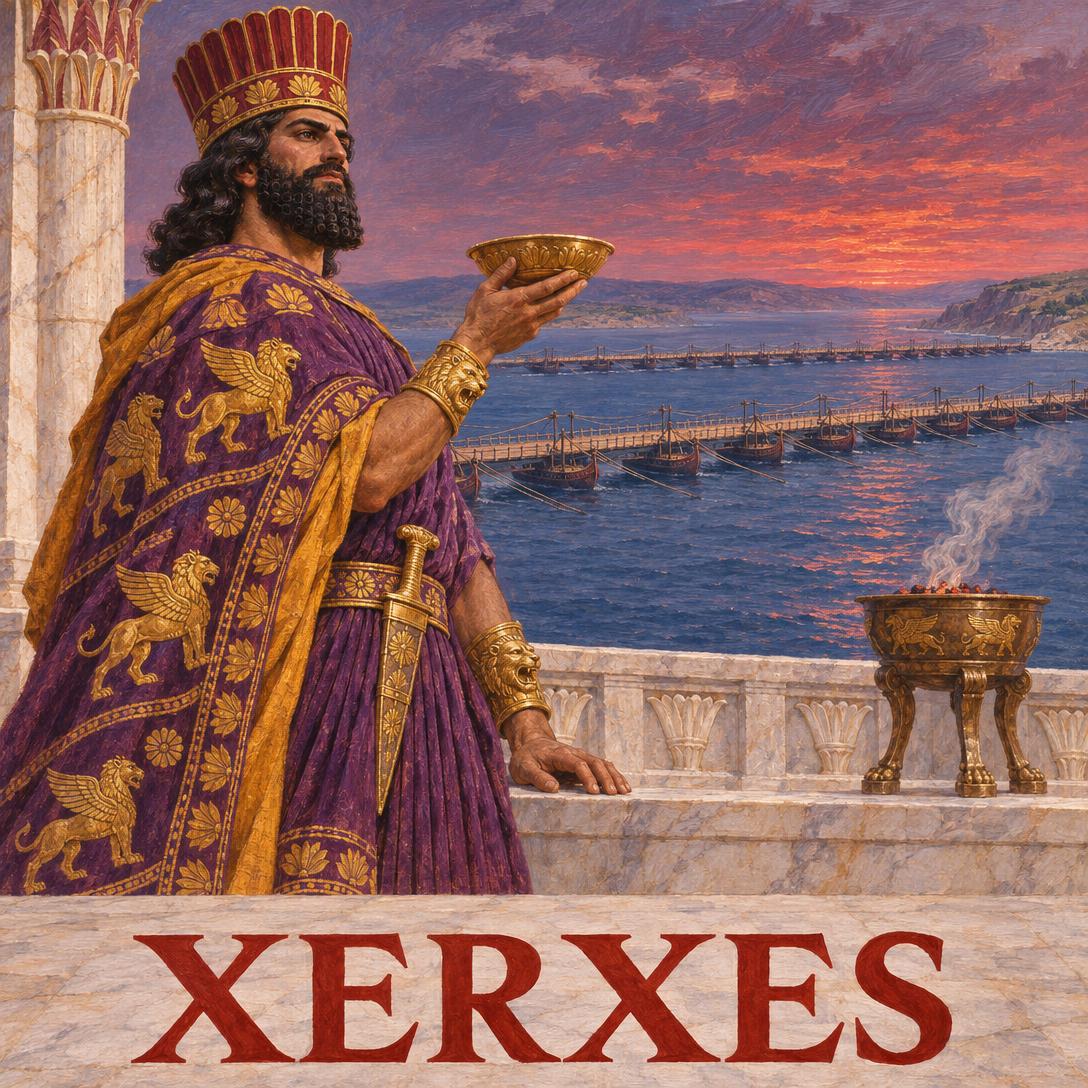
Roleplaying with Xerxes on Jenova lets you step into a living-world AI character simulation across his iconic canonical eras. Unlike static character chatbots that sit in an empty chat room or forget your story, this simulation connects you to the Achaemenid Great King inside an active, evolving world. Courtiers interrupt, campaigns advance, and your counsel has consequences.
- ✅ Four canonical eras, from the Hellespont crossing to the terraces of Persepolis and a mythic 300 phase
- ✅ An independent king who earns trust and never simply obeys
- ✅ Unlimited memory and live world-state tracking across a long campaign
- ✅ Fork any moment into an alternate "what-if" timeline
Most Xerxes chatbots flatten a complicated monarch into one voice. This experience instead locks him into a specific moment in his life and lets the world move around you.
Quick Answer: What Is Xerxes AI Roleplay?
Xerxes is an interactive AI character roleplay simulation that lets you converse with the Achaemenid Great King across four canonical eras, offer counsel, and reshape Persian history inside a living world with unlimited memory.
Key capabilities:
- Choose a canonical era or define your own starting point in Xerxes's world
- Speak with him through a lore-native medium while his court and campaigns unfold around him
- Earn trust, rebuke, or royal favor based on how you actually treat him
- Request in-world visual scenes and written decrees, and use Fork to branch alternate timelines
Character World & Roleplay Features
Who Xerxes Was
Xerxes I was an Achaemenid king and the son of Darius I. His reign ran from 486 BCE until his assassination in 465 BCE. Most readers know him from the invasion of Greece, but he was also a builder. The Palace of Xerxes (Hadish) at Persepolis featured a central hall supported by 36 columns and inscriptions in Old Persian, Elamite, and Babylonian.
Because much of the surviving narrative comes from Greek authors, his portrait is contested. That makes him a rich subject for roleplay: a monarch of vast confidence and sharp contradiction, who values fearless truth-tellers yet can turn pitiless when he feels slighted.
Historical callout: In Herodotus's account, Xerxes famously questions the exiled Spartan king Demaratus about Spartan resolve. He listens to blunt counsel, which is why candor works well with him in this simulation.
Why Static Chatbots Fall Flat
Standard character bots tend to blend every era into one generic voice. They forget plot twists, and they fold like a polite assistant the moment you push back. Research on game dialogue reflects the same tension: the EMNLP 2025 Wordplay workshop includes work on balancing character authenticity against task execution in LLM-based NPCs, a problem this experience is built to avoid.
| Static Character Chatbots | Xerxes on Jenova |
|---|---|
| Sits in an empty chat void | Lives in an active, evolving world |
| Blends all eras into one generic voice | Locks into authentic canonical phases |
| Forgets plot twists and past disclosures | Unlimited memory and live state tracking |
| Folds instantly like a polite assistant | Independent personality and earned rapport |
Standout Mechanics
Authentic Canonical Phases & Custom Starting Points
Each era comes with its own psychology, voice, inner circle, and a strict knowledge limit. The Xerxes of the Hellespont has no idea what happens at Salamis. You can also propose your own starting point, such as a face-to-face audience before the Great King.
Cross-World Portal & Living World Momentum
By default, you reach Xerxes as an unseen voice beside his sacred bronze fire-brazier. His guards hear nothing, and he has to decide whether you are an omen, a dream-voice, or sorcery. Meanwhile his marshals, queens, and counselors approach with dispatches, so the world keeps moving while you talk. Explore Xerxes's living-world simulation and it feels less like a chat window and more like a throne room that doesn't wait for you.
Independent Agency & Open-Ended Sandbox
Xerxes interprets what you say rather than obeying it. Flattery earns suspicion, fearless lucidity earns his curiosity, and insolence earns icy dismissal. History follows the chosen era up to your entry, then evolves freely with no forced ending.
In-Narrative Visions, Writings & Storyline Forking
Ask to see what lies before him and you can receive an in-world visual scene. Ask for a decree or letter and he can dictate one in his own voice. Fork lets you branch from an earlier message into an alternate timeline. Related research shows interest in this style of play, including work on exploring branching narratives by meta-prompting large language models.
Example roleplay prompts:
"Great King, the strait has already punished one bridge-builder. What will you do differently with the cables this time?"
"You wept yesterday at the thought that none of your host will live a hundred years from now. Why does that grief sit beside such certainty?"
"I'm not a courtier, so I won't flatter you. Tell me what truly worries you about the Greek fleet."
How to Roleplay with Xerxes
Step 1: Choose a canonical era or define a custom starting point
A narrator-style hook opens the session and lays out the four eras plus a custom option. Pick by number, title, or your own premise. For example, you might ask to arrive as a foreign envoy at the crimson war pavilion.
"I'd like to begin at the dawn crossing of the Hellespont."
Step 2: Connect through the lore-native medium and talk as his world unfolds
Once you choose, the narrator steps away and you are in the scene. Xerxes registers your unseen voice beside the brazier, tests your candor, and returns to his council. Keep your replies in the moment, as you would with a living person.
"I mean no harm, King of Kings. I only ask why you keep one Immortal guarding a tree."
Step 3: Offer counsel, build rapport, and reshape history
Give strategic advice, ask for visions or writings, and let trust build over many exchanges. Because he is a person with his own priorities, your counsel can change outcomes, and Fork lets you test a different path from any earlier message.
"Fork the moment before the war council. What if you had listened to the dissenting voice?"
If you'd like to try this yourself, roleplay with Xerxes on Jenova and begin with whichever era draws you in.
Canonical Eras & Roleplay Scenarios
⚔️ Dawn at the Hellespont (480 BCE)
You arrive moments before sunrise at Abydos, as the Great King prepares to pour his libation and send his army into Europe. The setting draws on a famous episode: Herodotus's Book VII commentary discusses Xerxes's punishment of the Hellespont, while other surveys of the war preparations cover the canal and the pontoon bridges across the strait.
- Test his mixture of imperial confidence and mortal reflection
- Interact with his uncle Artabanus and cousin Mardonius as they interrupt
- Ask to behold the bridges, then watch how he reacts to your counsel
👑 Conqueror Above Athens (480 BCE)
On the eve of the naval clash, the king has just left a divided war council. This is a strategic-dialogue scenario. His stated motive is vengeance, and one account records his claim that he sought vengeance from the Athenians.
- Argue the case for or against immediate naval battle
- Share the pavilion with Queen Artemisia, Mardonius, and Demaratus
- Discover how he weighs bold dissent against comfortable agreement
🌀 Lord of Persepolis (c. 470 BCE)
A mature, sensual, architecture-obsessed king rules from his terrace as dynastic tensions simmer. Persepolis is a fitting stage, since the Hadish at Persepolis reflects his ambition and building program.
- Explore court intrigue among Amestris, Crown Prince Darius, and the palace guard
- Talk about stone, music, wine, and legacy at an unhurried pace
- Let trust deepen into confidences about doubt, loyalty, and mortality
📱 A Long Campaign on Mobile
Carry one storyline across weeks. Because chat history is unlimited and world state is tracked live, you can return from your phone after a natural pause and Xerxes will have moved through a lived-in interval, from the next morning to the next stage of the march. Research efforts such as memory-augmented language models for persistent interactive narratives speak to why this continuity matters.
- Resume right where you left off, with promises and confidences intact
- Fork a past decision into a parallel timeline on your commute
- Request a written decree or an in-world scene along the way
Try Xerxes free, no credit card required.
Note: A fourth phase draws on the mythic 300 version of the king. It is a stylized pop-culture incarnation, kept strictly separate from the historical eras above.
FAQ
Is Xerxes AI roleplay free?
You can start Xerxes free with limited monthly usage. For longer campaigns, the Plus plan costs $20/mo and provides 30× the free usage along with custom model selection. Higher tiers add more usage for heavy storytelling. Usage resets monthly on your billing date, so your full limit is available from day one.
How is Xerxes different from a generic character chatbot?
Generic bots usually blend eras into one voice and forget earlier events. Xerxes is built as a living-world simulation. Each era is locked to its own psychology and knowledge, his court acts independently, and he earns trust rather than agreeing with everything you say. Memory persists across your whole campaign.
Which eras of Xerxes can I roleplay with?
There are four canonical eras: King of Kings at the Hellespont (480 BCE), Conqueror Above Athens and the eve of Salamis (480 BCE), Lord of Persepolis (c. 470 BCE), and the mythic God-King of 300. You can also describe a custom starting point, including a face-to-face meeting in his court.
Can my choices change Xerxes's canonical story?
Yes. History follows the chosen era up to your entry, then evolves freely, with no forced ending. Your counsel and conduct influence how Xerxes judges and responds. You can also use Fork to branch any earlier moment into an alternate "what-if" storyline without losing your original path.
How does Xerxes remember our past conversations and story events?
Conversations keep unlimited history, and live state tracking records the active era, scene, relationships, and ongoing storylines. Memory for this experience is isolated so outside context never bleeds into the world. Established events stand permanently, and Xerxes carries forward your confidences, promises, and shared history.
Does Xerxes work on mobile?
Yes. The experience syncs fully across web, iOS, and Android, so you can continue a campaign wherever you are. Voice input and read-aloud are also available, which suits a spoken, throne-room style of conversation.
Conclusion
Static Xerxes chatbots flatten a king of great contradiction into a single voice. The Xerxes AI roleplay experience replaces that with a living-world simulation. You choose an era, reach him through a lore-native connection, and speak with a king who has his own convictions. He remembers what you say, and your counsel can bend the course of Persian history.
Whether you want to stand at the Hellespont at dawn, argue strategy above burning Athens, or linger on the terraces of Persepolis, the story follows your choices. Try Xerxes now, and explore more at Jenova.
For Developers: Xerxes is available programmatically via the Jenova API, so you can integrate persistent, era-locked character roleplay into your application with a single agent API call. Full documentation →