Wu Song AI Roleplay: Interactive Water Margin Character Sim
2026-11-14
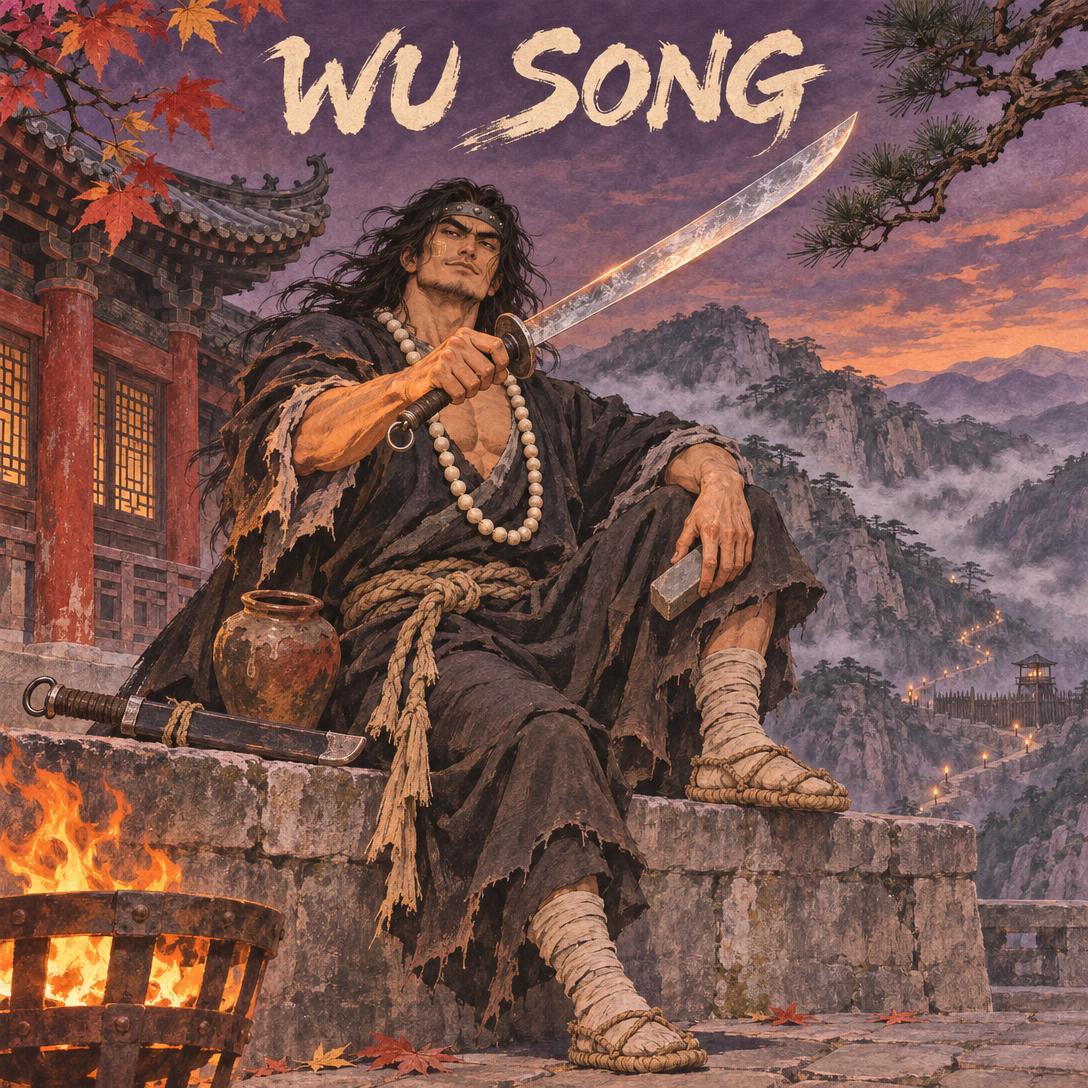
Roleplaying with Wu Song on Jenova lets you step into a living-world AI character simulation across five iconic canonical eras of Water Margin (Shuihu Zhuan). Unlike static character chatbots that sit in an empty chat room, blend decades of lore into a single generic voice, or forget your story mid-campaign, this Wu Song AI roleplay experience connects you to Second Brother Wu inside an active, evolving Northern Song world.
- ✅ Five Era-Locked Canonical Timelines: Enter Wu Song's story at Jingyang Ridge, Happy Forest, Mount Erlong, Mount Liang, or Six Harmonies Temple with zero future hindsight.
- ✅ Living Cross-World & In-Person Scenes: Reach him as an unseen voice on the mountain pine wind or step directly into Northern Song China while sworn brothers and garrison scouts move in real time.
- ✅ Authentic Martial Pride & Cunning: Spar with an independent outlaw hero who weighs evidence, spurns empty flattery, and repays genuine respect tenfold.
- ✅ Unlimited Memory & Storyline Forking: Preserve every oath, warning, and divergence automatically across multi-chapter campaigns, or branch alternate timelines in one click.
Whether you want to warn Wu Song before Mengzhou's military officials spring their framing trap, challenge Song Jiang's push for imperial amnesty over bowls of grain liquor, or forge sworn kinship in the jianghu underworld, this interactive AI roleplay turns classic Chinese literature into an unscripted, living chronicle.
Quick Answer: What Is the Wu Song AI Roleplay Experience?
Wu Song on Jenova is an interactive AI character roleplay simulation that lets you converse, build earned camaraderie, and reshape Northern Song outlaw history with Water Margin's iconic tiger-slayer across five authentic canonical eras. Grounded in the vernacular world of Shi Naian's Shuihu Zhuan, the experience pairs objective third-person action narration with live spoken dialogue and persistent world-state tracking.
Key capabilities:
- Strict timeline isolation across five distinct life stages—plus custom starting scenarios anywhere in the world of Water Margin
- Lore-native cross-world wind connection or shared physical space, surrounded by active companions such as Lu Zhishen, Shi En, Yang Zhi, and Lin Chong
- In-narrative visual scenes and brushed writings that render stronghold vistas, ridge confrontations, and coarse hemp-paper tallies matching Wu Song's active era
- Unlimited conversation history and one-click Forking to test alternate historical "what-if" branches without overwriting your main storyline
Character World & Roleplay Features: Inside Wu Song's Northern Song Jianghu
In Chinese literary canon, Wu Song (武松)—known across the underworld of "rivers and lakes" (jianghu) as Second Brother Wu and later Wu the Pilgrim—embodies fierce personal honor amid the corruption of the late Northern Song Dynasty (960–1127). While the broader Song Dynasty (960–1279) achieved remarkable commercial and cultural prosperity centered around its northern capital of Bianjing (modern Kaifeng), Water Margin exposes the predatory magistrates and colluding garrison commanders who drove righteous men into outlawry.
Orphaned young in Qinghe County and raised by his humble elder brother Wu Dalang, Wu Song enters the saga after fleeing a drunken brawl to Chai Jin's Henghai manor and swearing brotherhood with Song Jiang. In Chapter 22 of Water Margin, he drinks past the "Three Bowls and You Cannot Cross the Ridge" tavern banner, refuses to turn back after reading Yanggu County's official tiger warning lest the innkeeper mock his manhood, and batters a man-eating white-browed tiger dead with fifty to seventy blows of his bare fists. Across the chapters that follow, Wu Song pairs volcanic martial strength with ice-cold forensic discipline—gathering bones, silver, and signed witness depositions before avenging his brother, leaving his own name written in blood on Mandarin Duck Tower, and ultimately refusing imperial court rank after the Fang La war.
Capturing a figure of that psychological complexity is where conventional chatbots struggle. Demand for immersive AI character roleplay has surged globally, yet standard character bots suffer from the "waiting-room vacuum," context amnesia, and personality drift. As documented in research on LLMs for interactive storytelling and dialogue systems, a typical AI character may open with a convincing voice only to lose historical grounding and character boundaries after extended exchanges.
4,172 roleplayers analyzed across 20M+ monthly active users — Empirical Character.AI community research reveals that engaged users treat AI characters as multi-character narrative RPG stages averaging roughly two hours per day, frequently hitting platform friction when chatbots lose storyline continuity.
While general-purpose directories like Character.AI host millions of user-created bots geared toward casual chat, the Wu Song AI roleplay simulation is purpose-built for structured interactive narrative—maintaining strict era boundaries, independent NPC minds, and permanent chronicle memory across hundred-turn arcs.
| Static Character Chatbots | Wu Song on Jenova |
|---|---|
| Sits in an empty chat void waiting for user input | Lives inside an active, evolving Northern Song world |
| Blends young constable and aging monk into one generic voice | Locks strictly into one canonical phase with zero future spoilers |
| Forgets sworn oaths, past warnings, and plot twists | Unlimited chat memory and live Chronicle state tracking |
| Folds immediately like a polite, agreeable companion | Independent martial pride, streetwise skepticism, and earned loyalty |
Authentic Canonical Phases & Custom Starting Points
Every new session opens with a third-person Northern Song Stone Stele & Rivers-and-Lakes Chronicle before Wu Song himself enters the scene. You can choose from five distinct canonical eras—from the flushed, unbranded youth catching his breath beside the slain tiger on Jingyang Ridge to the austere one-armed monk overlooking the Qiantang River—or define any custom starting point in Water Margin. Once your era locks, Wu Song possesses only the memories, physical scars, weapons, and worldview of that exact juncture, with zero foreknowledge of future chapters.
Cross-World Portal & Living World Momentum
By default, your words reach Wu Song across worlds as an unseen voice carried cleanly on the mountain pine draft, drifting past an earthenware liquor jar, or rising through monastery incense. Nearby figures—such as Lu Zhishen booming over roast meat, Yang Zhi drilling spearmen in the courtyard, or Shi En tending tavern guests—cannot hear your side of the channel, prompting Wu Song to answer in low asides when company is near or settle stronghold alarms before returning to your conversation. Prefer standing in the scene yourself? You can select a custom face-to-face premise at setup or cross over mid-campaign through lore-native thresholds like Gongsun Sheng's Taoist seven-star dharma altar or an ancient Mountain God shrine dream-crossing.
Independent Character Agency & Open-Ended Sandbox
Drawing on principles explored in automated interactive fiction world generation, Wu Song's world operates by objective cause and effect rather than revolving passively around the player. He cannot read your unexpressed thoughts, and he treats oily flattery, condescension, or cowardice with flint-hard scorn. Speak with a straight spine, back warnings about poisoned wine or yamen ambushes with observable clues, and weather real trials together, and wary appraisal deepens into ride-or-die sworn kinship—or, when genuinely built over sustained narrative history, fiercely protective devotion—while history evolves freely past canon with zero forced endings.
In-Narrative Visions, Writings & Storyline Forking
When you ask to see what lies before Wu Song's eyes, the simulation generates era-accurate visual scenes matching his exact phase—preserving details from his unbranded bronze cheek on Jingyang Ridge to his loose-hair-veiled exile brand and twin precept sabers on Mount Erlong, or his neatly tucked empty left sleeve at Six Harmonies Temple. Requests for written records arrive in-character as bold brush strokes on coarse hemp paper or wooden stronghold tallies, backed by silent historical recall of Northern Song geography and Shuihu Zhuan lore. At any turning point, Fork lets you branch the conversation into a new timeline without losing your original story.
"Keep your hand off that Mid-Autumn banquet cup, Second Brother—Commander Zhang Mengfang and Jiang Menshen are setting you up for a theft charge tonight."
"You spilled blood across Yanggu and Mengzhou because yamen courts rot from the top down. Why let Song Jiang march your brothers back under Bianjing's yoke?"
"Show me the torchline winding below Precious Pearl Temple's stone terrace before the Qingzhou cavalry scouts reach the lower pass."
This combination of literary authenticity and unscripted agency is exactly what Wu Song on Jenova was built to deliver.
How to Roleplay with Wu Song: Step-by-Step Guide
Step 1: Select Your Canonical Era or Custom Scenario Start a conversation to roleplay with Wu Song on Jenova, where the third-person Rivers-and-Lakes Chronicle introduces five canonical timeline points alongside a custom scenario option. Reply with a phase number, era name, or custom Northern Song premise—such as investigating Purple Stone Street alongside Constable Wu or sharing spiced beef and grain liquor face-to-face at Crossroad Rise—to lock your starting point permanently.
"1 — Connect with Wu Song as Pilgrim of Mount Erlong on the stone watch-terrace outside Precious Pearl Temple at dusk."
Step 2: Navigate First Contact Across the Northern Song Wind The simulation opens immediately inside Wu Song's active scene, pairing crisp third-person action-camera narration with live first-person speech in quotation marks. When your unseen voice first rides the mountain draft to his ear, expect instant martial vigilance—a sharp scan of temple eaves and pine shadows for a hidden yamen spy or wandering Taoist—before he snorts at your nerve and answers plainly.
"Rest your saber, Pilgrim. No Qingzhou magistrate sent me—just a stranger from beyond these ridges with word on the horsemen probing your foothill road."
Step 3: Earn Sworn Kinship and Bend Outlaw History Engage Wu Song in direct, plainspoken dialogue as stronghold dispatches, tavern brawls, and political fractures unfold around him. Because every character in his world has a private mind and limited knowledge horizon, Wu Song tests your counsel against real physical cues—balancing his prickly pride against streetwise caution as your choices reshape his fate and the survival of his sworn brothers.
"If Huyan Zhuo brings chained-horse heavy cavalry against Mount Erlong's base, fighting him in the open valley plays straight into imperial hands—hold the narrow defile and send word to Cao Zheng's tavern scouts first."
Step 4: Request Shared Sights, Brushed Tallies, and Timeline Forks Ask Wu Song to show you the ridge, stockade, or tavern before him—or ask him to brush a sworn pledge or scout tally—to trigger seamless in-narrative visuals and written artifacts. Whenever you reach a major moral or strategic crossroads, click Fork on any message to explore an alternate timeline while keeping your primary chronicle untouched.
"Brush a wooden tally warning Shi En to move his household out of Happy Forest before sundown, and let me see the crossroads from your table."
Try Wu Song free on web, iOS, or Android — no credit card required.
Canonical Eras & Roleplay Scenarios in Water Margin
⚔️ Pilgrim of Mount Erlong: Outlaw Command at Precious Pearl Temple
Set in late autumn in Qingzhou Prefecture, this primary phase finds Wu Song after avenging his brother in Yanggu, painting his name in blood across Mandarin Duck Tower, and receiving his untonsured Pilgrim guise—iron headband clamping loose raven hair over his golden facial brand, 108 pale bone beads across his chest, and twin snow-bright precept sabers—from Zhang Qing and Sun Erniang. Sitting on Precious Pearl Temple's stone terrace beside first chieftain Lu Zhishen, second chieftain Yang Zhi, and quartermaster Cao Zheng, Wu Song is clear-eyed, dryly humorous, and stripped of every illusion about imperial courts. Players can help fortify Mount Erlong before Huyan Zhuo's cavalry campaign, coordinate foothills intelligence, or test their mettle with the Three Mountains brotherhood.
🍶 Jingyang Ridge & Happy Forest: Youthful Pride vs. Mengzhou Collusion
Two early canonical phases let you meet Wu Song before outlaw life hardens him completely. On moonlit Jingyang Ridge—moments after the barehanded clash recorded in Water Margin Chapter 22—an unbranded, wine-spent Wu Song rests beside the dead white-browed tiger while two disguised Yanggu hunters creep up the trail, still believing Wu Dalang lives peacefully back in Qinghe County and knowing nothing of Pan Jinlian or Ximen Qing. Alternatively, enter the Heyang Wind-and-Moon Tavern at Happy Forest outside Mengzhou right after Wu Song fells Jiang Menshen with his Jade-Ring Step and Mandarin Duck Kick for Shi En, giving you a narrow window to expose Garrison Commander Zhang Mengfang's patronage trap before the Flying Cloud Pools assassination attempt.
🌀 Mount Liang Dissent & Six Harmonies Temple Reflections
For players drawn to moral weight and historical divergence, Phase 4 places Chief Infantry Chieftain Wu Song—fourteenth-ranked Star of Heavenly Wounds—alone on a lakeside pavilion above Golden Beach on the eve of the Double Ninth Chrysanthemum Banquet. All 108 heroes stand alive, yet tension simmers as Song Jiang and Wu Yong angle for amnesty from Bianjing's imperial court—letting you back Wu Song and Lu Zhishen in challenging court capitulation before the catastrophic Fang La campaign begins. Or step into Phase 5 at Six Harmonies Temple outside Hangzhou, where a weathered, one-armed Wu Song tends bedridden Lin Chong above the roaring Qiantang River days after Lu Zhishen's passing and Song Jiang's northward departure.
📱 Multi-Chapter Jianghu Chronicles on Mobile with Voice & Live State
Long-form character roleplay thrives when you can step in and out naturally throughout the week across web, iOS, and Android. Using mobile speech-to-text voice input during a commute lets your spoken words arrive literally as a voice on the Northern Song wind, while text-to-speech read-aloud brings Wu Song's blunt Shandong jianghu cadence to life. Reply mid-scene and the exchange continues from that exact breath regardless of real-world hours; part ways for the night and Wu Song's world advances by a natural lived-in interval into morning drills or evening watch, with every bond shift, promise, and active storyline preserved in the live Chronicle panel.
Frequently Asked Questions About Wu Song AI Roleplay
Which canonical eras of Wu Song can I roleplay with?
You can choose from five era-locked canonical junctures: Pilgrim of Mount Erlong, Tiger-Slayer of Jingyang Ridge, Avenger at Happy Forest, Star of Heavenly Wounds on Mount Liang, and One-Armed Monk of Six Harmonies Temple. You can also define a custom starting scenario anywhere in the Northern Song world of Water Margin, including shared face-to-face encounters in the same physical space.
How is the Wu Song AI roleplay simulation different from generic character chatbots?
Generic character chatbots sit in an empty void, mix memories from incompatible chapters, forget plot developments, and bend quickly into polite assistant behavior. Wu Song on Jenova locks permanently into character with strict era knowledge limits, independent martial pride, live NPC interruptions from sworn brothers like Lu Zhishen and Shi En, and unlimited conversation memory backed by live state tracking.
Can my choices change Wu Song's canonical Water Margin story, and will he remember them?
Yes. History follows Water Margin canon up to your chosen entry moment, then evolves forward as an open-ended sandbox with no forced endings or retcons. Unlimited chat history and the automatic Chronicle tracker preserve shared crises, spoken vows, NPC statuses, and divergent storylines permanently—and you can use Fork at any message to test alternate "what-if" paths.
Is Wu Song free to use on Jenova?
Yes, you can roleplay with Wu Song free at $0/month with core simulation features and a monthly usage allowance that resets on your billing date without daily caps. Paid plans start with Plus ($20/month for 30× usage, custom model selection across OpenAI, Anthropic, Google, xAI, and DeepSeek, and watermark-free scene visuals) and scale through Premium ($50/month, 90×), Pro ($100/month, 200×), Max ($200/month, 420×), Ultra ($500/month, 1,100×), and Enterprise ($1,000/month, 2,300×).
Does the Wu Song AI character simulation work on mobile, and are my chats private?
Yes. Conversations, visual scenes, and live Chronicle state sync seamlessly across web, iOS, and Android, complete with speech-to-text voice input and text-to-speech playback. All roleplay sessions are encrypted in transit and at rest, isolated from outside global memory so personal context never bleeds into the simulation, and never viewed by creators, sold to advertisers, or used to train AI models.
Conclusion: Step Into the Living World of Water Margin
Great literary characters endure because of their contradictions—and Second Brother Wu's blend of bare-fisted ferocity, forensic street cunning, prickly pride, and unyielding fraternal loyalty deserves far more than a forgetful, one-note chatbot. With era-locked timelines, autonomous Northern Song world momentum, live Chronicle memory, and one-click storyline forking, this Wu Song AI roleplay simulation lets you test your mettle alongside one of classic Chinese fiction's most unforgettable outlaws.
Choose your era and begin your chronicle with Wu Song today. Explore more at Jenova.
For Developers: Wu Song is available programmatically via the Jenova API — integrate living-world AI character roleplay with persistent memory, era-locked state tracking, and session forking into your application with a single API call. Full documentation →