AI Worldbuilding Generator: Build Consistent Fictional Worlds Fast
2026-08-08
The Creative Fiction Writer works as an AI worldbuilding generator that helps you construct fictional worlds with internally consistent geography, magic systems, factions, histories, and characters — then keeps that canon straight across every draft. Most worldbuilding stalls not because writers run out of ideas, but because the world outgrows their ability to track it. This AI turns scattered notes into a coherent, expandable world bible.
✅ Generates regions, factions, magic systems, timelines, and cultures from a single premise ✅ Remembers your canon across sessions so lore stays consistent chapter to chapter ✅ Stress-tests world rules for contradictions before they reach your readers ✅ Works alongside your manuscript, screenplay, comic, or campaign
To understand why this matters, it helps to look at what worldbuilding actually demands of a working writer — and where the traditional toolset breaks down under the weight of a world that keeps growing.
Quick Answer: What Is an AI Worldbuilding Generator?
An AI worldbuilding generator is a tool that creates and maintains fictional world elements — geography, cultures, factions, magic systems, histories, and characters — from your prompts, keeping them internally consistent as the world expands. The strongest ones hold canon across sessions rather than producing disconnected text.
Key capabilities:
- Generate settings, regions, and cultures from a one-line premise
- Design magic systems, technologies, and economies with internal logic and stated costs
- Build casts of characters with linked relationships, motives, and secrets
- Track timelines, histories, and continuity so contradictions surface before publication
- Extend the world into prose, scripts, or campaign material with tools like the Creative Fiction Writer

The Problem: Why Worldbuilding Breaks Down
Worldbuilding is disproportionately invisible labor. As one detailed tools review puts it, worldbuilding is "10% visible in the story and 90% underwater in the bible" — and that submerged 90% is where projects quietly collapse. Meanwhile, writers are navigating a creative industry in genuine turbulence.
But building and maintaining a world is frustratingly difficult:
- Canon drifts. The magic system in chapter three quietly contradicts the one in chapter eleven.
- Tools don't remember. Generic chat tools produce vivid drafts but lose the world between sessions.
- Notes fragment. A wiki here, a spreadsheet there, a names tab, a binder — nothing links.
- Depth costs time. Economies, religions, and political systems each require research most writers don't have hours for.
- Output stays disconnected. Most generators hand you a paragraph and walk away.
Continuity Failures Compound
A world's credibility rests on rules that hold. Once a reader catches an inconsistency — a river running uphill, a currency that shouldn't exist yet, a character aging wrong — the spell breaks. The larger the world, the more surface area for contradiction, and manual tracking scales badly past a few dozen entries.
Generic AI Tools Lose the Thread
Industry reviews are direct about the limitation of raw chat models for this work: they have "no project context across sessions" and the output "is rarely usable as final worldbuilding." You get a good first draft, then start from zero next time. The drafting is solved; the holding is not.
The Craft Concern Is Real
The concern isn't paranoia — it's about where AI belongs in the process. In the Cambridge research, 97% of novelists were extremely negative about AI writing whole novels, while the aspects they felt least negative about were sourcing facts and information. The useful application is structural and research-heavy work, not authorship.
Fragmented Stacks Slow You Down
Most working worldbuilders end up juggling multiple platforms — one reviewer notes that "most working worldbuilders use two or three tools, not one". Every additional tool is another sync point, another place canon can diverge.
This is exactly what the Creative Fiction Writer was built for.
Why Creative Fiction Writer Works as an AI Worldbuilding Generator
The Creative Fiction Writer is a storytelling partner for original fiction across any genre, built for deep research into authentic worlds and editorial insight from first draft to final manuscript. That combination matters: worldbuilding isn't just invention, it's research plus invention plus consistency enforcement. It handles all three in one conversation, and it remembers.
| Traditional Approach | Creative Fiction Writer |
|---|---|
| Notes scattered across wikis, docs, and spreadsheets | One conversation holds the full world bible |
| Canon checked manually, catching errors late | Contradictions surfaced as you build |
| Research done separately in a browser tab | Research grounded directly into the world |
| Generic AI forgets the world between sessions | Persistent memory carries canon forward |
| Worldbuilding lives apart from the manuscript | World and prose developed side by side |
Deep Research for Authentic Worlds
Convincing fiction borrows from reality. A feudal economy needs plausible taxation. A desert culture needs water logic. A naval empire needs trade routes that make geographic sense. The agent researches real-world analogues — historical governance, ecology, linguistics, metallurgy — and translates them into your invented setting so the world holds up under scrutiny.
"Design a coastal merchant republic modeled on medieval Venice, but where the trade good is stormglass harvested from lightning strikes. Give me the guild structure, the succession crisis waiting to happen, and three ways the economy could collapse."
Systems That Actually Have Rules
The difference between decorative worldbuilding and load-bearing worldbuilding is constraint. A magic system without costs is a plot hole generator. The agent builds systems with explicit limits, resource costs, social consequences, and failure modes — then keeps those limits enforced when you write scenes that push against them.
"Build a magic system where casting shortens the caster's lifespan. Define the exchange rate, who regulates it, what the black market looks like, and what happens to a society that discovers a loophole."
Continuity Enforcement Across Sessions
Because the agent retains conversation history and your uploaded documents, you can ask it to audit your own canon. Feed it your existing chapters or notes and ask what breaks — timeline conflicts, character age errors, geography that shifted between drafts, rules bent for convenience.
"Here are chapters 1 through 9 of my manuscript. Check the magic system rules for contradictions and flag any place a character does something the established rules shouldn't allow."
From Bible to Prose
Worldbuilding that never surfaces in the story is a hobby. The agent moves fluidly between building the world and writing inside it — drafting a scene that demonstrates a cultural norm, writing an in-world document, or turning a faction's history into a character's grudge.
Related Agents You'll Also Find Useful
Worldbuilding rarely stays in one lane. These agents extend the same world into naming, visuals, and interactive design.
Name Generator — A naming consultant with deep cultural and linguistic fluency, useful when your world needs a hundred consistent-sounding place names, houses, and characters that feel like they share a language.
- Builds naming conventions that hold across an entire culture
- Linguistic grounding so names sound related rather than random
- Works for characters, cities, factions, artifacts, and titles
Game Designer Assistant — If your world is destined for a game rather than a novel, this agent handles brainstorming, systems analysis, documentation, and concept art across genres and platforms.
- Translates lore into playable systems and mechanics
- Design documentation your team can actually build from
- Genre and platform expertise for scoping decisions
Comic Creator — For worlds that want to be seen, this agent handles sequential art, dynamic layouts, and bold visual styles from single issues to graphic novel sagas.
- Turns world lore into visual sequences
- Consistent art style across a long-running series
- Panel and layout craft for pacing your world's reveals
Prompt Generator — When you need concept art, maps, or character portraits from image models, this agent crafts the prompts that get you there.
- High-quality prompts for image and video models
- Style consistency across a full visual set
- Collaborative refinement until the output matches your vision
Try Jenova free — no credit card required.
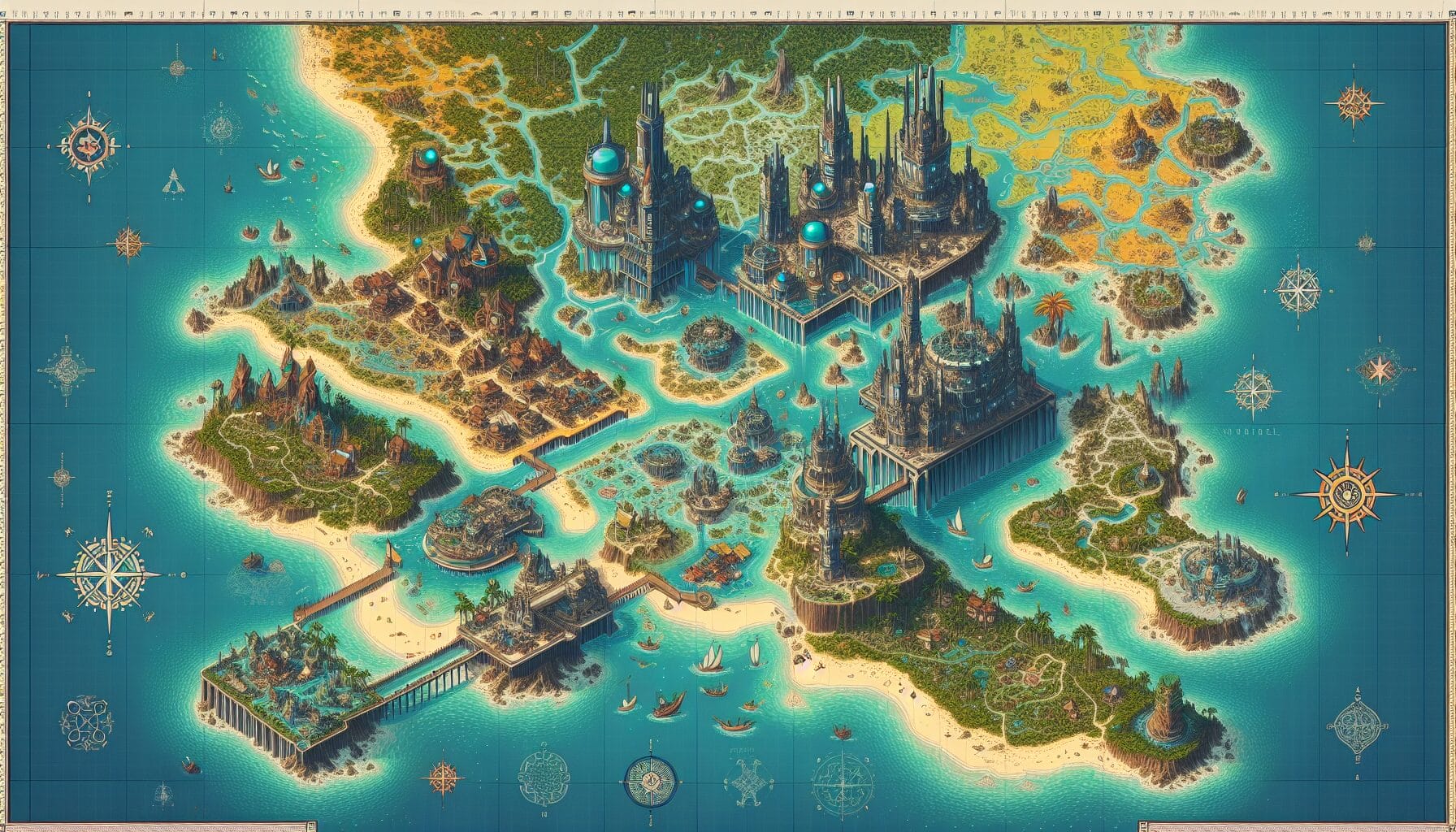
How It Works: From Premise to World Bible
Step 1: State Your Premise
Give the Creative Fiction Writer a single sentence — a genre, a hook, a strange image you can't shake. Specificity in tone matters more than detail in content at this stage.
"A sci-fi world where memory can be extracted, traded, and forged — and the wealthiest families own centuries of borrowed childhood."
Step 2: Build the Load-Bearing Systems First
Ask for the systems that everything else depends on: how power works, how resources move, what the technology or magic can and cannot do. These constrain every later decision, so define them early.
"Define the memory extraction technology: how it works, what it costs the donor, who regulates it, and what the three most common abuses are."
Step 3: Layer Geography, Factions, and History
With rules fixed, generate the places and powers that grew around them. Ask the agent to explain why each faction exists in terms of the systems you already defined — that causal chain is what makes a world feel discovered rather than assembled.
"Give me four factions shaped by the memory trade — one that profits, one that resists, one that regulates, and one that worships it. Include their founding conflict."
Step 4: Populate With Characters Who Embody the World
Generate a cast whose personal stakes come directly from world tensions. A character who exists outside your world's central conflict is decoration; one shaped by it is plot.
"Create five characters positioned across the memory trade — a forger, an heir with purchased memories, a regulator, a donor, and someone who remembers being someone else."
Step 5: Audit, Expand, and Write
Ask the agent to stress-test the world for contradictions, then start writing inside it. Upload existing drafts and notes so the world bible and manuscript stay synchronized as both grow.
"Audit everything we've built for logical contradictions. Then write the opening scene of chapter one from the forger's perspective."
Results & Use Cases
📚 Fantasy Novelist Building a Multi-Book Series
Scenario: A writer plotting a trilogy needs a magic system, six kingdoms, a thousand-year history, and continuity that survives across three manuscripts.
Traditional Approach: Weeks of wiki setup, cross-reference maintenance, and manual continuity passes — with errors surfacing at copyedit when they're expensive to fix.
Creative Fiction Writer: The full world bible develops in conversation, with canon retained across sessions and contradictions flagged as they appear. The Name Generator supplies consistent naming across all six kingdoms.
- Systems defined with explicit constraints before plotting begins
- Continuity audits run against uploaded manuscript chapters
- Research-grounded cultures and economies that survive reader scrutiny
🎲 Game Master Running a Long Campaign
Scenario: A tabletop GM needs a living world where NPCs, factions, and consequences persist across dozens of sessions.
Traditional Approach: Prep hours between every session, plus improvised lore that contradicts earlier improvisation.
Creative Fiction Writer: Generate regions, NPCs, and faction politics on demand while the established world stays consistent. Pair with the Game Designer Assistant to translate lore into mechanics.
- Session prep compressed from hours to minutes
- NPCs with motives tied to established faction conflicts
- Consequences that ripple logically from player choices
🎮 Indie Developer Scoping a Narrative Game
Scenario: A small studio needs a coherent setting, quest structure, and character roster before writing a line of production dialogue.
Traditional Approach: A narrative designer's salary, or months of founder time spent on lore instead of build.
Creative Fiction Writer: Develop the setting and cast in one workspace, then hand systems questions to the Game Designer Assistant and visual direction to the Prompt Generator.
- Setting, factions, and quest logic developed together
- Documentation the team can build from directly
- Concept art prompts that maintain a unified visual identity
📱 Mobile Worldbuilding Between Commitments
Scenario: A writer with a full-time job has fifteen-minute windows — a commute, a lunch break — and loses momentum every time context resets.
Traditional Approach: Notes app fragments that never get consolidated into the real world bible.
Creative Fiction Writer: With full feature parity across web, iOS, and Android and persistent memory, the world picks up mid-thought on any device.
- Add a faction, a legend, or a character on the train
- Everything syncs into the same continuous world
- No re-explaining canon at the start of every session
Frequently Asked Questions
Is the AI worldbuilding generator free to use?
Yes. Jenova's free tier includes all core features with limited usage, so you can build a world with the Creative Fiction Writer without a credit card. Paid tiers start at $20/month for 30× the usage plus custom model selection. Usage resets monthly on your billing date with no daily caps.
How is this different from using a general AI chatbot for worldbuilding?
General chat tools generate good first drafts but lose your world between sessions — industry reviews note they have no project context across sessions. The Creative Fiction Writer is purpose-built for fiction, with persistent memory, document attachment, and editorial judgment applied to consistency rather than just generation.
Can it check my existing manuscript for continuity errors?
Yes. Upload your chapters, notes, or existing world bible and ask the agent to audit them. It can flag timeline conflicts, magic-system contradictions, geographic inconsistencies, and character detail errors — the failures that typically surface too late in the process.
Will AI-generated worldbuilding make my story feel generic?
That risk is real if you let the AI author everything. Cambridge research found 97% of novelists were extremely negative about AI writing whole novels, while the same study found writers most comfortable using AI for research and information tasks. Use it for structural scaffolding, research, and continuity — keep the voice and the emotional truth yours.
Does it work for science fiction, horror, and non-fantasy genres?
Yes. The Creative Fiction Writer handles original fiction across any genre — hard sci-fi, cosmic horror, alternate history, literary fiction with invented settings, cyberpunk, and more. Genre conventions shape the questions it asks and the systems it prioritizes.
Can I use it on my phone?
Yes. Jenova has full feature parity across web, iOS, and Android, with settings and conversation history syncing across devices. Your world stays available whether you're at a desk or on a commute.
Conclusion
Worldbuilding fails at scale, not at the idea stage. The magic system is easy to invent and hard to enforce; the sixth kingdom is easy to name and hard to reconcile with the first five. An AI worldbuilding generator earns its place by holding the underwater ninety percent — the research, the systems logic, the continuity — so your attention stays on the ten percent readers actually see.
The Creative Fiction Writer builds fictional worlds with researched depth, enforced internal rules, and memory that carries your canon forward across every session and every draft. Pair it with the Name Generator for consistent nomenclature and the Game Designer Assistant if your world is headed for a screen.
Start building at Creative Fiction Writer. Explore more at Jenova.
For Developers: Creative Fiction Writer is available programmatically via the Jenova API — integrate worldbuilding and long-form fiction generation into your writing or gaming application with a single API call. Full documentation →