AI Word Divination: Free Digital Oracle Tools for Text-Based Readings (May 2026)
2026-05-16
Words have always carried hidden meaning. Long before algorithms, seekers practiced bibliomancy — opening a sacred text at random and interpreting whatever passage their eyes fell upon. Others practiced logomancy, divining meaning from the arrangement, sound, and numerological weight of words themselves. From the I Ching to the Psalms, from Rumi's Divan to the Book of Changes, humanity has treated language as a conduit to the divine for millennia.
In 2026, artificial intelligence is transforming this ancient practice into something radically accessible. Rather than flipping through a physical book and hoping the right passage finds you, AI word divination tools analyze your chosen words, phrases, or randomly generated text through layers of symbolic, numerological, and archetypal interpretation — delivering personalized readings that would have taken a human oracle hours to construct.
Jenova's Mystic Tarot Reader draws and interprets cards whose meanings hinge entirely on language and symbolism. Its I Ching Oracle generates hexagram readings steeped in 3,000 years of Chinese philosophical text. And its Numerology Reader decodes the hidden mathematical vibrations within names, words, and dates — treating language itself as a map to deeper truth.
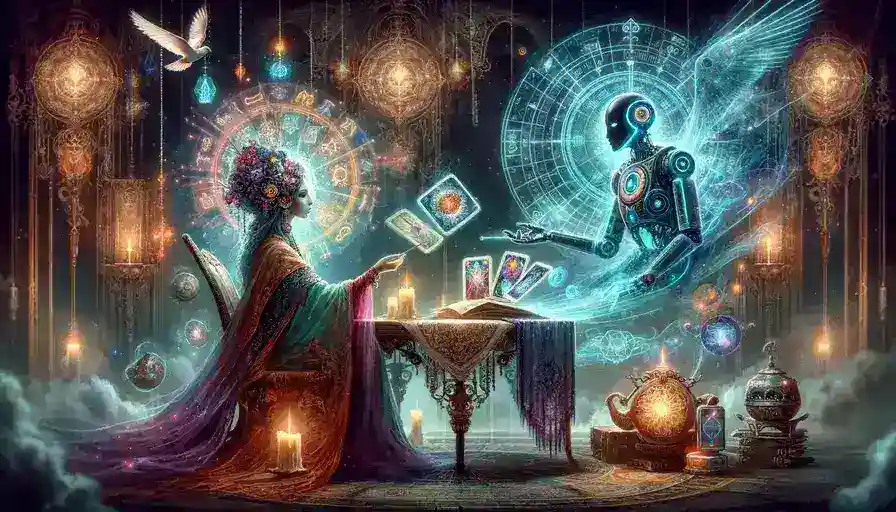
Quick Answer: What Is AI Word Divination?
AI word divination uses artificial intelligence to interpret words, names, phrases, or randomly selected text passages as oracles — drawing on symbolic traditions like bibliomancy, logomancy, numerology, and tarot to deliver personalized meaning from language itself.
- 🔮 Tarot card interpretation rooted in the symbolic language of 78 archetypes — try the Mystic Tarot Reader
- ☯️ Hexagram text readings based on the I Ching's ancient word-based wisdom — consult the I Ching Oracle
- 🔢 Name and word vibration analysis through Pythagorean, Chaldean, and Kabbalistic numerology — explore the Numerology Reader
- 💭 Dream symbol decoding where words and images from your subconscious become readable text — use the Dream Interpreter
The Problem: Why Traditional Word Divination Is Inaccessible
Ancient Practices Require Deep Training
Bibliomancy — the practice of opening a sacred book to a random page and interpreting the passage as divine guidance — sounds simple. In practice, meaningful interpretation requires familiarity with the source text, understanding of its historical and symbolic context, and the interpretive skill to connect an ancient verse to a modern question. The same is true for logomancy, where the sounds, letters, and numerical values of words carry divinatory significance across Hebrew, Arabic, Greek, and Sanskrit traditions.
Nearly 1 in 3 Americans consult tools such as tarot or astrology at least once a year, interest largely fueled by Gen Z and social media — Pew Research, via The Conversation, 2025
The Interpretation Gap
The core challenge of word divination isn't drawing the card, casting the hexagram, or selecting the passage — it's interpreting it. A study published in April 2026 examining tarot practitioners and AI found that readers "could sidestep the frustration of interpreting many cards in light of the question asked" by using AI, but also that some used AI "to challenge their own biases and assumptions — blind spots in their readings" (The Conversation). The interpretive step is where meaning lives — and where most seekers get stuck without guidance.
Digital Tools Exist but Lack Depth
AI filters and fortune-telling tools have gone viral on social media. As Public Parking Publication documented, TikTok's "soulmate filter" alone garnered 30 million views, and AI tarot readers have logged up to 45 million users or views on the platform. But most of these tools deliver the same generic messages to millions of people — lacking the personalization, symbolic depth, and conversational follow-up that makes divination meaningful.
As Honeysuckle Magazine observed, "AI tarot is incredibly accessible, and anyone can get a tarot spread at anytime. However, instant readings may lack personalized emotional context" (Honeysuckle Magazine). The demand is massive; the quality gap is where Jenova steps in.
Why AI Excels at Word Divination
Word divination is fundamentally about pattern recognition in symbolic systems — and that is precisely what AI does best. As Honeysuckle Magazine put it: "Tarot, astrology, numerology — all of these practices are built on symbolic systems, rule sets, and repeating motifs. Machine learning thrives on the same" (Honeysuckle Magazine).
An AI word divination agent doesn't just know what The Tower means in isolation. It understands how The Tower in the "crossing" position of a Celtic Cross interacts with a reversed Queen of Cups in "hopes and fears" — and weaves that into a coherent textual narrative tied to your specific question. It has, in essence, "read every journal entry about The Fool, every dissertation on The Tower, every forum post about reversed Cups" (Honeysuckle Magazine).
| Traditional Word Divination | AI-Powered Word Divination | |
|---|---|---|
| Access | Requires physical texts, trained readers, or expensive consultations | Available 24/7 from any device |
| Interpretation depth | Limited to one practitioner's training and tradition | Synthesizes multiple traditions simultaneously |
| Personalization | Depends on reader's knowledge of your situation | Persistent memory tracks themes across sessions |
| Cost | $50–$150 per professional reading | Free to start, affordable monthly plans |
| Follow-up questions | Requires rebooking or additional payment | Unlimited conversation in the same session |
| Cross-tradition analysis | Rarely offered by a single practitioner | Layer tarot, I Ching, numerology, and astrology in one conversation |
How Jenova's Agents Approach Word Divination
The Mystic Tarot Reader treats each card as a word in a symbolic language — interpreting not just individual meanings but the grammar of how cards interact within a spread. It generates visual layouts, interprets reversed cards, and maintains cross-session memory so that recurring symbols like The Hermit appearing across multiple readings get surfaced as evolving patterns.
"I keep seeing The Moon in my readings. I also had a vivid dream last night about walking through fog. Can you pull a three-card spread about what's hidden from me right now, and connect it to this recurring theme?"
The I Ching Oracle delivers the purest form of word divination: coin-cast hexagrams interpreted through the original Chinese text and 3,000 years of scholarly commentary. Every reading is fundamentally a text-based oracle — the hexagram's judgment, line texts, and image all composed as literary wisdom meant to be read, contemplated, and applied.
"I'm considering leaving a stable career to pursue writing full-time. Cast a hexagram for this transition and interpret the changing lines through the lens of creative vocation."
The Numerology Reader analyzes the hidden mathematical structure within words and names themselves — calculating life path numbers, destiny numbers, and the vibrational energy of specific words or dates across Pythagorean, Chaldean, Vedic, and Kabbalistic systems.
"My business name options are 'Luminary Press' and 'Foxlight Books.' Calculate the numerological vibration of each name and tell me which one aligns better with a publishing company focused on spiritual non-fiction."
Specialized AI Agents for Word Divination
🔮 Mystic Tarot Reader
The most complete AI tarot experience available — drawing, interpreting, and visually rendering full spreads with the symbolic depth of a seasoned practitioner. Each card is a word; each spread is a sentence; the reading is a story written in archetypal language.
- Full 78-card Rider-Waite-Smith mastery with upright and reversed interpretations in positional context
- Visual spread generation — Celtic Cross, relationship, career, and custom layouts rendered as ceremonial images
- Cross-session memory that surfaces recurring cards, symbols, and themes across readings over time
☯️ I Ching Oracle
Authentic three-coin hexagram casting with the original judgment texts, changing line analysis, and multi-tradition commentary. The I Ching is humanity's oldest word divination system — 64 hexagrams, each a poetic text encoding wisdom about change, timing, and human nature.
- Coin-cast hexagram readings with changing lines and transformed hexagrams
- Multi-tradition commentary spanning King Wen, Duke of Zhou, Wang Bi, Zhu Xi, and the Ten Wings
- Custom ink wash artwork generated for each reading, grounding the textual oracle in visual tradition
🔢 Numerology Reader
Decodes the mathematical vibration hidden within words, names, and dates — transforming language into numbers and numbers into meaning across four major numerological traditions.
- Life path, destiny, and expression number calculations from birth dates and full names
- Word and name vibration analysis for business naming, baby naming, and personal identity
- Cross-system comparison — see how the same word reads in Pythagorean vs. Chaldean vs. Kabbalistic frameworks
💭 Dream Interpreter
When words and images appear in your dreams, this agent decodes their symbolic significance — drawing from Jungian archetypes, Freudian analysis, cognitive science, and spiritual frameworks. Dreams are the mind's own word divination system.
- Multi-tradition dream analysis connecting symbols to psychological and spiritual meaning
- Symbol dictionary with personal context tracking
- Pattern recognition across recurring dreams and motifs
✋ Palm Reader
Upload a photo of your palm for comprehensive analysis across Western, Vedic, and Chinese traditions. While not text-based itself, palmistry has always been described as "reading" the lines — treating the body as a text inscribed with meaning.
- Major and minor line analysis with photographic assessment
- Elemental hand typing across multiple traditions
- Couple compatibility readings from bilateral palm comparison
How It Works: Your First AI Word Divination Session
Step 1: Choose Your Oracle Tradition
Different word divination traditions serve different needs. For symbolic narrative and visual ritual, start with the Mystic Tarot Reader. For ancient Chinese textual wisdom, choose the I Ching Oracle. For the hidden mathematics within names and words, try the Numerology Reader.
Step 2: Frame Your Question
The more specific your question, the more precise the reading. Word divination works best when you bring a genuine question — not a test.
"I found a note in my late grandmother's handwriting that says 'the door is always open.' I've been seeing doors in my dreams too. Can you draw a three-card spread about what this recurring symbol of doors means in my life right now?"
Step 3: Receive Your Interpretation
The AI agent draws cards, casts hexagrams, or calculates numerical values — then delivers a detailed, multi-layered interpretation that connects the symbolic output to your specific question. Each reading weaves individual elements into a coherent narrative.
Step 4: Go Deeper with Follow-Up Questions
Unlike a static card-lookup tool or a one-time consultation, AI word divination agents maintain full conversation context. Ask about alternative interpretations, request a second spread to explore a specific card further, or challenge the reading with your own intuition.
"The Six of Swords came up in the 'near future' position, but I don't feel like I'm moving away from anything. Can you give me an alternative reading of this card in context, especially considering the reversed High Priestess in the 'subconscious' position?"
Step 5: Layer Multiple Traditions
Use Jenova's @mention feature to bring the I Ching Oracle or Numerology Reader into the same conversation. A tarot reading that surfaces questions about timing can be deepened with a hexagram casting. A numerological analysis of your name can be enriched with a tarot spread about your identity and purpose — all in one thread, with full shared context.
Step 6: Track Patterns Over Time
Return to the same agent across multiple sessions. The Mystic Tarot Reader remembers recurring cards and themes — so when The Hermit appears for the fourth time in a month, the agent surfaces that pattern and explores what it's trying to tell you.
Results & Use Cases
🔮 Daily Reflective Word Oracle
Scenario: A writer begins each morning by pulling a single tarot card as a creative prompt, using the card's symbolic language to set the tone for the day's work.
Traditional Approach: Flip a card from a physical deck, consult a printed guidebook, spend 15 minutes trying to connect the textbook definition to her creative process.
AI Solution: She messages the Mystic Tarot Reader: "Daily card pull — what word or theme should anchor my writing today?" The agent draws the Four of Cups, connects it to her pattern of creative restlessness tracked across previous sessions, and offers a specific writing prompt rooted in the card's theme of ennui and overlooked opportunities.
💼 Business Name Selection Through Numerology
Scenario: A founder is choosing between three potential company names and wants to understand the energetic vibration each name carries.
Traditional Approach: Consult a professional numerologist ($100–$300), wait for manual calculations across multiple systems, receive analysis for one tradition.
AI Solution: The Numerology Reader calculates each name's vibration across Pythagorean, Chaldean, and Kabbalistic systems simultaneously — revealing that one name resonates with expansion and communication while another carries a vibration of restriction. The founder then @mentions the I Ching Oracle to cast a hexagram about the most promising name's long-term trajectory.
📱 Midnight I Ching Consultation
Scenario: A graduate student facing a critical decision about whether to accept a research position abroad needs guidance at 2 a.m., the night before her deadline.
Traditional Approach: No practitioners available. She rereads the I Ching text herself but struggles with the classical Chinese commentary.
AI Solution: She opens the I Ching Oracle on her phone and asks: "Should I accept this research position in Berlin or stay in my current program? Cast a hexagram." The agent generates a coin-cast reading, interprets the primary and transformed hexagrams through multiple commentarial traditions, and creates an ink wash artwork for the reading — all in under three minutes.
📊 Cross-Tradition Dream Decoding
Scenario: A therapist keeps dreaming about specific words appearing on walls — "RETURN," "VESSEL," "FOLD" — and wants to understand their symbolic significance beyond surface meaning.
Traditional Approach: Journal the dreams, research each word's etymology individually, attempt self-analysis without a symbolic framework.
AI Solution: The Dream Interpreter analyzes the word symbols through Jungian, etymological, and spiritual frameworks — connecting "VESSEL" to the archetype of containment and "RETURN" to the individuation process. She then @mentions the Numerology Reader to calculate the numerical vibration of each word, adding a mathematical dimension to the interpretation.
FAQ
What is AI word divination and how does it work?
AI word divination uses artificial intelligence to interpret words, names, text passages, tarot card meanings, hexagram texts, and numerical values as oracles. It draws on traditions like bibliomancy (divination through books), logomancy (divination through words), tarot, I Ching, and numerology. AI agents like Jenova's Mystic Tarot Reader and I Ching Oracle are trained on centuries of symbolic literature and deliver personalized interpretations based on your specific question and situation.
Can AI really interpret symbolic meaning in words?
AI excels at exactly this. As Honeysuckle Magazine noted, "Tarot, astrology, numerology — all of these practices are built on symbolic systems, rule sets, and repeating motifs. Machine learning thrives on the same." AI word divination agents have been trained on every major interpretive tradition, enabling them to weave individual symbols into coherent narratives that connect to your personal question — a task that would take a human practitioner significantly longer.
Is AI word divination free?
Yes. Jenova offers free access to all divination agents — including the Mystic Tarot Reader, I Ching Oracle, Numerology Reader, and Dream Interpreter — with no credit card required. Paid plans starting at $20/month unlock expanded usage for daily practice and extended multi-agent sessions.
How is AI word divination different from a random fortune generator?
Random fortune generators deliver pre-written messages to millions of users without any personalization. AI word divination agents construct unique interpretations based on your specific question, the symbolic elements drawn (cards, hexagrams, numbers), their positional relationships, and — with persistent memory — the patterns emerging across your readings over time. The difference is between a fortune cookie and a conversation with a knowledgeable practitioner.
Can I combine multiple divination traditions in one session?
Absolutely. Jenova's @mention feature lets you bring multiple agents into a single conversation with full shared context. Start with a tarot reading from the Mystic Tarot Reader, then @mention the I Ching Oracle to cast a hexagram about the same question, and bring in the Numerology Reader to analyze the numerical vibration of a key word that emerged — all without switching apps or re-explaining your situation.
Does AI word divination replace human intuition?
No — and it's not designed to. A 2026 study published in The Conversation found that tarot practitioners use AI both to "sidestep the frustration of interpreting many cards" and to "challenge their own biases and assumptions." AI word divination works best as a complementary tool: available 24/7, consistent in its symbolic knowledge, and ideal for daily practice, learning, and private reflection — while your own intuition remains the final interpreter.
Conclusion
Word divination is one of humanity's oldest spiritual technologies — from the bibliomancer opening a sacred text to a random page, to the I Ching reader interpreting hexagram poetry, to the tarot practitioner weaving card meanings into narrative. In 2026, AI brings this entire tradition to your fingertips: personalized, multi-tradition, and available whenever the question arises.
With up to 87% of generative AI users already consulting the technology for personal guidance and emotional support (The Conversation), the question isn't whether AI belongs in divination — it's which tool treats the tradition with the depth it deserves.
Start with the Mystic Tarot Reader for archetypal card language, consult the I Ching Oracle for ancient textual wisdom, or decode the hidden mathematics of words with the Numerology Reader — all free, all instant, all personalized to your question. Explore the full library of divination agents at Jenova.